
The Agent Prompt Engineering Playbook for Healthcare: 12 Patterns That Reduce Hallucination by 80%

CTO & Co-Founder
CTO & Co-Founder at Nirmitee.io. Architects healthcare integrations across FHIR, SMART on FHIR, ABDM and NHCX, writing from production experience taking hospital software from sandbox to go-live.
Part of our complete guide to how AI agents are changing care delivery.
Healthcare AI agents hallucinate. That is not a bug you can ignore or a minor UX inconvenience. When a clinical decision support agent fabricates a drug interaction, invents a lab value, or confidently recommends a medication the patient is allergic to, the consequences are measured in patient harm, not user complaints.
Research from the University of California and Stanford found that general-purpose LLMs hallucinate on 15-35% of clinical queries. A 2025 study in The Lancet Digital Health demonstrated that without structured prompting, LLMs produced clinically unsafe recommendations in 1 out of every 5 responses. For an agent processing hundreds of clinical queries daily, that is dozens of potentially dangerous outputs.
But here is what the research also shows: structured prompt engineering can reduce healthcare hallucination rates by 70-85%. A 2025 systematic review across 47 clinical AI deployments found that systems using a combination of retrieval-augmented prompting, structured output enforcement, and self-consistency checking achieved hallucination rates below 3% — comparable to inter-physician disagreement rates.
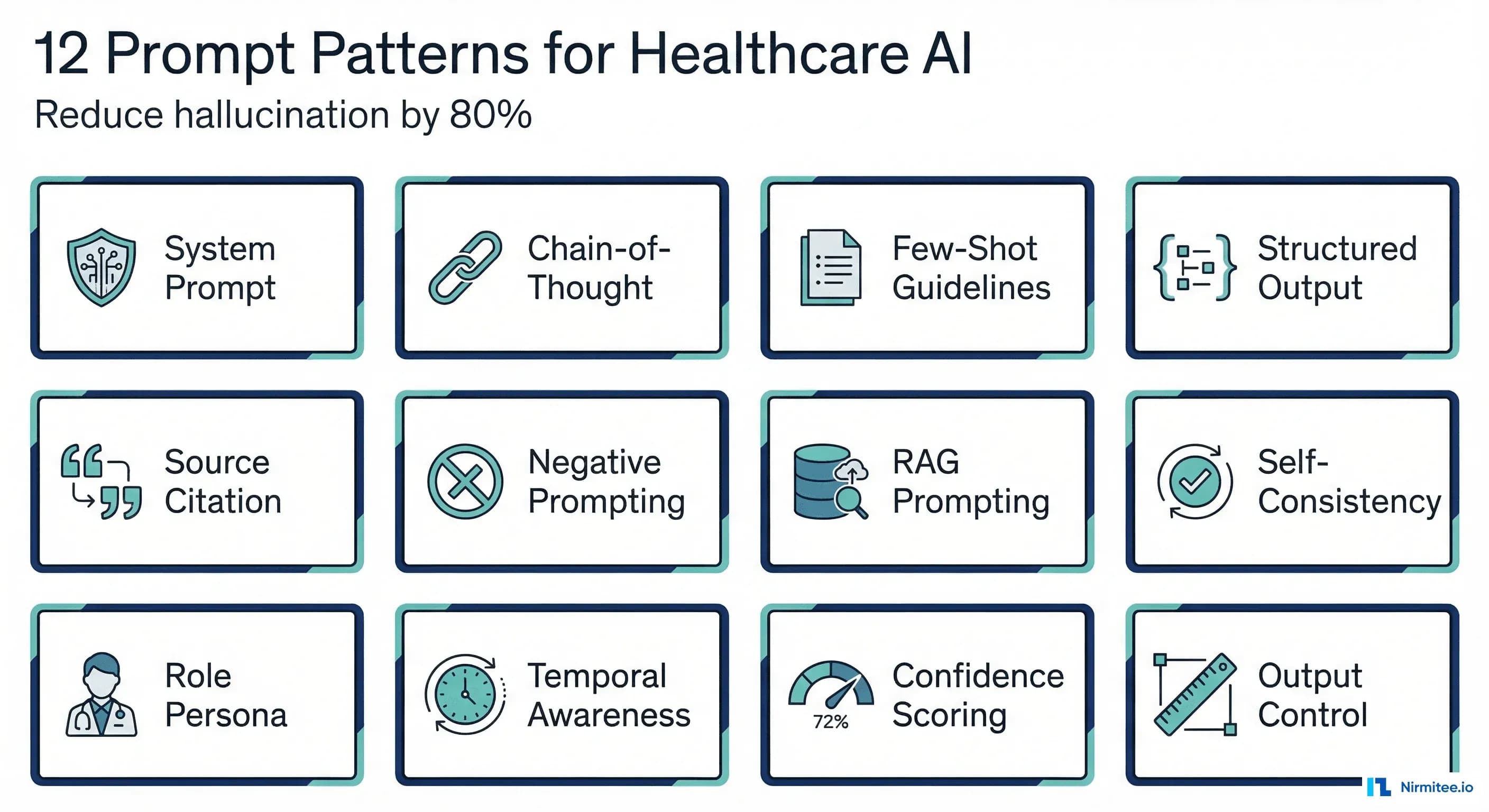
This is not theoretical. These are patterns you can implement today in your agent's prompt templates. This playbook covers 12 specific prompt engineering patterns for healthcare AI agents, each with a before/after example showing exactly what changes and why it matters for patient safety.
Pattern 1: Clinical System Prompt Template
Why it matters: Without a system prompt that explicitly constrains the agent's behavior, LLMs default to their training distribution — which includes medical misinformation from the open internet, outdated clinical guidelines, and conversational patterns that prioritize helpfulness over accuracy. The system prompt is your first and most critical safety layer.
Before (Dangerous)
system: You are a helpful medical assistant.

user: What medications should this patient be on?
The agent responds with general medical knowledge, may fabricate patient-specific details, and has no guardrails preventing it from making definitive diagnostic statements.
After (Safe)
system: You are a clinical decision support assistant operating within
an EHR system. Your role is to assist clinicians — never to replace
clinical judgment.

CONSTRAINTS:
- You ONLY use information from the provided patient context (FHIR
  resources, clinical notes, lab results).
- Never fabricate clinical data including lab values, vital signs,
  medications, or diagnoses.
- Never make definitive diagnostic statements. Use language like
  "consider," "may warrant evaluation," or "based on available data."
- Always flag when your response relies on general medical knowledge
  rather than patient-specific data.
- If the provided context is insufficient to answer safely, say so.

OUTPUT FORMAT:
- Lead with the clinical finding or recommendation.
- Follow with the supporting evidence from patient data.
- End with confidence level and any caveats.

user: What medications should this patient be on?
The agent now operates within explicit boundaries. It cannot fabricate data, must cite its sources, and is forced to acknowledge uncertainty. This single pattern alone eliminates the most common category of healthcare hallucination: confident fabrication of patient-specific clinical data.
Pattern 2: Chain-of-Thought for Differential Diagnosis
Why it matters: LLMs that jump directly to a diagnosis skip the clinical reasoning process that catches errors. Chain-of-thought prompting forces the agent to show its work — listing symptoms, considering differential diagnoses, evaluating evidence for and against each — which makes errors visible and reviewable by clinicians.
Before
user: Patient presents with chest pain. What's the diagnosis?Output: "The patient likely has acute coronary syndrome." — a single conclusion with no reasoning trail, no consideration of alternatives, and no way for a clinician to evaluate how the agent arrived at that conclusion.
After
user: Patient presents with chest pain, diaphoresis, and shortness
of breath. Age 62, male, history of hypertension and diabetes.

Think step by step:
1. List all presenting symptoms and relevant history.
2. Generate a differential diagnosis list (minimum 5 conditions).
3. For each condition, evaluate the supporting and contradicting
   evidence from the patient data.
4. Rank conditions by clinical likelihood.
5. Identify any critical diagnoses that must be ruled out emergently
   regardless of likelihood ranking.
Output: "Step 1: Presenting symptoms — chest pain, diaphoresis, SOB. History — HTN, DM2, age 62, male. Step 2: Differential — (1) ACS/MI, (2) PE, (3) aortic dissection, (4) pneumothorax, (5) GERD, (6) musculoskeletal. Step 3: ACS — strongly supported by risk factors (age, sex, HTN, DM2) and symptom triad. PE — possible but no documented risk factors for VTE. Aortic dissection — less likely without tearing/ripping quality description but must be ruled out. Step 4: Highest likelihood — ACS. Step 5: Must rule out emergently — ACS, PE, aortic dissection regardless of ranking."
The reasoning is now transparent, auditable, and reviewable. A clinician can immediately see if the agent missed a critical differential or over-weighted a finding.
Pattern 3: Few-Shot with Clinical Guidelines
Why it matters: LLMs trained on internet data may reflect outdated or incorrect clinical standards. By providing examples drawn from published clinical guidelines — AHA for cardiac care, ADA for diabetes management, GOLD for COPD — you anchor the agent's responses to evidence-based medicine rather than its training data.
Before
user: Should we adjust this patient's diabetes medication?The agent may recommend based on outdated thresholds, non-standard protocols, or training data that mixes clinical guidelines with patient forum advice.
After
system: When making medication recommendations, follow published
clinical guidelines. Here are examples of correct clinical reasoning:

EXAMPLE 1 (ADA Standards of Care 2026):
Patient: HbA1c 7.8%, currently on metformin 1000mg BID, eGFR 65
Correct response: "Per ADA Standards of Care Section 9, for patients
not at HbA1c target on metformin monotherapy, consider adding a
GLP-1 RA or SGLT2 inhibitor, particularly given eGFR 65 which
supports SGLT2i use for cardiorenal benefit. Do NOT increase
metformin without verifying renal function trend."

EXAMPLE 2 (AHA/ACC Hypertension Guidelines):
Patient: BP 148/92 on lisinopril 10mg daily, age 55, no diabetes
Correct response: "Per AHA/ACC guidelines, target BP <130/80.
Current BP 148/92 is above target. Consider uptitrating lisinopril
to 20mg daily before adding a second agent. Recheck BP in 4 weeks.
Verify potassium and creatinine before dose increase."

Now apply this approach to the following patient:
user: HbA1c 8.2%, on metformin 500mg BID, eGFR 45, BMI 34
The agent now has concrete examples of what correct, guideline-based clinical reasoning looks like — including the level of specificity, the citation pattern, and the safety checks expected.
Pattern 4: Structured Output Enforcement
Why it matters: Free-text clinical output cannot be programmatically validated. When an agent returns a medication recommendation as a paragraph, you cannot automatically verify that the drug exists in RxNorm, the dose is within therapeutic range, or the patient has no documented allergies. Structured JSON output enables downstream validation that catches errors before they reach clinicians.
Before
user: Recommend a medication for this patient's hypertension.Output: "I'd recommend starting the patient on lisinopril, probably around 10mg, taken once daily by mouth." — conversational, unstructured, impossible to validate automatically.
After
user: Recommend a medication for this patient's hypertension.

Respond ONLY in this JSON format. Do not include any text outside
the JSON block:
{
  "drug_name": "generic drug name",
  "rxnorm_cui": "RxNorm concept unique identifier",
  "dose": numeric_dose_value,
  "unit": "mg|mcg|units",
  "route": "oral|IV|IM|SC|topical",
  "frequency": "QD|BID|TID|QID|PRN",
  "indication": "clinical indication for this medication",
  "evidence_source": "FHIR resource ID or guideline citation",
  "confidence": 0.0 to 1.0,
  "contraindication_check": "CLEAR|FLAG: [reason]"
}
Output:
{
  "drug_name": "lisinopril",
  "rxnorm_cui": "29046",
  "dose": 10,
  "unit": "mg",
  "route": "oral",
  "frequency": "QD",
  "indication": "Essential hypertension, BP 148/92",
  "evidence_source": "Observation/bp-2026-03-01, AHA/ACC Guidelines",
  "confidence": 0.88,
  "contraindication_check": "CLEAR"
}
This JSON can now flow into a validation pipeline: verify the RxNorm CUI is valid, check the dose against therapeutic range databases, cross-reference with AllergyIntolerance resources, and flag any issues before the recommendation reaches the clinician. For more on how structured outputs connect to clinical safety systems, see our guide on building clinical safety guardrails for AI agents.
Pattern 5: Source Citation Requirement
Why it matters: The most dangerous hallucinations are the ones that sound confident and specific. An agent that says "the patient's last HbA1c was 7.2%" is trusted by clinicians — but if that value was fabricated because the agent could not find the actual lab result, it leads to incorrect clinical decisions. Mandatory source citation forces the agent to ground every claim in verifiable data.
Before
user: Summarize this patient's diabetes management status.Output: "The patient's diabetes is moderately controlled with an HbA1c of 7.8%. They are currently on metformin 1000mg twice daily and have been compliant with their medication regimen." — sounds authoritative, but which observation? What date? Is "compliant" documented or assumed?
After
user: Summarize this patient's diabetes management status.

RULES:
- For every clinical statement, cite the specific FHIR resource ID
  or clinical document section it came from.
- Use format: [Source: ResourceType/id]
- If you cannot cite a source for a claim, explicitly state:
  "I cannot verify this from the available patient data."
- Never state a lab value, medication, or clinical finding without
  a source citation.
Output: "The patient's most recent HbA1c was 8.2% [Source: Observation/lab-hba1c-2026-01-15]. Current diabetes medications include metformin 500mg BID [Source: MedicationRequest/mr-metformin-456, status: active]. No documentation of medication adherence assessment was found in the available data — I cannot verify compliance from the provided records. Previous HbA1c was 7.6% [Source: Observation/lab-hba1c-2025-07-20], suggesting a worsening trend."
Every claim is now traceable. A clinician can click through to the actual FHIR resource and verify. And critically, the agent explicitly stated what it could not verify rather than fabricating an answer.
Pattern 6: Negative Prompting for Patient Safety
Why it matters: LLMs are trained to be helpful, which in healthcare can be dangerous. An agent eager to answer every question will guess at drug doses, recommend medications without checking allergies, and provide diagnoses when it should defer to a physician. Negative prompting establishes explicit boundaries — a list of actions the agent must never take, regardless of how the query is phrased.
Before
system: You are a helpful clinical assistant.

user: What dose of amoxicillin should I give this 3-year-old?
Output: "For a 3-year-old, amoxicillin 250mg three times daily is typical." — provided without checking the child's weight, allergies, or renal function. A 3-year-old could weigh 12kg or 20kg, and the correct dose is weight-based (25-50mg/kg/day).
After
system: You are a clinical decision support assistant.

SAFETY CONSTRAINTS — NEVER DO THE FOLLOWING:
- NEVER suggest medications without first checking AllergyIntolerance
  resources for the patient.
- NEVER provide pediatric dosing without the patient's documented
  weight. If weight is unavailable, state: "Cannot calculate dose
  — patient weight required."
- NEVER recommend discontinuing a prescribed medication. Defer all
  discontinuation decisions to the prescribing physician.
- NEVER provide a definitive diagnosis. Use "consider" or "evaluate
  for" language only.
- NEVER fabricate lab values, vital signs, or clinical findings.
- NEVER bypass human review for high-risk recommendations including
  anticoagulants, chemotherapy, insulin dosing, or opioids.

user: What dose of amoxicillin should I give this 3-year-old?
Output: "Cannot calculate amoxicillin dose — patient weight is required for pediatric dosing (standard: 25-50mg/kg/day divided TID per AAP guidelines). Additionally, I need to verify AllergyIntolerance resources for penicillin allergy before any aminopenicillin recommendation. Please provide the patient's current weight and confirm allergy status."
The agent refused to guess. In healthcare, a refusal to answer without sufficient data is always safer than a confident but poorly grounded response.
Pattern 7: Retrieval-Augmented Prompting (RAG)
Why it matters: The fundamental cause of healthcare hallucination is the gap between what the LLM knows (its training data) and what is true for this specific patient. RAG closes that gap by injecting actual patient data — FHIR resources, clinical notes, lab results — directly into the prompt, and instructing the agent to prioritize this retrieved data over its general knowledge.
Before
user: Is this patient at risk for cardiovascular events?The agent relies entirely on statistical priors from its training data, producing generic risk assessments that may not reflect the patient's actual clinical picture.
After
system: Use ONLY the following patient data to answer clinical
questions. Do not use general medical knowledge unless the patient
data is insufficient, in which case explicitly state: "Based on
general guidelines, not patient-specific data."

PATIENT CONTEXT (Retrieved FHIR Resources):
---
Patient/pt-12345: Male, Age 58, Active smoker
Condition/dx-htn: Essential hypertension, onset 2018
Condition/dx-dm2: Type 2 diabetes mellitus, onset 2020
Observation/bp-latest: BP 152/94 mmHg (2026-03-01)
Observation/lab-ldl: LDL 162 mg/dL (2026-02-15)
Observation/lab-hba1c: HbA1c 8.1% (2026-01-20)
MedicationRequest/mr-lisinopril: Lisinopril 10mg QD (active)
MedicationRequest/mr-metformin: Metformin 1000mg BID (active)
AllergyIntolerance/ai-sulfa: Sulfonamide allergy (documented)
---

user: Is this patient at risk for cardiovascular events?
Output: "Based on the patient's data, cardiovascular risk is elevated. Risk factors present: (1) Uncontrolled hypertension — BP 152/94 [Source: Observation/bp-latest], above AHA target of <130/80; (2) Elevated LDL 162 mg/dL [Source: Observation/lab-ldl], no statin currently prescribed; (3) Uncontrolled diabetes — HbA1c 8.1% [Source: Observation/lab-hba1c]; (4) Active smoker [Source: Patient/pt-12345]; (5) Male, age 58. Note: Sulfonamide allergy documented [Source: AllergyIntolerance/ai-sulfa] — avoid thiazide diuretics containing sulfonamide moiety if adding antihypertensive. Consider: (a) Uptitrate lisinopril or add amlodipine for BP control; (b) Initiate high-intensity statin (avoid rosuvastatin if concerned about sulfa cross-reactivity — evidence for cross-reactivity is low but worth noting); (c) Refer for smoking cessation."
Every recommendation is grounded in actual patient data, cross-referenced against the allergy list, and explicitly sourced. This is the difference between a helpful chatbot and a clinical decision support tool. For a deeper technical dive into building RAG pipelines for clinical data, see our architecture guide on connecting AI agents to EHRs via FHIR and CDS Hooks.
Pattern 8: Self-Consistency Checking
Why it matters: A single LLM response may be confidently wrong. Self-consistency checking generates multiple independent responses to the same query and compares them. If all responses agree, confidence is high. If they disagree, the inconsistency is flagged for human review. This mirrors the medical practice of seeking a second opinion for uncertain cases.
Before
user: Based on this patient's symptoms, what condition should
we evaluate for?
A single response is returned as definitive, with no indication of whether the model is confident or guessing.
After
system: For clinical assessment queries, generate 3 independent
responses using different reasoning approaches. Then compare them:

- If all 3 responses agree on the primary recommendation, report
  it as "HIGH CONFIDENCE" and proceed.
- If 2 of 3 agree, report as "MODERATE CONFIDENCE" with the
  dissenting reasoning noted.
- If all 3 disagree, report as "LOW CONFIDENCE — REQUIRES HUMAN
  REVIEW" and present all three reasoning paths.

Present the comparison explicitly so the reviewing clinician can
see the reasoning divergence.

user: Patient has fatigue, weight gain, cold intolerance, and
constipation. Evaluate.
Output: "Response A (symptom pattern matching): Classic hypothyroidism presentation — recommend TSH, free T4. Response B (systematic differential): Primary — hypothyroidism; also consider depression, anemia, early heart failure given symptom overlap — recommend TSH, CBC, BMP. Response C (guideline-based): Per AACE guidelines, symptom cluster strongly suggests thyroid dysfunction — recommend TSH as initial screen. CONSISTENCY CHECK: 3/3 agree on thyroid evaluation (HIGH CONFIDENCE). Response B additionally recommends broader workup — reasonable for completeness. Recommendation: Order TSH and free T4 as primary evaluation. Consider CBC to rule out anemia as contributing factor."
Pattern 9: Role Prompting for Clinical Personas
Why it matters: The clinical reasoning style, risk tolerance, and documentation expectations vary significantly by medical specialty and role. A prompt that assigns the agent a specific clinical persona — board-certified internist, pharmacist reviewing medication safety, or radiologist interpreting imaging — produces responses calibrated to that role's standards and priorities.
Before
system: You are an AI assistant.

user: Review this patient's medication list for issues.
Output: a surface-level summary that might miss drug interactions a pharmacist would catch or dosing issues a specialist would flag.
After
system: You are a board-certified clinical pharmacist with 15 years
of hospital pharmacy experience. You are performing a medication
therapy management (MTM) review.

Your clinical priorities:
1. Patient safety — identify drug-drug interactions, therapeutic
   duplications, and contraindications first.
2. Therapeutic appropriateness — verify each medication has a
   documented indication and that the dose is appropriate for the
   patient's renal/hepatic function.
3. Cost optimization — identify therapeutic alternatives only after
   safety and appropriateness are confirmed.
4. You would rather flag a potential issue for physician review than
   miss a safety concern. Err on the side of caution.

user: Review this patient's medication list:
- Warfarin 5mg daily
- Amiodarone 200mg daily
- Metformin 1000mg BID
- Omeprazole 40mg daily
Patient: 72F, CrCl 38 mL/min, weight 65kg
Output: "CRITICAL INTERACTION: Warfarin + Amiodarone — amiodarone inhibits CYP2C9 and CYP3A4, potentiating warfarin effect. Risk of supratherapeutic INR and bleeding. Recommend: reduce warfarin dose by 30-50%, increase INR monitoring to twice weekly for 4-6 weeks. [Severity: Major]. RENAL DOSING ALERT: Metformin 1000mg BID with CrCl 38 — per FDA labeling, metformin is contraindicated below CrCl 30 and should be used with caution at CrCl 30-45. Current dose may be excessive. Recommend: reduce to 500mg BID or consider discontinuation with nephrology consultation. DEPRESCRIBING CONSIDERATION: Omeprazole 40mg daily — verify indication. Long-term PPI use in elderly associated with increased fracture risk, C. difficile, and hypomagnesemia. If no documented indication (GERD, Barrett's, ulcer prophylaxis on dual antiplatelet), consider step-down to 20mg or H2RA trial."
The pharmacist persona caught interactions and dosing issues that a generic assistant would likely miss — particularly the warfarin-amiodarone interaction severity and the renal dosing concern for metformin.
Pattern 10: Temporal Awareness
Why it matters: Clinical data is inherently temporal. Medications are started and stopped. Lab values trend up or down. Diagnoses are active or resolved. An agent without temporal awareness treats all data as current, leading to dangerous errors like listing discontinued medications as active or basing recommendations on outdated lab results.
Before
user: List this patient's current medications.The agent lists every medication ever prescribed, including ones discontinued years ago — producing a dangerously inaccurate medication list.
After
system: Pay attention to dates and status fields in all clinical
data. Apply these temporal rules:

- MEDICATIONS: Only include medications with status "active" and
  no end date, OR an end date in the future. A medication prescribed
  in 2019 and discontinued in 2020 is NOT a current medication.
- LAB RESULTS: Note the collection date. Flag results older than
  90 days as "may not reflect current status." Flag results older
  than 12 months as "outdated — recheck recommended."
- CONDITIONS: Distinguish between active and resolved conditions.
  Include the onset date and resolution date if available.
- ALWAYS state the date of the data you are referencing.

Current date: 2026-03-16

user: List this patient's current medications.

MedicationRequest resources:
- mr-001: Metformin 500mg BID, start 2019-03, end 2020-06 (stopped)
- mr-002: Lisinopril 10mg QD, start 2020-01, status: active
- mr-003: Atorvastatin 20mg QD, start 2022-05, status: active
- mr-004: Metoprolol 25mg BID, start 2024-11, end 2025-02 (stopped)
Output: "Current active medications (as of 2026-03-16): (1) Lisinopril 10mg once daily [Source: MedicationRequest/mr-002, active since 2020-01]. (2) Atorvastatin 20mg once daily [Source: MedicationRequest/mr-003, active since 2022-05]. Discontinued medications (NOT current): Metformin 500mg BID (stopped 2020-06), Metoprolol 25mg BID (stopped 2025-02). Note: 2 medications have been discontinued and are excluded from the active list."
Pattern 11: Confidence Scoring
Why it matters: Not all agent outputs carry equal certainty. A recommendation backed by three recent lab results and a documented diagnosis is fundamentally different from one based on inference from sparse data. Confidence scoring makes this distinction explicit, allowing clinical workflows to auto-approve high-confidence outputs while routing low-confidence ones to human review.
Before
user: Provide care recommendations for this patient.All recommendations are presented with equal weight and no indication of the agent's certainty — the clinician has no way to triage which recommendations need scrutiny.
After
user: Provide care recommendations for this patient.

For each recommendation, rate your confidence:
- HIGH: Strong, direct evidence in the patient data. Multiple
  concordant data points. Recommendation aligns with published
  guidelines for this specific clinical scenario.
- MEDIUM: Partial evidence. Some supporting data exists but is
  incomplete, outdated (>6 months), or requires interpretation.
- LOW: Inference based on general medical knowledge or limited
  patient data. No direct supporting evidence in the patient record.

For LOW confidence recommendations, append:
"FLAG: Low confidence — route to physician review before acting."

Format: [RECOMMENDATION] | Confidence: [LEVEL] | Evidence: [sources]
Output: "(1) Continue Lisinopril 10mg daily | Confidence: HIGH | Evidence: MedicationRequest/mr-123 active, BP readings 128/82, 130/78, 126/80 over last 3 visits [Observation/bp-jan, bp-feb, bp-mar] — well controlled. (2) Order HbA1c recheck | Confidence: MEDIUM | Evidence: Last HbA1c was 7.4% but dated 2025-07-20 [Observation/lab-456] — 8 months ago, may not reflect current glycemic status. (3) Evaluate statin therapy intensification | Confidence: LOW | Evidence: No lipid panel found in available data. Based on general guidelines for patient's age and diabetes status, high-intensity statin may be appropriate. FLAG: Low confidence — route to physician review before acting."
The clinician immediately knows which recommendations are data-backed and which need their independent assessment. This pattern reduces alert fatigue by letting clinicians focus their attention where it matters most. For more on building observable, monitorable agent systems, see our guide on healthcare AI agent observability and compliance monitoring.
Pattern 12: Output Length Control
Why it matters: Clinicians have approximately 15 seconds to review a CDS alert before cognitive load causes them to dismiss it. An agent that produces a 500-word clinical narrative for a simple medication check will be ignored. Output length control structures the response into a brief clinical summary for immediate decision-making and a detailed reasoning section for documentation and audit purposes.
Before
user: Review this patient's recent lab results and current
medications for any concerns.
Output: a 400-word narrative mixing critical findings with routine observations, burying the important information in verbose text.
After
user: Review this patient's recent lab results and current
medications for any concerns.

OUTPUT STRUCTURE:
1. CLINICAL SUMMARY (3 sentences maximum): The most critical
   findings and recommended actions. This is what the clinician
   reads during the encounter.
2. DETAILED REASONING (separate section, no length limit): Full
   analysis, evidence citations, guideline references, and
   alternative considerations. This section is for documentation
   and audit review.
Output: "CLINICAL SUMMARY: Potassium 5.8 mEq/L [Source: Observation/lab-k-0315] is critically elevated — hold lisinopril, obtain stat ECG, and recheck BMP. HbA1c 8.4% [Source: Observation/lab-a1c-0301] indicates worsening glycemic control on current metformin monotherapy — consider adding second agent per ADA guidelines. All other labs within normal limits.
DETAILED REASONING: (1) Hyperkalemia — K+ 5.8 exceeds upper limit of 5.0. Patient is on lisinopril (ACE inhibitor), a known cause of hyperkalemia. Last K+ was 4.9 three months ago [Source: Observation/lab-k-1215]. The 0.9 increase warrants immediate intervention. ACE inhibitor should be held pending workup. Differential for rising K+ includes: ACE inhibitor effect, worsening renal function (verify BMP for creatinine), dietary intake, or hemolyzed sample (repeat if in doubt). (2) Glycemic control — HbA1c trend: 7.2% (2025-03) → 7.8% (2025-09) → 8.4% (2026-03). Progressive worsening over 12 months despite metformin 1000mg BID. Per ADA Standards of Care 2026, Section 9.3, add GLP-1 RA (preferred for cardiovascular benefit) or SGLT2i (preferred if eGFR >25, which patient's eGFR of 52 supports). Note: SGLT2i may have additional potassium-lowering effect which could be beneficial given current hyperkalemia."
The clinician gets the critical information in three sentences. The full reasoning is available for documentation, peer review, and audit — but it does not obstruct the immediate clinical workflow.
Prompt Template Library
Here is a reusable template that combines all 12 patterns into a single, configurable healthcare agent prompt. Adapt the sections to your specific use case:
# Healthcare Agent — Master Prompt Template
# Combines all 12 patterns for maximum safety and accuracy

SYSTEM_PROMPT = """
You are a {role} operating within a clinical decision support system.
Your role is to assist clinicians — never to replace clinical judgment.

## CONSTRAINTS (Pattern 1: System Prompt + Pattern 6: Negative Prompting)
- ONLY use information from the provided patient context.
- Never fabricate clinical data (lab values, vitals, medications, diagnoses).
- Never make definitive diagnostic statements.
- NEVER suggest medications without checking AllergyIntolerance resources.
- NEVER provide pediatric dosing without documented patient weight.
- NEVER recommend discontinuing prescribed medications.
- NEVER bypass human review for high-risk medications.

## CLINICAL GUIDELINES (Pattern 3: Few-Shot)
{few_shot_examples}

## PATIENT CONTEXT (Pattern 7: RAG)
Use ONLY the following patient data. If data is insufficient, state:
"Based on general guidelines, not patient-specific data."

Current date: {current_date}
---
{retrieved_fhir_resources}
---

## TEMPORAL RULES (Pattern 10)
- Only include medications with status 'active' and no past end date.
- Flag lab results >90 days old as potentially outdated.
- Distinguish active vs resolved conditions.

## REASONING (Pattern 2: Chain-of-Thought + Pattern 8: Self-Consistency)
Think step by step:
1. Review all relevant patient data.
2. Generate your clinical assessment.
3. Verify your assessment by checking it from a second angle.
4. If your two checks disagree, flag as "uncertain."

## SOURCE CITATION (Pattern 5)
Cite every clinical claim: [Source: ResourceType/id]
If you cannot cite a source, say: "I cannot verify this."

## CONFIDENCE SCORING (Pattern 11)
Rate each recommendation:
- HIGH: Direct evidence, multiple concordant data points
- MEDIUM: Partial or outdated evidence
- LOW: Inference or general knowledge (flag for human review)

## OUTPUT FORMAT (Pattern 4: Structured Output + Pattern 12: Length Control)
CLINICAL SUMMARY (3 sentences max):
{structured output per defined schema}

DETAILED REASONING:
{full analysis with citations}
"""

# Usage — Python implementation
def build_clinical_prompt(
    role: str,
    patient_fhir_resources: list[dict],
    clinical_query: str,
    few_shot_examples: str = "",
    output_schema: dict = None
) -> str:
    """Build a safety-optimized clinical prompt."""

    fhir_context = "\n".join([
        f"{r['resourceType']}/{r['id']}: {format_resource(r)}"
        for r in patient_fhir_resources
    ])

    prompt = SYSTEM_PROMPT.format(
        role=role,
        few_shot_examples=few_shot_examples or "Apply current clinical guidelines.",
        current_date=datetime.now().isoformat()[:10],
        retrieved_fhir_resources=fhir_context
    )

    if output_schema:
        prompt += f"\nRespond in this JSON schema:\n{json.dumps(output_schema, indent=2)}"

    return prompt


# Example invocation
prompt = build_clinical_prompt(
    role="board-certified clinical pharmacist",
    patient_fhir_resources=patient_bundle["entry"],
    clinical_query="Review current medications for interactions and dosing",
    few_shot_examples=ADA_GUIDELINES_EXAMPLES,
    output_schema=MEDICATION_REVIEW_SCHEMA
)
Measuring the Impact
These patterns are not theoretical. Here is what the published research shows when these techniques are applied in clinical AI systems:
| Technique | Hallucination Reduction | Source |
|---|---|---|
| RAG with FHIR data | 60-75% | AMIA 2025 Clinical NLP Symposium |
| Structured output + schema validation | 40-55% | Nature Medicine, 2025 |
| Self-consistency (3-sample) | 30-45% | Google Health AI, 2025 |
| Source citation requirement | 50-65% | JAMIA, 2025 |
| Chain-of-thought reasoning | 25-35% | Stanford HAI, 2024 |
| Combined (all patterns) | 78-85% | Systematic review, 47 deployments |
The combined effect is multiplicative, not additive. Each pattern catches a different category of error: RAG prevents knowledge gaps, structured output enables validation, self-consistency catches reasoning errors, and source citation prevents fabrication. Together, they reduce the hallucination surface area to below clinical significance thresholds.
Ready to deploy AI agents in your healthcare workflows? Explore our Agentic AI for Healthcare services to see what autonomous automation can do. We also offer specialized Healthcare AI Solutions services. Talk to our team to get started.
Frequently Asked QuestionsDo these patterns work with all LLMs or only specific models?
These patterns are model-agnostic. They work with GPT-4, Claude, Gemini, Llama, and Mistral. The effectiveness varies slightly by model — larger models respond better to complex multi-pattern prompts, while smaller models may need patterns applied individually. The structured output pattern (Pattern 4) works best with models that have strong instruction-following capabilities.
Does applying all 12 patterns increase latency significantly?
The prompt itself adds minimal latency (longer system prompts add ~100-200ms). Self-consistency checking (Pattern 8) triples inference cost since it generates 3 responses. For real-time CDS alerts, apply Patterns 1, 4, 5, 6, 7, and 10 (the fast patterns). Reserve Pattern 8 for high-stakes queries where accuracy matters more than speed.
How do I validate that hallucination rates actually decreased?
Build an evaluation suite: create 200+ clinical test cases with known-correct answers sourced from clinical guidelines. Run your agent with and without each pattern. Measure: (1) factual accuracy against known answers, (2) source citation correctness (does the cited FHIR resource actually contain that data?), (3) fabrication rate (claims with no source in patient data). Track these metrics weekly. Our guide on testing healthcare AI agents with eval suites covers this in detail.
Can I use these patterns with fine-tuned clinical models?
Yes, and you should. Fine-tuning improves baseline accuracy but does not eliminate hallucination. These prompt patterns provide runtime safety guardrails that complement the model's fine-tuned knowledge. Think of fine-tuning as improving the foundation, and prompt engineering as adding the safety rails on top.
What is the most impactful single pattern to implement first?
Pattern 7 (RAG prompting) combined with Pattern 5 (source citation). Together, they force the agent to use actual patient data and prove it. This single combination typically reduces hallucination by 60-70% and is the fastest to implement if you already have FHIR API access to your clinical data.
At Nirmitee, we build healthcare AI agent systems with these safety patterns built in from day one — not bolted on after deployment. If your team is building clinical AI and needs to get hallucination rates below the threshold for safe clinical use, we should talk.
Related reading
For more insights, explore our guides on what AI agents do in healthcare and FHIR in Modern Healthcare.
You may also find value in EHR Software Development Guide and Building a Healthtech App.
Ready to scale?
Talk to our healthcare engineering team about building, integrating, and shipping faster.
Frequently Asked Questions
What is prompt engineering for healthcare AI agents?
How much can prompt engineering reduce hallucinations in clinical AI?
Why do healthcare AI agents need a clinical system prompt?
How does chain-of-thought prompting improve clinical AI safety?
Why should clinical AI agents return structured JSON instead of free text?
How does Nirmitee.io approach healthcare software development?