Clinician workspaces and specialty EHRs
Charting, orders, results, care plans and scheduling for a specialty or care setting, without rebuilding a general-purpose EHR.
Custom EHR developmentHealthcare software development company
We build custom healthcare software around your organization's clinical and operational workflows: clinician workspaces, patient applications, revenue-cycle tools and data platforms. We define the EHR, lab, payer and device connections alongside the application, with clear acceptance criteria and operating responsibilities.
Scope your healthcare software projectFor provider groups, payers and healthcare technology teams building or modernizing organization-specific systems. Updated September 26, 2026.
The clinical or operational task, mapped with the people who do it
Web and mobile apps for clinicians, patients and staff
A record model that keeps source, status and version
EHR, lab, payer and device connections under test
Illustrative workflow · scope tailored to your environment
The short answer
Custom healthcare software development creates or adapts software for a specific clinical, patient or administrative workflow. Start by comparing a custom build with configuring or connecting existing products. Define the data, user roles, integrations and applicable privacy requirements before implementation. This page covers software for your organization's operations; commercial products serving multiple customers have a separate product-engineering scope.
Building a product for multiple customers? Explore healthcare product developmentStart with the real problem
The happy path is rarely the problem. Projects stall on the parts a generic software shop has not built before: an EHR that only accepts writes under contract, a clearinghouse that rejects a claim for a reason buried in a 277CA, a corrected lab result that must replace the original without losing it, a patient app that loses data when the phone is offline. We scope those edges first, because they decide the timeline and the budget.
What we build
Each product type has its own integration and compliance load. We plan it before the first estimate.
Charting, orders, results, care plans and scheduling for a specialty or care setting, without rebuilding a general-purpose EHR.
Custom EHR developmentMobile and web apps for intake, outcomes, messaging, records and remote care, built for people who are tired, busy or offline.
Healthcare app developmentTools that access permitted data in Epic, Oracle Health, athenahealth or eClinicalWorks for the clinical teams you support.
EHR and EMR integration servicesEligibility, claims, remittance, denials and payment posting connected to clearinghouses and payers.
RCM software developmentPipelines, FHIR stores and analytics that turn feeds from many systems into one governed data set.
Healthcare data engineeringDocumentation drafting, triage, coding and summarization added to an existing product with review steps.
Healthcare AI solutionsYour starting point
Your staff need a queue, approval process or cross-system view that current products cannot provide. We define the users, required information, exceptions and first useful release.
A home-grown system or aging vendor product is slowing the team down. We carve out one workflow at a time and keep users and records safe during the move.
A live app has passed through several vendors. We audit security and code first, recover intent where documentation is missing, then keep shipping without users noticing the handover.
The Engineering Engagement
Workstreams are selected around your priorities. Each comes with an output your team can inspect, test and own.
Map the task with the clinicians, patients or billers who do it, including interruptions, corrections and handoffs. Prototype and test before building.
Choose the record model, FHIR resources or relational schema, tenancy, identity and hosting. Keep source, status and version on every clinical record.
Build web and mobile applications with automated tests. Agree the applicable accessibility standard, including WCAG 2.1 AA where required, and document the audit scope, acceptance criteria and remediation responsibilities.
Connect EHRs, labs, pharmacies, payers and devices through FHIR, HL7 v2, X12 or vendor APIs, with fixtures from real message shapes.
Encryption, role-based access, audit logging, BAA-covered hosting and a security risk assessment built into the delivery, not bolted on before launch.
Release pipelines, monitoring, on-call and a support model agreed before go-live. We can run the product or hand it to your team.
Compare your options
Custom development is not always the right answer. This is how we advise buyers to choose.
| Custom build | Off-the-shelf SaaS | Low-code platform | |
|---|---|---|---|
| Best for | A workflow that is your product or your advantage | Standard back-office needs many organizations share | Internal tools and early prototypes |
| Time to first release | Estimate after workflow and integration discovery | Depends on configuration, onboarding and interfaces | Depends on connector access and governance |
| EHR and payer integration | Scoped to supported interfaces and available access | Check connector coverage, write support and vendor terms | Check available connectors and custom integration options |
| Data and IP rights | Defined in the agreement, including third-party licenses | Confirm data export, usage rights and exit terms | Confirm application portability and platform licensing |
| HIPAA responsibilities | Applicable safeguards, contracts and operating responsibilities | Assess service scope, configuration, controls and BAA where required | Assess eligible services, controls and BAA where required |
| Long-term cost shape | Build cost, then run and improve | Per-seat or per-transaction fees | Platform fees that grow with use |
Many products combine all three: buy commodity parts, build the workflow that differentiates you, and prototype internal tools on low-code.
Expertise is in the decisions
If your product stores clinical data, decide early whether the EHR, your product or both own each field. That choice drives the data model, the interfaces and the audit trail.
App registration, interface agreements and clearinghouse enrollment take longer than the code. We start them in week one so they do not become the critical path.
Where PHI lives, who can see it, how it is logged and which vendors sign a BAA are design decisions. Retrofitting them after launch costs more than building them in.
Engineering support does not confer ONC certification or any regulatory clearance. We plan the evidence with you and the certifying bodies decide.
Decision support, medication rules and safety-critical behavior are specified and approved by qualified clinicians. We build and test the agreed logic.
Timeline
Use these phases to define a delivery plan. Dates follow discovery and depend on available interfaces, migration work, testing and third-party approvals. Planning budget: $30,000 to $120,000 for a first release, confirmed as a fixed price after discovery.
Map the workflow, prototype key tasks and test integration feasibility.
Implement one complete workflow with the agreed interfaces and exception handling.
Runs alongside the build; EHR and payer access often sets the pace.
Ongoing releases, new integrations and operational support.
Delivered work
Client names are withheld; each is a real engagement.
Patient-reported outcomes captured on a body map, gap-recovering health-data sync and a clinician view of weeks of outcomes.
A clinic record that supports offline capture on powered devices, collects readings from connected instruments and reconciles when network access returns.
Hardened an inherited clearinghouse integration: claim validation, acknowledgement handling and remittance reconciliation. The case study distinguishes reviewed and merged changes from work still open.
Scheduling, tooth-level charting, treatment plans, insurance billing and double-entry practice accounting in one system for a multi-location group.
Took over a live app from earlier vendors, closed inherited security gaps, then kept shipping provider records and wearable data to the app stores.
Scheduling, charts, care plans and billing on a FHIR server with no private database, and single sign-on bridged through OAuth token exchange.
A custom build is worth it when the workflow, the integrations or the data model are what make your organization different.
Screens, queues and rules follow your clinicians, front desk and billers, so staff do not work around the software.
EHR, lab, payer and device connections are part of the scope from the start, within what each vendor allows.
Access control, audit logging and PHI handling are designed around your roles and data, and documented for your security review.
Code, data model and repository access are assigned in the contract, with third-party licenses listed.
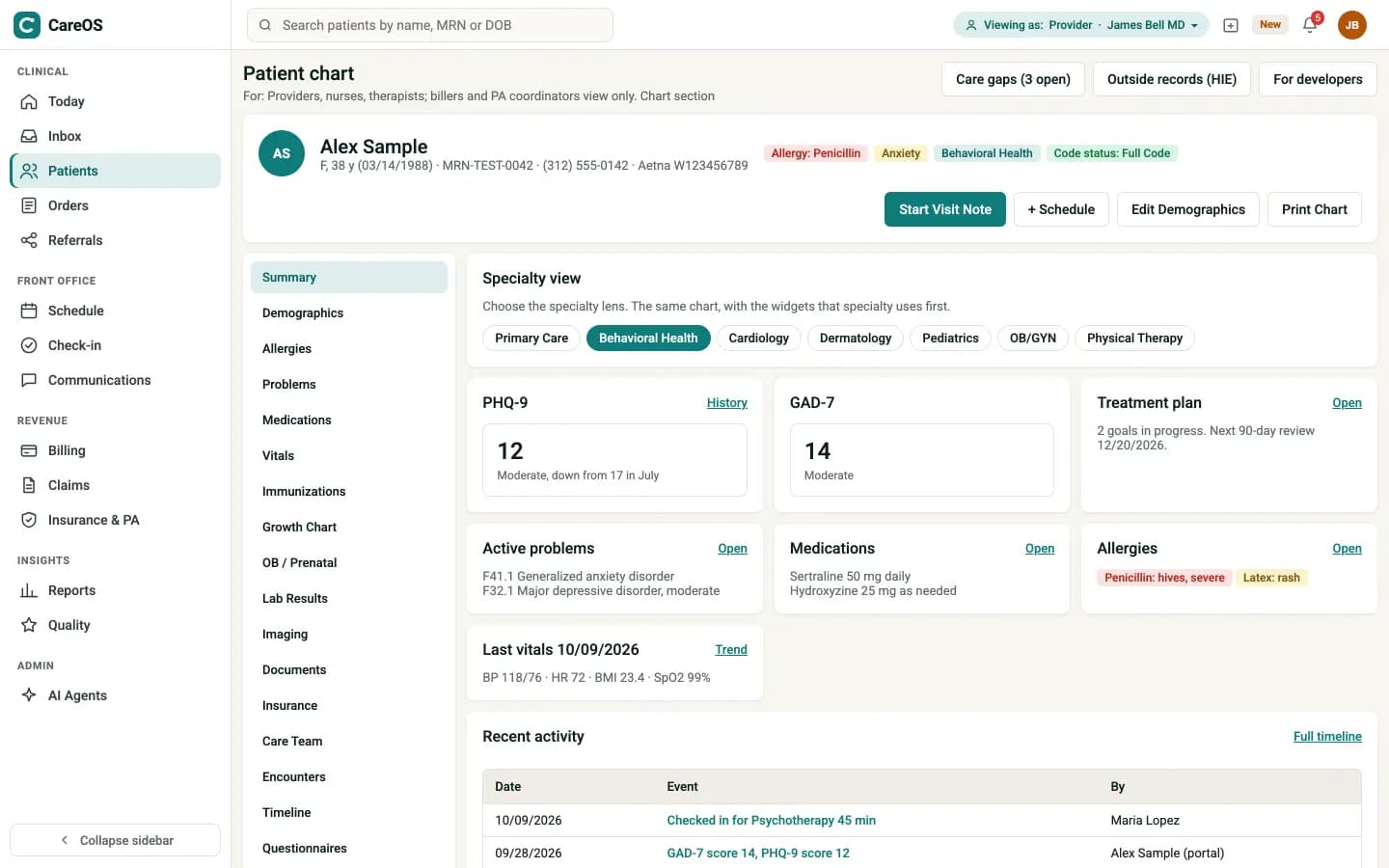
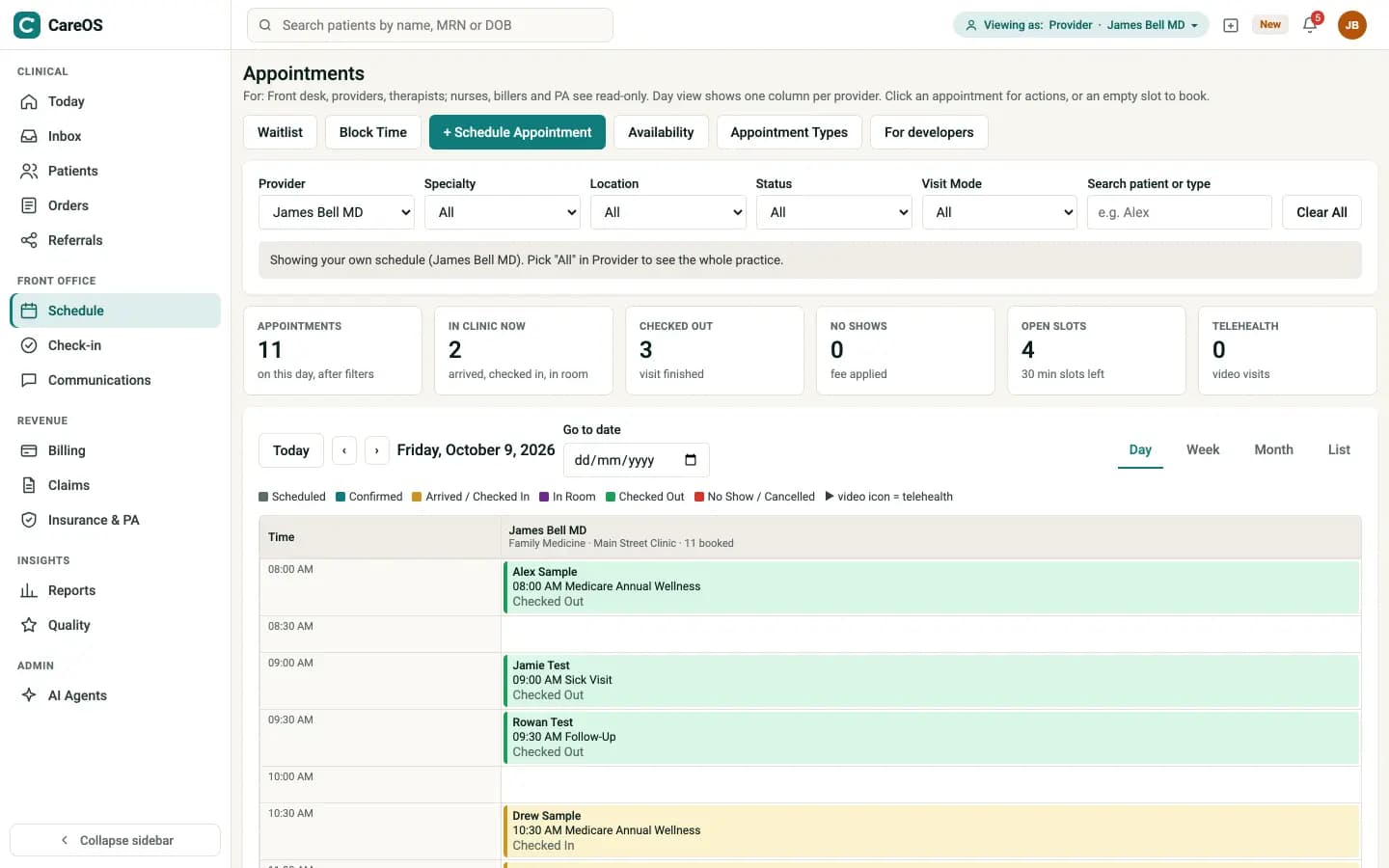
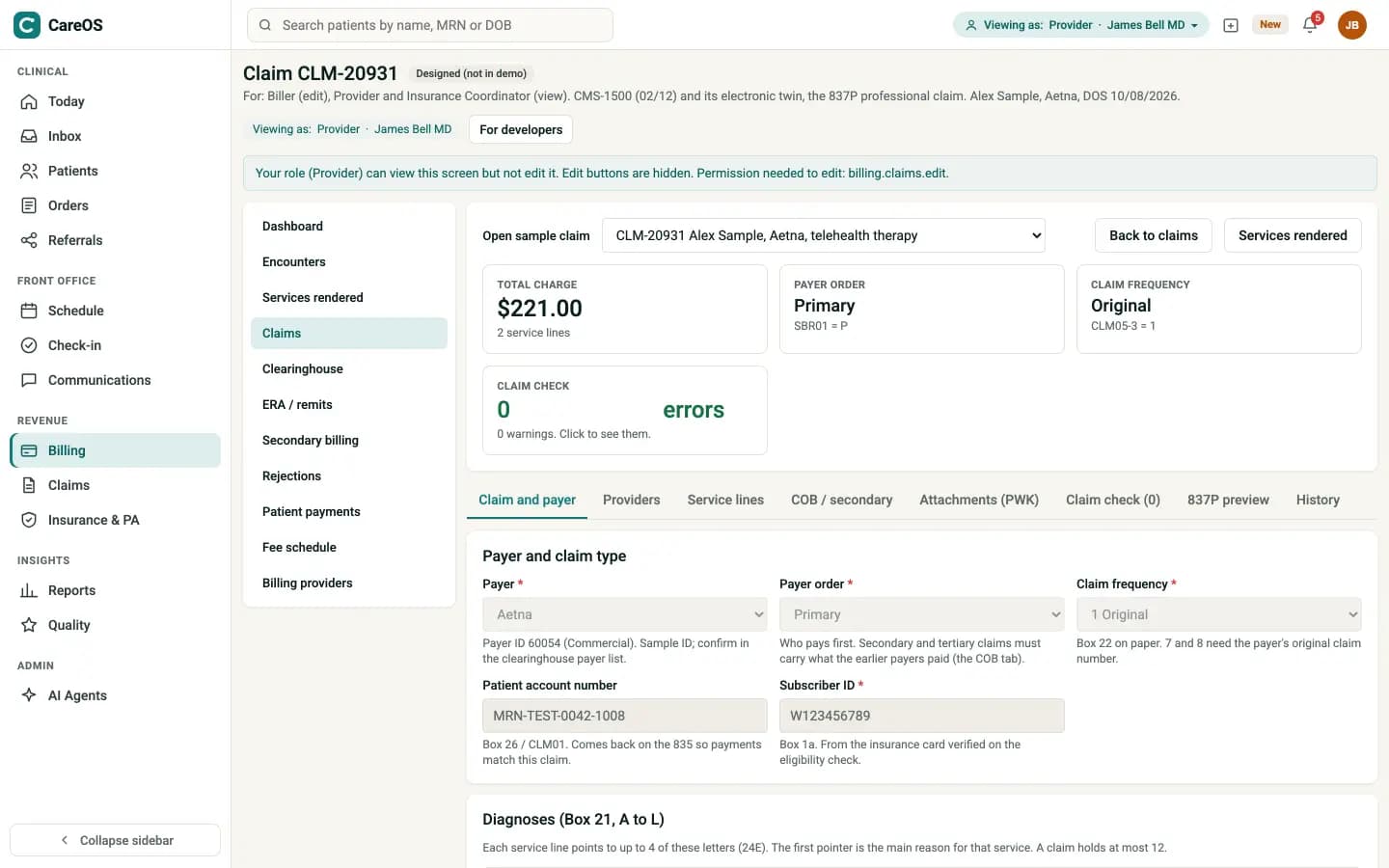
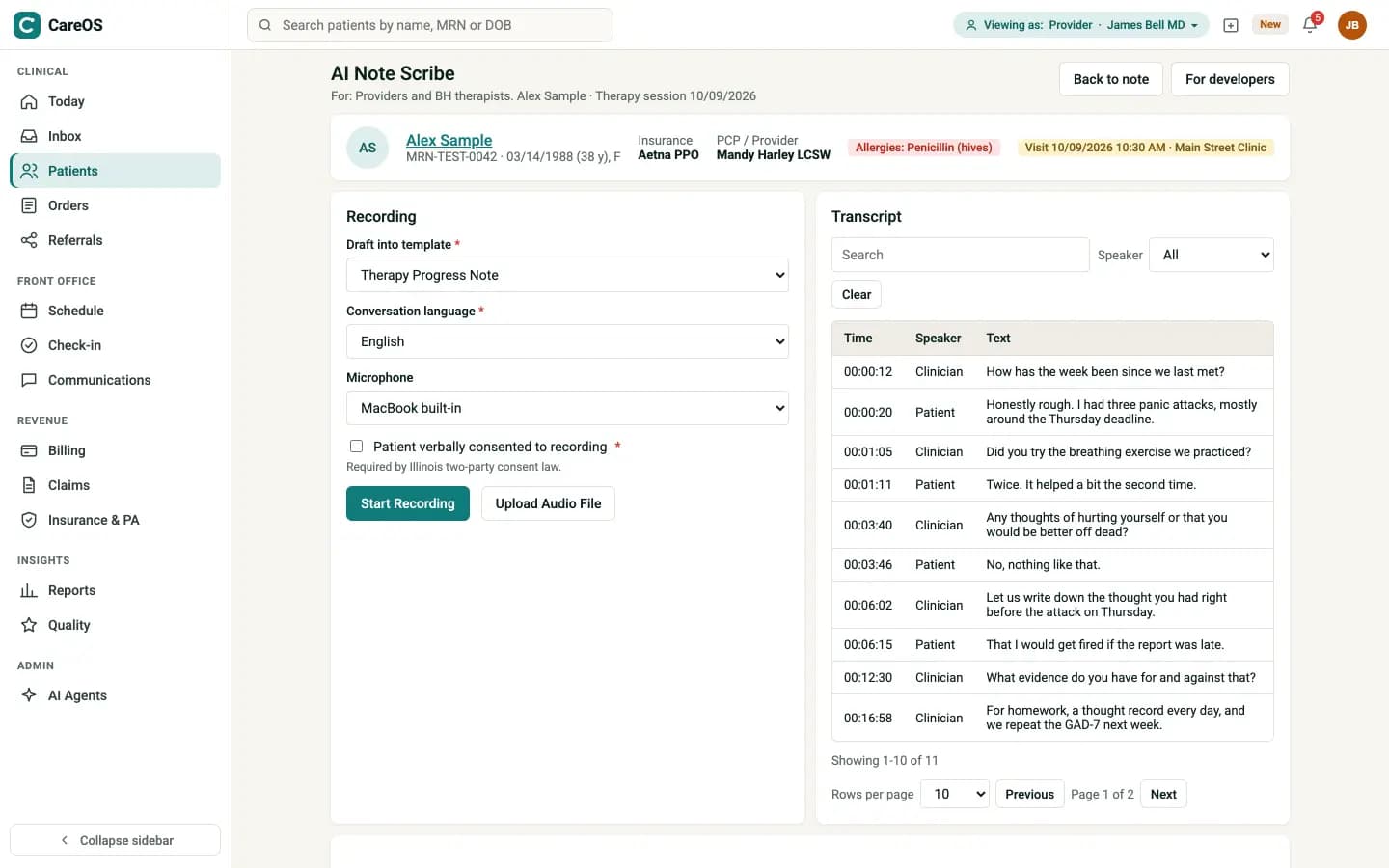
CareOS is the EHR and practice platform we design and build. These screens show the level of detail custom healthcare software needs: role-based views, coded data and the edge cases staff meet every day.


Beyond the six product types above, these are custom builds we deliver often. Each has its own page.
Video visits, intake, e-prescribing and visit documentation written back to the EHR.
Device readings, alert rules, clinician review and RPM billing support.
Scheduling, registration, eligibility and billing for clinics and groups.
Intake, measurement-based care, therapy notes and telehealth for behavioral health.
Coverage checks, documentation and payer submission, including the CMS-0057-F APIs.
Care plans, time tracking and outreach for chronic care programs.
Equipment registry, maintenance and calibration history for clinical engineering.
Agents for intake, scheduling and administrative work, with human review.
Planning ranges to budget before discovery. We confirm a fixed price once the first release and its dependencies are scoped.
| What you are building | Planning range | Note |
|---|---|---|
| First release of custom healthcare software | $30,000 to $120,000 | Planning range; fixed price after discovery |
| Telemedicine app MVP | $40,000 to $120,000 | Planning range; fixed price after discovery |
| One EHR integration | $15,000 to $50,000 | Per integration; EHR vendor fees are separate |
| Dedicated healthcare engineering team | From $10,000 a month | For an ongoing roadmap |
What moves the number most: the count of user roles, the number of integrations, data migration and the compliance scope.
We choose the stack with your team, so you can run and hire for it. These are the technologies we use most.
| Layer | Typical choices |
|---|---|
| Web | React, Next.js |
| Mobile | React Native, Flutter |
| Services | Node.js, Go, .NET, Python |
| FHIR servers | HAPI FHIR, Medplum |
| HL7 v2 and interfaces | Mirth Connect, vendor APIs, X12 for claims and eligibility |
| Cloud | AWS, Azure or Google Cloud, using services covered by a BAA |
Healthcare software fails on the cases the demo skips, so testing starts from those.
Written with the people who do the work, including missing data, corrected results and handoffs between roles.
Test messages and sandbox calls for each EHR, lab, payer or device, checked against the expected records.
Access control by role, audit log entries, PHI exposure checks and dependency scanning before each release.
Automated suites so a fix in billing does not break scheduling or charting.
These are the problems that most often delay a healthcare build, and what we do about each.
We request developer accounts, interface agreements and clearinghouse enrollment at kickoff and track them as named dependencies.
We read real sample messages and records before the data model is final, so codes, statuses and corrections are handled.
We document safeguards as we build, so the customer or vendor security questionnaire is answered from evidence.
We test screens with the people who will use them and design for interruption, correction and handoff.
We replace one workflow at a time and run old and new side by side until records reconcile.
Choose by how well defined the work is and how long the roadmap runs.
| Model | Best for | How it is priced |
|---|---|---|
| Fixed-scope first release | A defined workflow or MVP after discovery | Fixed price agreed after discovery |
| Dedicated team | An ongoing roadmap with changing priorities | Monthly, from $10,000 a month |
| Hybrid with your team | Your engineers own the core; we own integrations, compliance or a module | Monthly or per milestone |
Ask any healthcare software development company, including us, to show these before you sign.
Ask for interface specifications, test fixtures or public code for FHIR, HL7 v2 or X12, not only a logo slide.
Ask whether they sign a BAA, where PHI will live, who can reach it and how access is logged.
Code, data, repositories and cloud accounts should be yours, with third-party licenses listed.
A good estimate names each EHR, payer or device dependency and who owns getting access.
Agree support, monitoring and handover before go-live, not after the first incident.
We offer three related services. Pick the one that matches where you are.
From discussion to delivery
Workflow, users, integrations and constraints, agreed in writing.
Prototypes reviewed with real users; data model and security design signed off.
Working software every two weeks, with tests and release notes.
Pilot, go-live and an agreed support or handover model.
We agree the scope, dependencies, acceptance criteria and commercial model before implementation. Your existing team can stay involved throughout.
Find the right starting point ↗Before you commit
As a planning range, a first release of custom healthcare software is typically $30,000 to $120,000, and a single EHR integration $15,000 to $50,000. Dedicated teams start at $10,000 a month. Where a project lands depends on the number of user types, the integrations (each EHR, lab or payer connection is real work), the compliance scope and whether we also run the product. We confirm a fixed price after a short discovery, broken down by workflow and integration, so you can cut or phase scope with the numbers in front of you.
The schedule follows workflow scope, integration feasibility, migration and acceptance testing. Discovery separates engineering effort from vendor onboarding and customer approvals, then establishes phased milestones and a delivery estimate.
Yes. We sign BAAs, we are ISO 27001:2022 certified, and we host PHI only on cloud services covered by a BAA with you or with us.
We build the HIPAA Security Rule safeguards into the product: access control, encryption, audit logging, integrity controls and transmission security, plus a security risk assessment. HIPAA compliance also depends on your policies and operations, so we document which controls the software provides and which your organization owns.
Yes. We build SMART on FHIR apps, backend and bulk FHIR integrations and HL7 v2 interfaces, and handle vendor app registration. See our Epic, Oracle Health, athenahealth and eClinicalWorks integration pages for the detail per EHR.
The agreement defines ownership and usage rights for custom code, existing components and third-party software, together with data access, export and handover. We document the source code, infrastructure definitions and operational documentation included in your scope before work begins.
Both. Startups usually start with discovery and an MVP; enterprises often start with one workflow inside a larger platform or a modernization of a legacy module.
Yes. We start with a security and code audit, stabilize the product, then continue the roadmap. We have taken over live apps without interrupting their users.
It depends on your team and product. Typical choices are React and Next.js for web, React Native or Flutter for mobile, Node.js, Go, .NET or Python services, HAPI FHIR or Medplum as FHIR servers, Mirth Connect for HL7 v2, and AWS, Azure or Google Cloud under a BAA.
Yes. We add documentation drafting, summarization, triage and coding assistance with human review, evaluation sets and audit of every AI action, and keep PHI handling within your BAA-covered environment.
We engineer to the certification criteria and prepare evidence. Certification decisions are made by ONC-authorized testing and certification bodies, which we plan for as a separate track.
We can run the product with monitoring, on-call and a release cadence, or hand it to your team with runbooks and a transition period. The support model is agreed before go-live.
Ask to see integration work such as interface specifications, test fixtures or public code; how they handle PHI and whether they sign a BAA; code and data ownership in the contract; how they plan EHR and payer access; and who supports the software after launch.
Most custom medical software supports care or operations and is not a medical device. Software intended to diagnose or treat can be a medical device under FDA rules. If that may apply, we scope it with your regulatory lead in discovery and plan it as a separate track; the FDA decides device status.
A fixed-scope first release priced after discovery, a dedicated team from $10,000 a month for an ongoing roadmap, or a hybrid model where your engineers own the core and we own integrations, compliance or a module.
It fits how your teams work, connects to the EHR, lab, payer and device systems you already run within each vendor's rules, has compliance controls designed for your roles and data, and the code and data model are yours under the contract.
With clinical workflow scenarios written with the people who do the work, integration tests using real message shapes and sandbox calls, security and privacy checks, and automated regression suites before every release.
A useful first conversation
Tell us what exists today, who uses it and where the workflow breaks. We’ll discuss the scope, access dependencies and the next practical step.
A product overview and a de-identified workflow are enough to start. No patient records or credentials are needed.
These are independent reference sources, not endorsements. Applicability, platform access and current requirements are confirmed for your project.