Healthcare Data Engineering

Healthcare Data Engineering Services

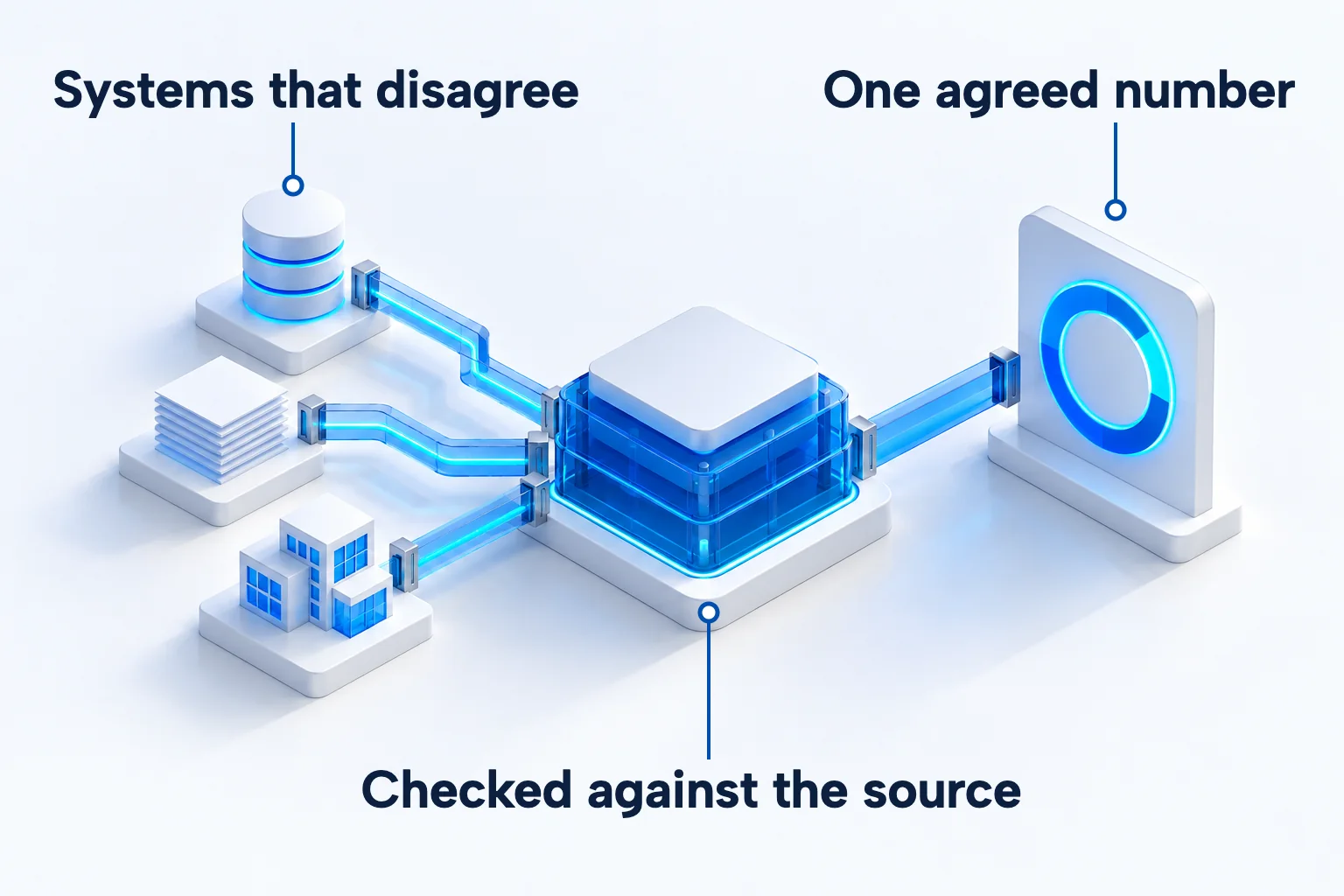
When finance, quality and operations each report a different number, decisions wait and trust in the data falls. We connect your clinical, claims and operational systems so your leaders get one agreed number for each decision, checked against the source. You start with a fixed-price assessment and see the plan and the cost before you commit to a build.

Book the Healthcare Data Platform Assessment

For healthtech leaders, data teams, providers and payers.

At a glanceFor decision makers
  1. 01
    The problem

    Teams report different numbers from the same data, and nobody can say which is right.

  2. 02
    The outcome

    One written definition and one owner for each number, reconciled to the source.

  3. 03
    How risk is controlled

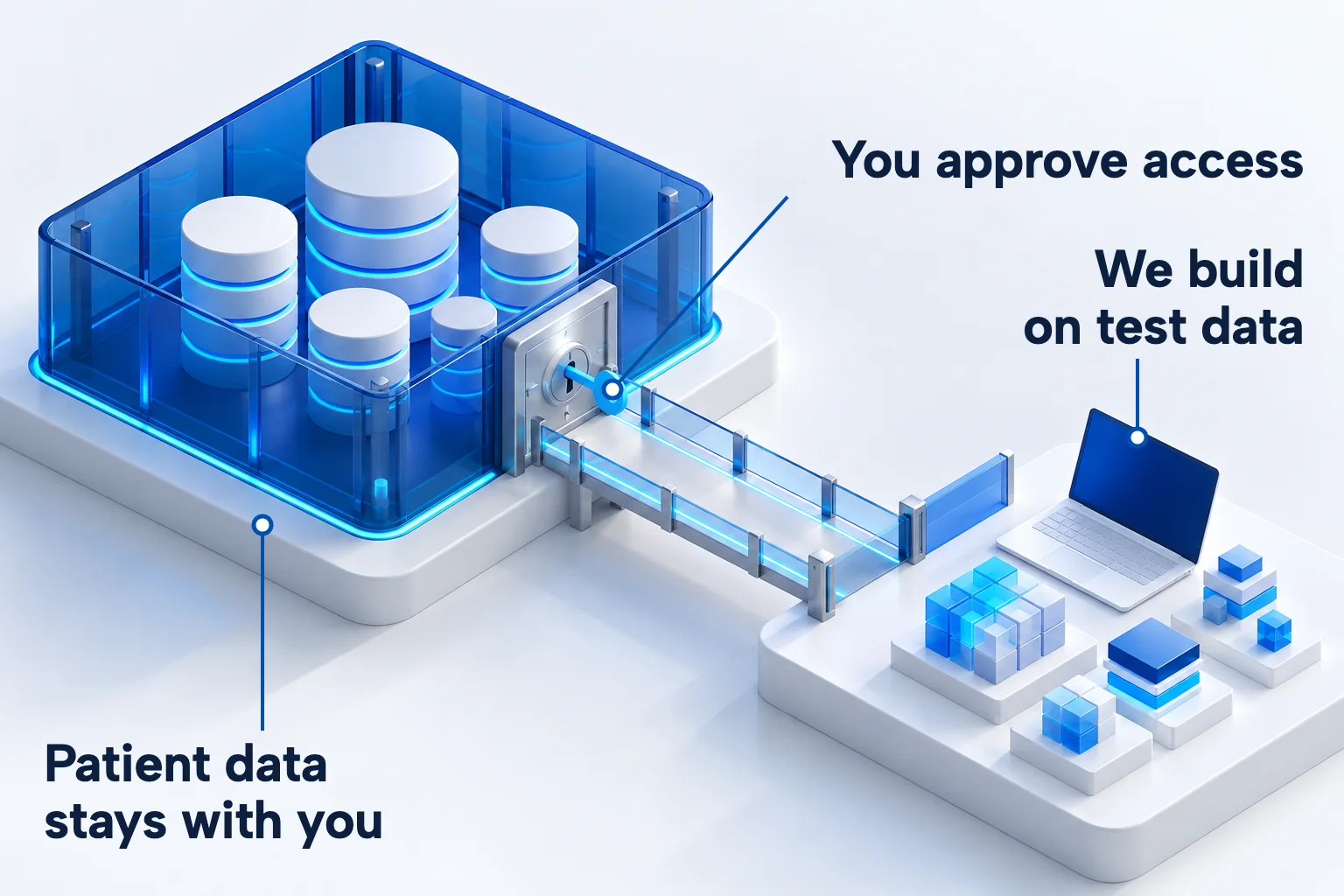
    Your data stays in your accounts. You approve who gets access, and you can remove it.

  4. 04
    What it costs

    $3,500 fixed for the assessment. 2 to 3 weeks, credited against the build.

  5. 05
    The next step

    Book the assessment and get a costed plan you can use with any vendor.

The business case

What Unreliable Data Costs a Healthcare Business

Most data programs stall for business reasons long before the technology fails.

Clinical systems, claims files and hospital operations feeding one checked data platform, which produces a single agreed number for leaders.

The problem

Your clinical, claims and operations systems each hold part of the picture. They were built separately, their records change after the fact, and they define the same measure in different ways. So people rebuild reports by hand and argue about whose number is right.

What it costs you

  • Decisions on staffing, denials and contracts wait while teams reconcile reports.
  • Analysts spend their time fixing spreadsheets instead of finding answers.
  • A new platform does not settle the argument if the definitions stay unsettled.
  • AI projects stall, because nobody trusts the data going in.

What you get

  • One written definition and one named owner for each number.
  • Reports your leaders can trace to the source when someone asks why.
  • Corrected records that move a number once, with the history kept.
  • A setup your own team can run and change after we hand over.

Our view

Agree the Numbers Before You Choose the Platform

Start a healthcare data program with one decision and the metric behind it. Choose the platform third, after the definitions and the source contracts. Buying first tends to give you fast queries over numbers that finance and your clinical leads still dispute.

Definitions cause the arguments

Two teams can query the same table and report different denial rates, because one counts claims and the other counts service lines. A faster engine does not settle that. A written definition with a named owner does.

Healthcare records change after they arrive

Lab results get corrected, claims get reversed and encounters get merged. The design has to say what happens to a number that was already reported, and that decision shapes the whole platform.

Source access sets the pace

Approvals for reporting access and interface changes depend on people outside the project. Plan them first, because no amount of engineering shortens them.

Both leading platforms can do the job

Databricks and Snowflake each support PHI under the right agreement and configuration. Your workload shape and the team who will run it should decide, and many organizations should extend what they already own.

When we would tell you not to build a platform: one source, one report and modest volume. A well-kept model in your existing warehouse will serve you better, and our assessment will say so.

For decision makers

What a CIO or Head of Data Should Check Before Hiring Us

These are the questions that decide whether a data engineering vendor is safe to hire. Here are our answers, and how to test them.

Patient data held inside a locked environment owned by the customer, reached only through one controlled access path, while our build work runs separately on synthetic data.

Risks and how we control them

RiskHow we control it
Source access arrives lateStart the requests during the assessment, with a named owner on your side
Stakeholders dispute the numbersSign off definitions before modeling, and show the reconciliation
PHI reaches people it should notBuild the access model first, test it with real roles and de-identify where the use allows
Platform costs grow unnoticedTie refresh rates to decisions and give each workload a cost owner
Knowledge leaves with the vendorKeep code and runbooks in your repository, and walk your team through a replay

Governance and PHI handling

  • We start with metadata, schemas and synthetic or de-identified samples. Production PHI comes in only when the work needs it and access has been approved.
  • We sign a business associate agreement with you before our work touches PHI. Your platform and cloud BAAs stay between you and those vendors, and we check that they are in place.
  • Nirmitee is ISO 27001:2022 certified. That covers how we run our security management. It does not certify your environment or your HIPAA compliance.
  • Access is tested using the roles that will really read the data, and your team approves who gets what.

Who owns the code and the data

  • Your data stays in your accounts and under your agreements. We work inside your environment.
  • Once paid, you own the custom code we write for you, including models, metric definitions and runbooks, and all of your data. We keep our reusable tools and open-source parts.
  • The custom code lives in your repository, so you can change vendor without a rebuild.

What the team looks like

  • A technical lead who owns the architecture and answers for the numbers.
  • Data engineers for ingestion and models, and an analytics engineer for metric definitions and dashboards.
  • A healthcare integration engineer when HL7 v2, FHIR or X12 sources are in scope.
  • From your side: a data owner, a clinical or finance owner for each definition, and someone who can grant access.

How to judge any vendor, including us

  • Ask them to explain how a corrected lab result or a reversed claim moves through their design, without double counting.
  • Ask who signs off a metric definition, and where that decision is recorded.
  • Ask to see a reconciliation report format and a replay test before you sign.
  • Ask what you would keep if you ended the contract next month.
  • Be wary of a firm that names a platform before it has asked about your sources and your decision.

The first step

Healthcare Data Platform Assessment

Fixed price: $3,500. 2 to 3 weeks, credited against the build.

A fixed-price first step for one decision you need the data to support. You finish with enough evidence to approve, change or stop the build, and the outputs are yours to use with any vendor.

Book the Healthcare Data Platform Assessment

What you receive

Source inventory
Each system, its owner, how it delivers data, how it sends corrections and what access still has to be granted.
Target architecture
The platform and layers we recommend for your workload, with the options we rejected and why.
Data model outline
The grain, the main facts and dimensions, and the first metric definitions to be agreed.
Risk list
Access, quality, identity, PHI and operating risks, each with an owner and a proposed control.
Costed build plan
The work in sequence with its cost and the dependencies on your team and your vendors.

What we need from you

  • One person who owns the decision the data must support.
  • Time with the owner of each source system and each metric.
  • Schemas, data dictionaries, sample layouts and any existing reports. We do not need PHI or production credentials for the assessment.

What is not included

  • Building pipelines, models or dashboards. That is separate work you can decide on after reading the plan.
  • Databricks, Snowflake or cloud subscriptions, which you contract directly with the vendor.
  • Clinical or measure sign-off, which stays with your clinical and quality leads.
  • Legal or compliance opinions, and any certification of your environment.

The assessment is complete when all five outputs are delivered and walked through with your owners. Sending the form starts a conversation, and you pay nothing until you agree the assessment.

How the work runs

How the Work Runs

Every stage ends with something your team can review and reject. We work on one decision at a time and add sources once the first path holds.

  1. 1

    Pick the decision

    Name the decision, who makes it and what they would do differently with better data.

    You review: A one-page decision brief

  2. 2

    Contract the sources

    For each source, record the owner, delivery method, keys, correction behavior and access route.

    You review: Source contracts

  3. 3

    Define the metrics

    Write the grain, inclusions, exclusions and owner for each metric before modeling it.

    You review: Signed-off metric definitions

  4. 4

    Build one path

    Implement ingestion, layers, tests and the semantic model for that single decision.

    You review: Code in your repository and test results

  5. 5

    Reconcile

    Compare counts and control totals with the source, and explain every difference.

    You review: A reconciliation report

  6. 6

    Operate and extend

    Set alerts, owners and a replay procedure, then choose the next source from the backlog.

    You review: A runbook and a ranked backlog

Related delivery

Multi-source Data Integration for Governed AI

Public-source life-sciences data moves through collection, name reconciliation and approval before reporting and source-cited AI answers.

Delivery context: a public-data intelligence platform built with Frappe and Power BI, with AI assistants. The case shows source integration, reconciliation and review workflows.

Read the implementation case study →
Jitendra Choudhary

Technical contact

Jitendra Choudhary

Co-Founder & CTO

Meet the engineering leadership →

Cost drivers

What Drives the Cost of Healthcare Data Engineering

The assessment is a fixed $3,500. It takes 2 to 3 weeks and is credited against the build. The build is costed in its plan, and these factors move that cost most.

Number and type of sources

A Bulk FHIR endpoint, an HL7 feed, an X12 file drop and a database CDC stream each need different tooling and tests.

History and volume

Years of history to backfill, resource counts and daily change volume shape both engineering and platform usage.

Freshness

Daily batch is simpler than hourly micro-batch, which is simpler than streaming with ordering guarantees.

Identity and terminology

Cross-source patient matching and local code mapping to LOINC, SNOMED CT or RxNorm add reviewed rules and test sets.

De-identification method

Safe Harbor is rule-based. Expert Determination adds a qualified statistician and documented risk analysis.

Governance and environments

Separate dev, test and production catalogs, access reviews and lineage requirements add setup and evidence work.

Book the Healthcare Data Platform Assessment →

For your engineers

The Technical Detail

Everything your technical team will want to check is here: sources, data layers, definitions and samples of the work.

What we build and connectSources, ingestion and who owns what

The short answer

What Our Healthcare Data Engineering Services Deliver

We ingest FHIR Bulk Data exports (NDJSON), HL7 v2 feeds, X12 837 and 835 files and database change streams. We land them in Databricks, Snowflake or your existing cloud warehouse, reconcile every load to its source and publish governed datasets with lineage, in identified or de-identified form. The first step is a fixed-price assessment. A first build then aims for one reconciled data product released in your environment, with a runbook and named owners for the next source.

Who it is for
Healthtech product teams, payers, provider groups and analytics leaders whose data work stalls on unreliable sources.
What we build
Ingestion, CDC, lakehouse or warehouse models, data quality checks, de-identification and lineage.
The outcome
A dataset your consumers trust, reconciled to the source, with monitoring and a backlog for the next source.

What we build

Healthcare Data Pipelines and Platforms We Build

Each workstream names the standard, the tool and the evidence your team reviews. Most engagements combine two or three of them around one consumer.

FHIR Bulk Data ingestion

Clients for the FHIR Bulk Data Access $export operation at Patient, Group or system level. We poll the status endpoint, download NDJSON files per resource type and load them incrementally with _since, keeping resource versions and meta.lastUpdated.

Bulk FHIR export from Epic, Oracle Health and athenahealth

HL7 v2 and X12 ingestion

ADT, ORU, ORM and SIU feeds through Mirth Connect or a cloud converter, and X12 837, 835, 277CA and 999 files parsed into claim, line and adjustment tables with CARC and RARC codes preserved for denial analytics.

X12 EDI integration services

Change data capture

Log-based CDC from EHR, practice-management and billing databases with Debezium, AWS DMS or native connectors, so inserts, updates and deletes arrive in order without nightly full extracts.

CDC for healthcare data warehouses

Lakehouse and warehouse models

Bronze, silver and gold layers on Delta Lake or Snowflake, with patient, encounter, claim and member grain documented, plus OMOP CDM or FHIR-shaped analytics models where research or quality programs need them.

Databricks healthcare implementation

De-identification

HIPAA Safe Harbor removal of the 18 identifier types, or pipelines prepared for an Expert Determination, with date shifting, tokenized linkage keys and a re-identification risk review before data leaves the identified zone.

Safe Harbor vs Expert Determination

Data quality and lineage

Completeness, validity, referential and terminology checks against LOINC, SNOMED CT, ICD-10-CM and RxNorm, with column-level lineage in Unity Catalog, OpenLineage or dbt docs so that published fields can be traced to their source where lineage is captured.

Governance, lineage and PHI access

Sources handled

Sources We Handle and What Goes Wrong With Each

A list of connectors tells you little. What matters is how each source delivers changes and what that does to your numbers.

SourceHow it usually arrivesWhat to plan for
EHR reporting databasesScheduled extracts or database replicationLocal build differences between sites, and vendor rules on access
HL7 v2 feeds (ADT, ORU, ORM, SIU)Interface engine over MLLPSite-specific Z segments, resent messages and out-of-order events
FHIR Bulk Data$export to NDJSON files per resource typeNested resources that fan out into many rows, and which resources your vendor enables
X12 837, 835, 277CA, 999Clearinghouse file dropsReversals and adjustments that change totals after the first load
Practice management and billing databasesLog-based CDC or snapshotsHard deletes that snapshots never show
Devices, labs and reference filesAPIs, flat files and vendor portalsUnits, local codes and files that change layout without notice

How warehouse, lake and lakehouse compare for these sources

Integration boundaries

Integration Boundaries for a Healthcare Data Engineering Project

Clear ownership keeps the first data product on schedule.

Source access

Your team or the EHR vendor grants export access, Bulk FHIR client registration, database credentials or SFTP drops. We prepare the technical request and test it.

Real-time exchange

Writing data back into an EHR or exchanging it with partners is interoperability work, scoped with our HL7, FHIR and X12 integration teams.

Clinical definitions

Your clinical and quality leads own measure definitions. We implement them as tested code and show every exclusion.

Platform contracts

Databricks, Snowflake and cloud subscriptions and their BAAs sit between you and the vendor. We sign a BAA with you for our work with PHI.

Models and AI

Model training, clinical evaluation and serving are a separate stage built on the published datasets.

Platform choice and data layersOptions compared, layers and the data model

Compare your options

Healthcare Data Platform Options Compared

We recommend the platform after the workload is clear. Most organizations already own one of these; the decision is usually what to add, not what to replace.

OptionBest fitStrength for healthcare dataPlan for
Databricks lakehouseLarge FHIR, HL7 and claims volumes, streaming, ML and AI workloadsDelta Lake, Unity Catalog lineage, Spark for nested FHIR JSON, MLflowCompliance security profile and a Databricks BAA before PHI; cluster and job cost ownership
Snowflake warehouseSQL-first analytics, reporting and partner data sharingVARIANT for FHIR JSON, Secure Data Sharing, masking and row access policiesBusiness Critical edition and a Snowflake BAA before PHI; warehouse sizing
BigQuery with Google Cloud Healthcare APITeams on Google Cloud with an operational FHIR storeStreaming export from FHIR stores to BigQuery, built-in de-identify operationSchema of the exported FHIR tables and query cost controls
Operational FHIR storeApplications that read and write FHIR resources in real timeStandard API, SMART on FHIR, Bulk Data export for analyticsIt is not an analytics engine; pair it with a warehouse for reporting
Existing SQL warehouse or PostgresA bounded use case with modest volumeNo new platform to buy or operateHeadroom for growth and a documented path if volume rises

Platform subscriptions and cloud usage are contracted directly with the vendor. We scope the engineering and make those dependencies visible in the plan.

Medallion layers

Medallion Layers, With a Job for Each One

Bronze, silver and gold are useful only when each layer has a rule about what may enter it and who may read it.

LayerIts jobRule to enterWho reads it
Bronze (raw)Keep what the source sent, with delivery details, for replay and auditThe delivery is loggedPipelines only
Silver (validated)One clean, non-aggregated version of each record with types, keys and code checksSchema, key and terminology checks pass, or the record goes to an exception queue with a reasonData engineers and approved analysts
Gold (business)Facts and dimensions at a stated grain for one business domainThe output reconciles with the source and the definition is signed offAnalysts and the semantic layer

Medallion architecture for healthcare data

Dimension mapping

Dimension Mapping Across Source Systems

Most cross-system reporting problems come down to one of these dimensions. Each mapping needs a rule, a test set and a person who settles the exceptions.

DimensionThe mess in the sourcesConformed resultWho settles exceptions
PatientDifferent MRNs per site, merged charts, member IDs in claimsA survivor key with a history of merges and match reasonsData steward or HIM
ProviderNPI, local IDs, group versus rendering providerNPI-based key with role and effective datesProvider data owner
Payer and planFree-text names, several IDs for one planA governed payer and plan hierarchyRevenue cycle
LocationFacility, department and bed codes that vary by systemA location hierarchy with effective datesOperations
Clinical codesLocal lab and drug codesLOINC, SNOMED CT, ICD-10-CM and RxNorm mappings, with the original code keptClinical informatics
DateService, admit, post and paid dates in mixed time zonesA date dimension with each role namedData engineering
Definitions, refresh and cleanupMetric definitions, how often data refreshes, and common fixes

Semantic models

Semantic Models and Metric Definitions

A metric is finished when its owner has signed these details. The examples show the level of detail we ask for. Your owners set the actual rules.

MetricWhat must be written downThe usual disputeTypical owner
Initial denial rateClaim or line grain, first remittance only, which reason codes countCounting claims in one report and service lines in anotherRevenue cycle lead
Days in accounts receivableWhich balances, which date starts the clock, how credits are treatedDates of service versus billing datesFinance
30-day readmissionIndex stays, exclusions, planned returns, and whether the program uses a published measure specificationAn internal rate compared against a risk-standardized published rateQuality lead
Open care gapsEligible population, measure version, lookback, what closes a gapUsing a different measure year or attribution listPopulation health lead

OMOP vs FHIR for clinical analytics

Refresh frequency

How Often Each Dataset Should Refresh

Refresh should follow the decision. Faster is more expensive and harder to run, so each step up needs a person who will act on the fresher number.

DataA sensible defaultWhyMove faster when
ADT and bed statusNear real timeStaff act within the shiftRarely needed beyond this
Lab results for analyticsHourly or a few times a dayTrends and cohorts tolerate some lagAn alert depends on the result
Claims and remittancesDaily, following file deliveriesThe source itself is batchAlmost never
Executive and quality reportingDaily or monthly closeA stable number matters more than a fresh oneAlmost never
Code sets and reference dataOn each published releaseChanges are versionedA mid-cycle correction is issued

Cleanup problems and fixes

Cleanup Problems and the Fixes We Use

These problems recur across healthcare data. Each fix comes with a check, so you can see it working.

ProblemFixHow you can check it
Duplicate patients across sitesReviewed match rules with a merge historySample review of matches, and a count of open exceptions
Mixed lab unitsConvert in silver and keep the original value and unitValue ranges by test code before and after
Reversed and adjusted claimsVersion by claim control number and apply adjustments in sequencePaid totals tie to the 835 control totals
Resent HL7 messagesDeduplicate on message control ID and event timeCount of duplicates removed per feed
Unmapped local codesA mapping table with an owner and a work queueShare of records mapped, by source
Silent gaps in deliveryA delivery ledger that expects each file or batchAn alert names the missing delivery

Why healthcare data quality can get worse after integration

Dashboards, forecasts and samples of the workWhat you receive, and what it looks like

Dashboards people act on

Dashboards People Act On

Each dashboard should name who opens it, what they decide and what they do next. If nobody can answer, it should not be built yet. These are examples of how we scope them.

Who opens itThe questionThe action it triggersTrust signal shown
Revenue cycle leadWhich payer and reason are driving new denials?Send a work queue to the right team and fix the rule upstreamLast load time and tie-out to the 835
Care managerWhich patients have an open gap and an upcoming visit?Add the gap to the visit planMeasure version and attribution date
Operations directorWhere will capacity run short this week?Move staff or rescheduleData freshness and forecast range
CFOWhat cash should we expect, and from which payers?Adjust the collections focusDefinition owner and close status

Forecasting loop

The Forecasting Loop

A forecast earns trust through repeated comparison with what really happened. We build the loop along with the model.

  1. 1

    Baseline

    Record what a simple method, such as last year or a moving average, would have predicted.

  2. 2

    Forecast with a range

    Publish the expected value with its lower and upper bounds.

  3. 3

    Decide

    Name the action and the person who takes it at each level of the range.

  4. 4

    Compare

    Store each forecast, then compare it with actuals when they arrive and against the baseline.

  5. 5

    Adjust

    Retrain or retire the model. If it cannot beat the baseline, keep the baseline.

Forecasts for clinical care decisions need clinical review and may raise regulatory questions, so we scope those separately. Operational forecasts are the usual place to begin.

Deliverables

What You Receive From a Build

All of it lives in your repository and your accounts.

Pipelines as code

Versioned ingestion and transformation code with its tests.

Source contracts

Owner, delivery, keys and correction behavior for each source.

Metric catalog

Signed-off definitions tied to the semantic model.

Reconciliation reports

Evidence that published numbers tie back to the source.

Access model

Roles, masking rules and the results of access tests.

Runbook

Alerts, owners, replay steps and a ranked backlog.

Samples of the work

See the Format Before You Hire

You should see what the work looks like before you hire anyone. These samples show the format we hand over. All values here are invented for illustration. They do not come from any patient, client or project.

Sample: Source-to-Target Mapping

One row for each field, with the rule and the way to test it.

Source fieldTarget columnRuleTest
HL7 OBX-3 (local code GLU1)silver.lab_result.loinc_codeCrosswalk to LOINC 2345-7 and keep the local codeNo unmapped code without a queue entry
HL7 OBX-5, OBX-6 (5.4, mmol/L)silver.lab_result.value_mg_dlConvert the unit and keep the original value and unitValue falls in the agreed range for the test
HL7 OBX-11 (C)silver.lab_result.result_statusC supersedes the earlier version for that orderOne current row per order and test
X12 835 CLP01silver.claim_payment.claim_control_noKey for sequencing reversalsPaid total ties to the file control total

Sample: Data Quality Report

What a data owner reads before a release. This run is held because one check failed.

CheckExpectedThis runResult and action
Lab result files received4 of 44 of 4Pass
Unmapped local lab codes0 without an owner37 in the queue, all with an ownerPass, steward reviews
Encounters without a patient012Fail: release held, ticket to the source owner
Paid total against 835 control totalEqualEqualPass

Time to first dataset

What Sets the Time to Your First Dataset

We do not quote a build duration before we have seen your sources. Four things decide it, and the assessment puts an owner on each.

What decides itIt moves faster whenIt slows down when
Source accessA person with authority owns the access request from the startVendor or security approval starts after the build does
Metric sign-offOne named owner can agree the definitionSeveral committees must agree on it
ScopeOne decision, one consumer and one or two sourcesThe first release tries to include every source
Source qualityKeys and codes are already reliablePatient matching or code mapping must be built first
Architecture, flows and ownershipThe design written out, step by step

The Healthcare Data Platform, End to End

StageWhat it holds
SourcesEHR reporting databases, HL7 v2 ADT and ORU, FHIR Bulk NDJSON, X12 837 and 835, billing databases through CDC, devices and labs.
Intake and delivery ledgerMLLP engine, $export client, SFTP and log-based CDC, with expected deliveries checked against what was received.
Bronze, silver, goldRaw history, validated records, an exception queue, and facts and dimensions.
Semantic layerOne definition per metric: measures, dimensions and a named owner.
People and modelsDashboards, forecasts, data products and AI datasets.
Across every stageAccess roles, masking, lineage, audit and reconciliation.

How a Corrected Lab Result Reaches a Dashboard

StepWhat happensWhat it protects
The lab sends a corrected ORUSame order, new version.The correction arrives by the normal route.
Bronze keeps both versionsWith control ID and received time.Replay stays possible.
Silver validatesKeys, unit and LOINC code.A failure goes to the exception queue with a reason and an owner.
The new version replaces the oldThe older version stays as history.The metric moves once.
Reconcile with the sourceCounts and control totals.A mismatch holds the release.
The dashboard is releasedIt shows the last load and the tie-out.Readers can see how fresh the number is.

A Shared Model for Claims and Clinical Data

Conformed dimensions let claims and clinical facts be compared by the same patient, provider and date.

TableGrain or content
Fact: claim lineOne line per claim version. Billed, allowed, paid, adjusted.
Fact: encounterOne row per encounter. Admit, discharge, disposition.
PatientSurvivor key and merge history.
ProviderNPI, role and effective dates.
Payer and planGoverned hierarchy.
LocationFacility and department.
DateService, post and paid roles.
CodeLOINC, ICD-10-CM and CARC.

Do You Need a New Data Platform?

Answer in this order. The first yes is the place to start.

QuestionIf yes
One bounded use case at modest volume?Extend your existing warehouse.
Already running one platform well?Stay and add to it.
Nested data at volume, streaming or machine learning at the center?Databricks.
SQL-first team, reporting or partner sharing?Snowflake.
None of these?Run the assessment and test both on your own workload.

Who Decides What

RoleDecides or does
Data ownerSets priorities and approves who gets access.
Clinical and finance ownersSign off each metric definition and its exclusions.
Security leadApproves PHI handling, BAAs and audit evidence.
Engineering teamBuilds code, tests, reconciliation and runbooks.
ConsumersAccept the dataset and report disputes to the owner.

Rule: no metric goes live without a named owner.

Where PHI Sits, and Who Can Reach It

WhereWhat happens there
Your environmentHolds your source systems, data platform and PHI, under your platform and cloud BAAs, your roles, your masks and your audit logs.
During the assessmentWe use schemas, data dictionaries and synthetic samples. We do not use PHI or production credentials.
During a buildWe sign a BAA with you first. Access uses approved roles, is logged and is the least needed. You grant, review and revoke it.
The codeCode and tests use synthetic data and live in your repository.
Guides and referencesFurther reading and vendor documentation

Explore the implementation decisions

Guides for the Work Ahead.

Before we begin

Healthcare Data Engineering Questions Buyers Ask

What are healthcare data engineering services?

They are the engineering work that moves clinical, claims and operational data from source systems into governed datasets: ingestion from FHIR, HL7 v2, X12 and databases, transformation into documented models, quality and reconciliation checks, de-identification, lineage and the operating runbook. The goal is a dataset your analytics, product and AI teams can use, with reconciliation reports that show where it agrees with the source.

Who owns the code and the data when you finish?

Once paid, you own the custom code we write for you and all of your data. We keep our reusable tools and open-source parts. Your data stays in your accounts, and the custom code, models, metric definitions and runbooks live in your repository.

Do we need Databricks or Snowflake?

Not automatically. Databricks suits large nested FHIR and HL7 volumes, streaming and ML. Snowflake suits SQL-first analytics and partner data sharing. A modest use case can run on your existing warehouse. We recommend after reviewing the workload, existing investments, skills and operating cost.

How do you get data out of Epic, Oracle Health or athenahealth?

We use the access path each EHR supports for your organization: FHIR Bulk Data $export where it is enabled, HL7 v2 feeds through an interface engine, vendor reporting databases and extracts, or scheduled files. Your organization authorizes the access; we build and test the client, the load and the reconciliation.

Who should own metric definitions?

A named business owner for each metric, such as a revenue cycle or quality lead. We write the definition down, implement it as tested code and show every exclusion, but your owner decides the rule. FHIR Bulk Data and NDJSON loads feed these metrics, and their _since refreshes are covered in the sources section.

How do you handle HIPAA and de-identification?

Identified data stays in an access-controlled zone with audit logging. For de-identified datasets we apply HIPAA Safe Harbor, removing the 18 identifier types, or build the pipeline an expert needs for an Expert Determination. We sign a BAA with you for work involving PHI and confirm your platform BAAs are in place.

How does this differ from healthcare interoperability?

Interoperability exchanges data between systems, often in real time and often back into the EHR. Data engineering prepares and operates datasets for analytics, reporting and product workloads. Many projects need both, so we define the boundary and connect the two scopes.

How do you check the data against the source?

Each load is reconciled to the source: record counts, control totals such as billed and paid amounts, referential checks between patients, encounters and claims, and terminology validity. Exceptions go to an owned queue with a reason code, so a published dataset states exactly what it excludes. These checks show agreement with the source. They do not establish clinical correctness, which stays with your clinical owners.

Can you prepare data for AI?

Yes. We publish reproducible, versioned datasets with provenance, access boundaries and quality checks, which is what retrieval, extraction and model training need. Model training, clinical evaluation and serving are scoped as a separate stage on top of that foundation.

How long does a healthcare data platform take to build?

The assessment takes 2 to 3 weeks. We do not quote a build schedule before it, because source access and sign-off owners set the pace and differ widely. The costed build plan gives the sequence and its dependencies, once those are known.

What does healthcare data engineering cost?

The Healthcare Data Platform Assessment is a fixed $3,500. It takes 2 to 3 weeks and is credited against the build. It ends with a costed build plan. The build depends on the number and type of sources, history and volume, freshness, identity and terminology work, the de-identification method and governance requirements. Platform charges are billed by the platform vendor.

Do you sign a BAA?

Yes. We sign a business associate agreement when our work touches PHI. Nirmitee is ISO 27001:2022 certified, and we start discovery and test design with synthetic or de-identified examples before any production data is involved.

Talk to our team

Book the Healthcare Data Platform Assessment

Tell us what you are planning, what exists today and what needs to change. We’ll review the context and discuss scope, dependencies and the next useful step.

hello@nirmitee.io →

Please exclude patient data and credentials. We use these details to respond to your inquiry. Privacy policy

Thank you. Your inquiry has been received. Our team will review your requirements.