Databricks for Healthcare

Databricks Healthcare Implementation Services

Databricks pays off when your data is large and messy or AI is central to your plans. A poorly run workspace brings unclear costs and loose access to patient data. We give you one governed platform for reporting and AI, with an owner for each cost and access you approve. A fixed-price assessment shows the plan, the cost and whether Databricks is the right choice.

Book the Healthcare Data Platform Assessment

For data leaders building or improving a Databricks environment.

At a glanceFor decision makers
  1. 01
    The problem

    The platform is bought, but costs, access to patient data and trust in the numbers are unclear.

  2. 02
    The outcome

    One governed platform for reporting and AI, with an owner for each number and cost.

  3. 03
    How risk is controlled

    Patient data stays in your account, with the required agreements and access limits in place first.

  4. 04
    What it costs

    $3,500 fixed for the assessment. 2 to 3 weeks, credited against the build.

  5. 05
    The next step

    Book the assessment. If Databricks is the wrong fit, it will say so.

The business case

What a Poorly Run Databricks Platform Costs You

The software is rarely the problem. How it is set up and who controls it decides whether it pays back.

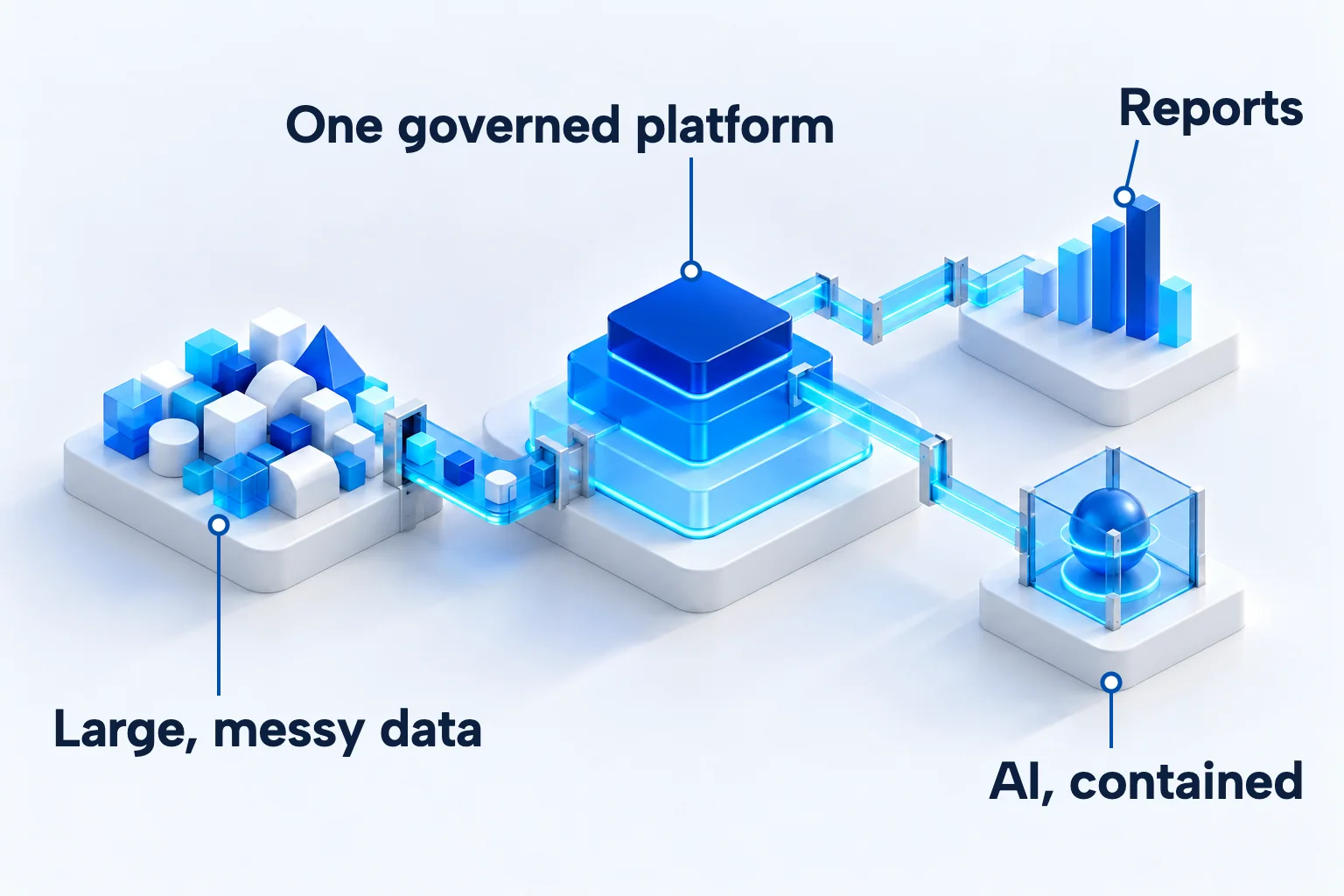
A heap of mixed healthcare data feeding one layered Databricks platform, with one output to reports and another to a contained AI model.

The problem

Healthcare data is large, nested and full of corrections. Databricks can handle it, but only when the setup is planned for patient data and someone owns the definitions. Without that, you pay for compute while reports still disagree and AI projects cannot get data they may safely use.

What it costs you

  • Compute bills grow without a clear owner for each workload.
  • AI teams wait, because nobody has cleared the data they need.
  • Reports still disagree, despite the money spent on the platform.
  • Audit questions about who can see patient data are hard to answer.

What you get

  • One platform that reporting and AI teams can both use.
  • One definition behind each number, whichever tool people use to read it.
  • Access tested with real roles before patient data goes in.
  • A cost owner for each workload, and code your team can run.

Our view

Choose Databricks for the Workload, Then Govern It First

Databricks earns its place when you have large nested FHIR and HL7 data, streaming, or machine learning on the same data your analysts use. If your work is mostly SQL reporting and partner sharing, compare it honestly with Snowflake. Whichever you pick, set up the compliance profile and Unity Catalog before the first PHI load.

The HIPAA setup is your task as well

Databricks states that you must have a BAA before processing PHI, and that confirming each workspace has the compliance security profile enabled is your responsibility. We treat that as a first-day check.

Previews need checking before PHI

Databricks tells customers not to use preview features with PHI unless they are on its supported list. New features look attractive in a demo, so we check the list before designing around one.

Row filters have real limits

Databricks documents that table-level row filters and column masks do not support time travel, clones, or being applied to a view. That affects audit and recovery plans, so the access design has to come early.

Expectations do not quarantine by themselves

Lakeflow expectations can warn, drop or fail. Quarantine is a pattern you build, and healthcare needs it, because silently dropping a lab result is rarely acceptable.

When we would tell you not to choose Databricks: your team is SQL-first, the data is mostly structured and your main need is reporting or sharing with partners. Snowflake or your existing warehouse may be the simpler choice.

For decision makers

What a CIO or Head of Data Should Check Before Hiring Us

These are the questions that decide whether a data engineering vendor is safe to hire. Here are our answers, and how to test them.

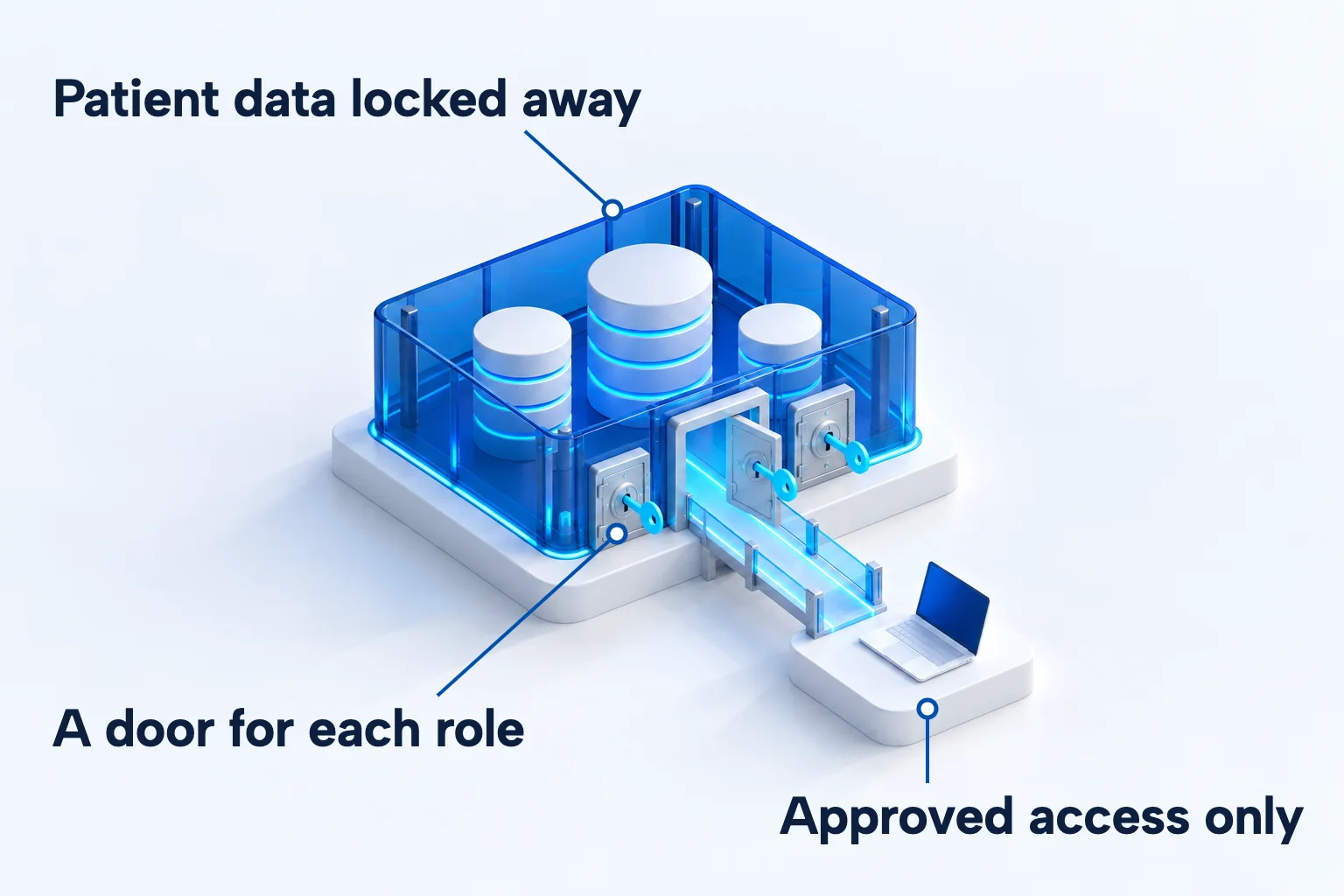
A secure room of stacked data with three separate locked doors, only one open and leading to one workstation, showing role-based access to patient data on Databricks.

Risks and how we control them

RiskHow we control it
PHI lands in an unprepared workspaceA written readiness check before the first load, for each workspace
A preview feature ends up in a PHI pathCheck the design against the Databricks supported list and record the result
Records dropped without noticeA quarantine pattern with counts that tie to the event log
Compute spend climbsCompute policies, a workload owner and refresh rates tied to decisions
Access rules break on some computeTest filters and masks on the runtimes and access modes you will really use

Governance and PHI handling

  • We start with metadata, schemas and synthetic or de-identified samples. Production PHI comes in only when the work needs it and access has been approved.
  • We sign a business associate agreement with you before our work touches PHI. Your platform and cloud BAAs stay between you and those vendors, and we check that they are in place.
  • Nirmitee is ISO 27001:2022 certified. That covers how we run our security management. It does not certify your environment or your HIPAA compliance.
  • Access is tested using the roles that will really read the data, and your team approves who gets what.

Who owns the code and the data

  • Your data stays in your accounts and under your agreements. We work inside your environment.
  • Once paid, you own the custom code we write for you, including models, metric definitions and runbooks, and all of your data. We keep our reusable tools and open-source parts.
  • The custom code lives in your repository, so you can change vendor without a rebuild.

What the team looks like

  • A technical lead who owns the architecture and answers for the numbers.
  • Data engineers for ingestion and models, and an analytics engineer for metric definitions and dashboards.
  • A healthcare integration engineer when HL7 v2, FHIR or X12 sources are in scope.
  • From your side: a data owner, a clinical or finance owner for each definition, and someone who can grant access.

How to judge any vendor, including us

  • Ask them to explain how a corrected lab result or a reversed claim moves through their design, without double counting.
  • Ask who signs off a metric definition, and where that decision is recorded.
  • Ask to see a reconciliation report format and a replay test before you sign.
  • Ask what you would keep if you ended the contract next month.
  • Be wary of a firm that names a platform before it has asked about your sources and your decision.

The first step

Healthcare Data Platform Assessment

Fixed price: $3,500. 2 to 3 weeks, credited against the build.

A fixed-price first step for one decision you need the data to support. You finish with enough evidence to approve, change or stop the build, and the outputs are yours to use with any vendor.

Book the Healthcare Data Platform Assessment

What you receive

Source inventory
Each system, its owner, how it delivers data, how it sends corrections and what access still has to be granted.
Target architecture
The platform and layers we recommend for your workload, with the options we rejected and why.
Data model outline
The grain, the main facts and dimensions, and the first metric definitions to be agreed.
Risk list
Access, quality, identity, PHI and operating risks, each with an owner and a proposed control.
Costed build plan
The work in sequence with its cost and the dependencies on your team and your vendors.

What we need from you

  • One person who owns the decision the data must support.
  • Time with the owner of each source system and each metric.
  • Schemas, data dictionaries, sample layouts and any existing reports. We do not need PHI or production credentials for the assessment.

What is not included

  • Building pipelines, models or dashboards. That is separate work you can decide on after reading the plan.
  • Databricks, Snowflake or cloud subscriptions, which you contract directly with the vendor.
  • Clinical or measure sign-off, which stays with your clinical and quality leads.
  • Legal or compliance opinions, and any certification of your environment.

The assessment is complete when all five outputs are delivered and walked through with your owners. Sending the form starts a conversation, and you pay nothing until you agree the assessment.

How the work runs

How a Databricks Engagement Runs

The order matters here: governance and environments come before pipelines, because PHI should never land in a workspace that has not been checked.

  1. 1

    Check the workspace

    Confirm the BAA, compliance security profile, customer-managed keys or notebook-results setting, and your cloud BAA.

    You review: A signed-off readiness record

  2. 2

    Lay out Unity Catalog

    Set catalogs per environment, schemas per domain, service principals and groups.

    You review: A catalog plan with access tests

  3. 3

    Deploy from code

    Set up CI/CD with Databricks Asset Bundles so that environments can be rebuilt.

    You review: A repeatable deployment

  4. 4

    Build one path

    Ingest with Auto Loader, then build silver and gold in Lakeflow with expectations and AUTO CDC.

    You review: Delta tables with quality metrics

  5. 5

    Publish metrics

    Define measures and dimensions in Unity Catalog metric views, then connect dashboards.

    You review: Governed metrics

  6. 6

    Operate

    Monitor with the pipeline event log and data profiling, review compute costs and rehearse recovery.

    You review: A runbook and a cost review

Related delivery

Multi-source Data Integration for Governed AI

Public-source life-sciences data moves through collection, name reconciliation and approval before reporting and source-cited AI answers.

Delivery context: a public-data intelligence platform built with Frappe and Power BI, with AI assistants. The case shows source integration, reconciliation and review workflows.

Read the implementation case study →
Jitendra Choudhary

Technical contact

Jitendra Choudhary

Co-Founder & CTO

Meet the engineering leadership →

Cost drivers

What Drives the Cost of a Databricks Healthcare Project

Engineering effort and platform consumption move together, so we review both.

Source count and format

FHIR NDJSON, HL7 v2, X12 and database CDC each need their own parsing and tests.

Freshness

Continuous streaming jobs cost more to build and run than scheduled batch or triggered pipelines.

Existing workspace state

Migrating from the legacy Hive metastore to Unity Catalog or untangling notebooks adds work before new features.

Data volume and history

Backfill depth and daily change volume shape both engineering time and compute.

Governance depth

Row filters, column masks, multiple environments and lineage evidence add setup and review work.

AI scope

Feature tables, evaluation sets and MLflow tracking are scoped separately from the core pipelines.

Book the Healthcare Data Platform Assessment →

For your engineers

The Technical Detail

What your technical team will want to check: ingestion, layers, governance on Databricks and samples of the work. Platform statements were read on the Databricks documentation in October 2026.

What we build and connectSources, ingestion and who owns what

The short answer

Databricks for Healthcare, in Short

We implement Databricks lakehouses for healthcare data: FHIR Bulk Data NDJSON and HL7 v2 feeds land in bronze Delta tables through Auto Loader, get validated and flattened in silver with Lakeflow pipeline expectations, and publish as gold patient, encounter, claim and cohort tables. Unity Catalog governs access to PHI with row filters, column masks and lineage. PHI workloads run in workspaces with the compliance security profile enabled and a Databricks BAA in place.

Who it is for
Data leaders starting a Databricks healthcare lakehouse or fixing one that has grown unreliable or expensive.
What we build
Ingestion, medallion layers, Unity Catalog structure, CDC handling, quality expectations and AI-ready datasets.
The outcome
One source-to-consumer path in production, reproducible from code, with lineage and a recovery runbook.

What we build

What We Build on Databricks for Healthcare Data

Named Databricks features, applied to healthcare sources and their update behavior.

FHIR NDJSON to Delta Lake

Auto Loader ingests Bulk Data $export files per resource type into bronze Delta tables with file, export and resource version metadata. Silver tables flatten nested FHIR JSON (Patient, Encounter, Observation, Condition, MedicationRequest, Claim) with explicit handling of extensions and contained resources.

FHIR-to-Databricks pipeline design

Medallion layers with promotion rules

Bronze keeps the source as received, silver applies schema, identifier and terminology checks, and gold publishes consumer models. Lakeflow pipeline expectations (formerly Delta Live Tables) can warn, drop or fail a record. Quarantine is a pattern we add, so failed records stay visible with a reason.

Medallion architecture for healthcare

Unity Catalog governance for PHI

Catalogs per environment, schemas per domain, service principals for jobs, row filters and column masks for PHI, and table and column lineage. Access is tested with the same roles that will consume the data.

Governance, lineage and PHI access

CDC and corrections

Change data feed and AUTO CDC, which replaces APPLY CHANGES (SCD type 1 or 2), for database CDC streams, corrected lab results, claim adjustments and reversals, and a replay test checks that reprocessing does not double count.

CDC for healthcare data warehouses

HL7 v2 and X12 on Spark

HL7 v2 messages from an interface engine or Kafka topic parsed to segment-level tables, and X12 837 and 835 files parsed to claim, service line and adjustment tables with CARC and RARC codes.

Streaming healthcare data with Kafka and FHIR

AI-ready and de-identified datasets

Versioned feature tables and evaluation sets tracked with MLflow, plus de-identified gold tables prepared under HIPAA Safe Harbor or for an Expert Determination.

Feature stores for clinical data

Sources handled

Sources on Databricks

Each source maps to a specific way in. The healthcare detail lies in what you keep alongside the payload.

SourceDatabricks pathWhat we keep or decide
FHIR Bulk Data NDJSONAuto Loader from cloud storage into bronzeExport ID, file name and resource version. Bronze fields stay as string or VARIANT to absorb schema changes
HL7 v2 via an interface engineKafka or files, then Structured StreamingThe raw message and control ID, then parse to segment tables in silver
X12 837 and 835Files through Auto Loader, parsed with SparkClaim, line and adjustment tables with CARC and RARC codes
EHR and billing databasesCDC feed or snapshots into AUTO CDCA sequence column, so that late changes cannot overwrite newer ones
Imaging and clinical notesUnity Catalog volumesMetadata and access rules, with extraction scoped as separate work

FHIR-to-Databricks pipeline design

Integration boundaries

Integration Boundaries for a Databricks Healthcare Implementation

What we deliver, and what stays with your platform, security and clinical owners.

Workspace and account

You own the Databricks account, cloud subscription and BAA. We configure workspaces, Unity Catalog and deployment within them.

Source systems

EHR and claims sources grant access; we build the connectors, loads and reconciliation.

Identity and security

Your identity team owns SSO and groups. We map them to catalogs, schemas and service principals and test the result.

Clinical meaning

Clinical owners approve definitions such as cohorts and measures. We encode them as tested transformations.

Model development

Training, evaluation and serving are a separate stage built on the published gold tables.

Platform choice and data layersOptions compared, layers and the data model

Compare your options

Databricks vs Snowflake for Healthcare Data

Both run healthcare workloads well. The deciding factors are the workload shape and the team that will operate it.

CriterionDatabricksSnowflake
Nested FHIR JSON at volumeSpark and Delta handle deep nesting and large NDJSON loads nativelyVARIANT and LATERAL FLATTEN work well; model the flattening deliberately
Streaming and CDCStructured Streaming, Auto Loader, change data feed and AUTO CDCSnowpipe Streaming, streams and tasks, dynamic tables
ML and AIMLflow, feature tables and model serving in the same workspaceSnowpark and Cortex; many teams pair it with an external ML stack
GovernanceUnity Catalog lineage, row filters and column masksMasking and row access policies, object tagging, access history
PHI prerequisitesCompliance security profile on the workspace and a Databricks BAABusiness Critical edition or higher and a Snowflake BAA
Team fitEngineers comfortable with Python, Spark and notebooksSQL-first analysts and analytics engineers using dbt

Many healthcare organizations run both. We design the boundary so each dataset has one owner and one definition.

Medallion layers

Bronze, Silver and Gold on Databricks

Databricks calls the medallion pattern a recommended practice, not a requirement. We follow its guidance, then add healthcare rules.

LayerDatabricks guidanceHealthcare rule we add
BronzeRaw, minimally validated data with full history, feeding silver and not analystsRestrict to pipeline service principals, because it holds unmasked PHI
SilverClean, deduplicate and type the data, keeping a non-aggregated version of each record. Read from bronze instead of writing directly from ingestionChoose how to represent nested FHIR (VARIANT, structs or normalized tables) for each resource, and quarantine failures with a reason
GoldDimensional models with pre-computed aggregates such as materialized views, by business domainApply row filters and column masks, and release only after reconciliation

Medallion architecture for healthcare data

Dimension mapping

Dimension Mapping in Delta Tables

AUTO CDC computes SCD type 1 or type 2 tables from a change feed, or from snapshots when the source has no CDC. Each dimension needs a deliberate choice between them.

DimensionHistory choiceWhyAccess treatment
PatientSCD type 2 on demographics, with a separate merge historyReports must explain past matchesColumn masks on identifiers
ProviderSCD type 2 on role and groupAttribution changes over timeStandard read
Payer and planSCD type 2 with effective datesContracts changeStandard read
LocationSCD type 2 on hierarchyDepartments get reorganizedRow filters where a facility limit applies
Code crosswalksSCD type 1 with a version columnEach release replaces the last, and the version stays traceableStandard read
Definitions, refresh and cleanupMetric definitions, how often data refreshes, and common fixes

Semantic models

Metric Views for Healthcare Definitions

Unity Catalog metric views let you define a measure once and group it by any available field. The engine generates the query, and SQL editors, dashboards, Genie and BI tools such as Power BI and Tableau can read it.

Example metricMeasure in the metric viewDimensionsDecision for its owner
Initial denial rateDenied first-pass claims divided by adjudicated first-pass claimsPayer, reason group, facility, monthClaim or line grain, and which reason codes count
Average length of stayPatient days divided by dischargesService line, facility, discharge monthHow to treat observation stays and transfers
Result turnaroundMedian time from collection to final resultTest group, lab, hour of dayWhich timestamp counts as collection

Refresh frequency

Refresh Options on Databricks

Databricks notes the tradeoff directly: continuous ingestion costs more with lower latency, and batch costs less with higher latency. Choose for each table.

NeedOptionCheck first
Files arrive through the dayAuto Loader on a triggered scheduleHow much delay the consumer accepts
ADT-driven workflowContinuous Lakeflow pipelineWho acts on it, and the cost of always-on compute
Database correctionsAUTO CDC with a sequence columnThat the sequence value is reliable
Heavy dashboard queriesMaterialized metric views on a scheduleRelease status for PHI use, plus a schedule, as changing one does not itself trigger a refresh

Cleanup problems and fixes

Databricks-Specific Problems and Fixes

These are issues we look for when reviewing an existing workspace.

ProblemFixHow you can check it
Ingestion writes straight into silverAdd a bronze layer so that data can be replayedRebuild silver from bronze in test
Expectations drop records silentlyRoute failures to a quarantine table with a reasonDropped counts in the event log match quarantine counts
Late CDC events overwrite newer onesAUTO CDC with a reliable sequence columnSend updates out of order and check the end state
A workspace is missing the compliance profileEnable it and record the check for each workspace that holds PHIAccount-level review of every workspace
Audit plan relies on time travel over filtered tablesKeep history in bronze or dedicated audit tables, since table-level filters do not support time travelRehearse a point-in-time question
PHI typed into job names or commentsNaming rules and review, as Databricks makes this your responsibilityScan names and comments in customer-defined fields

Feature stores for clinical data

Dashboards, forecasts and samples of the workWhat you receive, and what it looks like

Dashboards people act on

Dashboards People Act On, Built on Databricks

AI/BI dashboards and Genie can read the same metric views, so a chart and a typed question give the same definition. These are scoping examples.

Who opens itThe questionThe action it triggersDatabricks piece
Revenue cycle leadWhich denial reasons grew this month?Assign the rework queueMetric view with an alert
Quality leadWhich units are drifting on a measure?Start a reviewDashboard with row filters by facility
Data scientistHas an input feature shifted?Retrain or pause the modelData profiling drift tables
Data platform ownerWhich jobs cost most for what they serve?Change the schedule or computeDashboard over usage data

Forecasting loop

The Forecasting Loop on Databricks

Start with a SQL forecast and a baseline, and move to a custom model only if the numbers justify it.

  1. 1

    Forecast

    Use ai_forecast for a quick start. It returns a forecast with upper and lower bounds. Databricks marks version 1 as Public Preview and version 2 as Beta, so confirm the status before any PHI use.

  2. 2

    Build when needed

    Train a custom model with MLflow tracking when the simple forecast cannot meet the need.

  3. 3

    Store

    Write each forecast to a Delta table with its run date, so that later comparison is honest.

  4. 4

    Compare

    Join forecasts to actuals and to a simple baseline, and show the error on the dashboard.

  5. 5

    Watch for drift

    Use data profiling, which reports drift against a baseline or over time, to prompt a retrain or a retirement.

A model that influences clinical care needs clinical evaluation and its own scope.

Deliverables

What You Receive on Databricks

All of it lives in your repository and your Databricks account.

Workspace readiness record

BAA, compliance profile and encryption checks for each workspace.

Asset Bundles

Pipelines, jobs and environments defined as code.

Unity Catalog plan

Catalogs, groups, row filters, column masks and test results.

Metric views

Signed-off measures and dimensions in version control.

Quarantine and reconciliation

Tables and reports that count records read, written and quarantined.

Runbook and cost review

Recovery steps and a workload cost owner.

Samples of the work

See the Format Before You Hire

You should see what the work looks like before you hire anyone. These samples show the format we hand over. All values here are invented for illustration. They do not come from any patient, client or project.

Sample: FHIR Observation Mapping to Silver

One row for each field, including how nested data is handled.

FHIR pathSilver columnRuleExpectation
Observation.id, meta.versionIdobservation_id, version_idSequence for AUTO CDCFail the update if the key is null
Observation.code.coding[]loinc_codePick the LOINC system and keep the full array in bronzeWarn, and quarantine if no LOINC is found
Observation.valueQuantityvalue, unitKeep the source unit and convert in a separate columnQuarantine if the unit is unknown
Observation.subject.referencepatient_keyResolve through the patient crosswalkQuarantine if unresolved

Sample: Pipeline Quality Summary

Counts from the event log and the quarantine table, tied together.

DatasetRows readWritten to silverQuarantined and top reason
fhir_observation120,400120,112288, unknown unit
fhir_encounter18,35018,3500
claim_line_8359,7209,70119, reversal without an original claim
Architecture, flows and ownershipThe design written out, step by step

Databricks Healthcare Lakehouse

Features per Databricks documentation, October 2026. A reference design.

StageWhat it holds
SourcesFHIR NDJSON, HL7 v2 via Kafka, X12 837 and 835, and CDC feeds.
IngestAuto Loader, Structured Streaming and Lakeflow pipelines.
Delta tablesBronze for raw data, silver with expectations and AUTO CDC, a quarantine table, and dimensional gold.
Unity Catalog metric viewsMeasures, dimensions and materialization.
ConsumersDashboards, Genie, Power BI, Tableau and MLflow models.
Across it allUnity Catalog and the compliance security profile on each PHI workspace.

FHIR NDJSON to Governed Delta Tables

StepWhat happensWhy it matters
$export writes NDJSON to storageOne file set per resource type.
Auto Loader into bronzeString or VARIANT, with file and export ID.Keeps full history.
Silver expectationsWarn, drop or fail.Failures go to a quarantine table that you build.
AUTO CDC applies changesA sequence column orders updates.A late update cannot beat a newer one.
Gold dimensional tablesRow filters and column masks.
Metric viewDashboards and Genie read one definition.

Medallion Layers on Databricks

LayerStoresUsesAccessPromote when
BronzeRaw FHIR, HL7 and X12 with full historyAuto Loader, DeltaPipeline service principalsDelivery logged
SilverClean, non-aggregated recordsLakeflow, expectations, AUTO CDCEngineers, approved analystsChecks pass or quarantine
GoldDimensional models by domainMaterialized views, metric viewsAnalysts, with filters and masksReconciled and signed off

Databricks or Snowflake for Healthcare?

Answer in this order. The first yes is usually your answer.

QuestionIf yes
Already running one of them well?Stay on it.
Large nested FHIR or HL7 data needing custom processing?Databricks
Streaming or machine learning at the center of the work?Databricks
SQL-first team focused on reporting?Snowflake
Sharing governed data with partners?Snowflake
None of these?Test both on one workload.

Governing PHI on Databricks

AreaWhat applies
CatalogsOne each for dev, test and production.
SchemasBy domain: clinical, claims, reference.
IdentitiesService principals for jobs, groups for people.
PHI controlsRow filters, column masks, lineage and audit.
You confirmBAA, profile on each workspace, cloud BAA and keys.
DatabricksEncrypts PHI in the control plane.

Test filters and masks on the real runtimes and access modes.

Where PHI Sits, and Who Can Reach It

WhereWhat happens there
Your environmentHolds your source systems, data platform and PHI, under your platform and cloud BAAs, your roles, your masks and your audit logs.
During the assessmentWe use schemas, data dictionaries and synthetic samples. We do not use PHI or production credentials.
During a buildWe sign a BAA with you first. Access uses approved roles, is logged and is the least needed. You grant, review and revoke it.
The codeCode and tests use synthetic data and live in your repository.
Guides and referencesFurther reading and vendor documentation

Explore the implementation decisions

Guides for the Work Ahead.

Before we begin

Databricks Healthcare Questions Buyers Ask

Is Databricks HIPAA compliant?

Databricks supports HIPAA workloads: PHI must be processed in workspaces with the compliance security profile enabled and with a Databricks business associate agreement in place. Compliance also depends on how you configure access, logging and data handling, which is what we implement and document.

How do you load FHIR data into Databricks?

We request a FHIR Bulk Data $export, land the NDJSON files in cloud storage and ingest them with Auto Loader into bronze Delta tables, one per resource type. Silver tables flatten the nested JSON and apply validation, and incremental refreshes use _since plus resource versions to avoid duplicates.

What is medallion architecture in healthcare?

It is a layered design: bronze keeps source data as received, silver holds validated and standardized records, and gold holds consumer-ready models such as patient cohorts, encounters or claims. In healthcare the value is traceability: a gold field can be followed back through silver to the original resource or message.

Should we use Unity Catalog for PHI?

Yes. Unity Catalog gives one place for permissions, row filters, column masks, audit and lineage across workspaces. For PHI we separate identified and de-identified catalogs, run jobs as service principals and test access with the roles that will consume the data.

Can Databricks process HL7 v2 and X12 data?

Yes. HL7 v2 messages arrive from an interface engine or Kafka topic and are parsed to segment and field tables. X12 837 and 835 files are parsed into claim, service line and adjustment tables with CARC and RARC codes preserved.

Databricks or Snowflake for healthcare?

Databricks fits large nested FHIR and HL7 volumes, streaming and ML in one platform. Snowflake fits SQL-first analytics and secure data sharing. Many organizations run both; we define which platform owns each dataset.

Can you improve an existing Databricks implementation?

Yes. We assess pipeline reliability, data models, permissions and workload costs, then scope targeted changes, including Hive metastore to Unity Catalog migration, rather than assuming a rebuild.

How do you handle corrected lab results and claim adjustments?

We key records on stable source identifiers and versions, then apply changes with AUTO CDC (formerly APPLY CHANGES) or MERGE so a corrected Observation or an adjusted claim replaces or versions the earlier row. Replay tests prove that reprocessing the same input does not double count.

How do we judge a Databricks vendor?

Ask how they confirm the compliance security profile on each workspace, how failed records are quarantined when expectations only warn, drop or fail, and how a late change is kept from overwriting a newer one. Model development, if you need it, is scoped separately.

How long does a Databricks healthcare implementation take?

The assessment takes 2 to 3 weeks. We do not quote a build schedule before it, because source access and sign-off owners set the pace and differ widely. The costed build plan gives the sequence and its dependencies, once those are known.

What does a Databricks healthcare implementation cost?

The Healthcare Data Platform Assessment is a fixed $3,500. It takes 2 to 3 weeks and is credited against the build. It ends with a costed build plan. The build depends on sources, volume, freshness, governance and any rework in an existing workspace. Databricks and cloud usage are billed by those vendors.

Do you sign a BAA?

Yes. We sign a business associate agreement with you when our work touches PHI, and we confirm the Databricks BAA and compliance security profile are in place before PHI enters the workspace.

Talk to our team

Book the Healthcare Data Platform Assessment

Tell us what you are planning, what exists today and what needs to change. We’ll review the context and discuss scope, dependencies and the next useful step.

hello@nirmitee.io →

Please exclude patient data and credentials. We use these details to respond to your inquiry. Privacy policy

Thank you. Your inquiry has been received. Our team will review your requirements.