Who holds the athenahealth agreement and API access?
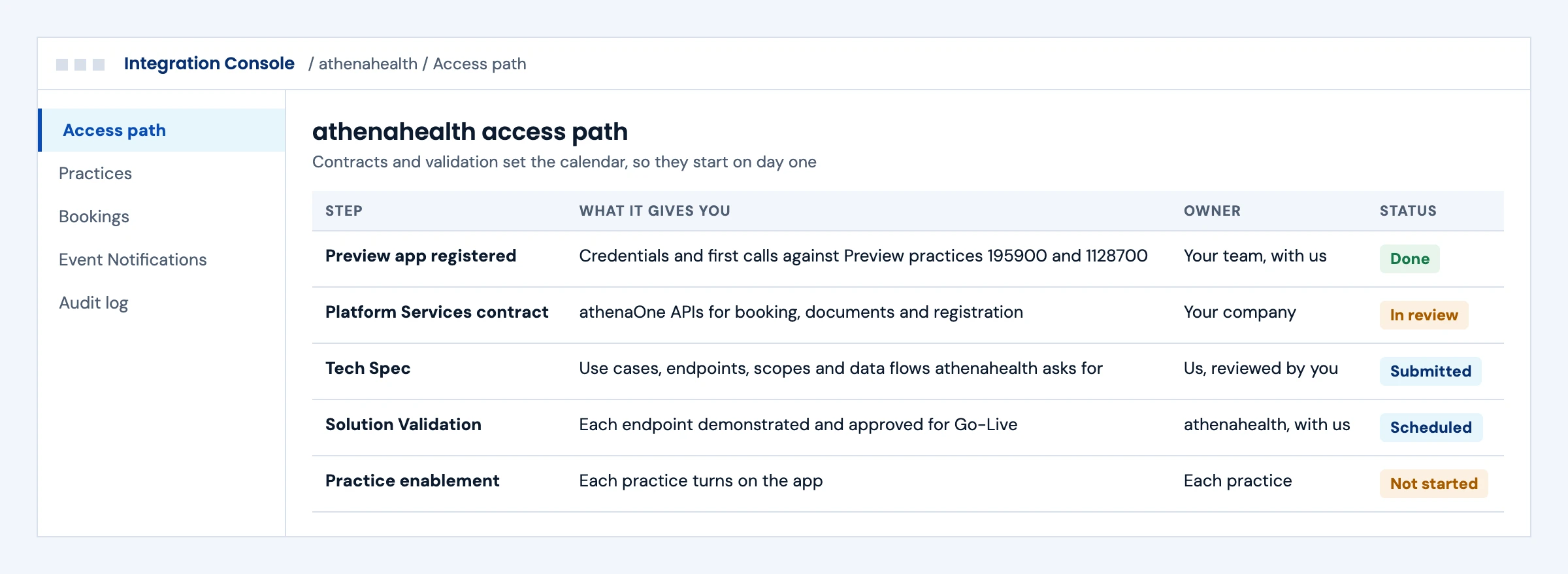
You do, or your customer does. API access and any Platform Services contract sit with your organization, so the integration and its credentials stay yours. We build the integration, prepare the Tech Spec and validation evidence with you, and run the rollout through practice enablement.
Do we need the FHIR API, the athenaOne APIs or both?
Usually both. The certified FHIR R4 API is the right place to read clinical data. Booking appointments, posting documents, registering patients and change feeds run on athenaOne APIs, which need an athenahealth Platform Services contract. We map each screen and job in your product to one of the two before you commit.
How quickly can we start?
The same day. We register a Preview app in athenahealth's developer portal and make first calls against the public sandbox practice. Patient apps can be tested end to end there. Provider apps and bulk export need a Preview tablespace from a customer or the partner program, and we start that request in the first week.
Can we write data back into athenaOne?
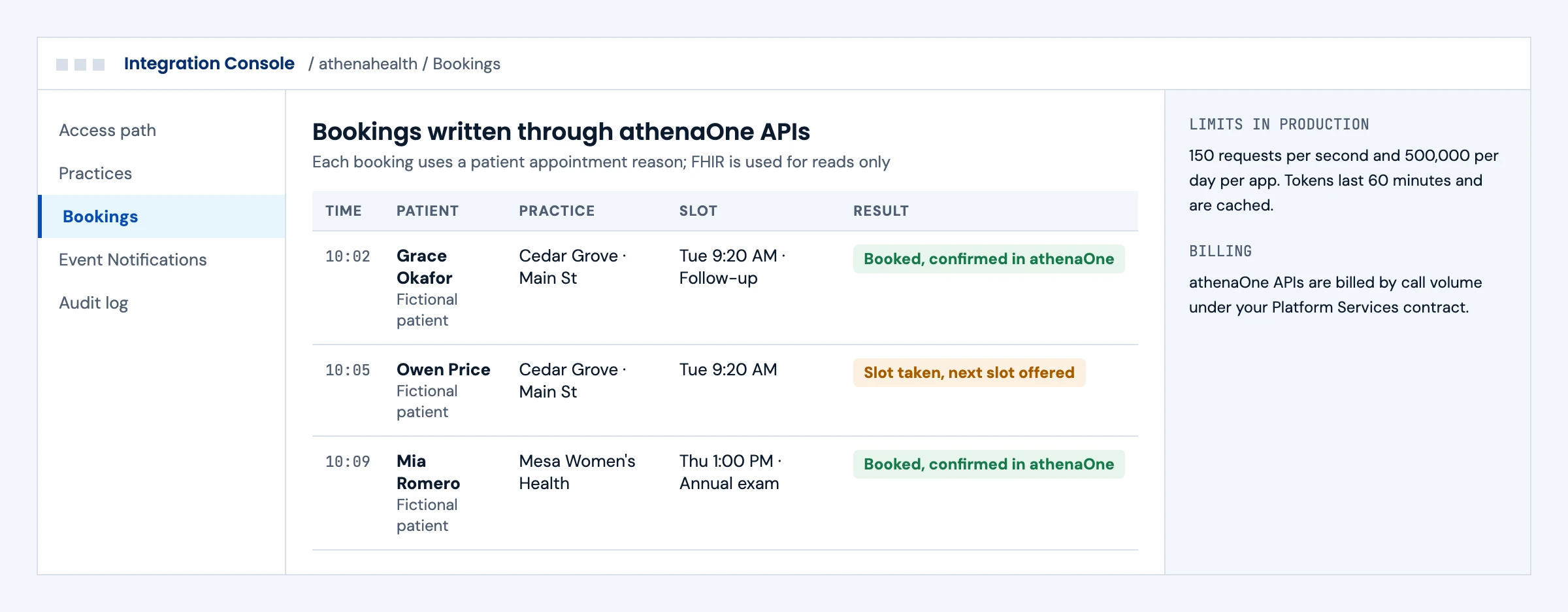
Yes, for the workflows athenahealth supports, through athenaOne APIs: appointments with reason IDs, clinical documents to the chart, encounter documentation and patient updates. FHIR write scopes are not granted by default. We confirm each write, how it appears to clinicians and how duplicates are handled before it goes into scope.
Can you connect more than one practice?
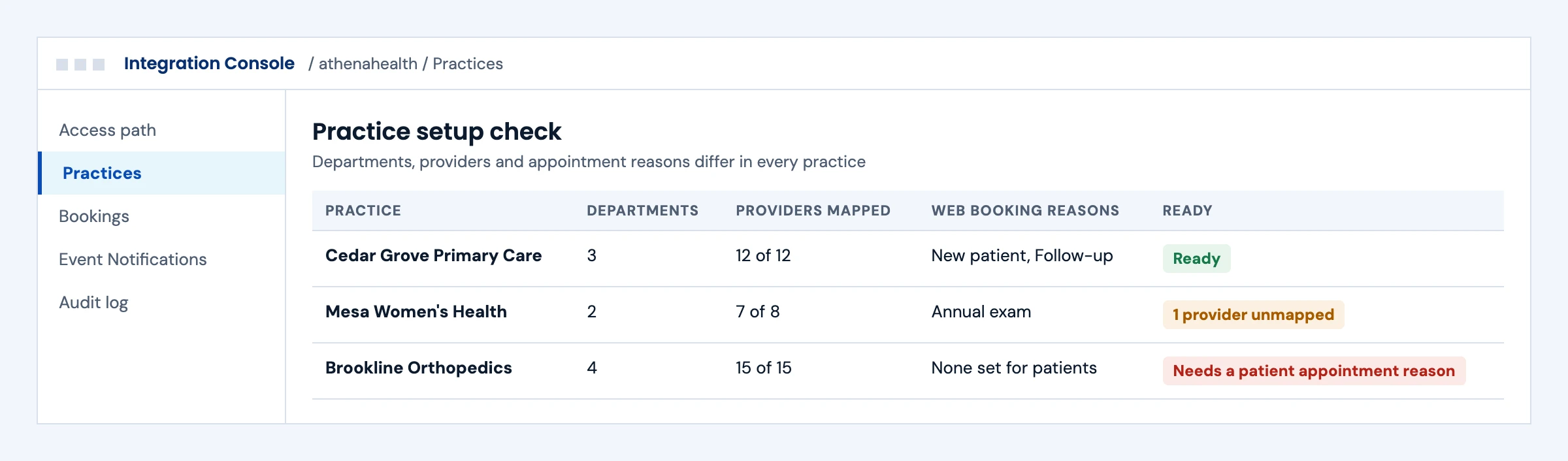
Yes. Each practice enables your app and has its own departments, providers and appointment reasons. We keep that per-practice context in configuration, not code, and give you an onboarding runbook so every new practice follows the same checklist.
Do we still need an integration if we use CommonWell, Carequality or TEFCA?
Often, yes. athenaOne reaches TEFCA through CommonWell Health Alliance, a designated QHIN, and exchanges records through CommonWell and Carequality. That network exchange is good for retrieving records for treatment. It does not put your product inside the athenaOne workflow, book appointments or write back to the chart; those need the APIs.
Where is the athenahealth developer portal?
athenaOne developers sign in to the athenahealth Developer Portal and manage apps in its Developer Console. Registering an app gives you Preview credentials the same day. athenaPractice and athenaFlow have a separate developer portal, with its own accounts and sandboxes, so the product your customers run decides which portal you need.
Where is the athenahealth API documentation?
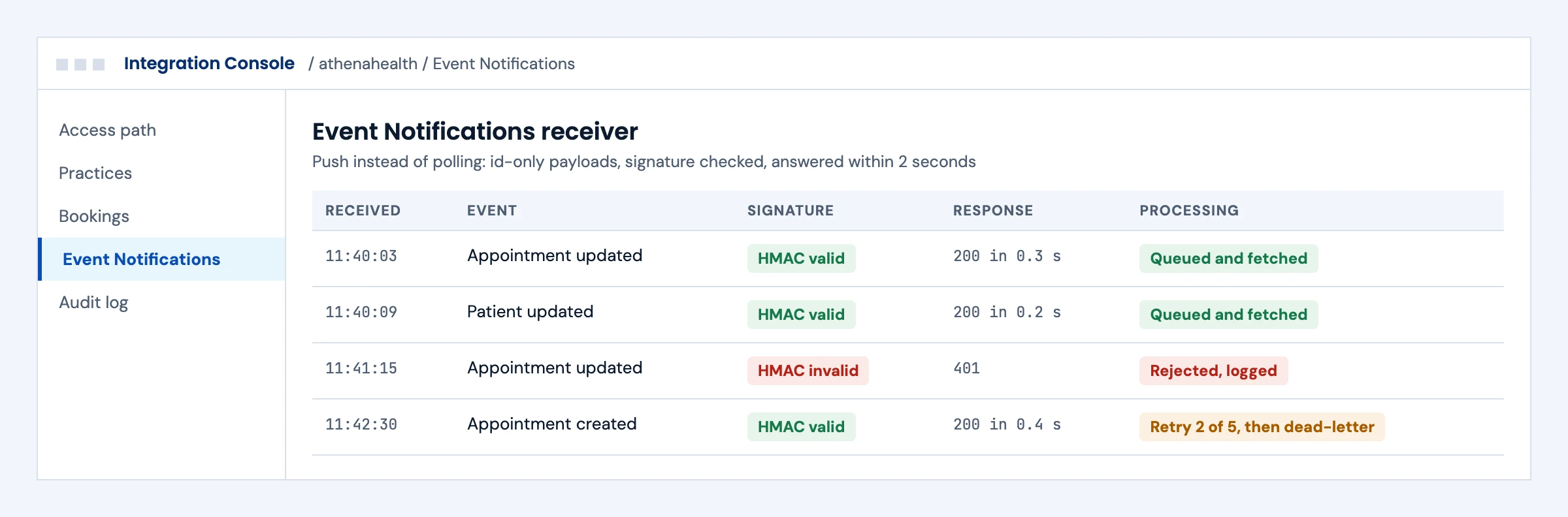
At docs.athenahealth.com. It covers the certified FHIR R4 API, the athenaOne API reference, authorization, Event Notifications and onboarding guides. The live FHIR CapabilityStatement at api.platform.athenahealth.com/fhir/r4/metadata is the quickest check of what the FHIR API allows: on 17 October 2026 it listed 32 resource types, and QuestionnaireResponse was the only one that allowed create.
Is there an athenahealth sandbox for testing?
Yes. Every new athenaOne app can call the shared Preview practices 195900 and 1128700 at api.preview.platform.athenahealth.com, with lower limits than production (15 requests per second and 50,000 per day). Patient apps and back-end reads can be tested there end to end. Provider apps that launch inside athenaOne need a Preview tablespace from a customer or the Marketplace Partner Program.
What are the athenaOne APIs?
The athenaOne APIs are athenahealth's proprietary REST APIs under /v1/{practiceid}/, where scheduling, chart write-back, documents, patient registration, billing and changed-data feeds live. They sit alongside the certified FHIR R4 API, need an athenahealth Platform Services contract, a Tech Spec and Solution Validation, and are billed by call volume.
How do we get listed on the athenahealth Marketplace?
Through athenahealth's Marketplace Partner Program, which your company applies to and holds. The program also gives partners a dedicated Preview tablespace for testing provider apps. We build and validate the integration with you and prepare the technical material the program reviews; the listing decision is athenahealth's.
How long does an athenahealth integration take?
In our estimates, 6 to 10 weeks for a certified read-only app to reach its first practice, and 3 to 6 months for an integration that writes through the athenaOne APIs. The access path sets most of that calendar: the Platform Services contract, the Tech Spec, Solution Validation and each practice enabling your app. We start those on day one and build in parallel.
What drives the cost of athenahealth integration services?
Our engineering cost grows with the number of workflows, whether you write back or only read, the app types you need (patient, provider, back-end), Event Notifications or HL7 v2 interfaces, and how many practices you roll out to. athenahealth's own charges are separate: certified FHIR APIs are free to call, and athenaOne API usage is metered under your contract.
What Affects Cost and Timing?
The number of workflows, read versus write scope, whether you need Event Notifications or HL7 v2, and how fast you get a Preview tablespace and a Platform Services contract. Certified FHIR APIs cost nothing to call; athenaOne APIs are metered by call volume at a rate athenahealth agrees with you. Those charges are separate from our engineering fees.