Nirmitee.io
Oracle Health · Formerly Cerner

Integrate With Oracle Health (Cerner).

The Millennium Platform, code Console registration, SMART on FHIR R4, and the per-tenant "Ignite APIs" activation model that makes Oracle Health different from Epic — mapped by engineers who ship it, not a rebrand press release.

Millenniumcode ConsoleSMART · STU1FHIR R4Ignite APIsFHIR R4 (4.0.1) · DSTU2 retired ~Dec 2025 · Inferno g10-validated
FHIR R4
v4.0.1 — DSTU2 retired ~Dec 2025 (rebuild legacy apps)
SMART · STU1
App Launch 1.0.0 / Backend 1.0.1 — not SMART 2.0
Per-tenant
register once, each customer activates via Service Request
Free to start
code Console + CernerCare; paid tiers optional
Start Here

Cerner Is Oracle Health Now — Here's What That Means

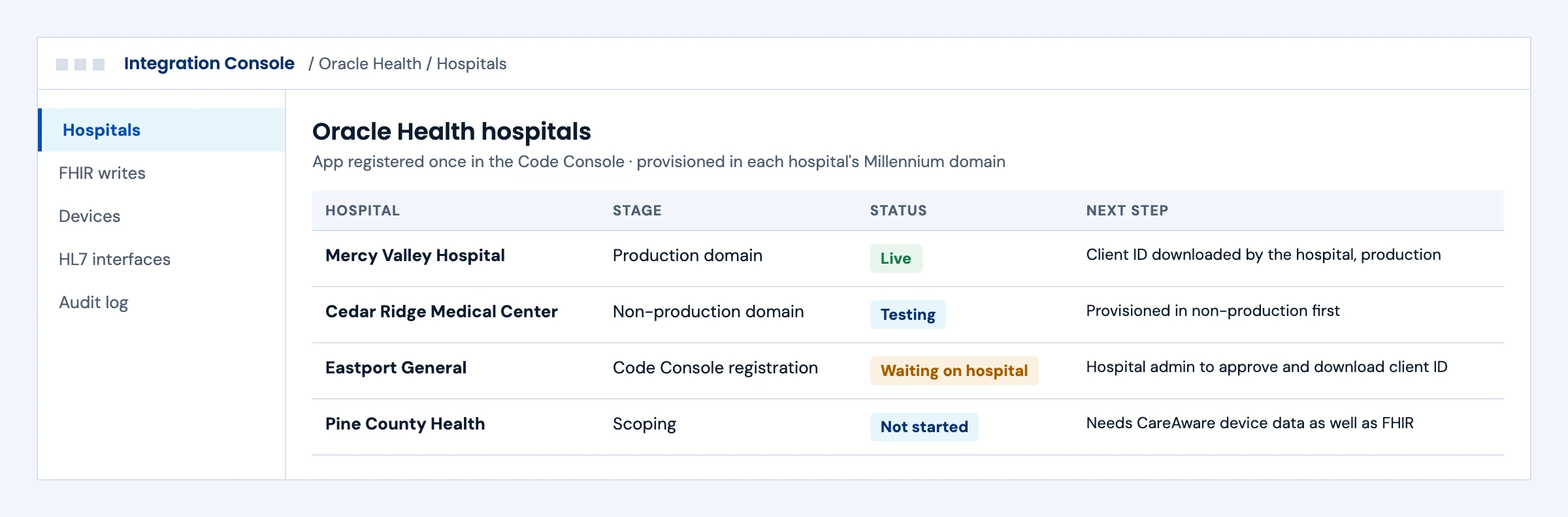
Oracle acquired Cerner in 2022, and "Cerner" is steadily becoming Oracle Health. For integration, the target you build against is the Oracle Health Millennium Platform (the rebranded Cerner Millennium EHR), and clinicians launch your SMART app from PowerChart — its table-of-contents column (with patient context) or the Organizer view (without). The good news: the developer plumbing — code Console, CernerCare, the FHIR endpoints — is stable through the rebrand, even though some names still say "Cerner."

Two things make Oracle Health genuinely different from Epic, and both catch teams off guard. First, SMART is still on STU1 (App Launch 1.0.0) — not SMART 2.0 — so don't assume the newer granular scope syntax. Second, and bigger: going live is per-tenant. You register your app once with Oracle, but each customer then has to opt your app in through a Service Request — registration is not activation. Get those two right and Oracle Health is a clean, well-documented FHIR integration.

And there's a second platform now. In Aug 2025 Oracle launched an all-new, OCI-based, AI-agent-driven Oracle Health EHR for ambulatory providers — separate from Millennium. Its third-party integration surface isn't documented yet, so Millennium remains the platform you integrate with today. We track both.
Interactive · Oracle Health Stack Explorer

The Stack — And What You Actually Integrate With

Oracle Health has its own vocabulary. Here's the map, sorted by what a third party connects to versus what lives inside the customer's system. Pick a layer.

The surfaces a third party actually connects to today — all on the Millennium Platform.

Millennium FHIR R4 APIsYou integrate

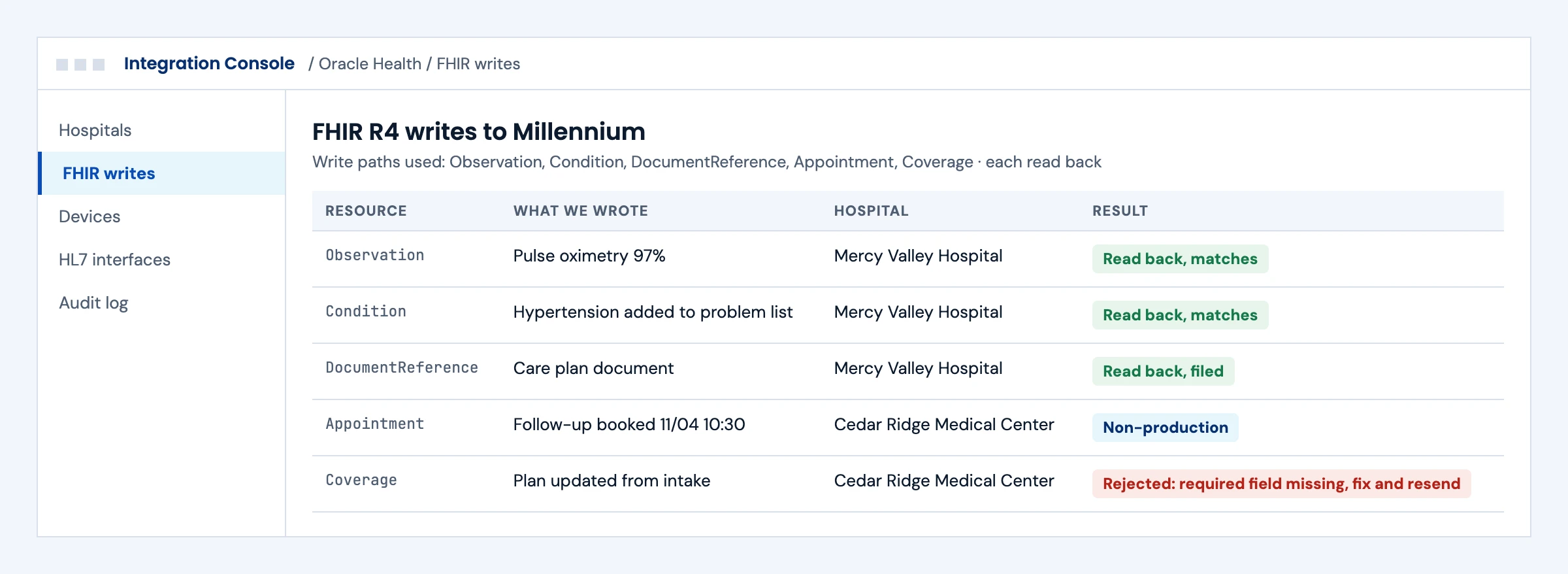
The core REST surface — US Core resources on /r4/<tenant>. R4 (4.0.1); DSTU2 is retired.

SMART on FHIR (STU1)You integrate

App Launch 1.0.0 + Backend Services 1.0.1. Flows: EHR launch, contextless (patient), client-credentials (backend).

code ConsoleRegister here

Where you register the app, test scopes, and get your application ID + client ID. Needs a free CernerCare account.

Cerner Ignite APIsPer-tenant gate

"Cerner Ignite APIs for Millennium" — the solution each customer files a Service Request against to provision your app to their tenant.

PowerChart launchWhere it runs

Provider apps open from PowerChart's TOC (patient context) or Organizer (no context) — the clinician entry point.

Open code sandboxTest free

fhir-open (read-only), fhir-ehr-code (provider), fhir-myrecord (patient) — public sandbox tenants to build against.

Around the FHIR surface sit products you'll hear about but mostly don't self-serve — they're customer- or implementation-gated.

Oracle Health Data IntelligenceNon-FHIR · B2B

The former HealtheIntent population-health line (also marketed as the AI Data Platform). Exposes RESTful B2B APIs that are explicitly not FHIR, tenant-gated to customers.

CareAwareImplementation-gated

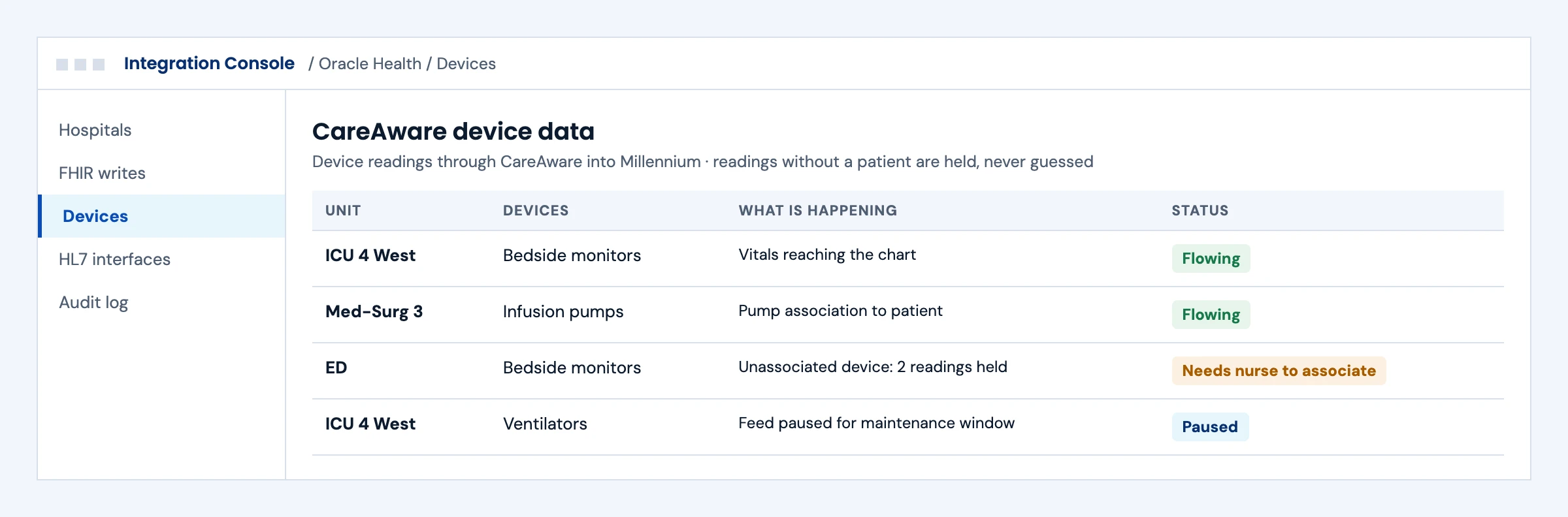
Cerner's device-connectivity / medical-device integration layer. Typically arranged through the customer's implementation, not a self-serve developer API.

Millennium (Chart Server)Customer-internal

The operational EHR/database itself. You read/write it through FHIR — you don't touch the database directly.

PowerChartThe client

The clinician application. Relevant as your launch surface, but it's Oracle's client, not an API.

HL7 v2 interfacesCustomer / integration

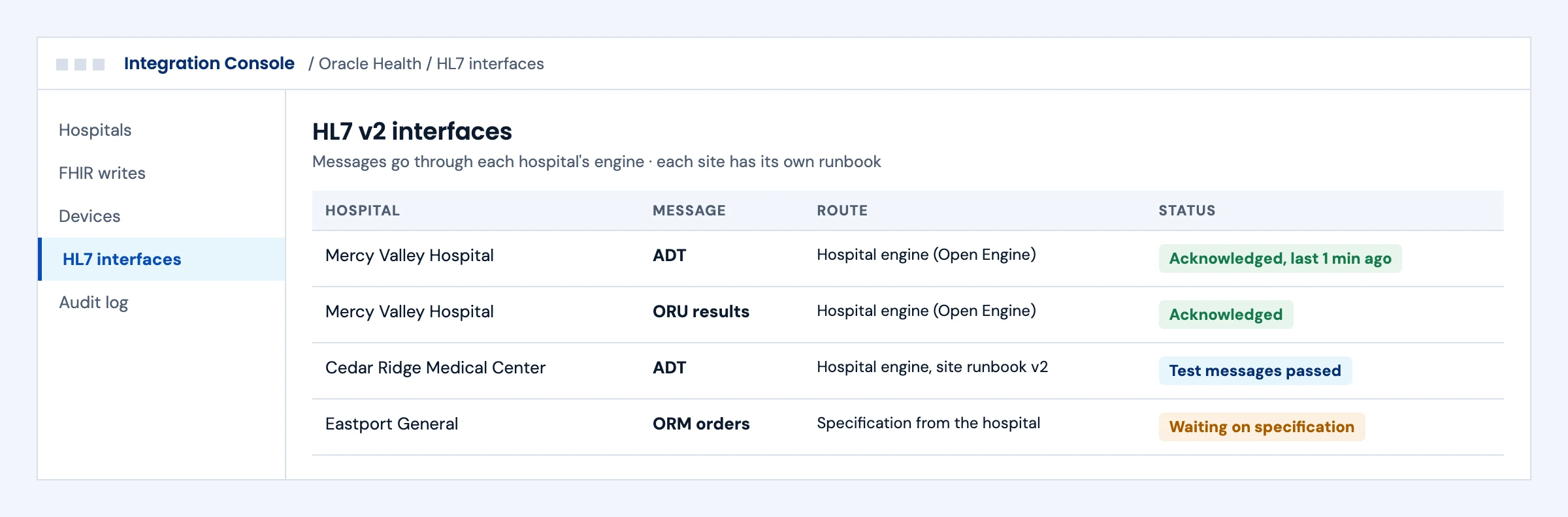
Legacy real-time interfaces still run at most Cerner sites — arranged via the customer's integration team, not the self-serve FHIR program.

Oracle's newest, most-hyped pieces — genuinely new, but not yet third-party integration points. Know what they are so you're not caught out.

Oracle Health EHR (OCI)New · 2025

An all-new, cloud-native, voice-first EHR on OCI, launched for US ambulatory providers Aug 2025 (ONC-certified late 2025). Separate from Millennium; its third-party surface isn't documented yet.

Clinical AI AgentNative feature

Oracle's ambient/voice assistant — as of Feb 2026 it drafts orders (labs, imaging, Rx, follow-ups) for clinician review. An Oracle-native capability, not a third-party API.

OCIInfrastructure

Oracle Cloud Infrastructure — where the new EHR and Oracle Health's cloud services run. Context, not an integration point for clinical apps.

Verified July 2026 against Oracle/Cerner primary docs (docs.oracle.com/en/industries/health, fhir.cerner.com, oracle.com/health). Some ecosystem items (CDS Hooks, Bulk Data, CareAware specifics) are implementation-dependent — we confirm per environment.

The Model That Trips Everyone Up

Registration Isn't Go-Live: The Per-Tenant Model

Unlike a single global switch, Oracle Health makes activation the customer's job, per tenant. Here's the real sequence.

1

Register in Code Console

Create the app (free CernerCare account); declare your FHIR resources & scopes; get an application ID + client ID.

2

Oracle Validates

Oracle reviews which resources and READ/WRITE operations your app uses (for provider apps) and registers it.

3

Available to Consider

Now the app is merely "available for clients to consider" — it is not auto-activated anywhere.▲ not live yet

4

Customer Files an SR

Each customer logs a Service Request to Cerner Ignite APIs for Millennium to provision your IDs against their tenant.▲ per customer

5

Domain & Role Opt-In

The customer decides domain-by-domain and which users/roles can use it — then you're live at that site.

This is the single biggest structural difference from Epic's model. We build the repeatable per-customer onboarding so each new tenant is a fast checklist, not another project.

Cerner → Oracle Health

The Rebrand Decoder

Docs, blogs, and Oracle's own pages mix old and new names. Here's what changed, what didn't, and what to actually call things in 2026.

You'll see (old)
Now (2026)
Notes
Cerner Millennium
Oracle Health Millennium Platform
The EHR you integrate with. Platform is stable — just renamed.
Cerner Corporation
Oracle Health
Company brand. Acquired by Oracle in 2022.
HealtheIntent
Oracle Health Data Intelligence / AI Data Platform
Population health. Two current names; non-FHIR B2B APIs.
code.cerner.com
code-console.cerner.com
Registration console. Old deep-links 301-redirect. Still "cerner.com".
code Console · CernerCare
unchanged
Stable through the rebrand — still the names you use.
Cerner Ignite APIs
still "Cerner Ignite APIs"
Internal solution name for Millennium — retains "Cerner" even in 2026 docs.
Oracle Health vs Epic

If You Know Epic, Here's What's Different

The two dominant EHRs share the FHIR spine but diverge on the details that decide your architecture.

Dimension
Oracle Health (Millennium)
Epic
SMART version
STU1 — App Launch 1.0.0 / Backend 1.0.1
v2 — granular c/r/u/d/s scopes
FHIR versions
R4 only (DSTU2 retired ~Dec 2025)
R4 + STU3 + DSTU2 concurrently (R4 recommended)
Register at
code Console + CernerCare account
fhir.epic.com — dual (prod/non-prod) client IDs, immutable record
Go-live model
Global register → each customer files an Ignite APIs Service Request
Federated — share client IDs, each customer activates
Bulk Data _since
reportedly supported (confirm per environment)
not supported — full $export only
Discovery
Developer program; no App-Orchard-style public storefront emphasized
Showroom marketplace + Connection Hub

Building for both? A shared US Core layer covers most reads — we abstract the auth-version and activation differences so your product isn't forked per vendor. See our Epic integration guide and all-EHR overview.

Common Pitfalls

Where Oracle Health Builds Go Wrong

The mistakes we're most often called in to fix.

Assuming SMART 2.0

Oracle Health is on STU1 (App Launch 1.0.0). Don't build against v2 granular scope syntax — match the STU1 framework.

Confusing register with go-live

Registration only makes you "available to consider." Each customer must file an Ignite APIs Service Request to actually turn you on.

Building on DSTU2

DSTU2 is retired (~Dec 2025). New apps must be R4 (4.0.1); legacy Cerner DSTU2 integrations need migrating.

Mixing sandbox & prod hosts

Sandbox is fhir-ehr.sandboxcerner.com; production is fhir-ehr.cerner.com (with regional hosts). Different domains — a classic misconfig.

FAQ

Oracle Health (Cerner) Integration, Answered

The questions teams ask before they start.

Is It "Cerner" or "Oracle Health" Now?
Both, for now. Oracle acquired Cerner in 2022 and is rebranding it to Oracle Health; you build against the Oracle Health Millennium Platform (formerly Cerner Millennium). But developer terms like code Console, CernerCare, and "Cerner Ignite APIs" still carry the Cerner name in 2026 docs. See our rebrand decoder above for what maps to what.
How Do I Register an App with Oracle Health?
Register in code Console (code-console.cerner.com), which needs a free CernerCare account. There you test authentication and your declared scopes and receive an application ID + client ID. There are two paths — a consumer-access app (attest to the CARIN Code of Conduct) and a provider/system-access app (accept API terms; Oracle reviews the FHIR resources and READ/WRITE operations you use).
Why Isn't My App Live After I Registered It?
Because registration isn't activation. On Oracle Health, an app is only "available for clients to consider" after registration — each customer then files a Service Request to "Cerner Ignite APIs for Millennium" to provision your application ID and client ID against their tenant, and decides domain-by-domain and which users/roles can use it. Going live is per-customer, and it's their action, not yours.
Which FHIR and SMART Versions Does Oracle Health Use?
FHIR R4 (4.0.1) — DSTU2 is retired (~Dec 2025), so build on R4. For auth, Oracle Health implements SMART App Launch 1.0.0 and Backend Services 1.0.1 — both STU1, not SMART 2.0. It supports EHR launch (provider), contextless (patient/standalone), and client-credentials (backend) flows.
How Is Oracle Health Different from Epic to Integrate?
Same FHIR spine, different details. Oracle Health is R4-only and SMART STU1; Epic runs multiple FHIR versions and SMART v2. Registration is code Console vs Epic's fhir.epic.com (immutable dual client IDs). And go-live differs: Oracle uses a per-customer Ignite APIs Service Request, while Epic is federated with a Showroom marketplace. Our vs-Epic table above breaks it down.
What Does It Cost to Integrate with Oracle Health?
Starting is essentially free — you can build and deploy on the certified FHIR APIs without paid developer services. Oracle lists optional paid tiers (an OPN membership and Millennium environment access, reported around $500 / $3,000 / $5,000 annually) that are not required to build and deploy, apply to certified-API developers, and are subject to change. Proprietary-API pricing differs. As always, we scope your specific build on a call rather than quoting Oracle's fees as fixed.
Get an Oracle Health Integration Plan

Skip the Guesswork — Get Your Path Mapped.

Tell us what you're building and which Oracle Health / Cerner customers you're targeting. We'll send back a specific plan: the FHIR resources, the SMART flow, the code Console + per-tenant steps, and a realistic timeline.

A concrete integration path for your use case — not a sales pitch.
The per-tenant activation checklist so onboarding customers is repeatable.
Reviewed by an integration engineer, within one business day.
+1 (669) 649-0706 · hello@nirmitee.io
Get your integration plan
Free · specific to your build · no spam

HIPAA-aware. We never share your details.

Thanks — We've Got It.

Your Oracle Health integration plan is on the way, within one business day.