Nirmitee.io
ABDM Integration Services · India

From ABDM on Your Roadmap to ABDM in Production.

Teams call us when ABDM stops being a policy update and turns into a line in someone's tender. We take you from the NHA sandbox to certified and live — M1 through M4, and NHCX claims after that — without replacing the system you already run.

ABHAHIPHIUNHCXFHIR R4Sandbox → NHA certification → production. DPDP-aligned. ISO 27001 certified.
ABDM readiness example programme
M1
Your patients get an ABHACreated or verified at registration
Certified
M2
Your records travelReleased to whoever the patient consents to
Certified
M3
You see their historyPulled in from other providers
In review
Certified per milestone. Sandbox first, then production against your live environment — one facility at a time.
M1–M4
Every ABDM milestone, plus NHCX claims — delivered and certified
6
Certification gates from sandbox key to production key. We run all six
~50%
Less integration code to write, using our .NET and TypeScript SDKs
0
Patient data stored outside your own database. Nothing leaves your systems
Who this is for

Five Buyers, Five Very Different Reasons.

ABDM means something different depending on what you sell and who you answer to. Pick the one that sounds like you — the trigger, what it unlocks, and what we actually hand over.

Hospitals and hospital chains

ABDM arrives through empanelment paperwork, a scheme requirement, or patients who expect their ABHA to mean something at your desk.

6–12 weeks
typical, M1 + M2, single HIS

What usually triggers it

Empanelment and scheme paperwork that asks for ABDM participation, a group-level digital mandate, or a corporate customer who wants records to move between your units.

What it unlocks

  • Your facility listed and verified on the national registries
  • ABHA created and linked at registration, in the workflow your staff already use
  • Discharge summaries and reports released to the patient on consent, instead of over WhatsApp
  • Eligibility to participate in digital-health incentive schemes, where terms apply

What we hand over

Your HIS talking to ABDM, the NHA test evidence for each certified milestone, staff-facing screens that don't add clicks, and a runbook your IT team can actually operate.

Timelines are from our own delivery, for planning. Yours gets scoped on the call.

The milestones, in business terms

Four Things You Can Do Once It's Live.

ABDM ships in milestones. You don't need all of them — most organisations get real value from the first two and add the rest when a partner or a payer asks.

M1The entry ticket

Your patients get an ABHA

Identity, created or verified at your registration desk and tied to your own record.

Why it mattersIt's what tenders and scheme checklists mean when they ask if you're ABDM-enabled.
M2The one patients notice

Your records travel

Reports and summaries released to whoever the patient consents to share them with.

Why it mattersRecords follow the patient instead of living in your building.
M3The clinical payoff

You see their history

A patient's prior records pulled in from other providers, with their consent.

Why it mattersFewer repeat tests, and a real reason to be chosen for continuing care.
NXThe cash-flow one

You get paid faster

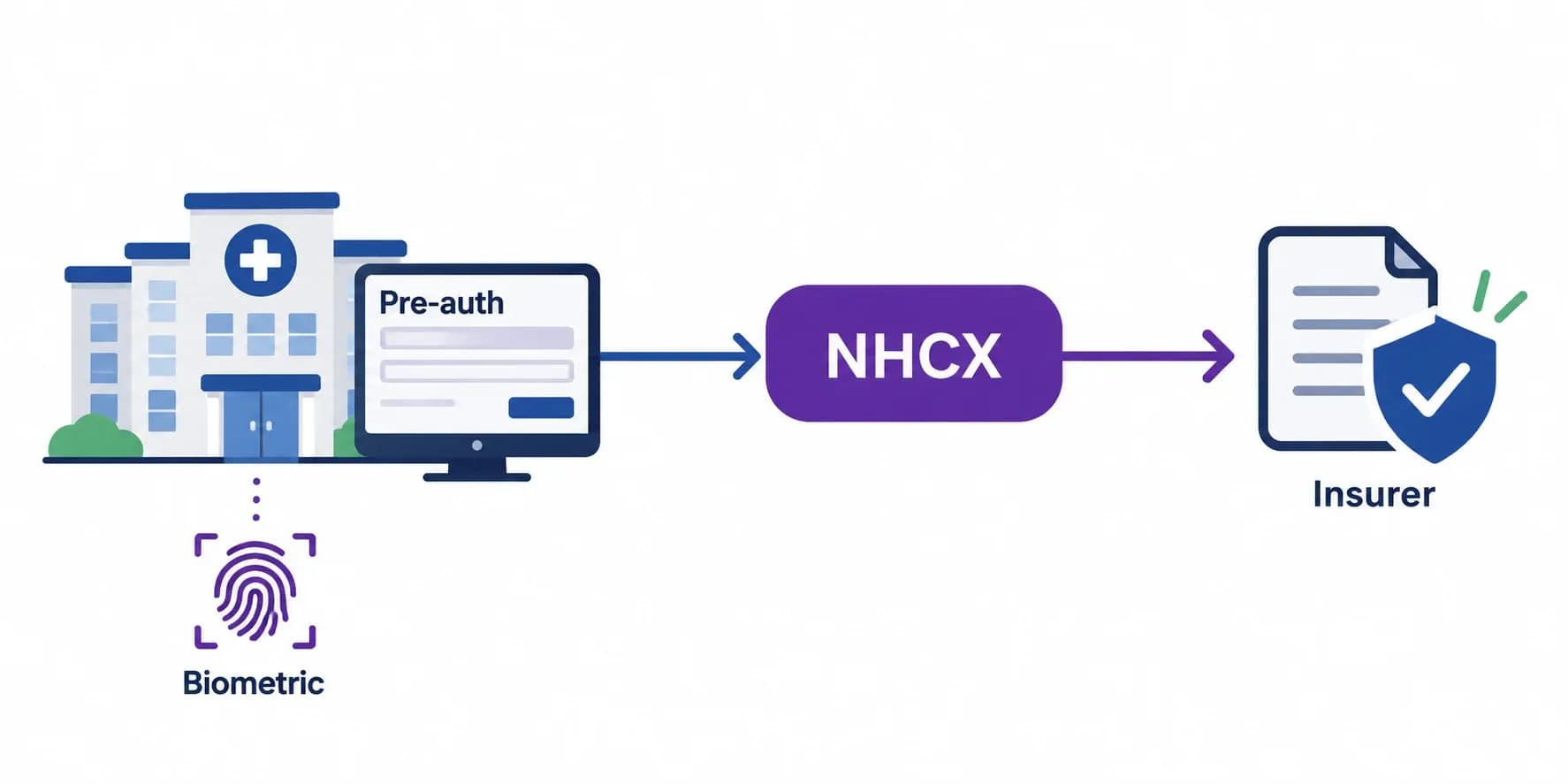
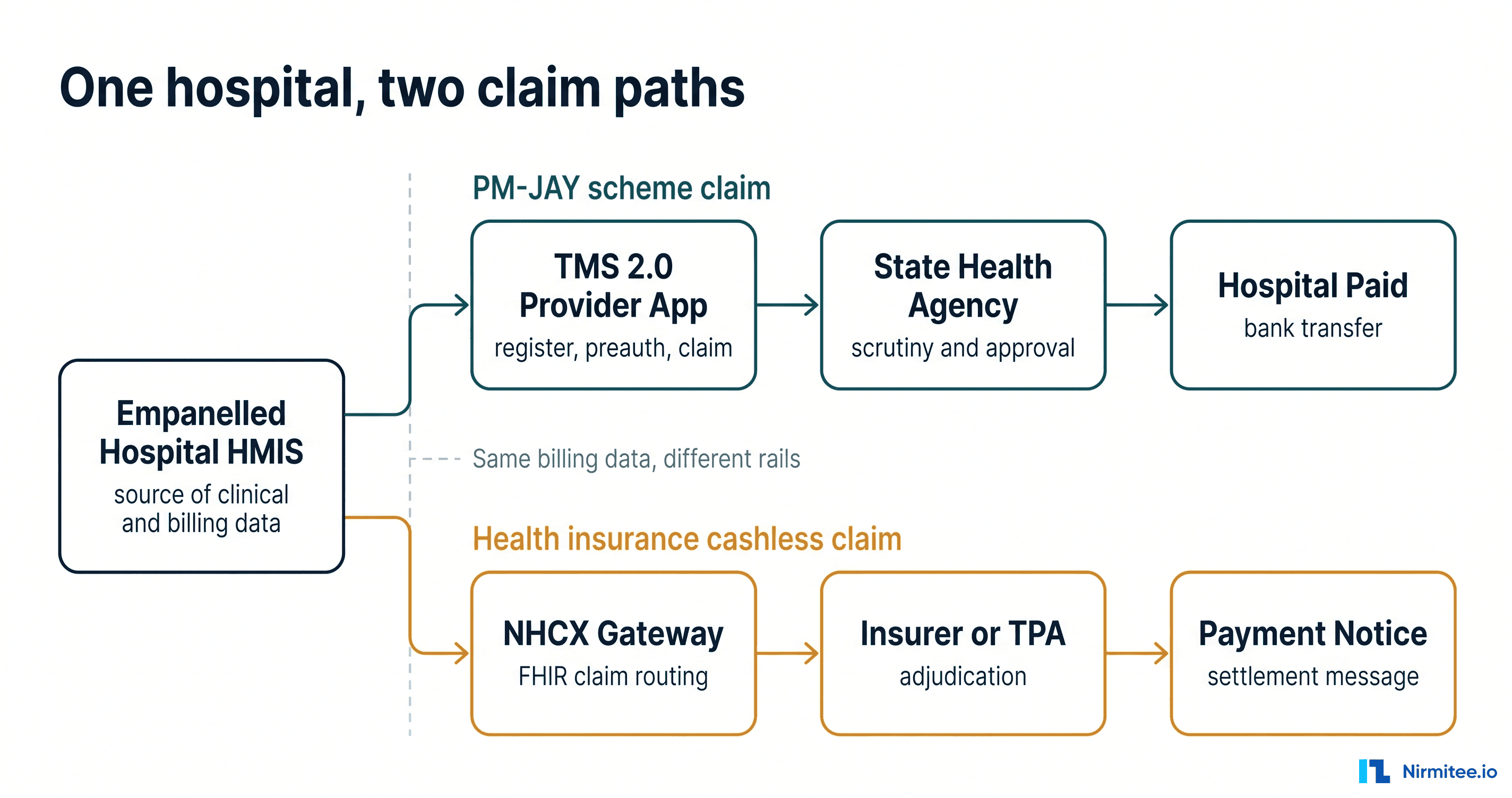
Eligibility, pre-auth and claims with every insurer through one connection.

Why it mattersThe same national rails, pointed at how quickly money reaches you.

M4 — listing your facility and doctors on the national registries — is optional, and we do it when it helps you. Everything is certified in the sandbox first, then promoted against your live system. Your existing HIS stays where it is.

Two ways to do it

Three Ways We Do It. You Pick.

Two questions: who writes the code, and how many applications need to end up certified.

Your team codes

Our SDK, our consultants

You keep the keyboard. Our consultants sit with your developers and stay on it until you're certified.

  • Roughly 50% less code for your team to write
  • Field mapping done with you, against your data model
  • We still run certification and the NHA calls
  • Your team owns it afterwards, properly
You have engineers free
We code

Our developers, in your codebase

Engineers who have shipped ABDM before write it inside your product. No separate system, no handover gap.

  • .NET and TypeScript, on ABDM V3
  • UI, consent screens and linking flows included
  • Your data never leaves your database
  • Full source handed over — you're never locked in
Your team is committed
Many apps

One gateway, every application

One central layer with shared mapping and consent screens. Certify it once; bring each application on after.

  • One certified integration, many applications
  • New schemes join by mapping, not re-certifying
  • One consent experience for the patient
  • Consent and token storage designed up front
States, groups and vendors

Fixed price agreed before we start, or a dedicated team by the month. Licensing is a one-time fee bundled with the consultancy — source code included, engineers with you until go-live. No per-transaction fee, nothing that grows as you do.

Timeline & cost

How Long Does ABDM Integration Take, and What Does It Cost?

The build is predictable. Everything around it isn't — certification queues and how many facilities you're rolling out move the date far more than the code does. Ranges from our own delivery.

Scope
Typical timeline
What actually drives it
ABHA onlyM1
~4–6 weeks
to certified
The fastest route to a defensible "yes" in a tender.
Share recordsM1 + M2
~8–12 weeks
to certified
Where most single-hospital programmes stop. Driven by how your data is structured today.
Full ABDMM1 + M2 + M3
~3–5 months
to certified
Adds consent management and exchange with other providers — more test cases, more review.
Vendor rolloutper facility
+ days to weeks
each, after the first
Design it multi-tenant once and each new hospital is onboarding, not a project.
NHCX claimsextension
~6–10 weeks
after ABDM is live
Depends on how clean your billing data is, and how much mapping it needs.
Keeping it liveannual
continuous
The specification changes. Budget for monitoring, updates and new facilities.

Planning ranges from projects we've delivered, not a quote. You get a fixed number after one scoping call, before you commit to anything.

1Sandbox2Internal demo3Functional & WASA4Security testing5NHA demo6Production keys

Six gates, and we run all six — including the NHA correspondence and any written exceptions your product needs.

Get a scoped estimate
Proof, not promises

What We've Already Shipped on ABDM.

Delivered work, not a capability slide.

HMIS vendor
Softronics

Hospital information system with live installs across multiple facilities. ABDM built inside the existing product and certified — without touching the clinical modules.

M1M2M3
Healthcare platform
Affex Healthcare

ABHA identity and consented record exchange delivered into a live healthcare platform.

M1M2
Product foundation
Nirmitee ABDM SDKs

Our own .NET and TypeScript SDKs for ABDM V3, maintained in production and reused across every client project.

.NETTypeScript
HMIS product vendor

Three milestones inside a live product, no rewrite

ABDM appeared in their customer contracts with a hard date. We delivered M1, M2 and M3 inside their existing application and covered every mandatory NHA test case — without touching the clinical modules their hospitals use daily.

60/60
mandatory test cases
0
clinical modules touched
Multi-tenant HIS

One ABDM layer, many hospitals

One tenant-aware ABDM layer behind separate identities and databases per hospital. Adding the next facility became a configuration step, not a delivery project.

1
shared ABDM layer
n
facilities onboarded
Engineering depth

We build and maintain our own ABDM SDKs

We maintain production ABDM V3 SDKs in .NET and TypeScript — milestone flows, encryption and FHIR bundles, under a real test suite. Your project starts on tested foundations, not a blank sandbox.

2
languages supported
296
automated tests
FAQ

ABDM, Answered.

The questions that come up before anyone signs anything.

What does ABDM actually get us commercially?
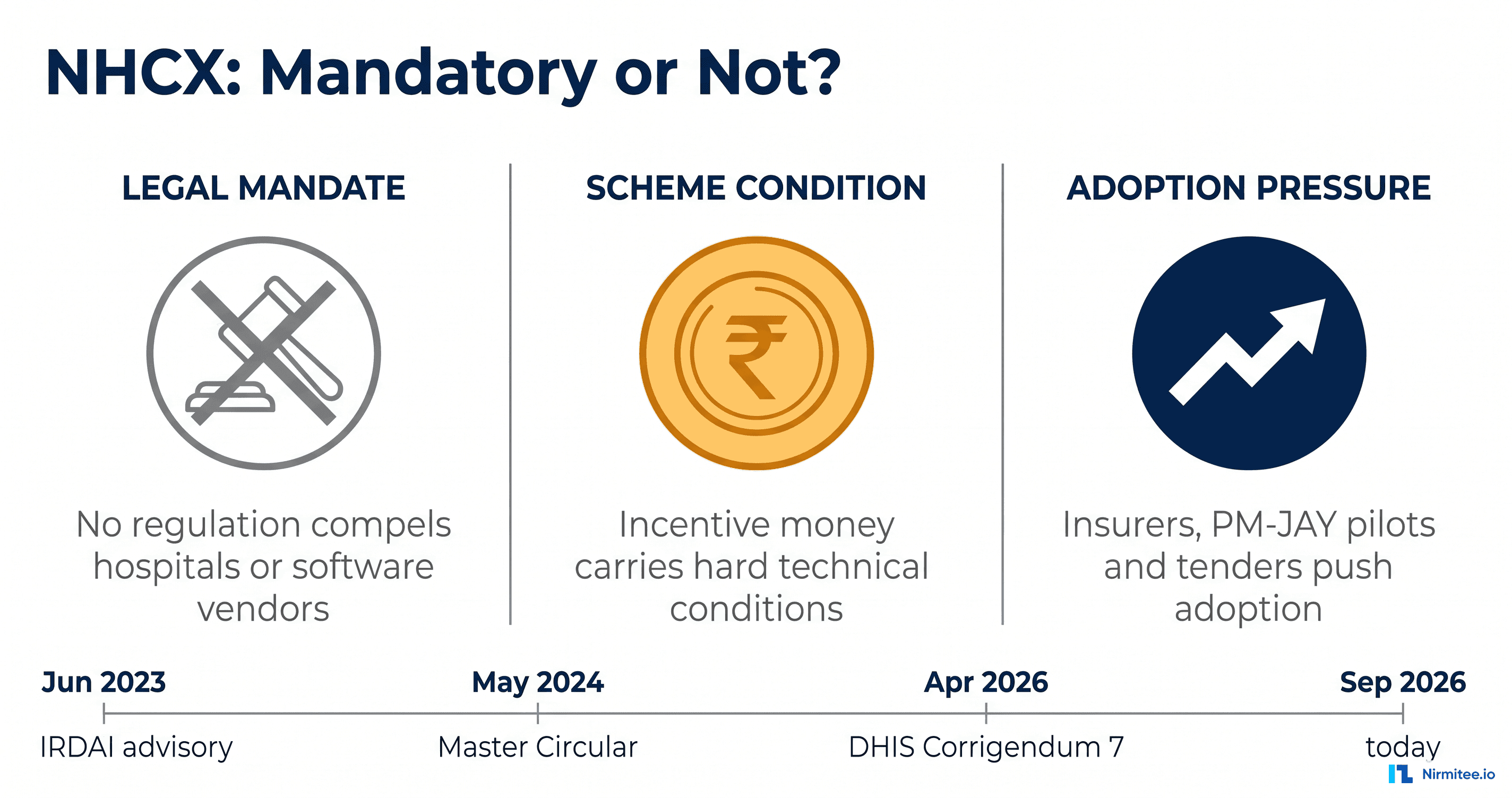
Three things, in the order people usually care about them. It answers the compliance question in tenders, empanelment paperwork and customer RFPs — often the reason the project exists at all. It makes records portable, which is what patients and referring providers notice. And through NHCX it extends to claims, which is where it starts affecting cash flow rather than just compliance. Digital-health incentive schemes have existed for ABDM-linked transactions; check the current terms before you count on them, and we'll tell you honestly what applies to you.
Do we have to replace our HIS or EHR?
No — and we'd push back if someone told you otherwise. ABDM is added alongside what you run today: new flows inside your existing application, and a small number of screens your staff already recognise. We've done this inside stacks a decade old. The clinical software people rely on every day does not get migrated to make ABDM work.
How long does ABDM certification take?
Roughly four to six weeks for M1 alone, eight to twelve for M1 and M2 together, and three to five months for all three — measured to certified, not to demo. Certification itself is six gates: sandbox registration, an internal demo with your team, functional and WASA testing, security testing, the final demo to NHA, and production keys. Expect several NHA touchpoints rather than one submission at the end. The variable that moves the date most isn't engineering — it's how quickly sandbox access is sorted at your end and how the review queue runs at the other. We sequence the work so both run alongside the build rather than after it.
What does it cost?
It depends on which milestones you need, how many systems are involved, and how much your own team keeps. We won't publish a number that turns out to be wrong for you — but you will get a fixed figure and a timeline after one scoping call, before you commit to anything. If the honest answer is that you should do it in-house, we'll say that too.
We run several applications. Do they each need their own certification?
Not if you design for it. Instead of putting our SDK into every application, we build one central ABDM gateway — a shared mapper and a common consent experience — and each application connects to that. You certify the gateway, then bring applications onto it by mapping their data. It's the right shape for a state department running multiple schemes, a hospital group with different systems per unit, or a vendor with more than one product line. We'll tell you on the call which of the two approaches fits, and we're happy to say "just use the SDK" when that's the honest answer.
What's the SDK licensing model, and do we get the source code?
A one-time licence fee, bundled with the consultancy — not a subscription, not a per-transaction charge, and nothing that grows as your volumes do. You get the full source code, and our engineers stay with your team until you're live rather than handing over a zip file and disappearing. The SDK runs inside your application: it does the ABDM work, writes to your database, and stores nothing on our side. If you later want to maintain it yourself, everything you need is already yours.

Tell Us Where ABDM Has Landed on Your Plate.

One call. We'll tell you which milestones you actually need, roughly how long it takes, and what it would cost — including if the answer is that you should do it in-house.

+1 (669) 649 0706
hello@nirmitee.io
India

Baner, Pune,
Maharashtra 411045

USA

Iselin,
NJ 08830

Reviewed by an integration engineer, not a sales queue. We never share your details.

Thanks — we've got it.

An engineer who has actually shipped ABDM will reach out within one business day.