Is NHCX Mandatory in 2026? What IRDAI and NHA Actually Require

CTO & Co-Founder
CTO & Co-Founder at Nirmitee.io. Architects healthcare integrations across FHIR, SMART on FHIR, ABDM and NHCX, writing from production experience taking hospital software from sandbox to go-live.
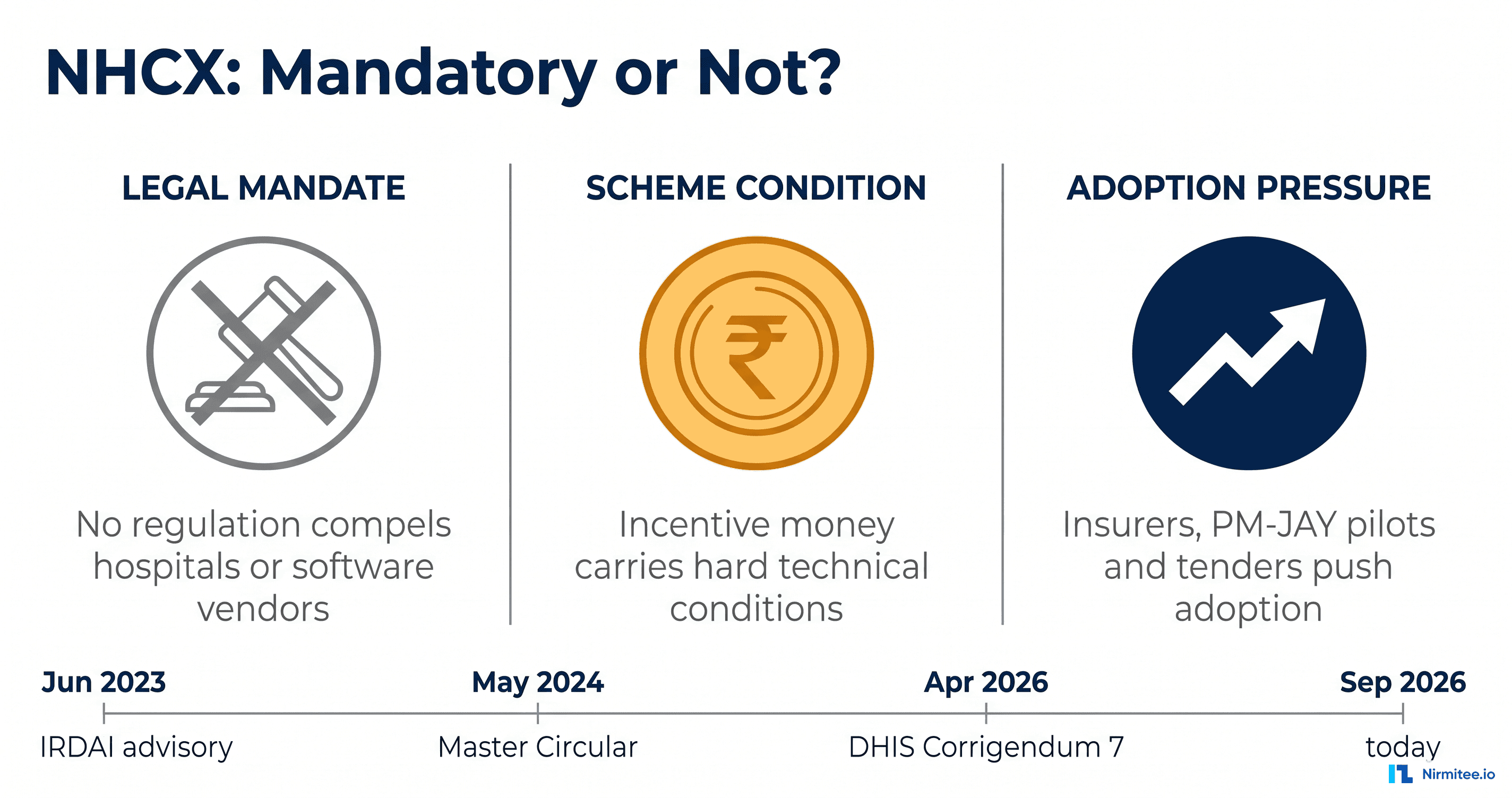
The short answer to is NHCX mandatory: no. As of September 2026 there is no law and no insurance regulation that compels an Indian hospital, or the software vendor serving it, to use the National Health Claims Exchange. The regulator's own language is advised and may endeavor to, and the circular that started all of this was addressed to insurers and TPAs, not to providers.
That is the accurate answer, and it is also the least useful one on its own. The binding obligations around NHCX exist, they are just not where people look for them. They sit in the conditions attached to government incentive money, in the ABDM API versions your product must be running by a fixed date, and in the questions hospital procurement teams now put in writing. This post separates those three things, cites each one, and then sets out what a hospital software vendor needs in place when customers start asking.
Nirmitee builds ABDM and NHCX integrations for hospital software products, and has run NHCX flows end to end against NHA's sandbox including eligibility, pre-authorisation, claim and payment notices. The vendor checklist further down is the one we work from.
Key takeaways
- No Indian law or IRDAI regulation makes NHCX mandatory for hospitals or for HMIS vendors. IRDAI's June 2023 circular advised insurers and TPAs to adopt NHCX specifications, and said insurers may onboard.
- The May 2024 Master Circular on Health Insurance Business asks insurers and the Insurance Councils to "endeavor to" onboard hospitals onto NHCX. That is a soft obligation, and it lands on insurers, not on providers.
- What is hard and dated is the money. NHA's DHIS Corrigendum 7 pays Rs 200 per AB PM-JAY claim filed in FHIR format through NHCX to the facility, and Rs 10 per claim to the software company whose product raised it, with conditions that will disqualify most vendors as written.
- From July 2026, under that same corrigendum, no DHIS incentive is payable to a facility or a software company unless the software is compliant with the v3 versions of ABDM milestones M1, M2 and M3.
- There is no NHCX certification programme. Readiness is self-attested, which is exactly why tender answers need care.
- Adoption pressure is real and concentrated: it lands first on AB PM-JAY empanelled hospitals with high cashless volume, and only slowly on OPD-heavy clinics.
Is NHCX mandatory for hospitals in 2026?
It is not. No statute, no IRDAI regulation and no NHA order that we could verify makes NHCX use compulsory for a hospital or a clinic. The strongest instruments in existence are an IRDAI circular that uses the word "advised", and a Master Circular clause that asks insurers to "endeavor to" bring providers on. Neither carries a penalty for a hospital that does nothing.
The founding document is IRDAI circular reference IRDAI/HLT/CIR/MISC/124/06/2023 dated 8 June 2023, Testing and adoption of Health Claims Exchange (HCX) Specifications and e-claim standards. It is addressed to "All Insurers (except ECGC, AIC) and TPAs". Clause 4 reads that "all Insurers and TPAs are hereby advised to test and adopt the National Health Claims Exchange (NHCX) specifications and its data profiles as part of e-claim standards". Clause 6 is softer still: "Insurers may on-board themselves to the National Health Claims Exchange platform as soon as possible. Insurers and TPAs may also get the healthcare providers in their network to join the National Health Claims Exchange platform at the earliest."
Read that clause 6 twice if you sell hospital software. The only route by which that circular reaches a hospital is an insurer asking its network to join. It creates a commercial request, not a regulatory duty.
The second instrument is IRDAI's Master Circular on Health Insurance Business dated 29 May 2024. Under the general principles chapter it says insurers along with the Insurance Councils "may endeavor to" do three things, the third being to "Onboard Hospitals and Health Care Providers on National Health Claims Exchange (NHCX) for faster payment/ settlement of claims". Again, the subject of the sentence is the insurer.
Government communications have been consistent with this. The Ministry of Health's July 2024 update on NHCX describes the exchange as "supported by" IRDAI and the General Insurance Council, and reports that as on 21.07.2024, 34 insurers and TPAs were live on NHCX with roughly 300 hospitals ramping up. A November 2023 release describes the NHA and IRDAI work as taking place "in the context of a circular issued by IRDAI in June 2023, whereby the insurance regulator had advised all insurers and providers to onboard the NHCX". Advised, in both cases.
One more thing to be clear about, because it shows up in tenders: there is no NHCX certification programme to point at. ABDM milestone integration has a sandbox and certification process. NHCX readiness itself is self-attested. Anyone selling you an "NHCX certificate" is selling you something that does not exist as a formal government credential.
Mandate, scheme condition, adoption pressure: how to tell them apart
Most of the confusion about NHCX comes from collapsing three different kinds of obligation into the single word "mandatory". They have different subjects, different consequences and different time horizons. Here is the separation that matters for a product roadmap.
| Type of obligation | Who it binds | Consequence of ignoring it | Does NHCX sit here? |
|---|---|---|---|
| Law or regulation | Everyone in scope | Regulatory action | No, not for hospitals or vendors |
| Regulator advisory | Insurers and TPAs | Nothing direct for a provider | Yes, IRDAI June 2023 and May 2024 |
| Scheme money condition | Facilities and software companies claiming incentives | You lose the payout | Yes, NHA's DHIS, with dated terms |
| Commercial pressure | Anyone selling software to hospitals | You lose the deal or the renewal | Yes, and it is the fastest moving of the four |
A vendor who answers a customer with "it is not mandatory" is technically right and commercially wrong. A vendor who answers "it is mandatory, here is our price" is overclaiming and will be caught. The useful answer names the row the customer is actually in.
What is actually binding: the DHIS conditions in force from April 2026
NHA's Digital Health Incentive Scheme is where NHCX stops being a suggestion. The scheme pays real money for NHCX claims, and it attaches technical conditions that disqualify a lot of software. Those conditions are the closest thing to a mandate that a hospital software vendor faces today, and they carry dates.
The current instrument is Corrigendum 7 to the Digital Health Incentive Scheme, issued by NHA on 9 April 2026 and effective from April 2026 to September 2026. The NHCX-specific terms are these.
| Condition in DHIS Corrigendum 7 | What it means for a vendor |
|---|---|
| Rs 200 per claim, or 10% of the claim amount, whichever is lower, to the health facility | Only for AB PM-JAY claims linked to an ABHA address and filed in FHIR format through NHCX. Ordinary retail insurance claims do not earn this. |
| Rs 10 per claim to the Digital Solution Company whose software raised the claim | The vendor is a named beneficiary. This is a direct revenue line for an HMIS product, not just a customer benefit. |
| Maximum Rs 1 crore in this category for a facility, and Rs 1 crore for a software company | Caps the upside. Useful for sizing, fatal for a business case built on volume alone. |
| A valid WASA report is mandatory for a software company to receive any DHIS incentive | Transactions before a valid report are not eligible whatever the claim date, and payment starts only from the month after the report is furnished. |
| From July 2026, incentives are disbursed only if the software is fully compliant with the v3 versions of M1, M2 and M3 | A product still on older ABDM API versions earns its customers nothing, and earns itself nothing. |
| Effective window is April 2026 to September 2026, subject to availability of funds | The terms are revised by corrigendum, repeatedly. Treat the current rate as a snapshot. |
That last row deserves emphasis. The immediately preceding Corrigendum 6, which ran from November 2025 to March 2026, paid Rs 500 per NHCX claim to the facility and nothing at all to the software company. Corrigendum 7 cut the facility rate to Rs 200 and introduced the Rs 10 vendor share. Seven corrigenda have been issued since the scheme launched on 1 January 2023, with the previous six dated 16 March 2023, 29 July 2023, 13 December 2023, 11 June 2024, 19 February 2025 and 20 November 2025. Current terms are always on the NHA DHIS page.
The honest reading: build NHCX because your customers need it, and treat DHIS as a timing argument that helps you close the deal. Do not build a revenue model on a rate that has changed seven times in three and a half years.
Why NHCX is effectively unavoidable for some hospitals and not for others
Adoption pressure is not spread evenly. It concentrates where cashless claim volume, scheme participation and insurer relationships overlap. A 400-bed PM-JAY empanelled hospital with a busy cashless desk and a 12-chair dental clinic face the same regulatory position and completely different practical ones.
| Hospital segment | What is pushing them | Practical urgency |
|---|---|---|
| AB PM-JAY empanelled, high claim volume | Per-claim incentive applies only to PM-JAY claims through NHCX; NHA is running early integrator programmes | High, and it is the segment NHA is actively recruiting |
| Large private chains with cashless desks | Insurer and TPA network requests, plus NHCX questions appearing in RFPs | High, driven by procurement rather than regulation |
| Mid size private hospitals | They follow the insurers and TPAs they depend on for cashless volume | Medium, typically a next-renewal conversation |
| Single specialty and day care centres | Lower claim counts mean a longer payback on integration effort | Low to medium |
| OPD-only clinics and small practices | Little cashless claim activity to move | Low |
Two official signals are worth watching if you are timing a roadmap. First, the direction of travel on the payer side is settled: 34 insurers and TPAs were already live in July 2024, so the counterparties exist. Second, PM-JAY itself is moving onto the exchange. At the NHCX Innovation Meet at IIT Hyderabad on 6 and 7 March 2026, NHA felicitated a first cohort of NHCX-PMJAY Early Integrators, described as organisations that "have successfully built modules enabling PM-JAY claims to be submitted through NHCX". Early integrators, not universal rollout, which is the correct way to read it.
For scale context, the Ministry of Health's year end review published in January 2026 records 83.94 crore ABHA numbers created and roughly 4,42,000 health facilities registered under ABDM as on 12 December 2025, and lists NHCX as one of ABDM's three gateways alongside the consent manager and the Unified Health Interface. The identity layer that NHCX claims depend on is already in place at national scale.
What a vendor needs in place when customers start asking
If your hospital customers begin demanding NHCX, the work splits cleanly into a foundation layer you probably owe them anyway and a claims layer that is genuinely new. The foundation is where most schedules slip, because it is invisible in a demo.
- ABDM Milestone 1 in production. Every NHCX claim is anchored to the patient's ABHA identity. NHA's own account of the November 2023 workshops describes M1 integration, which lets software create and verify ABHA, as "an essential step to complete NHCX integration". If you do not have M1, that is step one, not step zero. The full milestone picture is in our ABDM M1 to M4 implementation guide.
- ABDM v3 APIs across M1, M2 and M3. Not optional if any customer wants DHIS money after July 2026. Budget this as a migration, not a patch.
- A current WASA report. It expires. Corrigendum 7 makes incentive eligibility start only from the month after a valid report is furnished, so a lapsed report costs your customers money and they will notice.
- Facility and practitioner identity. HFR registration for the facility, and HPR IDs for the clinicians whose names appear on claims. We cover why the practitioner side bites late in HPR ID requirements for NHCX.
- Claim bundles in FHIR. Your billing tables have to become standards-conformant claim structures. This is a data modelling job, not a serialisation job.
- Procedure and package mapping. Internal charge codes have to line up with the insurer's package structures, and this is where claim rejections come from. See mapping procedures to insurance packages.
- Asynchronous callback handling. Insurer responses arrive later, separately, and must be matched back to the right claim. Architecture options are compared in NHCX asynchronous callbacks, and the on-premise deployment problem in callback URLs for on-premise HMIS.
- Eligibility and pre-authorisation in the clinical workflow. The value to the hospital is knowing the patient payable before admission, which is a front-desk screen, not a back-office report. See getting the patient payable amount right.
- Reconciliation of payment notices. Claims are only useful if settlement can be matched back to the original submission and to the hospital's receivables.
- A production onboarding path. Sandbox success is not production access. The sequence, approvals and artefacts are set out in our sandbox to production onboarding checklist.
Two further reads if you are scoping rather than building: which HMIS modules NHCX actually touches tells you what changes in registration, billing and MIS, and adding claims to an existing HMIS without a rewrite covers the architecture. The failure patterns are catalogued in 10 common NHCX integration mistakes.
How to answer "are you NHCX compliant" in a tender
Because there is no certification to cite, the question is really asking three separate things, and the safe answer addresses each one plainly rather than saying yes.
- Which ABDM milestones are certified and on which API version. This one has a documented answer. Give the milestone, the version and the date.
- Which NHCX flows the product supports today. Name them individually: eligibility, pre-authorisation, claim, communication, payment notice. Partial support is a normal answer. Claiming all five when three are built is the mistake that ends badly at go-live.
- Whether it is in production with a live payer, or sandbox-proven. Say which. "Sandbox-proven, production onboarding pending" is a credible position. "Compliant" with no qualifier invites a question you cannot answer.
For a hospital board asking the same question from the other side, our NHCX guide for hospital leaders covers what to expect from a vendor and what to put in the contract. The commercial framing for vendors is in NHCX for HMIS vendors.
What would change the answer
Three things would move NHCX from strongly encouraged to genuinely compulsory, and each is observable. Watch for them rather than guessing.
- IRDAI converting advisory language into a regulation. The instruments to date use "advised" and "may endeavor to". A regulation or a master circular clause using "shall" would be a clean change of state, and IRDAI publishes both.
- The next DHIS corrigendum. Corrigendum 7 runs to September 2026. Whatever replaces it will reset the per-claim rate, the caps and the technical preconditions. Read it on issue rather than relying on a summary.
- PM-JAY claims moving from early integrators to default. NHA recognised its first NHCX-PMJAY early integrator cohort in March 2026. The step after a first cohort is a wider rollout, and that is the change that would reach tens of thousands of empanelled hospitals at once.
Until then, the accurate position is the one to hold: NHCX is not mandatory in law for hospitals or their software vendors, the incentive money that surrounds it carries hard technical conditions with dates already passed or approaching, and the commercial pressure is arriving through insurers and procurement teams rather than through the regulator. That is a case for building deliberately, not urgently, and for being precise about what your product does.
Nirmitee builds NHCX and ABDM integrations for hospital software products, from M1 through claims. Explore our healthcare interoperability services to see how we approach health data exchange, and our healthcare software product engineering practice for the platform work around it. Talk to our team about your NHCX roadmap.
Ready to scale?
Talk to our healthcare engineering team about building, integrating, and shipping faster.
Frequently Asked Questions
Is NHCX mandatory for hospitals in India?
Is NHCX mandatory for HMIS and hospital software vendors?
What does IRDAI actually say about NHCX?
Is there an NHCX certification a vendor can obtain?
How much does a hospital earn per NHCX claim?
Does NHCX apply to ordinary retail health insurance claims or only PM-JAY?
What is the first thing to build if our customers start demanding NHCX?