PMJAY Claim Process 2026: TMS 2.0 vs NHCX for Hospital Software

CTO & Co-Founder
CTO & Co-Founder at Nirmitee.io. Architects healthcare integrations across FHIR, SMART on FHIR, ABDM and NHCX, writing from production experience taking hospital software from sandbox to go-live.
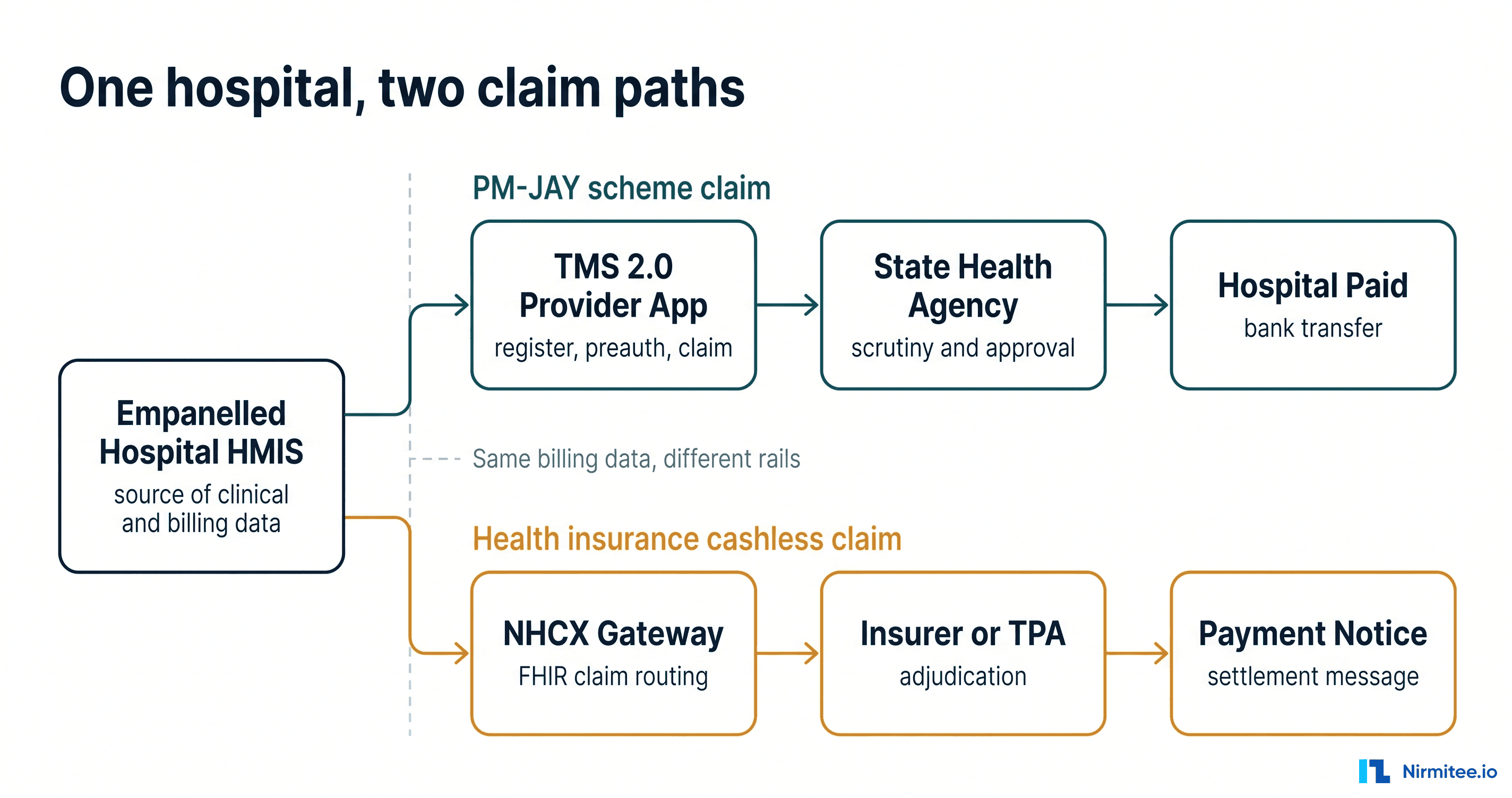
A PMJAY claim today is raised inside the Transaction Management System, NHA's own web application for empanelled hospitals, and not over NHCX. The current provider-facing release is TMS 2.0, whose Provider Application User Manual reached version 12.0 dated 10 January 2025. NHCX, the National Health Claims Exchange, is live and carrying health insurance claims between hospitals, insurers and TPAs. For hospital software vendors the practical position is that the two run alongside each other, and a product selling into PMJAY-empanelled hospitals has to be honest about which of the two it actually touches.
Key takeaways
- The PMJAY claim process runs through TMS 2.0: beneficiary identification, registration, pre-authorization, treatment and discharge, then claim submission after discharge.
- Payer-side scrutiny is a chain of human desks, not a single decision, and each hop has a published turnaround time.
- NHCX is live and supported by IRDAI for health insurance claims. PIB's July 2024 update reported 34 insurers and TPAs live on NHCX and around 300 hospitals ramping up.
- NHA's own TMS 2.0 manual states that the crux of the PM-JAY 2.0 solution lies in NHCX routing requests from provider to payer and back. That is the documented direction, stated in a scheme document.
- No official source we could fetch says PMJAY claims have moved to NHCX in production. Treat TMS and NHCX as coexisting, and build for both.
- The expensive mistake is building two claim modules. Build one claim core and two thin adapters.
How does the PMJAY claim process work today?
The PMJAY claim process is a six stage sequence inside TMS 2.0, and every stage is gated by the one before it. A hospital cannot submit a claim for a case that was never pre-authorized, and cannot pre-authorize a patient who was never registered. The sequence below is taken from NHA's TMS Provider Application User Manual for PM-JAY 2.0.
Stage by stage, this is what the hospital staff member is actually doing:
- Beneficiary identification. Staff search for the beneficiary using Ayushman ID, mobile number or ABHA number, then verify identity through Aadhaar fingerprint, iris or face authentication. Where verification fails, the manual allows a documented path to proceed without Aadhaar authentication, with a Medical Superintendent declaration and consent form.
- Registration. The case is registered as inpatient or outpatient by the Pradhan Mantri Arogya Mithra or the Medical Coordinator, known as Medco. Registration can be cancelled only while no pre-authorization exists on the case.
- Pre-authorization. Medical information, admission information, diagnosis, treatment plan, investigations, care team and finance details are captured, then the request is submitted. It lands with the Pre-authorization Processing Doctor at the payer end, unless the selected procedure is an auto-approved one, in which case the case moves straight to under treatment.
- Treatment and discharge. Discharge type is recorded as live, normal, LAMA, DAMA or death, each with its own mandatory evidence set: surgery date, post surgery photograph with the doctor or Arogya Mithra, discharge summary, feedback form, and in death cases a death certificate and mortality audit report.
- Claim submission. Only after discharge. The hospital verifies the finance section, enters the hospital bill number and date, and uploads the bill, post-operative investigations and supporting documents.
- Payment. Released after the payer-side chain approves, through the bank, following PFMS guidelines, per NHA's Claims Adjudication Manual 2.0.
Two pricing rules matter to anyone writing the billing logic. Packages are all-inclusive for the episode, covering registration, bed, diagnostics, medicines, food, and post-hospitalization follow-up for a defined window. And where multiple procedures are booked on one case, the manual sets the split at 100 percent for the highest procedure, 50 percent for the second and 25 percent for subsequent ones. If your product shows the hospital a bill total that ignores that taper, your users will find out at claim time.
Who decides on a PMJAY claim, and how long do they have?
A submitted PMJAY claim does not meet one adjudicator. It moves through a queue of named roles on the payer side, and any one of them can send it back. NHA's Claims Adjudication Manual describes the chain as Claims Executive, then Claims Processing Doctor, then Accounts Officer, then State Health Agency.
The Claims Executive checks the non-technical side: names, ages, mandatory documents, hospitalization photographs, discharge summary. The Claims Processing Doctor reviews on merit and may approve, raise a query, seek a second opinion, send the case for investigation, or reject. Rejected claims move to the State Health Agency bucket, which can revoke the rejection and send the case back to the doctor. Hospitals may appeal a rejection with the District Grievance Nodal Officer within 15 days.
The turnaround times below come from the same manual, and they are the reason a queue and a reminder engine belong in your product rather than in someone's spreadsheet. Note that private and public empanelled hospitals run on different clocks.
| Step | Private empanelled hospital | Public empanelled hospital |
|---|---|---|
| Pre-authorization initiation after registration | 48 hours, auto rejection after that | 72 hours, auto rejection after that |
| Pre-authorization decision | 6 working hours, auto approval after that, per the threshold set in TMS | |
| Response to a pre-auth doctor query | 24 hours, auto reject after 72 hours | Not later than 5 days, auto reject after 5 days |
| Claim submission after discharge | 7 days, up to 21 days with SHA approval, up to 45 days with CEO SHA approval, beyond 45 days not admissible | 15 days, up to 30 days with SHA approval, up to 60 days with CEO SHA approval, beyond 60 days not admissible |
| Response to a claim doctor query | 7 days, auto reject after that | 15 days, auto reject after that |
| Claim payment | 15 days within the state, 30 days for inter-state portability | |
Read the claim submission row again. For a private hospital, a claim that sits undrafted for eight days after discharge has already left the normal lane and needs a State Health Agency reconsideration with a written reason. That is a product problem, not a hospital discipline problem, and it is the single highest-value feature most PMJAY-facing products are missing.
Where does NHCX sit for PMJAY right now?
NHCX is a gateway built by NHA under ABDM that routes claim messages between providers and payers in a standard format. It is live. A PIB release of 26 July 2024 recorded 34 insurers and TPAs live on NHCX with around 300 hospitals ramping up to send claims. Adoption on the payer side followed an IRDAI circular of June 2023 advising all insurers and providers to onboard, as described in PIB's account of the NHA and IRDAI accelerator workshops.
The PMJAY connection is real but it is stated as design intent, not as a completed migration. Three official statements are worth reading carefully:
- The NRCES FHIR Implementation Guide for ABDM opens its NHCX section with this: to support the vision of Pradhan Mantri Jan Arogya Yojana, NHA has created a standardized health claim platform based on the Health Claim Exchange specification. The same page says the initial version is focused on the cashless claims process.
- NHA's own TMS 2.0 Provider manual, under Purpose, says the crux of the solution lies in NHCX, which will route the request from provider to payer and back. Future tense, in a live scheme manual.
- NHA's NHCX brochure describes a common claim standard format using FHIR objects to be used across government and private health claims, and lists government payers alongside insurance companies.
What we could not find in any official source fetched for this article is a statement that PMJAY claims are being submitted over NHCX in production today. So the accurate position for a vendor is this: PMJAY claims are raised in TMS, NHCX carries insurance claims, the two coexist, and NHA's documentation points at convergence without publishing a switch date. If a competitor tells your customer that PMJAY has moved to NHCX, ask them for the circular. If you want the background on the exchange itself rather than its relationship to PMJAY, our explainer for hospital leaders covers it, and the ABDM milestones guide places the claims milestone in the wider ABDM sequence.
NHCX versus TMS: the differences that reach your code
From a product perspective the two routes differ in entry point, identity, pricing basis, message format and response style. Those five differences decide how much of your existing claims code can be reused. The comparison below is what we work from when scoping this for a hospital software product.
| Dimension | PMJAY through TMS | Insurance through NHCX |
|---|---|---|
| How data gets in | Hospital staff log into the TMS Provider application and key it in | Your product sends messages to the gateway over APIs |
| Identity | Ayushman ID, mobile or ABHA, with Aadhaar biometric or OTP verification | Policy details and ABHA, without the Aadhaar biometric step |
| What is priced | State health benefit package rate, with the multiple-procedure taper | Insurer policy terms, tariffs and exclusions |
| Message format | Portal form fields and document uploads | FHIR R4 bundles: ClaimBundle, CoverageEligibilityRequestBundle and their response counterparts |
| How answers arrive | Status changes on the TMS dashboard, checked by a human | Asynchronous callbacks to an endpoint your product exposes |
| Who pays | State Health Agency, directly or through its insurer | Insurer or TPA |
| Timers | Published turnaround times with auto-approval and auto-rejection | Set by insurer process and policy terms |
The callback row is the one that breaks schedules. On the TMS side a human refreshes a dashboard. On the NHCX side your product must receive a message it did not ask for, at a time it did not choose, and match it to the right claim. If your HMIS is deployed on-premise inside hospital networks, that requirement reaches into the deployment model, not just the codebase. We have written that up separately in the asynchronous callback architecture for an HMIS and callback URL options for on-premise deployments.
What your product must support if you serve PMJAY hospitals
A hospital-software product serving PMJAY-empanelled hospitals needs nine capabilities. Six of them are TMS-shaped and exist whether or not NHCX ever touches the scheme. Three are NHCX-shaped and are the part you can build once and reuse.
- Scheme flag on the encounter. Decide at admission whether this episode is a PMJAY case, a cashless insurance case, a hybrid where liability is shared, or self-pay. Everything downstream branches off that one field, and retrofitting it later is painful.
- Package and procedure mapping. Map your internal procedure and charge codes to the state health benefit package list, and keep the mapping versioned because state package lists change. The same discipline is what NHCX needs on the insurance side, which we cover in procedure to insurance package mapping.
- Claim-clock timers. A visible countdown from discharge to the claim submission deadline, with escalation before the 7 day or 15 day mark. Also timers on pre-auth initiation after registration and on responses to payer queries.
- Evidence capture at the point of care. Discharge summary, post surgery photograph, feedback form, death documentation where applicable. These are mandatory in TMS and are the most common cause of a returned claim. Capture them in the clinical workflow, not in a claims clerk's rework queue.
- Query inbox. Payer queries arrive against a specific case and expire. Route them to a named owner in the hospital with the case context attached.
- Reconciliation ledger. Claim submitted, amount claimed, amount approved, amount paid, and the difference with a reason. Hospitals run on this and most products do not provide it.
- ABDM Milestone 1 capability. Creating and verifying ABHA is the prerequisite gate on the NHCX path. PIB's account of the NHA and IRDAI workshops records that the hospital systems present completed M1 integration as the essential step before NHCX integration.
- FHIR claim construction. Build ClaimBundle and CoverageEligibilityRequestBundle structures from your billing data, per the NRCES profiles, rather than hand-rolling JSON per insurer.
- Signed and encrypted envelopes with a callback receiver. Messages are sealed for a specific recipient using participant registry keys, and answers arrive asynchronously. This is the layer that must work before anything else does. Our NHCX onboarding checklist walks the path from sandbox to production.
The architectural point is in the diagram above. Items 1 through 6 belong in a shared claim core that knows nothing about either destination. Items 7 through 9 belong in an NHCX adapter. The TMS side gets a thin adapter of its own, mostly task queues and data capture. Vendors who instead bolt a separate NHCX module onto an existing PMJAY module end up maintaining two encounter models, two document stores and two reconciliation reports.
Four failure modes we see in PMJAY-facing products
These are the specific ways teams lose quarters on this work.
- Treating the claim as a billing export. A PMJAY claim is a case file with a clinical narrative, photographs and consent artefacts attached. Products that model it as an invoice with a PDF attachment fail the Claims Executive check and never learn why, because the rejection reason arrives as free text into a shared mailbox.
- Ignoring the auto-rejection clocks. Auto rejection after 48 or 72 hours on pre-auth initiation, and auto rejection on unanswered payer queries, both happen silently from the hospital's point of view. A product without timers converts these into pure revenue loss for the customer.
- Assuming NHCX replaces the TMS work. It does not, not today, and a roadmap that defers PMJAY workflow improvements until NHCX arrives leaves the customer's actual revenue path untouched for a year.
- Promising certification. There is no formal NHCX certification programme. Readiness is self-attested against the specifications. Selling a certificate that does not exist is a short-lived advantage. The commercial framing that does hold up is set out in our business guide for HMIS vendors, and the scope question of which modules are affected is covered in which HMIS modules NHCX affects.
How to sequence the work
If your customers are PMJAY-empanelled hospitals and you have not started, the order that wastes least engineering time is this. First, fix the TMS-side operational gaps: clocks, evidence capture, query inbox, reconciliation. These pay back immediately, are independent of NHCX, and require no onboarding with anyone. Second, complete ABDM Milestone 1 so ABHA creation and verification work in your product, because it gates everything after it. Third, build the shared claim core and refactor the PMJAY path onto it. Fourth, add the NHCX adapter and run it against the sandbox, starting with coverage eligibility, which is the lowest risk flow to get right and the one hospitals feel first at the counter. We have walked that flow in detail in the coverage eligibility check.
One more commercial note that is easy to miss. NHA's Digital Health Incentive Scheme provides, for every insurance claim transaction through NHCX, an incentive of Rs 500 per claim or 10 percent of the claim amount, whichever is lower, for hospitals. The operational guidelines for the scheme set out eligibility and registration. That is a real reason for a hospital to prefer software that supports the exchange, and a reason worth putting in front of your customer rather than burying in a release note.
Nirmitee builds ABDM and NHCX integrations for hospital software products, and has run NHCX flows end to end against NHA's sandbox, including pre-auth, claim and payment notices. If you are scoping this for a product that already serves PMJAY hospitals, our healthcare interoperability team can review your claim model before you commit to an architecture, and our healthcare software product development practice can help stage the refactor. Talk to our team to start that conversation.
Ready to scale?
Talk to our healthcare engineering team about building, integrating, and shipping faster.
Frequently Asked Questions
What is the PMJAY claim process step by step?
Have Ayushman Bharat PMJAY claims moved to NHCX?
What is TMS 2.0 in PMJAY?
How long does a PMJAY claim take to be paid?
What is the difference between NHCX and TMS for a hospital software vendor?
Is NHCX mandatory for hospitals and their software?
What must an HMIS support to serve PMJAY-empanelled hospitals?