NHCX for HMIS Vendors: The Complete Readiness Guide

CTO & Co-Founder
CTO & Co-Founder at Nirmitee.io. Architects healthcare integrations across FHIR, SMART on FHIR, ABDM and NHCX, writing from production experience taking hospital software from sandbox to go-live.
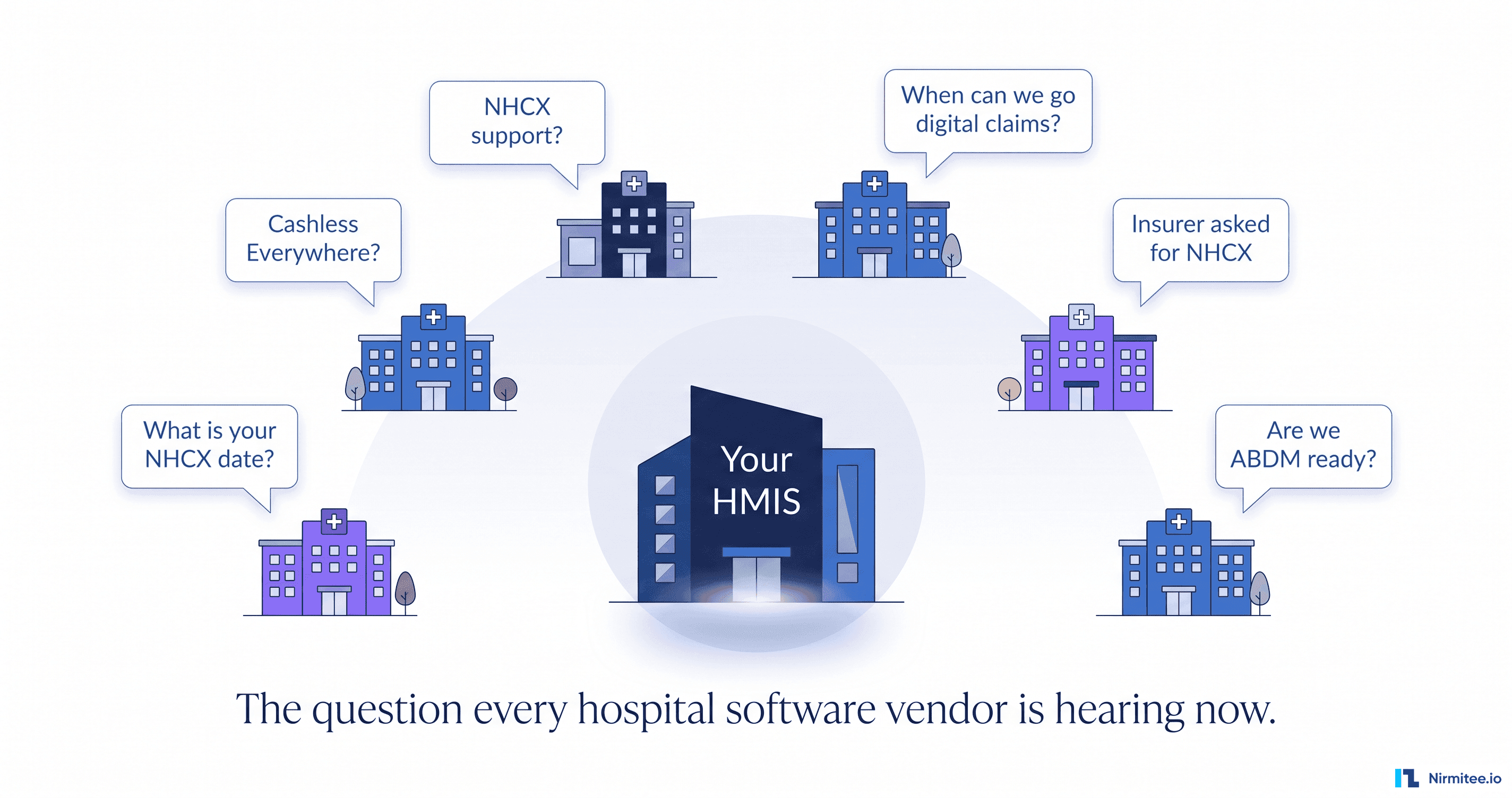
Hospital software vendors in India are about to face a standard question in every renewal and every sales conversation: does your product support NHCX? The payer side of the National Health Claims Exchange is already built out — IRDAI directed adoption in June 2023, and by mid-2024 insurers and TPAs covering nearly the whole retail market were connected. Provider-side adoption is the next phase. Hospitals can only participate through their software, and government incentives for digital claims are accelerating the demand.
Whether and how to support NHCX is a business decision with real consequences on both sides: a working "yes" protects renewals and wins deals; building it carelessly consumes quarters of engineering time. This guide covers what the work actually is, the prerequisite most vendors miss, what certification involves, where projects go wrong, and how to decide between building and partnering.
What your product must actually do
Supporting NHCX means your HMIS handles the full claim lifecycle as digital message exchanges with the insurer, through the national gateway:
- Coverage eligibility check — confirm the patient's policy is active and the treatment covered, before admission.
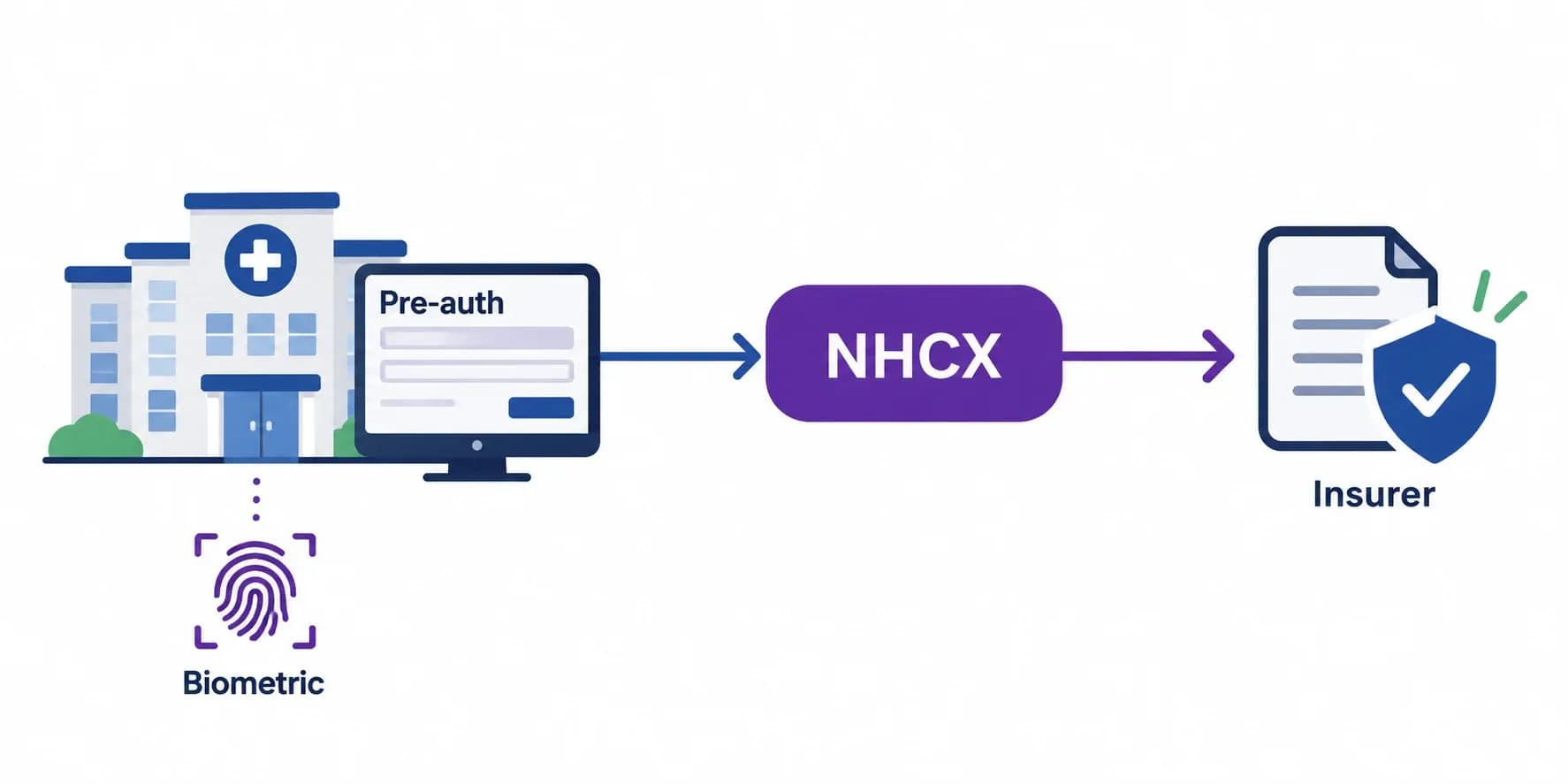
- Pre-authorization — send the estimated cost and treatment plan; receive approval, query, or partial approval before treatment.
- Claim submission — send the final structured bill: diagnoses, procedures, itemized charges, supporting documents.
- Settlement tracking — receive and reconcile payment confirmations against submitted claims.
- Communications — handle the insurer's mid-claim requests for additional documents, tied to the original claim.
Every one of these is a two-part exchange: your system sends a request to the gateway, and the insurer's answer arrives later as a separate digital callback to your system. Your product must be able to receive those callbacks, match them to the right claim, and act on them. This asynchronous pattern — not the individual messages — is what makes the integration genuinely different from calling a typical API.
This applies whether your product is on-premise ASP.NET or cloud-hosted SaaS — the flows are identical; only the callback architecture differs, and both are solved problems.
Two more format realities, stated plainly:
- Claims are FHIR-based. The exchange uses the same national FHIR standards family (published by NRCES) that ABDM health records use. Your billing data must be transformed into standardized claim structures — including mapping your internal charge codes and diagnosis entries to the standard code sets the exchange requires.
- Messages are signed and encrypted. Every message travels in a sealed digital envelope, encrypted for the specific receiving insurer using keys from the exchange's participant registry. Getting this layer right is a precondition for anything else working.
The prerequisite most vendors miss: ABDM Milestone 1
Every claim on NHCX is anchored to the patient's ABHA identity. Before your product can transact a single claim, it must already create, verify, and link ABHA numbers — ABDM Milestone 1. No M1, no claims. If your product hasn't completed M1, that is step one of any NHCX roadmap, and it has its own sandbox process and certification.
A related correction, because the market repeats it: NHCX is not "ABDM Milestone 4." It is a separate program with its own onboarding, its own sandbox, its own standards, and its own certification track. Completing ABDM milestones makes you eligible to start NHCX work; it does not make you NHCX-ready.
So the full path, in order:
- HFR / registry footing — your hospital customers need facility IDs; your product should handle facility identity cleanly.
- ABDM Milestone 1 — ABHA creation, verification, linking, certified through the ABDM sandbox.
- NHCX participant onboarding — register as a participant on the exchange, get sandbox credentials and encryption keys provisioned.
- Sandbox integration — build and test the claim flows against the exchange's test environment.
- Certification — clear the official test scenarios (functional verification of each claim flow, similar in shape to ABDM milestone audits).
- Production — production participant identity and keys; go-live hospital by hospital, each with its own HFR ID.
Where projects actually go wrong
These are the failure points we see in national health-stack integrations — worth budgeting for regardless of who builds:
- The callback problem. Insurer responses arrive as separate incoming messages to your system. Products deployed on hospital premises or private networks have no public endpoint to receive them — solving this (usually with a relay/bridge component) is an architecture decision, not a code detail.
- Correlation bugs. Every response must be matched to its originating request by identifiers that must be handled exactly right. Correlation mistakes fail silently: nothing errors, responses simply never arrive, and debugging burns weeks.
- Code mapping. Internal charge masters and free-text diagnoses must map to the standard code sets the exchange requires. This is unglamorous work, it is per-customer work, and it is usually underestimated by the largest margin.
- Key and certificate management. Encryption keys, signing, and registry lookups must work across sandbox and production, per participant. Teams treat this as a one-time setup; it is an operational discipline.
- Certification rework. Teams that build to the spec document without studying the certification scenarios typically discover gaps at testing time and lose cycles to rework.
None of this is beyond a good engineering team. But it is specialist work — healthcare data standards, secure message exchange, national-sandbox certification — and acquiring those skills from scratch typically costs two to three quarters of senior engineering time that would otherwise go to your product.
Build versus partner: an economics question
Build in-house when: claims exchange will be a core differentiator of your product; you have senior engineers you can commit through the learning curve and certification; and you intend to reuse the capability across many customers as owned IP.
Partner when: your differentiator lies elsewhere and claims support simply needs to exist — certified, on a predictable timeline — while your team stays on your roadmap. A partner who has already walked the sandbox-to-certification path removes the trial-and-error, which is where most of the calendar time goes.
A realistic timeline either way: with ABDM M1 already live and experienced hands on the claims work, sandbox integration through certification is a matter of months. Starting from zero — standards learning, M1 first, then claims — is a multi-quarter program. The difference between those two paths is the cost of the learning curve, and it is the main thing you are buying when you partner.
Whichever you choose, insist on reusable foundations: ABDM identity work and NHCX claims work share the same underlying standards family. Work done once should serve both — and should serve every hospital you deploy, not one.
The build decision in numbers
Illustrative economics for a mid-size HMIS vendor (your salary bands will vary):
| Build in-house | With a partner | |
|---|---|---|
| Team | 2–3 senior engineers, pulled from your roadmap | Your team stays on your product |
| Calendar | 6–9 months including learning curve and certification retries | Months, on a committed timeline |
| Payroll consumed | ₹40–80 lakh before the first certified claim | A defined engagement, a fraction of that |
| Roadmap cost | Two to three quarters of features not shipped | None |
| What you own after | Code only your team understands | Maintained components + the knowledge transfer |
"We'll wait until it's mandatory" is the expensive option. The demand is arriving through evaluations, not regulation: "NHCX-ready" is entering HMIS comparison checklists now, hospitals are asking for dates now, and the vendors who can demonstrate certified capability — not a roadmap slide — are taking those deals now. By the time it is mandatory, it is table stakes and the differentiation window is gone.
The commercial upside for vendors
NHCX support is not only a defensive checkbox. Hospitals earn incentives on fully digital claims under the government's Digital Health Incentive Scheme, discharge and settlement improvements are directly visible to hospital owners, and "NHCX-ready" is becoming a line item on HMIS evaluation checklists. And every hospital that adopts through your product deepens the relationship your renewals stand on.
The questions vendors ask us before partnering
"Who owns the code?" You do. The adapter integrates into your product and you own the source. We are not building a dependency; we are building your capability — with documented handover as a deliverable, not an afterthought.
"Our product is ASP.NET, on-premise. Does that work?" Yes — that is the market we come from. The claims adapter ships as a native .NET component for ASP.NET products (Java and Node equivalents for other stacks), or as a sidecar service where you prefer isolation. Your team chooses what it can operate; nothing lands in a stack you can't touch.
"What does the bridge mean for us long-term?" The callback bridge can run on your infrastructure or ours — your choice, and switchable. It holds no business logic by design, so moving it is an operations task, not a rebuild.
"What happens in the readiness review?" A scoped, NDA-first look at your ABDM status, claims gaps and deployment model — read-only, two weeks, ending in a dated plan. You see the plan before you commit to anything beyond it.
Where Nirmitee.io fits
We are a healthcare interoperability company; connecting health systems is our entire business. We have taken hospital software vendors through the complete ABDM journey — sandbox, milestone certification, production rollouts in live hospitals — and we build the FHIR-based foundations that both records and claims run on. Our claims-readiness engagement packages that experience: the integration components your HMIS needs, the bridge architecture for callbacks, the code-mapping work, and support through sandbox and certification — so your product gains NHCX capability while your team stays on your roadmap.
And on NHCX specifically, here is exactly where we stand: the payer side of the exchange is live, and we are currently taking an existing HMIS client through NHCX onboarding toward go-live. We would rather tell you that plainly than imply a long certified track record on a rail this new — the ABDM production record is fact; the claims rail is where we are applying it now, and early partners get our most senior attention because your outcome is our reference.
Our work is public where it can be: the open-source ABDM Node SDK, ABDM V3 Postman collection, FHIR bundle examples and error catalog — judge the depth yourself before you ever talk to us.
What working with us looks like
- Readiness review (first two weeks). Where your product stands — ABDM M1 status, claims gaps, deployment model — and a dated plan to certified.
- Foundation. If M1 is missing, we close it first; it is the entry condition for claims.
- Claims capability. The NHCX module integrated with your product, taken through sandbox and certification with our team hands-on.
- Rollout. Per-hospital go-lives with your customer-success team, plus the option of ongoing managed support.
Your engineers stay on your roadmap throughout — that is the point.
Share our hospital leaders' guide to NHCX with your customers, and hand the integration architecture guide to your CTO for the technical evaluation.
If your customers have started asking about NHCX, we can map your fastest path to a working "yes." Explore our interoperability and EHR integration solutions or talk to our team.
Ready to scale?
Talk to our healthcare engineering team about building, integrating, and shipping faster.
Frequently Asked Questions
Is NHCX the same as ABDM Milestone 4?
Can we skip ABDM and integrate NHCX directly?
How long does NHCX integration take?
Our product runs on-premise at hospitals. Is that a problem?
What does Nirmitee.io actually deliver?