NHCX Explained for Hospital Leaders: India's UPI Moment for Health Claims

CTO & Co-Founder
CTO & Co-Founder at Nirmitee.io. Architects healthcare integrations across FHIR, SMART on FHIR, ABDM and NHCX, writing from production experience taking hospital software from sandbox to go-live.
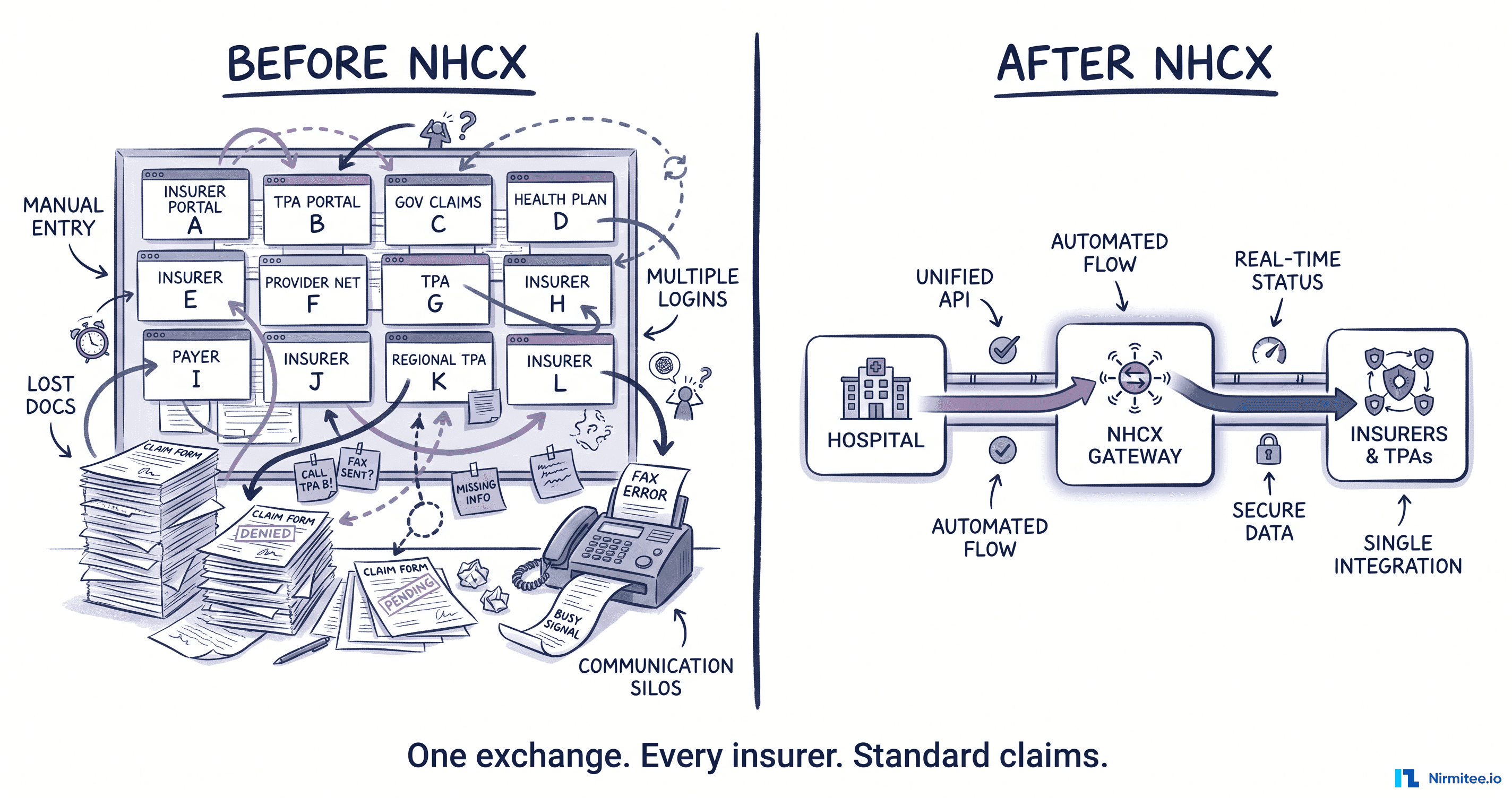
Cashless insurance claims in India still run on insurer-specific portals and manually exchanged documents. A hospital working with 25–30 insurers and TPAs maintains a separate login, form set, and follow-up process for each. Claims move as scanned files that insurers re-enter by hand. The results are familiar to every hospital administrator: pre-authorizations that take a day, discharges held up for hours, settlements that stretch for weeks, and a billing team whose time goes into chasing rather than processing.
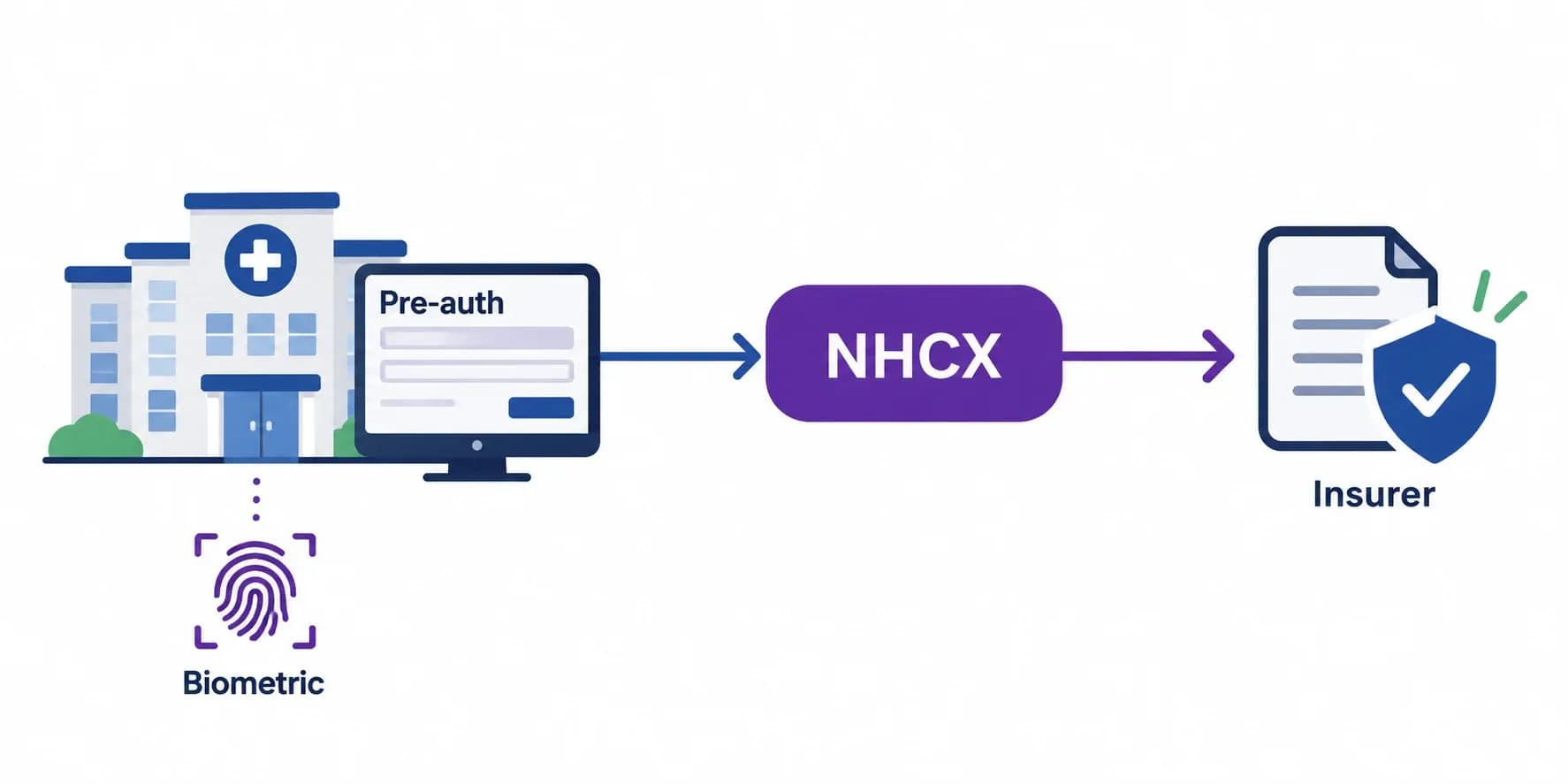
NHCX — the National Health Claims Exchange — is the government's answer to this. Built by the National Health Authority (the body behind Ayushman Bharat and ABDM) together with the insurance regulator IRDAI, it is a single national gateway through which hospitals and insurers exchange claims in one standard digital format. Connect once, and the same process works for every insurer. One common rail replaces dozens of incompatible private channels — the same shift UPI brought to payments.
NHCX carries and standardizes claim messages; it does not decide them. Approval and rejection remain with your insurer. What changes is the speed and form of the exchange — structured digital data instead of PDFs, one channel instead of thirty.
How a claim actually moves on NHCX
A cashless claim has four stages, and NHCX changes each of them:
1. Coverage check. Today: the front desk calls the TPA or logs into a portal to confirm the policy is active and the treatment is covered; answers take hours and are sometimes wrong. On NHCX: the hospital's software sends a digital eligibility request and the insurer's system responds — the answer arrives as data, not a phone call.
2. Pre-authorization. Today: forms and scanned estimates are uploaded per-insurer, then chased by phone; approval commonly takes 6–24 hours, and patients wait in admission or the OT schedule slips. On NHCX: the pre-auth goes as a structured digital request the insurer's system can process directly. Insurers can automate the routine approvals, which is where the biggest speed gains come from.
3. The final claim. Today: discharge summary, itemized bill, and reports are scanned and uploaded; the insurer re-enters key fields manually, and every re-entry is a chance for a query or a technical rejection. On NHCX: the claim leaves your HMIS as structured data — diagnoses, line items, amounts — so there is nothing to re-type and far less to query.
4. Settlement. Today: payment advice arrives by email or portal, and reconciliation against dozens of claims is manual. On NHCX: settlement updates flow back through the same channel, tied to the original claim, so your receivables ledger can update itself.
If the insurer needs more documents at any stage, that request also comes through the exchange — logged, trackable, and tied to the claim, instead of an email someone misses.
For Ayushman Bharat cases specifically, see PMJAY on NHCX: how PMJAY pre-auths and claims move from the TMS portal into the hospital's own HMIS.
Why this matters now
Three developments make NHCX a present-tense question rather than a future one:
- The regulator has directed adoption. IRDAI instructed all insurers and providers to adopt the claims-exchange standards and onboard NHCX in June 2023.
- The payer side is done. By mid-2024, insurers and TPAs covering nearly the entire retail health-insurance market had connected to NHCX.
- "Cashless Everywhere" depends on it. In January 2024 the industry committed to cashless treatment at any hospital — not only network hospitals. That promise cannot operate on portal-per-insurer plumbing; it needs a common rail, and NHCX is that rail.
There is also a direct financial push: under the government's Digital Health Incentive Scheme (DHIS), hospitals have been eligible for incentives on fully digital claims — reported at up to ₹500 per claim or 10% of the claim amount, whichever is lower. For a hospital processing a few hundred cashless claims a month, that is meaningful money for doing what the ecosystem wants done anyway.
What changes operationally — and what doesn't
Changes:
- Discharge waits shrink. Structured pre-auths and claims can be processed in hours rather than day-plus cycles. Discharge stops being the worst moment of the patient experience — and beds turn over faster.
- Cash comes in sooner. Digital claims carry fewer data errors, draw fewer queries, and get rejected less often on technicalities. Cleaner claims settle faster; receivables shrink.
- The billing team gets capacity back. One claims workflow replaces a portal per insurer. For a mid-size hospital, that is often one or two full-time roles' worth of chasing, permanently recovered.
- Disputes get evidence. Every request and response is logged on the exchange with timestamps. "We never received it" stops being an argument.
Does not change:
- Your tariff negotiations and empanelment contracts with insurers.
- The insurer's right to approve, query, or reject — NHCX is the messenger, not the judge.
- Scheme claims you already process digitally (PMJAY has its own established flow, and the two are converging over time).
What this means in money: a worked example
Illustrative numbers for a hospital handling 300 cashless claims a month, average claim ₹40,000:
| Lever | Today | On NHCX | Monthly impact |
|---|---|---|---|
| Digital-claim incentive (DHIS) | ₹0 | Up to ₹500/claim | Up to ₹1.5 lakh earned |
| Settlement time on ₹1.2 crore of monthly cashless billing | Weeks | Days faster | Working capital freed every cycle |
| Billing-team time per claim (portal logins, re-uploads, follow-up calls) | 1–2 hours | Minutes of data work — medical queries still take insurer time | 300–500 staff hours back |
| Rejections on technical grounds (re-typed data) | Every re-entry is a risk | Structured data, nothing re-typed | Fewer write-offs and disputes |
Your numbers will differ — which is exactly why the first step is a readiness check against your own claim volumes, not a leap of faith.
And the cost of waiting is not zero. Insurers are consolidating their processes onto the exchange, "NHCX-enabled" is appearing in empanelment conversations, and every month on the old process is incentive money not earned and discharge hours your competitors are eliminating.
Where adoption actually stands — and what the transition looks like
A fair question: if insurers connected in 2024, why isn't every hospital on NHCX already? Because hospitals can only join through their software, and the HMIS vendors are building and certifying that capability now. Provider-side adoption is happening vendor by vendor — which is exactly why the early hospitals are the ones collecting incentives and shorter settlement cycles while it is still a differentiator.
Plan the transition honestly:
- Expect a dual-running period. Your TPA desk keeps the portal process as fallback while NHCX flows stabilize — sequence your top insurers by claim volume first, and expect a few months where both paths exist.
- Speed gains arrive insurer by insurer. The rail is instant; approval speed also depends on the insurer automating routine cases. Ask your top insurers which claim types auto-adjudicate on NHCX today — that is the number that shortens your discharge queue.
- Medical queries don't disappear — they get trackable. "Justify the ICU stay" still comes, but it arrives through the exchange, tied to the claim, instead of lost in an inbox. Your team stops chasing and starts responding.
- Train the TPA desk before go-live. The people who know 30 portals by muscle memory need to see the new workflow first — budget for it, and make your vendor deliver it.
NHCX Readiness Checklist: 3 Questions for Your Hospital
1. Is the facility registered on the Health Facility Registry (HFR)? The HFR is your hospital's official identity in India's digital health ecosystem, and every NHCX participant needs one. This is administrative work — a registration, not a technology project.
2. Does your HMIS handle ABHA? Every claim on NHCX is anchored to the patient's ABHA number (the 14-digit health account under ABDM). Software that cannot create, verify, and link ABHA — known as ABDM Milestone 1 — cannot transact claims. This is the hard prerequisite, and it is where most hospitals discover their real starting point.
3. Can your HMIS produce NHCX-format claims? The exchange requires claims in a specific structured, secured digital format, sent and received over a certified connection. This is a genuine software capability that your HMIS vendor must build or bring in — it cannot be worked around at the front desk.
The first is paperwork. The second and third are questions for your software vendor, and they are worth asking this quarter — adoption timelines are being set by regulators and insurers, not by hospitals. The useful phrasing for the vendor conversation: "Where are we on ABDM Milestone 1, and what is your NHCX roadmap and date?" A vendor without a concrete answer is telling you something.
A realistic adoption path
- Register the facility on HFR (days, administrative).
- Get ABHA capability live in your HMIS — through your vendor (this is ABDM Milestone 1).
- Have your vendor add and certify NHCX claims capability.
- Move your top 5 insurers by claim volume onto the NHCX flow first; keep the portal process as fallback during transition.
- Track two numbers monthly: average pre-auth turnaround and average settlement days. These are where the return shows up.
If you run hospital software decisions with a vendor: forward them our NHCX readiness guide for HMIS vendors — it answers the questions this article will make you ask.
Nirmitee.io helps hospitals and their software vendors become claims-ready — from ABDM identity milestones through NHCX connectivity. Explore our AI-driven interoperability solutions, or talk to our team for a readiness assessment.
Ready to scale?
Talk to our healthcare engineering team about building, integrating, and shipping faster.
Frequently Asked Questions
Is NHCX mandatory for hospitals?
Does NHCX approve or reject claims?
What does a hospital need before it can use NHCX?
We already use TPA portals - what actually improves?
Does this replace our PMJAY claims process?