
Patient Intake and Triage Agents
Collect demographics, insurance and symptoms by chat, SMS, portal or voice, screen for red flags with deterministic rules, apply licensed protocols such as Schmitt-Thompson, and route to a nurse or scheduler.
Healthcare AI agent development
We design, build and run AI agents for providers, payers and digital health companies. Each agent works through your EHR, clearinghouse and scheduling systems with scoped permissions, a human approval step where the stakes call for one, and an evaluation suite that gates every release.
For CTOs, CMIOs, revenue cycle leaders and healthtech product teams in the US.
Updated September 2026

An AI agent for healthcare is software that uses a language model to understand a task, calls approved tools such as FHIR APIs, X12 transactions and scheduling services to gather context and act, and hands decisions that need clinical or financial judgment to a named person. We build agents for patient intake and triage, ambient clinical documentation, prior authorization, eligibility verification, denial management, patient communication and chronic care management. The outcome is a workflow your staff trust: fewer manual steps, every action logged, and results written back to the systems of record.
Each agent type has its own systems, standards and approval boundary. Start with one, prove it in shadow mode, then extend.
Collect demographics, insurance and symptoms by chat, SMS, portal or voice, screen for red flags with deterministic rules, apply licensed protocols such as Schmitt-Thompson, and route to a nurse or scheduler.
Capture the encounter with consent, draft a SOAP, H&P or behavioral health note in the clinic's template, link every sentence to its source, suggest ICD-10-CM and E/M codes, and write the signed note back to the chart.
Check whether a service needs authorization, gather the documentation the payer's criteria ask for, pre-fill Da Vinci DTR questionnaires, and submit through Da Vinci PAS or the X12 278, with a person approving every submission.
Prior authorization automation Prior auth agent architecture
Run X12 270/271 inquiries before the visit, read coverage, copay, deductible and plan dates from the 271, flag inactive coverage and coordination of benefits issues, and post the result to the appointment.
Parse 835 remittances and CARC/RARC codes, group denials by root cause, pull the chart evidence an appeal needs, draft the appeal letter against the payer's policy, and queue it for a biller to approve.
Answer questions from approved content, book and reschedule appointments against open slots, take refill requests for staff review, and send reminders, with identity checks before any PHI is shown.
Prepare care coordinator worklists, triage device readings against thresholds your care team sets, draft outreach, track CCM and RPM time, and keep the care plan current for the billing audit trail.
AI chronic care management agent Chronic care management software
Route studies to FDA-cleared imaging models, return results as DICOM SR and SEG objects to PACS, reprioritize the radiologist worklist, and track follow-up recommendations for incidental findings.
What the agent may do, and who stops it
An agent differs from a chatbot because it acts. So the useful questions are what it may do alone, what it must ask about, and what happens when it is wrong. This reference design shows one agent run from trigger to audit, and how it can earn more freedom over time.
Trigger
Each run starts with a named workflow, a named patient or claim, and a task identity
Agent logic
The model can only ask for a tool. It cannot call a system directly
Agent gateway
Allowed reads run. Consequential writes wait for a person
Approval and tools
Each call and approval goes to the run record
Oversight
Set these per action, with your workflow owner. The examples show a cautious starting point, and you can move a line only when evidence supports it.
835 event
Denial arrivesCARC and RARC codes open a run for that claim.Agent
Classifies the denialFixed rules sort known codes. The model helps with unclear remarks.If this is a type outside its scope: it goes straight to a biller with a note.
Agent
Gathers evidenceReads the claim, note and policy, using read-only tools.Gateway
Treats documents as dataTool permissions sit outside the model, so an instruction hidden in a payer letter cannot grant the agent new ones.If a known injection pattern appears: the run stops and flags it. Pattern checks catch only some attempts, which is why the permissions matter more.
Agent
Drafts the appealEach statement links to its source. Those with no link are held back, and a link still needs a person to check it.Denials specialist
Reviews and signsEdits, approves or rejects. Reasons feed the test set.Gateway
Submits and watchesSends through the approved route, and a retry key prevents a duplicate.Workflow owner
Reviews overridesCommon edits become fixes, tests or rule changes.Connect typed tools to sandboxes, with no model acting.
Runs on real work without acting, beside your staff.
Staff approve every proposed action.
Only named low-risk actions run alone, with sampling.
A chatbot can say something wrong, while an agent can do something wrong. So test the failures as well as the good runs.
PHI, under a BAA
IDs only
Blocked
Once paid, you own the custom code we write for you and all of your data. We keep our reusable tools and open-source parts. For agents, go beyond code, because these are the parts that took the longest to get right.
Test cases written by your clinicians or billers should stay usable with another model or vendor.
Documented interfaces, so another team or framework can use them.
A readable list of what each agent may do, which your governance team approves.
Who holds it, how long it stays, and whether you can export it if you leave.
You will see large interaction counts on other sites. We do not publish those. Here is what you can look at directly.
Interaction counts tell you about volume, and little about safety. Ask to see these for your workflow.
Pick one workflow with a clear owner, and tell us which systems it touches. We will talk through where the approval lines should sit, and whether an agent is the right tool at all.
Talk through one workflowThe model is one component. What makes an agent safe in a clinic or a billing office is the layer around it.
Agents act only through typed tools behind an agent gateway: FHIR R4 reads and writes authorized with SMART Backend Services, X12 270, 276, 278 and 837 through your clearinghouse, HL7 v2 ADT events as triggers, and CDS Hooks for in-workflow cards. Tools can be exposed over the Model Context Protocol so the same contracts serve any model.
Reads are automatic. Writes that change the chart, a claim or a patient message wait in an approval queue with the evidence attached. Each tool carries an approval policy, so a reminder can send on its own while an appeal or a note needs a signature.
Safety-critical logic such as red flags, eligibility rules and payer criteria runs as deterministic rules. Model output is validated against a schema, claims must cite a source record, prompt injection is filtered at every tool boundary, and out-of-scope requests route to a person.
We sign BAAs. Models run on endpoints covered by a BAA with no training on your data, such as Amazon Bedrock, Azure OpenAI Service or Google Vertex AI, or on models hosted in your own cloud. PHI is encrypted in transit and at rest, logs carry IDs rather than clinical text, and access follows the minimum necessary standard. Nirmitee is ISO 27001:2022 certified.
Every agent ships with a clinician- or biller-authored test set, regression gates on each prompt and model change, red-team cases for injection and PHI leakage, a shadow period against live work, and production monitoring of override rates, escalations and drift.
Each run records the input, the tools called with their responses, the model and prompt versions, the output, and who approved or overrode it. Reviewers can replay any run, and dashboards show cost, latency and failure modes per workflow.
Agents are only as useful as their read and write access. Each EHR exposes different FHIR write support, so we map every tool to what the target system accepts.
FHIR R4 APIs registered through Epic's developer program, SMART on FHIR launch for clinician-facing agents, Backend Services for background agents, CDS Hooks for in-workflow suggestions, and HL7 v2 or Bridges interfaces where a FHIR write is not offered.
Millennium FHIR R4 APIs for patient context, documents and scheduling, SMART launch inside PowerChart, and HL7 v2 interfaces for results and ADT events that trigger agent work.
athenahealth's FHIR R4 endpoints plus its proprietary APIs, which cover appointments, clinical documents, claims and patient cases that FHIR alone does not reach.
eClinicalWorks FHIR APIs for read access, and HL7 v2 or document interfaces for write-back, which is the common path for ambulatory notes, orders and results.
See Interoply, our integration platform for FHIR, HL7 v2 and X12
We design each agent so its intended use sits on the right side of these rules, and we document the mapping for your compliance and clinical governance teams.
Section 520(o)(1)(E) of the FD&C Act excludes some clinical decision support software from device regulation when it supports a clinician who can independently review the basis of a recommendation. Agents that analyze images or signals, or that direct patients to act, fall outside that exclusion and are regulated as software as a medical device.
ONC's HTI-1 final rule created the Decision Support Interventions criterion at 45 CFR 170.315(b)(11). Certified health IT must expose source attributes for evidence-based and predictive DSIs, and developers of predictive DSIs must run intervention risk management. Agents delivered inside a certified EHR inherit these expectations.
The 2024 Section 1557 rule (45 CFR 92.210) requires covered entities to identify patient care decision support tools that use race, color, national origin, sex, age or disability as inputs, and to mitigate the risk of discrimination. Our evaluation plans include subgroup analysis for that reason.
California AB 3030 requires a disclaimer and a path to a human on generative AI patient communications about clinical information unless a licensed provider reviews them. Texas HB 149 requires providers to disclose AI use in treatment, Colorado SB 24-205 sets duties for high-risk AI in healthcare decisions, and Illinois restricts AI in psychotherapy. We build disclosure, review and opt-out paths as configuration per state.
CMS requires Medicare Advantage coverage decisions to rest on the individual patient's circumstances (CMS-4201-F), and CMS-0057-F sets FHIR prior authorization API deadlines in January 2027. Payer-side agents prepare and summarize; a qualified reviewer makes any adverse determination.
Agents follow the minimum necessary standard, run under BAAs with every subprocessor, and respect the separate consent rules for substance use disorder records under 42 CFR Part 2 and for psychotherapy notes.
Most organizations combine options. The question is where your workflow differs enough that a packaged agent will not fit.
| Option | Fits when | Watch for |
|---|---|---|
| EHR-native AI features | The workflow lives entirely inside one EHR and the vendor's roadmap covers it. | Limited control over prompts, evaluation and data outside the EHR; release timing follows the vendor. |
| Point-solution vendors (ambient scribes, prior auth, contact center) | A common workflow such as primary care documentation with standard templates. | Per-seat or per-transaction pricing at scale, specialty gaps, and integration depth that varies by EHR. |
| Cloud agent platforms (Amazon Bedrock Agents, Azure AI Foundry, Vertex AI Agent Builder) | You have an engineering team and want managed orchestration under your cloud BAA. | The healthcare work remains yours: FHIR and X12 tools, guardrails, evaluation and approvals. |
| Custom build with Nirmitee | The agent is part of your product, spans several systems, or needs specialty logic, payer rules or your own approval model. | Needs an internal owner for the workflow and an agreed evaluation baseline before build. |
Deliverables
Once paid, you own the custom code we write for you and all of your data. We keep our reusable tools and open-source parts. Custom code, infrastructure, test sets and documentation live in your repositories.
Confirm the workflow owner, systems, data access, approval points and the baseline you will measure against.
Build the agent against EHR and clearinghouse sandboxes with real tool contracts, then run the first evaluation set.
Run beside your staff on live work without acting, compare outcomes, tune rules and prompts, and sign off the release gate.
Release to one site or queue, review overrides weekly, then extend. We can run the agent or hand it to your team.
Each EHR, clearinghouse or payer adds tool contracts, sandbox access and certification steps. Writes cost more than reads.
Clinical agents need protocol encoding, red-flag rules and review screens. Back-office agents need payer rule logic and exception queues.
The size of the test set, clinician review time, subgroup analysis and the length of the shadow period.
Hosted models under a BAA are faster to start. Self-hosted models in your cloud add GPU infrastructure and MLOps.
Voice adds telephony, speech recognition and latency work on top of chat or portal channels.
Whether we operate the agent with monitoring and on-call, or hand it to your team with a runbook.
Client names are withheld. Each item below is live work or a public repository you can inspect.
An assistive scribe inside a US behavioral health practice group's clinical platform. It drafts progress notes in SOAP, DAP or BIRP format, and a licensed clinician accepts or edits each section before signing.
A mobile app for a long-term care operator: a nurse speaks the assessment, and it returns as discrete fields for vitals, pain and skin that the nurse confirms before they reach the chart.
A patient app that answers by voice or chat only from the patient's own record and a cited clinical guideline, and hands anything else to the care team.
Prior authorization servers tested with the ONC Inferno test kits, the same rails a prior auth agent calls.
Our open-source headless EHR passes 47 of 47 ONC (g)(10) SMART App Launch STU2 standalone patient tests in Inferno.
Our integration platform connects EHRs and payers over FHIR R4, HL7 v2 and X12, with a full run log and a task inbox for the exceptions a person must decide: the rails our agents call.
Evaluating an integration or product partner? Explore the systems, workflows, and technical decisions behind our work.
Explore all case studies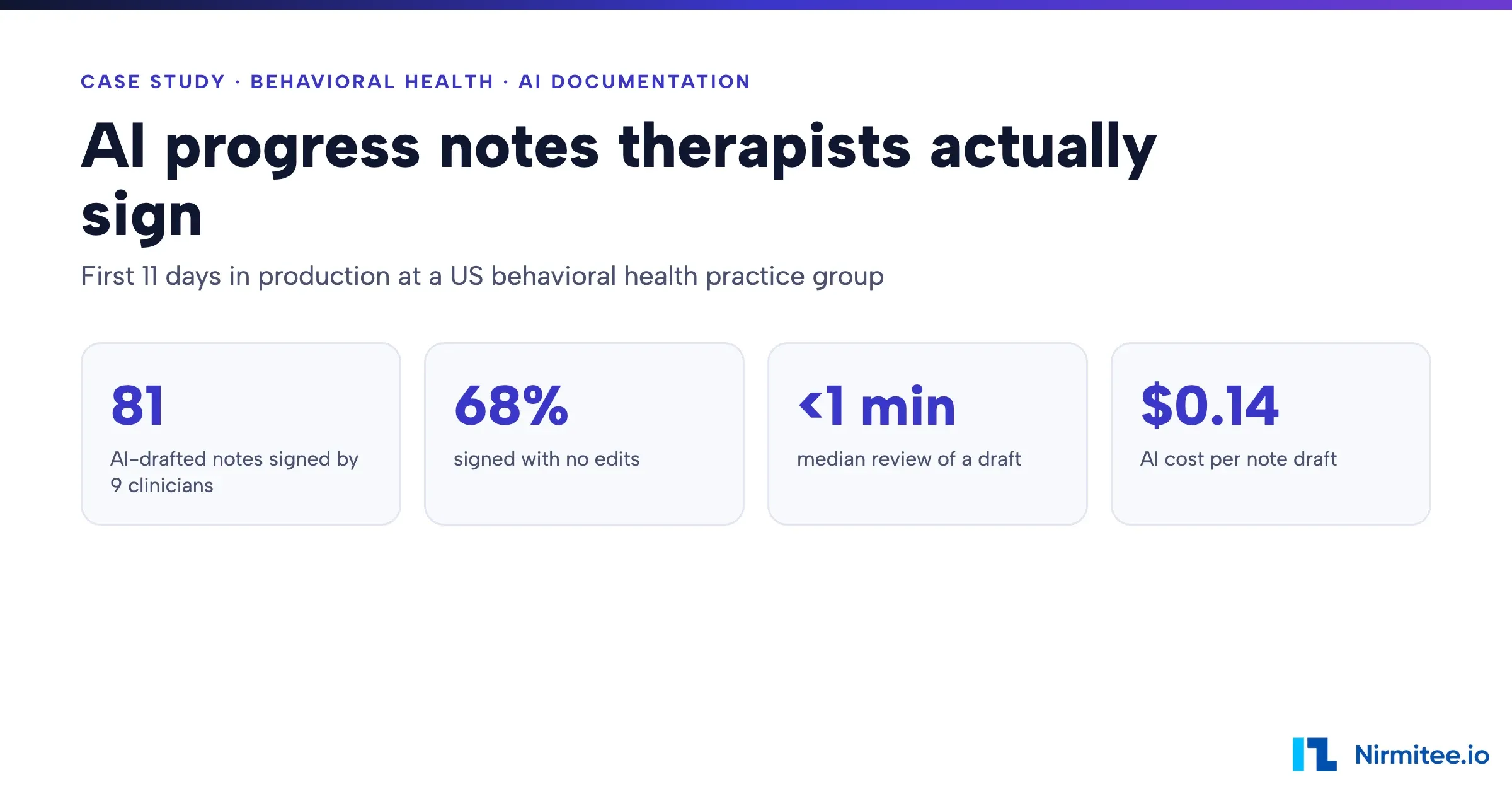
81 AI-drafted therapy notes signed in 11 days, 68% with no edits, $0.14 a draft. How we built it, the safety rules, and the time-saved formula.
Explore the implementation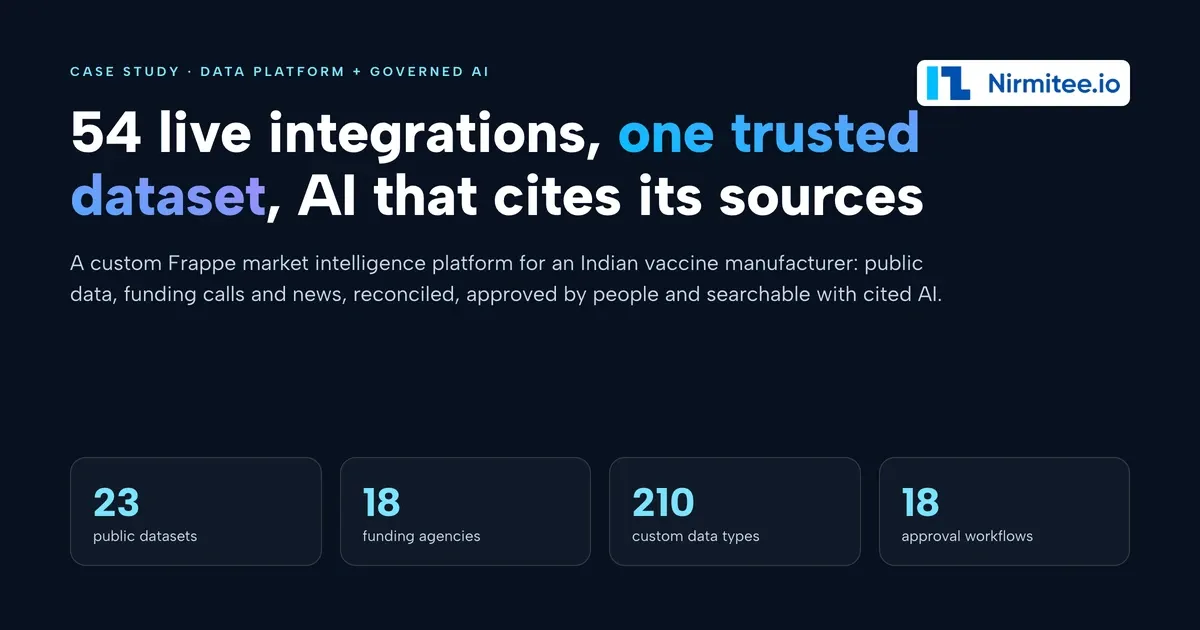
How Nirmitee built a multi-source data integration platform for a vaccine maker: 54 live integrations, human approval and AI answers traced to their sources.
Explore the implementation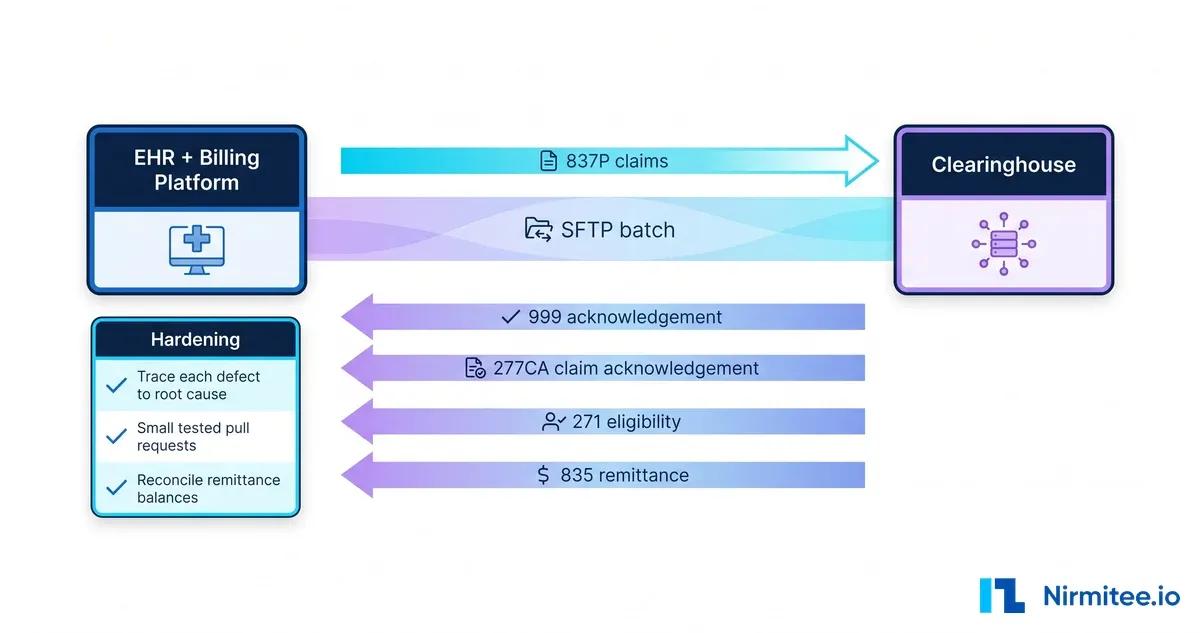
How Nirmitee hardened a live clearinghouse claims integration for a US behavioral-health EHR, tracing 837P, 835 and 277CA defects to root cause and fixing them.
Explore the implementationExplore specific possibilities
Browse the existing agent library to guide your conversation. Suitability, availability, validation, and integration scope need assessment for your environment.
FAQs
An AI agent in healthcare is software that uses a language model to interpret a task, calls approved tools such as FHIR APIs, X12 transactions and scheduling services, and completes a workflow step or prepares it for a person to approve. Unlike a chatbot, it acts on systems of record under defined permissions and leaves an audit trail.
The most common are patient intake and triage, ambient clinical documentation, prior authorization, eligibility verification, denial management and appeals, patient scheduling and communication, chronic care management and remote monitoring, and imaging workflow. Back-office revenue cycle agents are usually the fastest to prove because the inputs and outcomes are structured.
A chatbot answers questions. RPA repeats fixed clicks on a screen. An agent reasons over context, chooses which approved tool to call, handles variation in documents and payer responses, and escalates when it is unsure. Many good designs combine all three, with deterministic rules owning the safety-critical steps.
Through each EHR's FHIR R4 APIs, authorized with SMART on FHIR for clinician-facing agents and SMART Backend Services for background agents, plus CDS Hooks for in-workflow cards. Where the EHR does not accept a FHIR write, we use the vendor's own APIs or HL7 v2 interfaces for write-back.
An agent is HIPAA compliant when the whole system is: BAAs with every party that touches PHI including the model provider, encryption in transit and at rest, minimum necessary access per tool, PHI kept out of logs, and audit trails. We sign BAAs, run models on BAA-covered endpoints with no training on your data, and Nirmitee is ISO 27001:2022 certified.
It depends on intended use. Administrative agents for scheduling, eligibility or billing are not medical devices. Clinical decision support can fall outside device regulation when a clinician can independently review the basis of each recommendation, under section 520(o)(1)(E) and FDA's CDS guidance. Agents that analyze images or signals, or direct patients to act, are regulated as software as a medical device.
Safety-critical logic runs as deterministic rules rather than prompts, each tool carries an approval policy, outputs are validated against a schema and must cite source records, and uncertain cases route to a person. A release ships only when it passes a clinician- or biller-authored evaluation suite, and a shadow period compares it with live staff decisions first.
Buy when the workflow is common and lives inside one system, such as primary care ambient documentation with standard templates. Build when the agent is part of your product, spans several systems, needs specialty or payer-specific logic, or must follow your own approval model. Many organizations buy for commodity workflows and build where they differ.
A single-workflow agent typically takes 11 to 19 weeks from discovery to staged go-live: 2 to 3 weeks of discovery, 4 to 6 weeks for a connected prototype, 3 to 6 weeks of evaluation and shadow mode, and 2 to 4 weeks for staged release. EHR vendor app review and clearinghouse enrollment can extend that.
Cost depends on the number of systems and write paths, the approval and safety design, evaluation depth, model hosting, channels such as voice, and whether we operate the agent afterwards. We scope a fixed discovery first and price the build once the systems and approval points are known.
We choose per workflow: frontier models through Amazon Bedrock, Azure OpenAI Service or Google Vertex AI under your cloud BAA for reasoning-heavy work, and smaller or self-hosted models where cost, latency or data residency matter. Tools and evaluations are model-agnostic, so a model change is a tested release, not a rebuild.
We agree a baseline before build and track workflow measures such as turnaround time, touches per case, first-pass acceptance, override rate with reasons, escalation accuracy and error types. Clinical agents add safety measures such as red-flag sensitivity and omission rates in drafted notes.
Start with one workflow
Bring one workflow, the systems it touches and the result you want. In a 30-minute call we will map the tools, approval points and evaluation plan, and tell you what the first release needs.
From our YouTube channel
Explore the workflows and decisions behind this service. Demonstrations and recorded discussions have the scope described in each video.
A simulated denial-management workflow using fictional clinic records and payer responses.
Epic sandbox note filing and verification. Drafting uses a fixed template with synthetic data; the lost reply is injected.