Agentic AI In Healthcare: The Complete Guide For Leaders

Digital Growth Lead
Writes about healthcare technology, interoperability, and AI-driven transformation across modern care systems.
Every healthcare CTO is being asked the same question in 2026: where do agents fit, and what breaks when we deploy them? The pressure is real — boards want an AI story, clinicians want fewer clicks, and the pilot graveyard keeps growing. Most teams don't need convincing that agentic AI matters. They need a straight answer on what it is, where it earns its keep in a clinical environment, and what the architecture looks like when it has to survive a hospital security review instead of a demo.
This guide is that answer. It's written from production work, not conference slides — we've built 100+ AI-enabled healthcare products, and the patterns below come from the ones that shipped and the ones that taught us hard lessons. Use it as a map: each section links to a deeper technical guide where we've covered the details.
What Agentic AI Actually Means (And What It Doesn't)
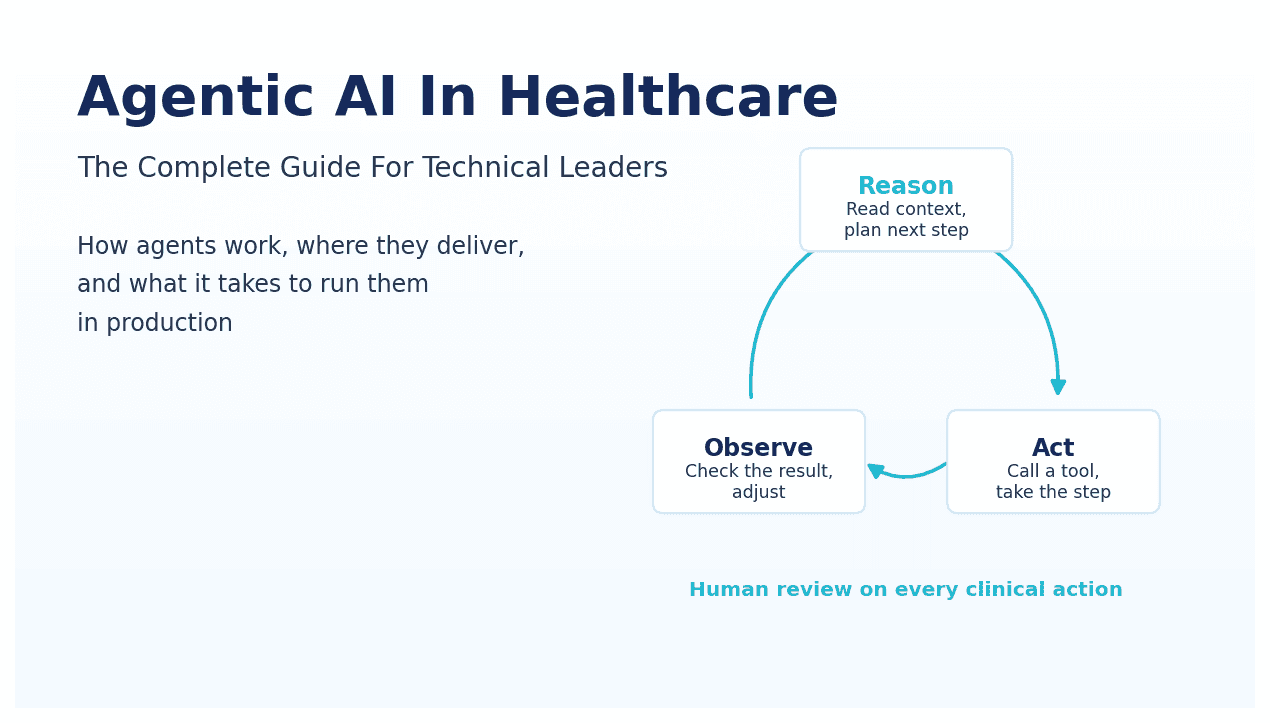
An agent is software that pursues a goal by deciding its own next step: it reads context, chooses a tool, acts, observes the result, and repeats until the job is done or a human needs to step in. That loop — reason, act, observe — is the difference between an agent and everything that came before it.
It is not a chatbot with a system prompt. It is not a single LLM call wrapped in an API. And it is not robotic process automation with better marketing — RPA broke in healthcare precisely because it followed brittle scripts against interfaces that changed weekly, while agents handle the variability that defines clinical work: free-text notes, inconsistent payer portals, half-filled forms.
The distinction matters commercially too. Calling a rules engine an agent invites a diligence problem; there are five questions any technical buyer will ask to tell the difference, and sophisticated hospital procurement teams now ask them.
Where Agents Earn Their Keep In Healthcare
The workflows worth automating share three traits: high volume, structured goal, messy inputs. In practice, the ones producing returns today cluster into five areas.
Clinical Documentation
Ambient scribing is the most mature category. The engineering behind ambient clinical documentation — diarization, medical NER, note assembly, EHR write-back — is well understood now, and the vendor field is crowded enough that we maintain an AI medical scribe comparison for teams deciding between building and buying. Our own Autochart deployment takes dictated vitals and populates EMR fields directly, in clinical use today.
Revenue Cycle Operations
Prior authorization, claim status checks, denial triage, and payer contract reconciliation are agent-shaped problems: repetitive, rules-adjacent, but full of exceptions. One of the strongest business cases we've analyzed is payer contract management, where agents catch underpayments that manual audits miss.
Clinical Data Management
Agents are quietly fixing the unglamorous middle of healthcare IT: reconciling records, normalizing codes, routing documents. The patterns are covered in our guide to agentic AI in healthcare data management.
Patient-Facing Operations
Scheduling, intake, pre-visit screening. Well Station, a kiosk-style mental health booth we built, runs AI pre-screening before a clinician ever gets involved — a pattern that generalizes to most intake flows.
Clinical Decision Support
The most regulated category, and the one where the integration pattern matters most. Agents surface inside the clinical workflow via CDS Hooks rather than another dashboard — because a recommendation nobody sees during the encounter is a recommendation that doesn't exist.
Finding your first workflow is its own discipline. Before committing a roadmap, run the exercise in how to find the workflows agents can automate, and score yourself against an agentic AI readiness assessment honestly. Most failed pilots were doomed at workflow selection, not at model choice.
The Architecture That Survives Production
Demos need a model and a prompt. Production needs six layers: interface, orchestration, model, tools, memory, and governance. The full breakdown is in the six layers between a notebook and a clinic, but three of them deserve attention here because they're where healthcare deployments actually fail.
Orchestration
Single agents plateau quickly. Real clinical workflows need multiple specialized agents with hand-offs, retries, and durable state — the multi-agent orchestration patterns that make this reliable are closer to distributed-systems engineering than prompt engineering. Framework choice matters less than teams think, but it still matters: our LangChain vs CrewAI vs AutoGen comparison covers the trade-offs for healthcare specifically.
Memory
Patient context does not fit in a context window, and pretending it does produces agents that forget allergies. The agent memory problem — what to retrieve, what to summarize, what to never truncate — is the hardest unsolved design question in clinical agents.
Human Oversight
Autonomy in healthcare is bounded by design, not by accident. Every write-action that touches a chart, a claim, or a patient needs a defined review point — human-in-the-loop is the point, not a limitation to engineer away. Deterministic guardrails matter as much as the model: process engines running BPMN and DMN alongside agents keep the auditable parts auditable.
When Not To Use An Agent
The fastest way to lose credibility with a hospital IT director is to propose an agent for a problem a rules engine solves. If the inputs are structured, the logic is enumerable, and the volume is stable, the rules engine wins — cheaper, deterministic, and explainable in an audit. Agents earn their complexity only where variability defeats rules. Teams that skip this test contribute to the statistic nobody likes quoting: most healthcare AI projects still die at pilot, and workflow mis-selection is the leading cause of death.
The Compliance Surface Agents Create
An agent that reads PHI, calls external tools, and writes back to systems of record has a larger compliance surface than any software you've deployed before. HIPAA didn't anticipate autonomous tool use, so the burden falls on architecture: every agent action logged with inputs, outputs, and rationale; PHI minimized at each tool boundary; model providers under BAA; and access scoped per agent, not per application.
Two practices make audits survivable. First, treat agent audit trails as a first-class feature — done right, agent logging actually makes HIPAA compliance easier than the manual process it replaced, because every decision is recorded by default. Second, build observability for agentic systems from day one: token traces, tool-call monitoring, drift alerts, and a dashboard your compliance officer can read without an engineer translating.
If the agent influences diagnosis or treatment, FDA SaMD questions follow. The line between workflow automation and clinical decision-making is where your regulatory exposure lives — ship an LLM feature carelessly and the FDA is the smaller of your problems.
Governance: The Part That Decides Whether It Scales
Every stalled agentic program we've examined stalled the same way: the pilot worked, and nobody could answer the questions that came next. Who owns the agent's errors? What's the escalation path when it's uncertain? Which actions can it take unattended, and who signed off on that list? Governance is those answers written down before deployment — an autonomy matrix per workflow, a named human owner per agent, error budgets with review triggers, and a change process for prompts and models identical in seriousness to a code deploy. Organizations that treat this as paperwork get pilots; organizations that treat it as architecture get production systems.
The Unit Economics
Agents are priced per token and per tool call, which means cost is an engineering property, not a procurement line. The teams running agents profitably obsess over agent cost engineering — model routing, caching, batch windows — and they model unit economics against the manual workflow before writing code. The honest comparison isn't agent-vs-zero; it's agent-vs-the-loaded-cost of the humans currently doing the work, including the error rate of both.
Testing And Evaluation
You cannot unit-test your way to clinical safety, and you cannot skip evaluation because the output "looks right." Production agent teams maintain eval suites tied to clinical safety — golden datasets, regression gates on every prompt change, and red-team cases for the failure modes that matter. Prompting itself is disciplined engineering here: the patterns that measurably reduce hallucination in clinical contexts are documented and repeatable. Study the field's failures as well — the agent failures of the past year are a cheaper education than repeating them.
The State Of Adoption In 2026
Cutting through the noise: adoption is real, and so is the failure rate. Analyst surveys of US payers and providers show agentic AI moving from experimentation into core transformation budgets, with most large organizations planning deployment within the next two years. At the same time, industry projections expect a large share of agentic projects to be cancelled before 2028 — the recurring causes are unclear business value, weak governance, and costs that surprise nobody who skipped the unit-economics work.
The clinical evidence base is thinner than the marketing suggests. Peer-reviewed studies of deployed healthcare agents are still few, and almost none involve patient-facing autonomy. That's not a reason to wait — the operational use cases don't need clinical trials — but it is a reason to be precise about claims. What's driving adoption anyway is arithmetic: workforce shortages projected in the millions globally, denial rates above ten percent at many organizations, and margins that no longer absorb manual administrative cost. Automation stopped being optional; the open question is execution quality.
The Vendor Landscape, Briefly
The 2026 market splits into three tiers. Platform vendors (the enterprise conversational and workflow players, plus the EHR vendors themselves) sell breadth and time-to-value — configuration over engineering. Specialist vendors go deep on one workflow: ambient documentation, voice agents for outreach, prior authorization. And a growing number of health systems and healthtech companies build their own agent layer where the workflow is their differentiation or crosses systems no vendor connects. We track the space in our review of the agentic AI companies shaping healthcare in 2026. The practical takeaway isn't a vendor name — it's that the operating model around the agent (who owns exceptions, who reviews outputs, who measures drift) predicts success better than the platform choice does.
Build Vs Buy
The scribe market proves both paths work: strong vendors exist, and yet health systems keep commissioning custom builds. The deciding factors are consistent. Buy when the workflow is generic (ambient notes for outpatient visits), when a vendor's BAA and security posture pass your review, and when configuration covers your specialty. Build when the workflow is your differentiation, when the data can't leave your environment, or when the agent must operate across systems no vendor integrates — which describes most revenue-cycle and data-management work inside hospitals.
There's a third path that fails predictably: assembling a production agent from a no-code builder. The platforms are improving — we evaluated ten of them against healthcare requirements in our no-code agent builder evaluation — but audit trails, PHI handling, and EHR write-back remain where they fall short. Prototype on them; don't deploy patient-facing workflows on them.
Choosing Models, And Whether To Fine-Tune
Model selection is less strategic than it looks. For most agent workloads the frontier hosted models win on capability, and the real choices are routing (which calls need the expensive model), context strategy, and fallbacks. Fine-tuning earns its cost in narrow cases — consistent output formats, specialty vocabulary, latency-sensitive classification — and our guide to choosing a model for fine-tuning in healthtech covers when it does. Data sovereignty is the other honest reason to leave hosted APIs: some health systems are moving inference on-premise entirely, a shift covered in sovereign AI for healthcare.
Whatever the model, the deployment discipline is the same one that governs classical ML in hospitals: versioned models, monitored drift, staged rollouts. Teams that already run MLOps for clinical AI adapt to agents fastest, because they already treat models as things that decay in production rather than artifacts that ship once.
A Working Example: Documentation Burnout
To make the abstractions concrete, consider the deployment pattern in our provider burnout case study. The problem was familiar — clinicians spending evenings on notes — and the agent design followed the rules above: one workflow (encounter documentation), bounded autonomy (agent drafts, clinician signs), full audit logging, and a baseline measured before launch. The same shape appears in Autochart, our voice-to-EMR system in clinical use: the clinician dictates, the agent populates the EMR fields, the human confirms. No diagnosis in the loop, no unreviewable action, and a time saving the clinician feels in the first week.
That is the general lesson of the last two years of agentic AI in healthcare: the wins are unglamorous, measurable, and architecturally conservative. The teams collecting them are not the ones with the most ambitious demos — they're the ones who picked boring workflows, instrumented everything, and let the eval data expand the agent's autonomy one boundary at a time.
How To Start
The pattern we've seen work, repeatedly, looks like this:
- Pick one workflow with high volume, a measurable outcome, and no direct clinical decision in the loop. Documentation and revenue-cycle tasks are the usual first wins.
- Baseline the manual process — time, cost, error rate — before the agent exists, or you will never prove the return.
- Ship with bounded autonomy: agent drafts, human approves. Loosen the boundary only when the eval data says you can.
- Instrument everything from day one. Logs, traces, and evals are not phase two; they are the product.
- Design for the agent from the start if you're building a new product — retrofitting agent capability into a finished MVP costs more than building the MVP agent-first.
For teams that want a partner rather than a longer reading list: healthcare is the only industry we serve, our 70+ engineers work on clinical AI systems daily, and our healthcare AI development services cover exactly this path — workflow selection, agent architecture, compliance design, and production deployment. The concrete next step is a 30-minute working session on your highest-volume workflow: bring the process, we'll bring the feasibility assessment.
Ready to scale?
Talk to our healthcare engineering team about building, integrating, and shipping faster.
Frequently Asked Questions
We're a healthtech startup — should our MVP have an agent, or is that premature?
Our board wants an 'AI agent story' but the team is skeptical. Who's right?
How do we get an AI agent past a hospital's security and compliance review?
What does a realistic budget and timeline look like for a first production agent?
Should we buy a platform, use a specialist vendor, or build our own agent layer?
How autonomous should we let agents be with patient data and clinical workflows?