TEFCA Integration Guide: IAS Record Retrieval, QHINs and Patient Matching

Nirmitee.io Engineering
Author
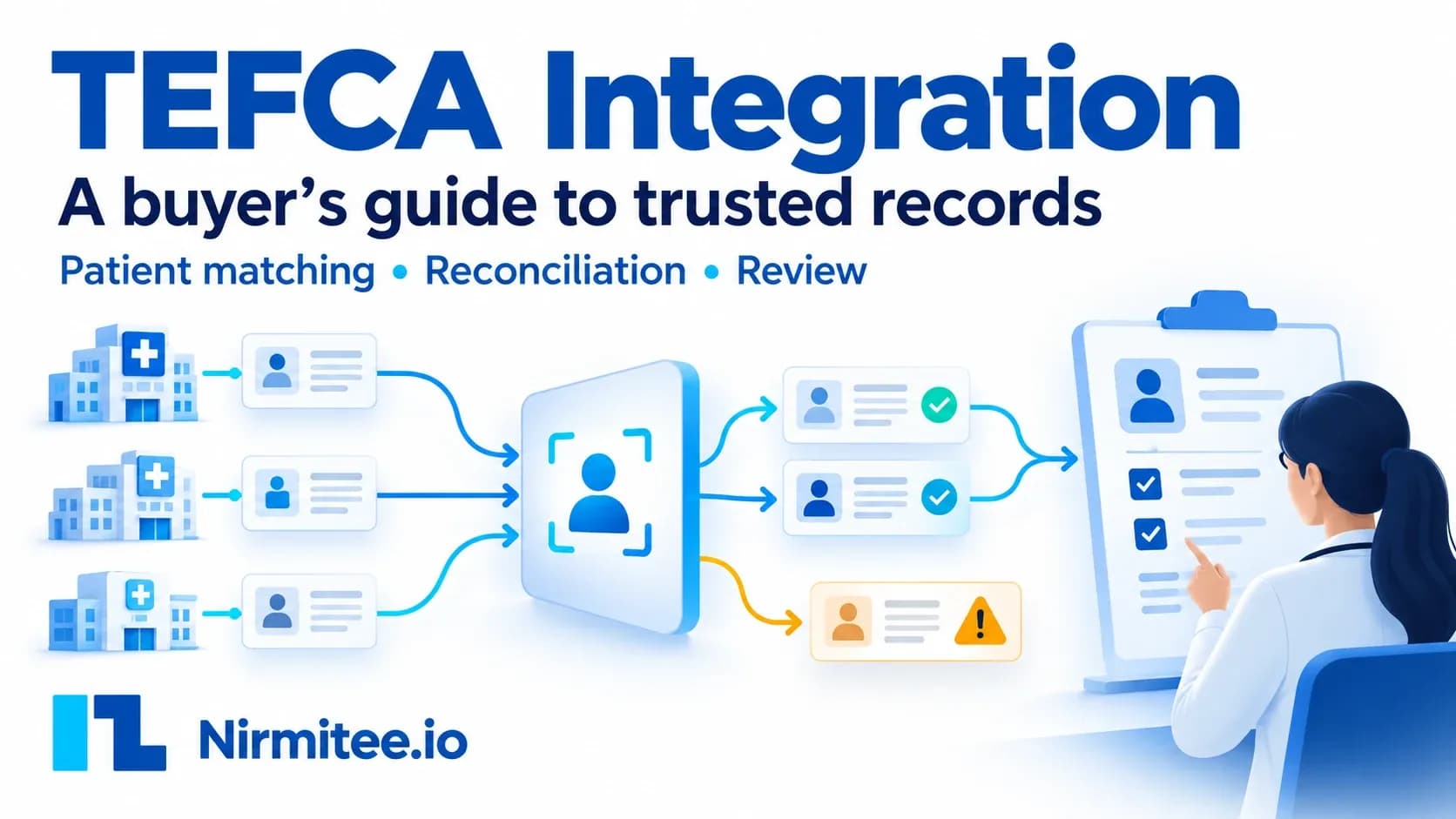
Buying TEFCA integration means paying for a usable outside-record workflow: the right information reaches the right patient, unresolved conflicts remain visible, and your team can verify what was reviewed and accepted. Network access is one part of that purchase. Patient matching, record reconciliation and the destination workflow determine whether the connection is useful to your customers.
Watch: TEFCA Explained (2026): Live Patient Records Pull, QHINs, and Reconciliation (12:06). Recorded in test mode with synthetic identities; the disclosure further down explains what it does and does not show.
This guide helps healthcare founders, product leaders and procurement teams decide what to buy, what drives the cost, which dependencies can delay a launch and what evidence to request before signing. It builds on Nirmitee’s recorded test demonstration and turns its observed limitations into practical buying criteria. The checklists are recommendations for evaluation, not a legal opinion or a claim of production certification.
When TEFCA integration is worth evaluating
TEFCA, the Trusted Exchange Framework and Common Agreement, supports health information exchange through participating networks. For a buyer, the starting question is specific: which outside records would improve an approved workflow, who needs them and what decision follows?
Examples worth evaluating include a patient-directed records experience, outside-record review before an appointment, or a care-team application that brings relevant history into an existing workflow. These are possible use cases to assess with a connector; naming one does not establish eligibility, availability or permission. Write down the current problem before asking for a demonstration: repeated manual requests, fragmented review, unclear sources or the inability to distinguish missing information from an unfinished search.
Consider a narrower route first if the immediate requirement is confined to one known EHR, a specific transaction or a destination write that an existing interface already supports. Compare TEFCA with the available direct integration against the same business outcome. If your product promise depends on every record being available instantly, revise that promise until the selected provider can substantiate the relevant coverage and response behavior.
The purchase should have a measurable result: more of the required record types available to an authorized reviewer, less avoidable manual retrieval, or a clearer review process. Establish a baseline during discovery. Do not convert a sandbox resource count into a forecast of time saved or revenue gained.
Watch the demonstration and understand its limits
Watch Nirmitee’s TEFCA retrieval and reconciliation walkthrough. The video gives buyers concrete questions to bring to a vendor evaluation.
Test-data disclosure: the narrated workflow uses Fasten Connect in Individual Access Services test mode. Derrick Lin is a synthetic identity. Test tools skip the email one-time-code and identity-proofing steps. Sample documents for a different synthetic patient, Myra Jones, stand in for upstream records. Fasten’s IAS test guide documents that fixture mechanism. The recording does not establish production patient retrieval, successful real-world identity verification, security certification or clinical outcomes.
- 6:42 — Partial completion: three of four selected test sources have delivered 158 FHIR resources; the fourth remains pending.
- 7:10 — Identity conflict: the discovery context and sample-document demographics identify different synthetic patients.
- 8:18 — Filing is blocked: the narration describes an identity hold rather than accepting the documents into the intended patient’s chart.
- 8:35 — Reconciliation view: the narrated example groups 18 problem entries into 7 while retaining source context. These are demonstration counters, not a measured accuracy or productivity result.
The buying lesson is straightforward: ask to see incomplete and unsuitable results handled clearly. A demonstration is most useful when it shows where the product stops, who takes responsibility and how the next decision is recorded.
Confirm the access route before committing to a build
Ask the proposed provider to name the contracting entity, its QHIN connection, your organization’s participation route and the exchange purpose supporting the intended use. A QHIN is a Qualified Health Information Network. The RCE’s participation guidance distinguishes organizations connecting directly to a QHIN from those connecting through a Participant. Your purchasing decision should identify the actual route and responsibilities.
The Exchange Purposes SOP version 5.1, effective August 3, 2026, sets purpose-specific conditions. An allowed purpose, a required response and the information a particular provider can deliver are separate considerations. Have your privacy or compliance owner confirm the intended use and the selected provider’s support before approving the implementation scope.
For patient-directed Individual Access Services, request a demonstration of the production identity journey, including a user who cannot complete it. The IAS SOP version 3.0 specifies identity-proofing and authentication obligations. Budget for their impact on user experience, support and abandonment; a test-mode bypass provides no evidence about those production steps.
Your decision record should state who approves eligibility, handles agreements, supplies identity services, resolves exceptions and supports the end user. Resolve these ownership questions before comparing delivery dates. Nirmitee’s patient identity and consent services cover the associated application workstream.
Separate the three things your proposal should price
1 Network access and retrieval
This covers the approved connection route, patient discovery and retrieval from available sources. Request evidence relevant to the records and patient population your product needs. Define what a completed request means, how long a source can remain pending and how the service distinguishes no match, no documents, denied access and an operational failure.
A nationwide-network claim does not answer whether your required source is available for your purpose. Ask what the provider can verify during evaluation, what remains uncertain until an authorized pilot and what your customer will see when data is unavailable.
2 Patient matching and record reconciliation
This covers deciding whether returned information belongs to the intended person, organizing repeated information and making conflicts reviewable. Ask whether the quoted service supplies raw documents, converted FHIR resources or a reconciled view. Require a sample output and identify which checks still belong to your application.
FHIR is a structured representation of health information. Receiving it does not establish that the data was exchanged natively through TEFCA’s Facilitated FHIR path, nor that it has been clinically reconciled. Confirm where conversion happens and who fixes mapping errors. If this is a separate workstream, scope the necessary FHIR integration explicitly.
3 Review and use in the destination workflow
This covers what the customer actually does with the information: view outside records, review suggested changes or accept approved content into an EHR. Each is a different commitment. A portal that displays documents may meet one product need; writing reconciled information into a clinical record introduces additional destination access, testing and ownership questions.
Require the proposal to name the destination, permitted actions and evidence of completion. Include how failures and uncertain writes are resolved without duplicating accepted entries. Scope EHR and EMR integration separately when the destination requires its own implementation or customer approval.
Make patient matching a purchase acceptance criterion
Ask for two demonstrations: finding the intended patient’s candidate records, and checking the identity within returned content before it is used. The video’s disclosed sample substitution illustrates why both matter. It is not evidence that TEFCA returned another real person’s records.
Use synthetic examples with a name variation, an outdated address, missing demographics, two plausible matches and an unmistakable wrong-patient document. Ask who resolves each case and what the end user sees while it is unresolved. A conflict must not become accepted information through a bulk action, a retry or an AI summary.
For IAS Mode 2, the current IAS SOP, sections 4.7 and 4.8, gives the demographics double-check a January 1, 2027 compliance date and specifies rejection, retrieval restrictions and notification after a failed check. It also addresses notification and purging when an individual reports receiving another person’s data. Have the responsible privacy owner define the applicable response. A hold queue is not permission to retain wrong-patient data indefinitely.
Evaluate the operational cost as well as the matching behavior. Who owns the queue? What evidence may they inspect? How is the case escalated? What remains in the audit trail after required deletion? A proposal should make those responsibilities visible without promising a universal matching-accuracy percentage.
Buy a reviewable record reconciliation workflow
A cleaner-looking list can still hide important differences. Ask to review examples across the data your product actually uses, with a clinical owner involved in deciding which differences require attention.
- Problems and diagnoses: repeated entries should retain their sources and meaningful dates. A condition’s absence from a later document should not silently mark it resolved.
- Medications: different strengths, routes, instructions and historical statuses must remain distinguishable. A past prescription should not become an unqualified current medication because it arrived most recently.
- Allergies: a reaction reported in one source must remain visible even when another source is silent. Missing information should remain unknown rather than being treated as a negative finding.
- Results: preserve units, dates, reference ranges and source wording where available. Similar display names alone should not make unlike tests appear comparable.
For any grouped item, the reviewer should be able to inspect the contributing sources and understand what changed during processing. The FHIR Provenance specification provides one standards-based way to describe origin and transformation; the exact implementation depends on the interface. As a buyer, request a traceable demonstration rather than a particular screen design.
If AI assists with summaries or grouping, ask how suggestions are labeled, how conflicting evidence is surfaced and what requires human approval. Agree on permitted use, evaluation evidence and escalation before placing those suggestions in a clinical workflow. The recorded synthetic example does not validate an AI model’s accuracy or a clinician’s decision.
What drives TEFCA integration cost
Compare proposals using the same use case, record types, expected workload and acceptance criteria. A connector subscription and an implementation quote often cover different responsibilities. Request a first-year view with one-time work, recurring charges, customer effort and exclusions shown separately.
| Cost driver | What to clarify in the quote |
|---|---|
| Participation and onboarding | Required agreements, eligibility review, setup charges and which party completes each step. |
| Network or connector usage | The billing unit, minimum commitment, limits, overages, failed-request treatment and sandbox access. |
| Identity and authorization | Production identity services, repeat verification, user support and responsibility for exception handling. |
| Returned-data quality | Included formats, source mapping, provenance, reconciliation rules and how mapping changes are maintained. |
| Destination workflow | Display versus chart writes, destination interfaces, customer approvals and required acceptance testing. |
| Operations and review | Human review workload, support coverage, escalation, storage, incident handling and recurring maintenance. |
| Change and exit | Additional sources or use cases, volume changes, export arrangements, termination charges and transition support. |
Have providers price a clearly stated workload, including partial and repeated requests, instead of letting each choose its own definition of a transaction. Ask which assumptions change the estimate and how those changes will be approved. No universal price follows from TEFCA participation alone, and this demonstration supplies no verified production cost benchmark.
Use the pilot to test your business case. Measure the work involved in retrieving and reviewing the required information, including exceptions. Track the proportion of attempted workflows that reach an accepted result and define the observation window. Excluding pending requests or identity holds would make the benefit look larger than the experience your customers receive.
What controls the implementation timeline
A credible schedule separates work the delivery team controls from decisions and access supplied by the network provider and your customers. Ask for a dependency-based plan rather than a single go-live date without assumptions.
- Scope and eligibility: agree on the intended workflow, participating entity, purpose and business success criteria. Exit with a responsibilities map and a decision about the access route.
- Provider and customer readiness: obtain the necessary agreements, access, documentation and named customer owners. Confirm who can approve production identity, data handling and destination permissions.
- Bounded pilot: test representative data and failure cases in the agreed environments. Establish coverage and review effort without generalizing beyond the evaluated workflow.
- Launch decision: review acceptance evidence, unresolved risks, support ownership and recovery procedures. Record who can approve expansion and what changes require another review.
Your team should expect to provide a product owner, privacy or compliance owner, security reviewer and a clinical decision-maker when clinical reconciliation is involved. Identify a destination-system owner if records will be filed there. These people do not all need to work full-time, but unresolved decisions can block a delivery team that has finished its assigned implementation.
Before accepting a promised date, ask: what starts the clock, which approvals are already in place, what happens if an external dependency slips, and which outcomes are excluded from the first release? Keep any commercial launch commitment aligned with the evidence available.
Eight tests to include in the buying checklist
Request a short evidence pack for each scenario: the test input, expected behavior, observed result, accountable owner and any unresolved issue. The following are proposed acceptance tests to tailor with your clinical, privacy and security stakeholders.
- Unauthorized request: a missing required authority or unsupported purpose prevents retrieval. The allowed path retains appropriate evidence of the request context.
- Wrong-patient content: a clear identity conflict cannot reach the accepted record or its summary. The applicable notification and deletion process is demonstrated.
- Partial results: completed, pending, empty and failed sources remain distinguishable. A late result does not imply it was included in an earlier review.
- Repeated delivery: a replay or retry does not produce duplicate accepted entries or overwrite a later reviewer decision.
- Clinical meaning: important medication, allergy, diagnosis and result details survive grouping and normalization, with source links intact.
- Reviewer decision: an authorized reviewer can inspect conflicting evidence and record acceptance or rejection with their identity and time.
- Destination failure: a failed or uncertain write remains visible, with a recovery path that checks what was already accepted before resubmission.
- Operational ownership: restricted access, incident escalation, provider outages and production identity failures have a tested owner and response path.
The RCE’s questions for QHINs and other TEFCA connectors provide additional due-diligence prompts. Ask for evidence relevant to your product rather than inferring readiness from a network logo, a successful demonstration or a general security claim.
Make the first paid scope small enough to decide
When access, data quality or destination requirements remain uncertain, make the first engagement a bounded readiness and workflow evaluation. Specify the business question it must answer and the information your team will provide. Avoid buying an open-ended build to discover whether the intended workflow is possible.
Useful deliverables include an approved-use and responsibility map, a provider capability comparison, representative-data findings, a destination workflow design, a cost and dependency model, and acceptance criteria for a pilot. The final decision should be explicit: proceed with a defined implementation, narrow the use case, choose a different route or pause until a dependency is resolved.
For an implementation proposal, request those outputs alongside the connector, patient matching, reconciliation, review and support scope. Bring your intended users, required records, current systems, preferred provider if any, and the customer outcome you want to measure.
Discuss your TEFCA integration scope with Nirmitee to evaluate the connection and application work required for your use case. The next useful step is a scoped evidence plan, with assumptions and responsibilities clear before a production commitment.
Sources and links reviewed October 4, 2026. Reconfirm current requirements and provider capabilities before contracting or launching.
Ready to scale?
Talk to our healthcare engineering team about building, integrating, and shipping faster.
Frequently Asked Questions
What should I buy beyond TEFCA network access?
Will TEFCA provide every record for every patient?
How much does TEFCA integration cost?
How long does a TEFCA implementation take?
Does the linked demonstration prove production readiness?