
AdvancedMD integration services · United States
AdvancedMD Integration Services
Connect your healthcare product to the practice workflow it needs. We scope clinical reads, scheduling, patient engagement, revenue cycle workflows and analytics separately, then build against the access approved for that customer. The implementation covers mapping, recovery, acceptance tests and operational handover.
Plan your AdvancedMD integrationCompare connection optionsFor healthcare product teams and the customers who use their integrations.
Connect APIs · FHIR R4 · SMART authorization · Practice workflows · Data pipelines
Updated October 11, 2026
- 01Define the action
Identify the user, source record and business outcome. Separate viewing data from changing a practice record.
- 02Validate access
Confirm the API family, permitted operations, customer environment and vendor prerequisites.
- 03Build and reconcile
Implement mappings, identity checks, recovery and evidence that the intended result reached the right record.
- 04Activate and support
Run customer acceptance checks, assign operational owners and prepare a controlled rollout.
Illustrative implementation plan · no patient data
Your starting point
AdvancedMD integration services, in short
AdvancedMD EHR integration connects a product to the practice operations or clinical data it needs. Nirmitee helps healthcare product teams connect an application or data pipeline to an AdvancedMD customer workflow. We begin with the required actions and the access available today, then agree a connection design and acceptance criteria. That prevents a read-only clinical connection from being scoped as a scheduling or billing write integration. Our proposed delivery covers the connector, field mappings, record matching, error handling, customer testing and a support runbook. A successful request is only one checkpoint: the feature must show the correct patient, handle incomplete data and recover without repeating a business action. Vendor approval, customer authorization and production activation remain separate dependencies, with owners recorded before implementation starts.
Who it is for
Health tech teams serving AdvancedMD practices, practice IT teams connecting a new product, and data teams consolidating authorized practice data.
Identify the user, source record and business outcome. Separate viewing data from changing a practice record.
What we build
Workflow-specific adapters, clinical read experiences and data pipelines, subject to the documented API and customer permissions.
Confirm the API family, permitted operations, customer environment and vendor prerequisites.
What you receive
A scoped connection contract, source code, environment-labelled test results and a rollout plan with unresolved dependencies visible.
Implement mappings, identity checks, recovery and evidence that the intended result reached the right record.
Documented connection routes
AdvancedMD FHIR integration, Connect APIs or ODBC?
AdvancedMD publishes several connection routes. The following vendor facts were checked on October 11, 2026; the linked developer documentation is the source. We confirm the chosen route for your customer before fixing the scope.
| Route | Documented role | What the project must confirm |
|---|---|---|
| Connect APIs | Proprietary transactional APIs in REST and XML-RPC formats. | Developer agreement and fees, licensed documentation, permitted methods and the customer configuration. |
| FHIR R4 | Read-only GET access with SMART OAuth authorization for clinical data. | Resources, searches, user flow, granted permissions and behavior in the intended environment. |
| ODBC | SQL-based bulk extraction with full and delta-load support. | Available tables, extraction permissions, freshness needs and secure destination design. |
| Orders, results and HL7 | Partner-mediated interfaces; custom external-developer HL7 interfaces are not directly supported. | Partner scope, source and destination contracts, routing, acknowledgements and support responsibility. |
Vendor sources are linked below. The selected route must support the intended operation; a working clinical read does not establish scheduling or billing write access.
Find your workflow
AdvancedMD API integration for EHR and practice workflows
These are implementation workstreams to assess with your team. Each requires operation-level validation and an approved customer environment before it becomes a committed delivery scope.
AdvancedMD scheduling integration
Define the appointment lifecycle and the system that owns each field. Specify how the product handles rescheduling, cancellation, a changed provider or an unavailable slot. For any write, verify the supported method and retrieve the resulting record before marking the action complete.
Appointment states · field ownership · duplicate prevention · reconciliation
Clinical data viewers and patient apps
Build a focused view of the clinical information the user is permitted to access. Model unavailable data separately from an empty record, preserve source identifiers and timestamps, and prevent a previous patient response from appearing after the user changes context.
Read-only FHIR · SMART authorization · patient context · data freshness
AdvancedMD billing integration
Scope the specific billing workflow rather than treating all revenue cycle data as one feed. Agree the required records, financial state transitions and reconciliation evidence. Confirm licensed access and operations before designing charge, payment or claim-related actions.
Business states · ledger reconciliation · permitted operations · audit trail
Clinical form and documentation workflows
Identify the document type, author, target encounter and review owner. Assess the permitted transactional route for any write. Define draft, accepted and rejected states explicitly, and confirm how a submitted item appears to the practice user before calling it delivered.
Document mapping · encounter selection · review states · result verification
Analytics and warehouse pipelines
Agree the authorized extraction scope and destination schema. Plan an initial load, incremental processing, reconciliation and deletion handling. A completed job should report its coverage and gaps, so analysts can distinguish a current dataset from a partial refresh.
ODBC assessment · full and delta loads · schema mapping · freshness checks
Partner interface coordination
For a lab, imaging or HL7 workflow, identify the vendor-supported partner route before building an adapter. Own the agreed application-side mapping and tests, while recording which party provisions the practice connection and handles interface incidents.
Partner scope · routing · acknowledgement · escalation ownership
Choose the right connection
Choose an approach by the action your product needs
The first design question is whether the product reads a clinical record, changes an operational record, extracts a dataset or exchanges an interface message. The acceptance evidence differs for each.
FHIR
The first design question is whether the product reads a clinical record, changes an operational record, extracts a dataset or exchanges an interface message. The acceptance evidence differs for each.
- Design focus
- Patient context, supported searches, pagination and partial results.
- Acceptance evidence
- Correct record displayed; denied access, missing data and session expiry handled.
Correct record displayed; denied access, missing data and session expiry handled.
| Need | Candidate route | Design focus | Acceptance evidence |
|---|---|---|---|
| Display authorized clinical information | FHIR | Patient context, supported searches, pagination and partial results. | Correct record displayed; denied access, missing data and session expiry handled. |
| Change a practice workflow record | Connect API assessment | Permitted operation, field ownership and uncertain write outcomes. | Result retrieved and reconciled; duplicate submission and recovery tested. |
| Build a reporting dataset | ODBC assessment | Extraction coverage, incremental checkpoints and destination controls. | Source-to-destination reconciliation and freshness evidence for the agreed scope. |
| Exchange orders, results or HL7 messages | Vendor-supported partner assessment | Partner contract, identifiers, routing and acknowledgement handling. | End-to-end workflow test with partner and practice owners. |
Select a route after reviewing current documentation and customer permissions. A protocol match alone is not evidence that the requested business action is supported.
Decisions before development
Decisions to settle before AdvancedMD implementation
We record each decision, its evidence and the person who can approve it. This exposes dependencies while the scope can still change.
Access is a sequence of gates
Separate developer registration, agreement execution, sandbox access, successful testing and production activation. AdvancedMD describes an InterOps demonstration before Connect production credentials. Track customer authorization independently.
Patient identity needs an explicit rule
Agree the identifiers that connect a product account to the practice record. A demographic similarity can produce a candidate match, but it cannot approve a clinical write. Ambiguous records need a review path and should remain blocked from automatic action.
Read and write contracts differ
Validate required reads first, then assess each write operation independently. Specify required fields, allowed transitions and how the connector verifies the result. Do not promise clinical write-back through the read-only FHIR route.
Retries must respect business effects
A timeout can leave a write outcome unknown. Retrieve or reconcile the intended result before retrying when the operation permits that check. Use a durable operation record and manual review when a safe automatic decision cannot be made.
Tenants and credentials stay isolated
Bind each job and request to the authorized customer environment. Store secrets in the agreed secret manager, redact request logs and test that one practice cannot read another practice connection through a shared product session.
Bulk data needs a change policy
Define how updates, deletions, late records and extraction gaps affect the destination. Agree retention, access roles and freshness expectations. An incremental checkpoint proves progress through a process; reconciliation determines whether the intended records arrived.
Rate and session behavior needs measurement
Read the licensed documentation for the selected API and validate relevant limits in the approved environment. Make pacing and token recovery configurable. We leave exact limits open until there is vendor or environment evidence.
Partners need operational ownership
Name the customer, vendor and interface-partner contacts for provisioning and incidents. Record which team can replay data, investigate routing and approve a correction. The application adapter is only one part of the end-to-end workflow.
What we define together
What your engineering and practice teams receive
Agree the deliverables with your product owner and customer before development. The handover makes the tested behavior reproducible.
Workflow and operation specification
Actors, record types, required operations and acceptance criteria, including the behavior for denied access, ambiguous identity and unavailable data.
Capability and access register
Source-linked route decisions, environments, permissions and unresolved approvals. Include customer and vendor owners; keep credentials out of the document.
Connector code and mappings
Application adapters, configuration examples and field mappings in your repository, with source identifiers and ownership documented.
Automated test evidence
Unit, integration and browser results labelled by environment. Include duplicate actions, uncertain outcomes, partial responses, cross-customer isolation and recovery.
Reconciliation and monitoring plan
Signals for failed requests, stale extracts, queue backlog and unresolved operations. Alerts identify the affected workflow and the owner who can act.
Activation and support runbook
Configuration steps, customer acceptance checks, rollout and rollback actions, credential rotation and escalation routes. Outstanding dependencies remain listed.
Delivery, with ownership
Five stages from workflow assessment to customer rollout
Implementation effort and elapsed approval time are tracked separately. The project advances when the agreed evidence is available.
Scope the first workflow
Review the customer workflow, data ownership and failure consequences. Choose a candidate route and list capability questions that documentation or a test must resolve.
Output: operation and acceptance contract
Confirm access and capabilities
Use approved documentation and development access to test the required methods and data. Record licensing, provisioning, customer and partner tasks with their owners.
Output: environment and dependency register
Build the connector and recovery
Implement mapping, identity checks, tenant isolation and error handling. Test reads and writes independently, with synthetic fixtures and controlled failure cases.
Output: source code and automated tests
Run customer acceptance
Validate the end-to-end feature with customer reviewers. Confirm record selection, operational side effects and what the practice user sees. Keep untested actions outside the activation scope.
Output: recorded workflow results
Activate and hand over
Enable the agreed scope after the required vendor and customer approvals. Run smoke checks, assign alert ownership and rehearse the recovery or rollback path.
Output: approved rollout and support plan
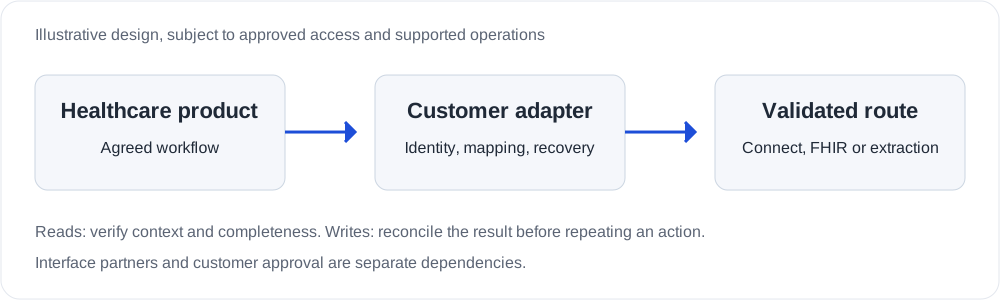
The estimate structure
What changes AdvancedMD integration cost and timeline
A quote follows the workflow assessment. Development ranges await approved figures, and vendor fees require a current quote. The estimate separates engineering work from licensing, partner charges and approval dependencies.
API family and access readiness
An approved environment and complete documentation reduce uncertainty. Pending agreements or missing permissions remain external dependencies in the plan.
Workflow depth
A clinical viewer, scheduling workflow and financial transaction have different state and recovery requirements. Count the actual user actions and their consequences.
Data mapping and identity
Existing stable identifiers and agreed field ownership simplify the connector. Ambiguous matching, legacy values and conflicting updates require additional review and tests.
Customer count and configuration
Each customer connection adds configuration, authorization and acceptance work. Shared adapters do not remove customer-level validation.
Historical data and refresh needs
An initial extract, ongoing delta loads and near-real-time product actions have different operating requirements. Specify coverage, freshness and retention before estimating.
Partners and ongoing support
Interface partner scope, monitoring, incident response and credential rotation need commercial and technical owners. Confirm vendor and partner charges directly with those parties.
Engagement options
Three ways to move the integration forward
Choose the starting point that matches your access, existing product and delivery needs.
Discovery and feasibility
For an uncertain route or missing access. Define the workflow, test the difficult assumptions and produce a scope with named dependencies.
Scoped implementation
For a validated operation contract. Agree the connector, application changes, acceptance evidence and customer rollout milestones.
Engineering and operational support
For an existing connection. Prioritize new workflows, diagnose recovery gaps and define monitoring and support ownership.
Evidence you can check
Acceptance evidence to request before activation
These are proposed acceptance artifacts for your project. This page does not claim an existing AdvancedMD customer deployment, vendor endorsement or an approved partnership.
Operation-level capability results
A record of the methods tested, the environment used and the expected versus observed response. Unsupported actions remain visible.
Synthetic recovery demonstrations
Tests for expired access, partial data, duplicate submission and unknown write outcomes using synthetic records. Label simulated responses separately from vendor-connected tests.
Customer workflow acceptance
A reviewer confirms the correct patient and intended practice action. Technical success and clinical or financial acceptance are recorded separately.
Named case study
A public AdvancedMD case study is awaiting an approved customer example. We will publish only details and results that can be supported and shared.
Before you commit
AdvancedMD integration questions
Does AdvancedMD offer an API?
Yes. Its developer documentation describes Connect APIs, FHIR APIs and ODBC extraction. Choose the route by the operations and data your product needs, then confirm the customer access and documented capabilities.
Can we write clinical data through AdvancedMD FHIR?
AdvancedMD describes its regulatory FHIR APIs as read-only GET access. A workflow that creates or changes records needs a separate Connect API assessment and confirmation of the permitted operation.
What does Connect API access require?
AdvancedMD documents a developer agreement with licensing and support fees, followed by documentation and sandbox access. It describes a successful InterOps demonstration before production credentials. Confirm the current terms directly with the vendor.
Can you integrate appointment scheduling?
We can scope the appointment workflow against the licensed transactional documentation. Before committing the feature, confirm the required methods, fields, customer permissions and how creation, rescheduling and cancellation are reconciled.
Can an application use SMART authorization?
The vendor documents SMART OAuth authorization for its FHIR access. We assess the intended patient or provider flow, supported context and permissions against the current documentation and approved environment.
Is ODBC suitable for a reporting warehouse?
It is a candidate route for bulk extraction. The design still needs an agreed table and field scope, update and deletion handling, destination access controls, reconciliation and a freshness policy.
Can we connect a lab or custom HL7 feed directly?
AdvancedMD directs orders, results and custom external-developer HL7 workflows through integration partners. We assess that route and coordinate the application-side mapping and acceptance work with the customer and partner.
How do you prevent duplicate writes?
The design records each intended operation and its outcome. When a request times out, it uses supported retrieval or reconciliation before retrying. If the result cannot be determined safely, the operation moves to review rather than automatically repeating the action.
How do you handle patient matching?
We agree stable identifiers and record ownership with the customer. Demographic matches remain candidates until the required review confirms them. Ambiguous records are blocked from automatic clinical or financial actions.
How much does an AdvancedMD integration cost?
A scoped quote depends on the workflows, API route, mapping, access readiness, customer count and support needs. Development charges, vendor licensing and interface partner fees are listed separately. Published fixed ranges are awaiting approved figures.
How long will the integration take?
We estimate engineering effort after reviewing the required operations and access. Vendor provisioning, demonstrations, partner work and customer acceptance are separate elapsed-time dependencies. We do not publish a fixed timeline without that scope.
What does an AdvancedMD API integration assessment include?
The assessment maps each product action to a candidate connection route, identifies the licensed documentation and customer access needed, and defines how the resulting record will be verified. It also lists unsupported operations and approval dependencies before the build is committed.
Can you extend an existing AdvancedMD EHR integration?
We can assess the existing adapter, access configuration and operational evidence, then scope the new workflow. The review checks field ownership, customer isolation, duplicate handling and regression risks before adding new reads or writes.
Are you an approved AdvancedMD marketplace partner?
This page does not establish an approved partnership or marketplace listing. Vendor program approval and customer production access must be verified separately from our proposed implementation services.
Next useful step
Scope your first AdvancedMD workflow
Tell us which practice workflow your product needs, what access is available and which action must work first. We will use those details to define the implementation and approval dependencies.
Plan with the right evidence
Confirm the workflow and the available access.
Review the current vendor documentation alongside your customer's requirements. The delivery plan records the operations tested, environment and outstanding approvals.
AdvancedMD developer solutions: connection routes and access requirements (checked October 11, 2026) ↗AdvancedMD FHIR developer portal ↗AdvancedMD FHIR registration and access guide ↗AdvancedMD API connection request ↗AdvancedMD is a trademark of its respective owner.
Implementation guides for your team
SMART on FHIR implementation guide →SMART authorization troubleshooting →Healthcare API security planning →Plan the rest of your integration
EHR and EMR integration services →FHIR integration services →SMART on FHIR app development →Revenue cycle integration →HL7 integration services →Talk through your requirements
What should your AdvancedMD connection do?
Share the workflow, required reads or writes and current access status. Include any customer or partner dependency that is blocking the next step.
- Your workflow and target customer
- The data and operations you need
- What is already built and what is blocked