Healthcare Data Pipelines

Healthcare Data Pipeline Services

When a data feed fails quietly, people act on wrong or late numbers and nobody knows until someone complains. Our healthcare data pipeline services move your clinical and claims data on time, hold back anything that fails a check and show what happened. You start with a fixed-price assessment and see the plan and the cost before you commit to a build.

Book the Healthcare Data Platform Assessment

For teams facing unreliable feeds, manual exports or inconsistent datasets.

At a glanceFor decision makers
  1. 01
    The problem

    Data arrives late, twice or not at all, and people find out from a wrong report.

  2. 02
    The outcome

    Data that arrives on a schedule you can see, with failed checks holding the release.

  3. 03
    How risk is controlled

    Release waits on a reconciliation check, and the original data is kept for a rerun.

  4. 04
    What it costs

    $3,500 fixed for the assessment. 2 to 3 weeks, credited against the build.

  5. 05
    The next step

    Book the assessment and get a costed plan you can use with any vendor.

The business case

What Unreliable Data Feeds Cost You

A pipeline is only worth paying for when people can rely on what comes out of it.

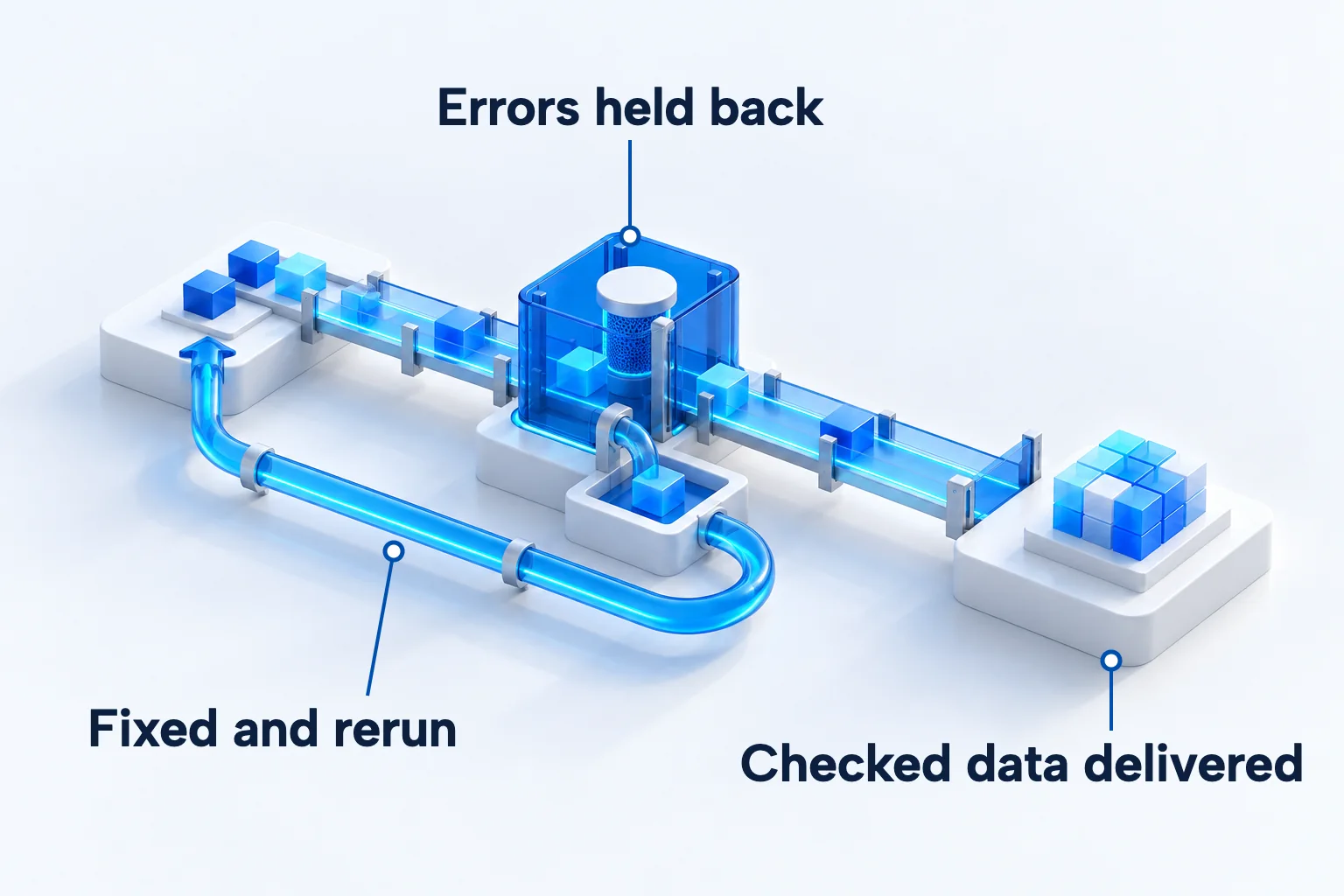
Data moving through a clean set of pipes with one bad packet held at a filter and sent round a return loop, while neat checked blocks arrive at the receiving end.

The problem

Healthcare data arrives from many places, on different schedules, and it changes after it arrives. Lab results get corrected and claims get reversed. Without a controlled route, a missed file or a resent message quietly changes your numbers.

What it costs you

  • Leaders act on numbers that are late or wrong, and find out afterwards.
  • Staff chase missing files and fix errors by hand every week.
  • Corrections get counted twice, which damages trust in every report.
  • A vendor change or a new source turns into a long, risky rebuild.

What you get

  • An alert names the missing delivery before your reports go out.
  • Bad records are held with a reason, so someone can fix them.
  • A corrected record replaces the old one, with the history kept.
  • Code and runbooks your own team can run after we hand over.

Our view

A Pipeline Is Done When It Reconciles

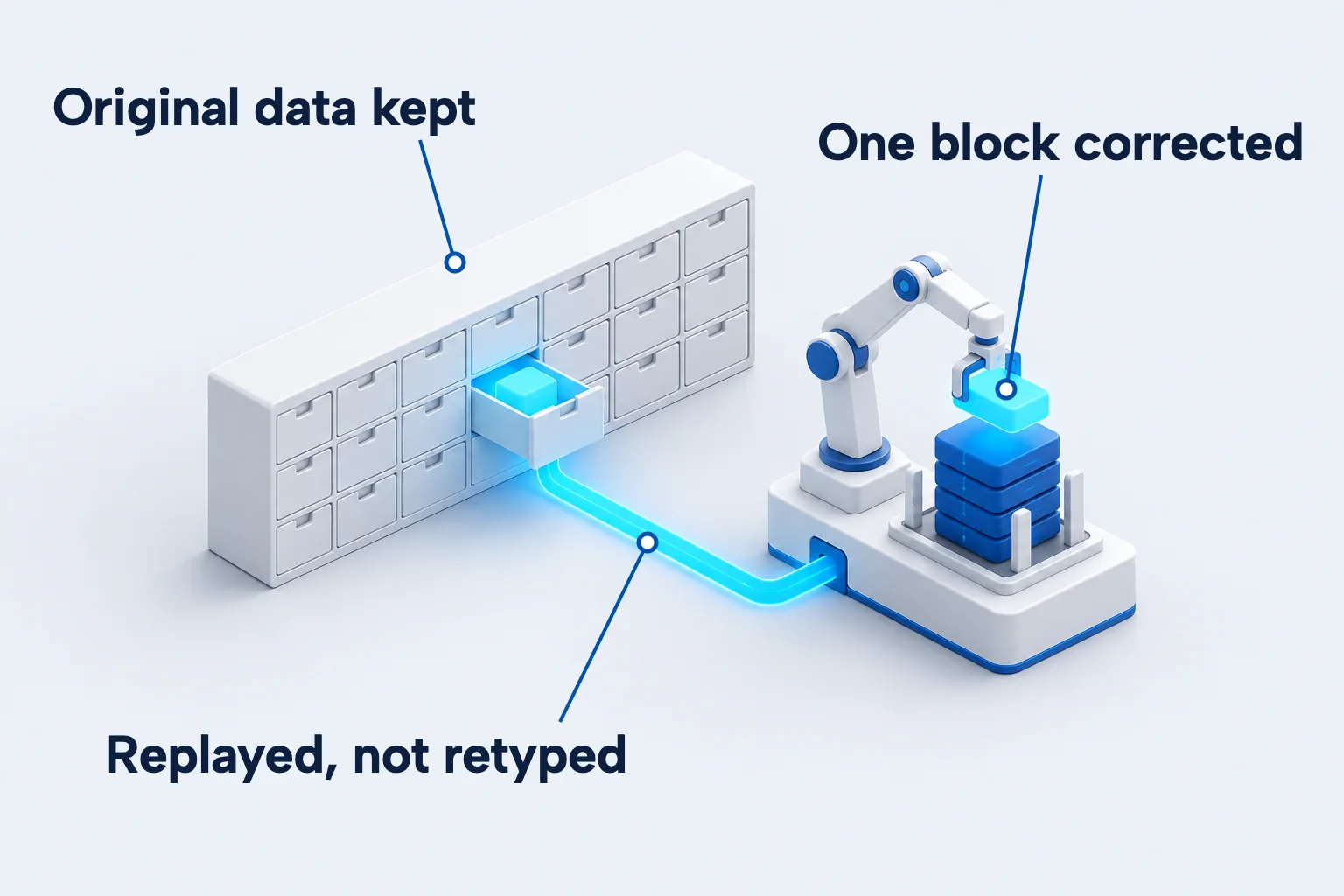
A green job status tells you the code ran. It does not tell you the data is complete or correct. We treat a healthcare pipeline as finished when its output ties back to the source and your team can replay a bad day without double counting.

Batch and CDC should be your default

Streaming adds ordering, replay and on-call work. Use it when someone acts on the event within minutes, as with ADT-driven bed management. Remittance files arrive in batches, and streaming cannot make them earlier.

Corrections are normal traffic

A corrected ORU, a reversed 835 and a merged patient are everyday events in healthcare. Design for them from the start, since retrofitting them means rebuilding the keys.

Keep what arrived

Without an untouched copy and a delivery ledger, you cannot prove what the source sent or rebuild after a bad mapping.

Interface engines and pipelines do different jobs

Mirth Connect is good at routing and acknowledging messages. Analytics history, reconciliation and modeling belong downstream of it.

When we would tell you not to build a new pipeline: an existing one fails for a known reason, such as one mapping or missing retries. Repair it first and spend the money on the next source.

For decision makers

What a CIO or Head of Data Should Check Before Hiring Us

These are the questions that decide whether a data engineering vendor is safe to hire. Here are our answers, and how to test them.

An archive drawer of original data pulled open and used to rebuild one corrected block in a neat stack, showing how a correction is replayed from kept history.

Risks and how we control them

RiskHow we control it
A source changes without noticeContract checks at intake that quarantine and alert
Replay creates duplicatesIdempotent writes, tested before release
PHI appears in logs or dead-letter queuesRestrict and retain these stores like production data, and log identifiers without payloads
Streaming costs more than it returnsRequire a named person who acts on the fresher data
One person holds all the knowledgeRehearse the runbook with your team before handover

Governance and PHI handling

  • We start with metadata, schemas and synthetic or de-identified samples. Production PHI comes in only when the work needs it and access has been approved.
  • We sign a business associate agreement with you before our work touches PHI. Your platform and cloud BAAs stay between you and those vendors, and we check that they are in place.
  • Nirmitee is ISO 27001:2022 certified. That covers how we run our security management. It does not certify your environment or your HIPAA compliance.
  • Access is tested using the roles that will really read the data, and your team approves who gets what.

Who owns the code and the data

  • Your data stays in your accounts and under your agreements. We work inside your environment.
  • Once paid, you own the custom code we write for you, including models, metric definitions and runbooks, and all of your data. We keep our reusable tools and open-source parts.
  • The custom code lives in your repository, so you can change vendor without a rebuild.

What the team looks like

  • A technical lead who owns the architecture and answers for the numbers.
  • Data engineers for ingestion and models, and an analytics engineer for metric definitions and dashboards.
  • A healthcare integration engineer when HL7 v2, FHIR or X12 sources are in scope.
  • From your side: a data owner, a clinical or finance owner for each definition, and someone who can grant access.

How to judge any vendor, including us

  • Ask them to explain how a corrected lab result or a reversed claim moves through their design, without double counting.
  • Ask who signs off a metric definition, and where that decision is recorded.
  • Ask to see a reconciliation report format and a replay test before you sign.
  • Ask what you would keep if you ended the contract next month.
  • Be wary of a firm that names a platform before it has asked about your sources and your decision.

The first step

Healthcare Data Platform Assessment

Fixed price: $3,500. 2 to 3 weeks, credited against the build.

A fixed-price first step for one decision you need the data to support. You finish with enough evidence to approve, change or stop the build, and the outputs are yours to use with any vendor.

Book the Healthcare Data Platform Assessment

What you receive

Source inventory
Each system, its owner, how it delivers data, how it sends corrections and what access still has to be granted.
Target architecture
The platform and layers we recommend for your workload, with the options we rejected and why.
Data model outline
The grain, the main facts and dimensions, and the first metric definitions to be agreed.
Risk list
Access, quality, identity, PHI and operating risks, each with an owner and a proposed control.
Costed build plan
The work in sequence with its cost and the dependencies on your team and your vendors.

What we need from you

  • One person who owns the decision the data must support.
  • Time with the owner of each source system and each metric.
  • Schemas, data dictionaries, sample layouts and any existing reports. We do not need PHI or production credentials for the assessment.

What is not included

  • Building pipelines, models or dashboards. That is separate work you can decide on after reading the plan.
  • Databricks, Snowflake or cloud subscriptions, which you contract directly with the vendor.
  • Clinical or measure sign-off, which stays with your clinical and quality leads.
  • Legal or compliance opinions, and any certification of your environment.

The assessment is complete when all five outputs are delivered and walked through with your owners. Sending the form starts a conversation, and you pay nothing until you agree the assessment.

How the work runs

How a Pipeline Project Runs

We reproduce failures before designing fixes, and test the bad days on purpose before release.

  1. 1

    Trace

    Follow one record from source to report, and reproduce any current failure.

    You review: A failure map with evidence

  2. 2

    Contract

    Agree schema, keys, update behavior, delivery windows and quality rules for each source.

    You review: A source contract

  3. 3

    Build

    Implement intake, the ledger, validation, transformation and exception handling.

    You review: Versioned code with tests

  4. 4

    Exercise

    Feed in duplicates, late records, corrections, rejected records and a full replay.

    You review: Exercise results you can inspect

  5. 5

    Reconcile

    Tie counts and control totals to the source.

    You review: A reconciliation report

  6. 6

    Hand over

    Set freshness and volume alerts, assign dead-letter ownership and walk through recovery.

    You review: A runbook and named owners

Evidence you can check

Related delivery

Clearinghouse Claims Integration in a Behavioral-health EHR

Read how Nirmitee diagnosed and hardened an existing clearinghouse X12 pipeline inside a live behavioral-health EHR, using reviewed fixes and automated tests.

Delivery context: an operational claims integration. Its source and workflow constraints shape how we design data pipelines.

Read the implementation case study →
Jitendra Choudhary

Technical contact

Jitendra Choudhary

Co-Founder & CTO

Meet the engineering leadership →

Cost drivers

What Drives the Cost of a Healthcare Data Pipeline

Pipeline effort follows source behavior more than data volume.

Source count and variety

Each HL7 feed, FHIR endpoint, X12 trading partner or database adds its own contract and tests.

Freshness

Streaming and CDC need ordering, idempotency and back-pressure handling that batch does not.

Update semantics

Corrections, cancellations, merges and deletes require versioned keys and restatement logic.

Data quality at the source

Missing identifiers, local codes and free text add mapping and review work.

Existing pipeline state

Repairing undocumented jobs starts with reverse engineering the current behavior.

Monitoring expectations

On-call coverage, alert routing and SLAs add operational setup.

Book the Healthcare Data Platform Assessment →

For your engineers

The Technical Detail

What your technical team will want to check: sources, batch or streaming choices, layer rules, failure handling and samples of the work.

What we build and connectSources, ingestion and who owns what

The short answer

What a Healthcare Data Pipeline Service Delivers

We build and repair the pipelines that move healthcare data from source to consumer: HL7 v2 ADT and ORU feeds, FHIR Bulk Data NDJSON and FHIR Subscriptions, X12 837, 835 and 277CA files, flat-file drops and log-based CDC from EHR and billing databases. Each pipeline has a source contract, validation with a quarantine path, reconciliation to the source, safe replay and freshness alerts routed to a named owner.

Who it is for
Teams facing unreliable feeds, manual exports, duplicate records or numbers that do not match the source.
What we build
Batch, CDC and streaming pipelines with quality rules, reconciliation, replay and monitoring.
The outcome
Data that arrives on time, matches the source and recovers from failure without manual clean-up.

What we build

Healthcare Data Pipelines We Build

Pipelines named by source and standard, each with the behavior it must handle.

HL7 v2 feed pipelines

ADT, ORU, ORM, SIU and MDM messages from Mirth Connect or another interface engine, over MLLP or a queue, parsed to segment-level tables with message control IDs used for de-duplication and ordering.

HL7 integration services

X12 claims pipelines

837 claim, 835 remittance, 277CA and 999 acknowledgment files parsed to claim, line and adjustment tables, with CARC, RARC and claim-status codes kept for denial and payment analytics.

X12 837 and 835 to FHIR

Change data capture

Log-based CDC with Debezium, AWS DMS or native connectors from EHR, practice-management and billing databases, with ordered inserts, updates and deletes and a replayable offset.

CDC for healthcare data warehouses

Terminology and identity steps

Local code mapping to LOINC, SNOMED CT, RxNorm and ICD-10-CM, and patient matching rules with review queues for uncertain matches.

Terminology mapping in production

Observability and recovery

Checkpoints, idempotent writes, dead-letter queues, freshness and volume alerts, and OpenTelemetry traces across interface engine, pipeline and warehouse.

Instrumenting HL7 and FHIR pipelines

Sources handled

Sources and How Each Is Received

The intake method follows from how the source delivers data. These are the patterns we use.

SourceIntake patternAcknowledgment or completeness signalCommon failure
HL7 v2 ADT, ORU, ORM, SIUMirth Connect or another engine over MLLP, then a message topic or storeACK per message and a sequence checkResends, and A08 updates arriving before A01 admits
FHIR Bulk DataKick off $export, poll status, download NDJSON and load with _sinceThe manifest of output filesExpired download links and partial downloads
FHIR SubscriptionsWebhook intake with a queue behind itEvent numbers and a catch-up queryMissed events during an outage
X12 837, 835, 277CA, 999SFTP or clearinghouse API, then a loop-aware parser999 and 277CA responses, and 835 control totalsReversals counted as new payments
DatabasesLog-based CDC with Debezium or AWS DMSLog position and a periodic count comparisonSchema changes that stop the connector
Flat files and vendor exportsScheduled pickup with a layout checkExpected-file ledger and row countsA changed layout loading the wrong columns

CDC for healthcare data warehouses

Integration boundaries

Integration Boundaries for a Healthcare Pipeline Project

Explicit ownership keeps failures from falling between teams.

Source owners

Grant access, publish schema changes in advance and own corrections at the source.

Interface engine

If Mirth Connect or another engine feeds the pipeline, channel changes are coordinated with its owner or our Mirth team.

Pipeline and quality

We own ingestion code, validation, reconciliation, replay and the runbook for the agreed scope.

Consumers

Consuming teams define freshness and completeness expectations and accept the published dataset.

Real-time write-back

Sending data back into an EHR is integration work, scoped with our interoperability team.

Platform choice and data layersOptions compared, layers and the data model

Compare your options

Batch, CDC and Streaming Healthcare Pipelines Compared

Choose the pattern from the freshness your consumer needs, not from a default real-time promise.

PatternTypical freshnessGood forEngineering watch-points
Scheduled file batch (SFTP, CSV, CCD)Daily or hourlyPayer files, vendor extracts, legacy systemsLate or partial files, re-sent files, schema drift
FHIR Bulk Data $exportDaily or weekly, incremental with _sincePopulation analytics, quality measures, payer data exchangeExport job limits, deleted resources, version handling
Log-based CDCSeconds to minutesEHR and billing databases you are permitted to readSchema changes, ordering, initial snapshot, source load
Event streaming (HL7 v2 or FHIR Subscriptions to Kafka)SecondsADT alerts, lab results, care coordinationDuplicates, out-of-order events, consumer back-pressure

Tooling follows the pattern and your stack: Mirth Connect, Kafka, Airflow, dbt, Spark, Databricks, Snowflake or your cloud services.

Medallion layers

Layer Rules for Pipelines

Whatever you call the layers, a pipeline needs these boundaries. They are what make a replay safe.

LayerPipeline ruleWhat it makes possible
Bronze: landingAppend only, with source, delivery ID and received time on every recordRebuild everything downstream after a bad mapping
Silver: validatedIdempotent writes keyed on source ID and version, with rejected records kept and given a reasonRerun without creating duplicates
Gold: publishedReleased only after reconciliation passesRelease waits until the day's load reconciles

Medallion architecture for healthcare data

Dimension mapping

Mapping Dimensions Inside the Pipeline

Do the mapping once, in one place, and keep the original value. Changing a rule then means a rerun and leaves the raw data untouched.

DimensionWhere it comes fromPipeline treatment
PatientPID segment, Patient resource, 837 subscriber loopKeep source identifiers side by side and resolve them in a separate, rerunnable step
ProviderPV1, Practitioner, NM1 loopsNormalize to NPI where present, with the role kept
PayerClearinghouse IDs, plan filesCrosswalk table with an owner and effective dates
Lab codesOBX-3 local codesCrosswalk to LOINC, with unmapped codes sent to a work queue
TimeMSH, event and service timestampsStore in UTC with the source time zone and name each date role
Definitions, refresh and cleanupMetric definitions, how often data refreshes, and common fixes

Semantic models

Metric Definitions That Pipelines Must Protect

A pipeline change can quietly alter a metric. So we tie each metric to the pipeline rules it depends on, and test them together.

MetricPipeline rule it depends onWhat breaks it
Net paid amountApply 835 reversals in sequence, by claim control numberLoading a reversal as a new payment
Current admitted patientsProcess ADT events in event order, with cancels appliedA cancelled admission that stays open
Abnormal result countKeep only the latest result version for each orderCounting preliminary and final results together
Eligible populationApply effective dates from the 834 or member fileOverwriting past coverage with today's status

Refresh frequency

Batch, CDC or Streaming: Choosing Refresh

Ask how soon someone acts on the data, then choose the simplest method that meets that need.

MethodFitsYou take onAvoid when
Scheduled batchClaims, remittances, quality reporting and monthly closeDelivery windows and backfillsSomeone must act within the hour
Micro-batchLab trends and operational reporting during the dayLate-arriving data handlingThe source only delivers daily
Log-based CDCBilling and practice databases, including deletesLog access, schema changes and connector upkeepThe vendor will not allow log access
StreamingADT-driven workflows and alertsOrdering, replay and on-call coverNobody acts on the event in minutes

Cleanup problems and fixes

Pipeline Failures and Their Fixes

These are the failure modes we test for on purpose.

FailureFixTest that proves it
Same message delivered twiceIdempotent write on message control IDReplay a day and compare totals
Events out of orderSequence on event time and version, and hold or re-apply late eventsShuffle a test batch and compare the end state
Corrected result or claimSupersede the prior version and keep historySend a correction and check the metric moves once
Source schema changesContract check at intake that quarantines unknown shapesAdd a column and rename another in test
Partial file or exportCompare with manifest and trailer counts before processingTruncate a file in test
Bad records pile up unseenA dead-letter queue with an owner, reason codes and an age alertInject bad records and confirm the alert

Why healthcare data quality can get worse after integration

Dashboards, forecasts and samples of the workWhat you receive, and what it looks like

Dashboards people act on

Pipeline Health Views People Act On

Pipeline monitoring needs its own screens. These are the views we set up with the operations team.

Who opens itThe questionThe action it triggers
Data on-callWhat delivery is missing or late?Call the source owner or start a replay
Data stewardWhat is in the dead-letter queue, and how old is it?Fix the mapping or reject with a reason
Analytics leadDid today's load reconcile?Hold or release the affected dashboards
Platform ownerWhich pipelines cost the most for the decisions they serve?Lower the refresh rate or retire the job

Forecasting loop

The Forecasting Loop for Pipeline Operations

The first useful forecast is about the pipeline itself: how much data should arrive. A gap against that forecast catches trouble no error log will show.

  1. 1

    Learn the pattern

    Record normal volume by source, weekday and hour.

  2. 2

    Predict

    Set an expected range for each delivery.

  3. 3

    Alert

    Flag deliveries outside the range even when the job itself succeeded.

  4. 4

    Review

    Label each alert as a real issue or a false alarm.

  5. 5

    Tune

    Adjust ranges, and feed verified history to downstream forecasts.

Business forecasts can use the same reconciled history once the pipeline has been stable long enough to trust.

Deliverables

What You Receive From a Pipeline Project

All of it lives in your repository and your accounts.

Intake and transformation code

Versioned, tested and deployable by your team.

Source contracts

One for each feed, kept with the code.

Delivery ledger

What was expected, received, rejected and released.

Failure test pack

Duplicate, late, corrected, partial and replay scenarios using synthetic data.

Alerts and dead-letter ownership

Freshness, volume and age alerts, each with a named owner.

Runbook

How to replay, backfill and recover, rehearsed with your team.

Samples of the work

See the Format Before You Hire

You should see what the work looks like before you hire anyone. These samples show the format we hand over. All values here are invented for illustration. They do not come from any patient, client or project.

Sample: Delivery Ledger

The ledger shows what was expected and what happened to it, even when no job failed.

DeliveryExpectedReceivedStatus and action
ADT feed, site AWithin normal volume rangeIn rangeReleased
835 file, clearinghouseOne file by morningNot receivedAlert sent to the source owner, dashboards held
FHIR export, ObservationAll files in the manifest11 of 12Partial: reload the missing file, then process

Sample: A Claim Reversal, Traced

One reversal followed through to the metric, so the total moves once.

StepWhat arrives or happensNet paid for this claim
First 835Claim paid 120.00120.00
Reversal in a later 835Status 22, minus 120.00, same claim control number0.00
Corrected paymentClaim paid 95.0095.00
Replay of all three filesEach file is already in the ledger, so it is skipped95.00

Sample: Replay Test Result

A replay should change nothing except what was wrong.

TestBeforeAfter replayResult
Rows in validated lab table48,21048,210Pass: no duplicates
Corrected results applied once6 corrections sent6 versions replacedPass
Net paid against control totalEqualEqualPass
Dead-letter records with a reason19 of 1919 of 19Pass
Architecture, flows and ownershipThe design written out, step by step

Healthcare Data Pipeline Architecture

StageWhat it holds
SourcesHL7 v2 over MLLP, FHIR $export, FHIR Subscriptions, X12 837 and 835, database logs and flat files.
Intake and delivery ledgerMirth or another engine, NDJSON loader, SFTP pickup, Debezium or DMS, with expected deliveries checked against what was received.
Raw store, append onlyDelivery ID, received time and original payload.
Validate and transformContract check, idempotent write, dead-letter queue and code crosswalks.
Reconcile, then releaseControl totals, freshness and consumers.
AlertsMissing delivery, odd volume and aged dead letters.

Where Every Record Ends Up

StepWhat is checkedWhat happens
Message arrivesChecked against the ledger.
Seen this control ID?The exact same message, resent.Yes: skip it and count it.
Passes the contract?Schema, keys and codes.No: dead-letter queue, with a reason.
Newer version of a record?A corrected result or a reversal.Yes: replaces the prior version and keeps history.
Write to validated tableKeyed on source ID and version.
Totals tie to source?Counts and control totals.No: release held.

What Must Be True to Cross Each Layer

LayerRuleKeepsAllows
Bronze: landingAppend onlyPayload, delivery ID, received timeFull rebuild after a bad mapping
Silver: validatedIdempotent, keyed on ID and versionRejected records, with a reasonRerun with no duplicates
Gold: publishedRelease only after reconciliationGrain and metric ownerConsumers get reconciled days only

Batch, CDC or Streaming?

Answer in this order. The first yes is the method to use.

QuestionIf yes
Does someone act on the event within minutes?Streaming
Database source, log access allowed, deletes matter?Log-based CDC
Source delivers through the day, and the same-day number is used?Micro-batch
None of these?Scheduled batch

When a Delivery Fails

WhoWhat they do
Alert firesMissing delivery, odd volume or aged dead letters.
On-call engineer: triageIs it the source, the pipeline or the mapping?
Source ownerResends or fixes the feed.
Data stewardClears dead letters: fix the mapping or reject.
On-call engineer: replayReplays from raw, then checks totals.
Analytics leadReleases or holds affected dashboards.

Where PHI Sits, and Who Can Reach It

WhereWhat happens there
Your environmentHolds your source systems, data platform and PHI, under your platform and cloud BAAs, your roles, your masks and your audit logs.
During the assessmentWe use schemas, data dictionaries and synthetic samples. We do not use PHI or production credentials.
During a buildWe sign a BAA with you first. Access uses approved roles, is logged and is the least needed. You grant, review and revoke it.
The codeCode and tests use synthetic data and live in your repository.
Guides and referencesFurther reading and vendor documentation

Explore the implementation decisions

Guides for the Work Ahead.

Before we begin

Healthcare Data Pipeline Questions Buyers Ask

What is a healthcare data pipeline?

It is the automated path that receives data from a source such as an EHR, lab, clearinghouse or device platform, validates and transforms it, and publishes it for a consumer such as a warehouse, product feature or AI workflow. A production pipeline also reconciles to the source, quarantines bad records and recovers from failure.

Should healthcare data use ETL or ELT?

Most modern healthcare warehouses use ELT: land the source as received, then transform in the warehouse so raw data stays available for audit and reprocessing. ETL still fits when data must be filtered or de-identified before it reaches the destination.

Can you build pipelines from HL7 v2 feeds?

Yes. We receive HL7 v2 messages through Mirth Connect or another interface engine, parse segments such as PID, PV1, OBR and OBX into tables, de-duplicate on message control ID and preserve the raw message for audit.

How do you process X12 835 remittance files?

We parse 835 files into payment, claim and service line tables, keep CAS adjustment groups with CARC and RARC codes, and reconcile totals to the BPR payment amount. The result supports denial analytics and payment posting checks.

What is change data capture and when do we need it?

Change data capture reads a database transaction log so inserts, updates and deletes flow downstream in order, without nightly full extracts. It fits when you are permitted to read an EHR or billing database and need fresher data than batch provides.

How do you handle corrected lab results and late-arriving data?

We key records on stable source identifiers and versions, apply corrections as updates rather than new rows, and allow late data within an agreed window. Consumers see a restatement flag when historical numbers change.

How do we judge a pipeline vendor?

Ask them to show a replay test, what happens to a corrected result, where rejected records go and who owns them. Ask too what signals a missing delivery when no job has failed. We work on Databricks, Snowflake and your existing warehouse, so the tool should follow from those answers.

Can you fix a pipeline that already exists?

Yes. We start with failure evidence, source behavior and operational ownership, then deliver targeted remediation with measurable acceptance checks.

How do you monitor healthcare pipelines?

We track freshness, volume, rejected-record counts and reconciliation results per run, route alerts to a named owner and trace records across interface engine, pipeline and warehouse. Dead-letter queues keep failed records for review and replay.

Do you need real patient data to start?

No. Discovery and test design start with synthetic or de-identified examples. Later access to production data happens in approved environments under a BAA.

How long does it take to build a healthcare data pipeline?

The assessment takes 2 to 3 weeks. We do not quote a build schedule before it, because source access and sign-off owners set the pace and differ widely. The costed build plan gives the sequence and its dependencies, once those are known.

What does a healthcare data pipeline cost?

The Healthcare Data Platform Assessment is a fixed $3,500. It takes 2 to 3 weeks and is credited against the build. It ends with a costed build plan. The build depends on source count and variety, freshness, update behavior, source data quality and the state of any existing pipeline.

Talk to our team

Book the Healthcare Data Platform Assessment

Tell us what you are planning, what exists today and what needs to change. We’ll review the context and discuss scope, dependencies and the next useful step.

hello@nirmitee.io →

Please exclude patient data and credentials. We use these details to respond to your inquiry. Privacy policy

Thank you. Your inquiry has been received. Our team will review your requirements.