Healthcare organizations generate approximately 50 petabytes of data annually, yet a staggering 97% of hospital-generated data goes unused, according to a 2023 study published in the Journal of Medical Internet Research. The architecture you choose to store, govern, and analyze this data isn't a technical footnote — it's a strategic decision that determines whether your organization can deliver on the promise of data-driven care.
As the HL7 community noted in a widely cited blog post, healthcare is "drowning in data but starving for information." The gap between data collection and actionable insight is an architecture problem. Whether you're a single-hospital system running clinical dashboards or a multi-state health network training ML models for readmission prediction, the wrong architecture creates technical debt that compounds for years.
Related Reading
For more insights, explore our guides on Data Mesh in Healthcare: Domain-Owned Data Products and FHIR in Modern Healthcare.
You may also find value in EHR Software Development Guide and Building a Healthtech App.
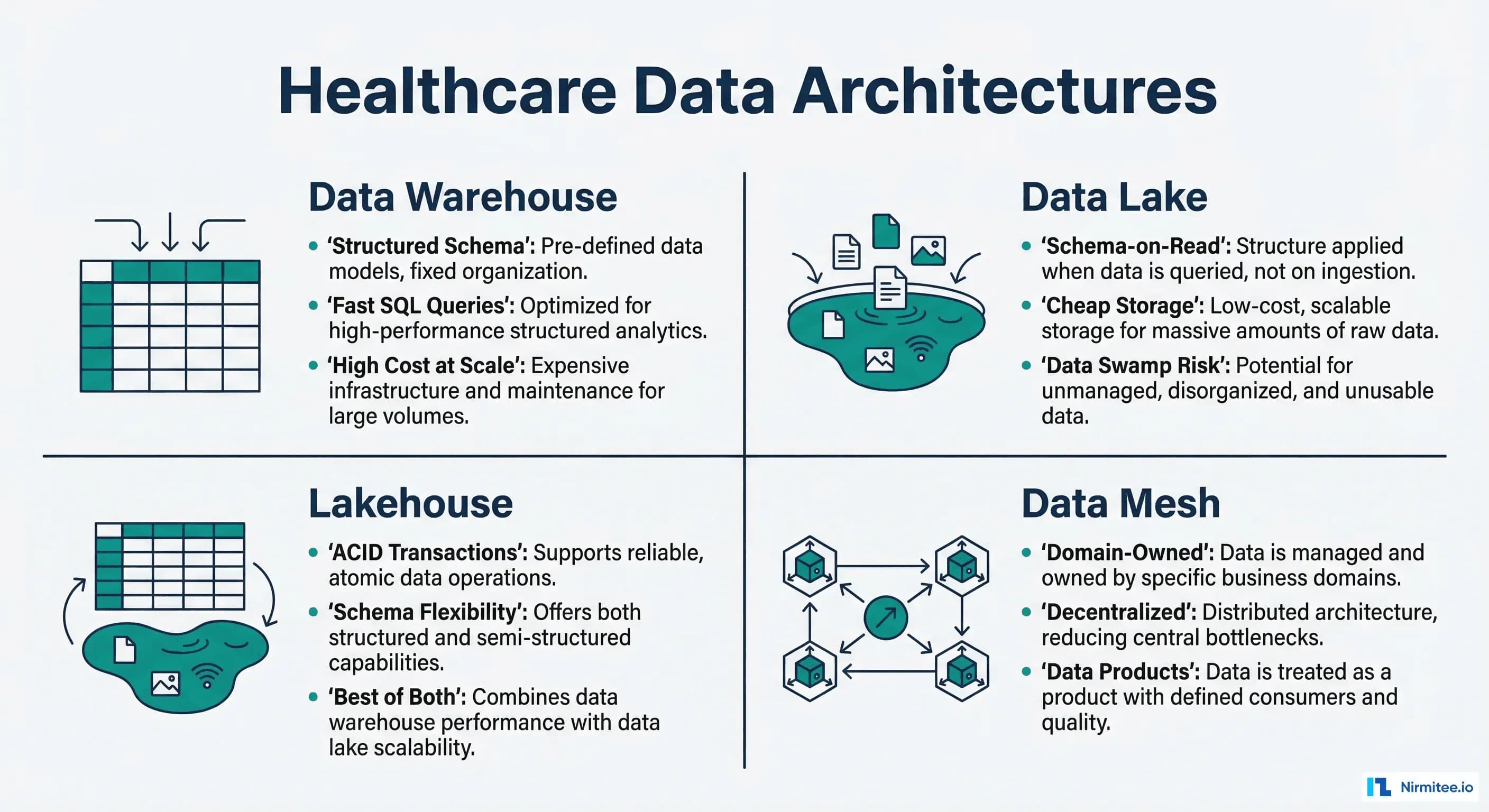
This guide compares four dominant data architectures — Data Warehouse, Data Lake, Lakehouse, and Data Mesh — through the lens of healthcare. We'll cover real-world trade-offs, healthcare-specific constraints (HIPAA, data lineage, PHI governance), and a decision framework you can use today.
For a lakehouse pattern applied end to end, see our case study on medallion architecture for healthcare data.
Architecture 1: Data Warehouse — The Trusted Workhorse
How It Works
A data warehouse is a centralized repository of structured, schema-on-write data optimized for analytical queries. Data is extracted from source systems (EHRs, claims, labs), transformed to conform to a predefined schema (star or snowflake), and loaded into the warehouse via ETL pipelines.
In healthcare, this typically means tools like Snowflake, Amazon Redshift, Google BigQuery, or on-prem solutions like Teradata. The schema is defined upfront — a Patient dimension table, an Encounter fact table, a Diagnosis dimension — and all incoming data must conform or be rejected.
Healthcare Pros
- Fast, predictable SQL queries: Clinical dashboards, quality measure reporting (HEDIS, CMS Stars), and executive KPIs run in seconds. A well-tuned Snowflake warehouse can return readmission rates across 500K encounters in under 2 seconds.
- Strong governance: Schema-on-write enforces data quality at ingestion. You know exactly what's in each column, which makes HIPAA audit trails straightforward. Column-level access controls protect PHI.
- Mature tooling: BI tools (Tableau, Power BI, Looker) integrate natively. Clinical analysts can self-serve without engineering support.
- Regulatory compliance: Centralized data lineage makes it easier to prove data provenance for CMS audits and HIPAA compliance requirements.
Healthcare Cons
- Rigid schema kills agility: When CMS releases new quality measures or your organization adopts a new FHIR resource type, schema changes require weeks of ETL pipeline modifications. Healthcare data models evolve constantly.
- Expensive at scale: Snowflake compute costs for a mid-size health system (10M+ encounters) can easily exceed $200K/year. Redshift reserved instances help but lock you in.
- Poor for unstructured data: Clinical notes, pathology reports, scanned documents, and DICOM images don't fit a relational schema. You lose 80% of clinical data — the unstructured portion that contains the richest clinical context.
- ETL bottleneck: Data freshness is limited by ETL batch frequency. Most healthcare warehouses refresh nightly, meaning today's discharge isn't in tomorrow morning's dashboard.
Real-World Example
Arcadia Analytics built its population health platform on a warehouse-first architecture. Their Snowflake-based clinical data warehouse aggregates claims, EHR extracts, and ADT feeds from 500+ provider organizations. The structured approach enables sub-second query performance for quality measure calculations across millions of patients — but they've had to build separate pipelines for NLP-extracted data from clinical notes.
Architecture 2: Data Lake — The Raw Data Reservoir
How It Works
A data lake stores raw data in its native format — no schema required at write time. Data is organized by source, date, and type in a flat object storage system like Amazon S3, Azure Data Lake Storage (ADLS), or Google Cloud Storage. Schema is applied at read time ("schema-on-read"), meaning each consumer defines their own interpretation of the data.
In healthcare, this means dumping HL7v2 messages, FHIR NDJSON bundles, CSV claims files, DICOM images, and scanned PDFs into the same storage layer. A data scientist querying for readmission predictors can access both structured claims and unstructured clinical notes.
Healthcare Pros
- Cost-effective storage: S3 Standard costs $0.023/GB/month. Storing 100TB of raw FHIR data costs about $2,300/month — a fraction of equivalent warehouse storage. For health systems generating terabytes of imaging data, this matters enormously.
- Handles all data types: Clinical notes, fax images, HL7v2 messages, genomic sequences, waveform data from patient monitors — everything goes in. This is critical because healthcare's data fragmentation means you receive data in dozens of formats.
- ML-ready: Data scientists can access raw data directly for feature engineering. Training a readmission model? You can combine structured encounter data with NLP features extracted from discharge summaries without waiting for ETL teams to model new dimensions.
- Preserves data fidelity: Raw storage means you never lose information to transformation. When CMS changes reporting requirements, you can re-process historical raw data without re-extracting from source systems.
Healthcare Cons
- Data swamp risk: Without governance, data lakes become data swamps. A 2022 Gartner report found that 85% of data lake initiatives fail to deliver business value, often because organizations dump data without metadata, lineage, or access controls.
- Slow queries: Schema-on-read means every query pays a parsing cost. Running a quality measure calculation across a petabyte of raw FHIR JSON is orders of magnitude slower than querying a pre-modeled warehouse table.
- Governance nightmare: PHI can end up scattered across thousands of S3 prefixes with inconsistent access controls. Data lineage is manual. HIPAA auditors will not be impressed.
- No ACID transactions: Concurrent writes can corrupt data. No support for updates or deletes — problematic when a patient exercises their right to data deletion under state privacy laws.
Real-World Example
Large academic medical centers like Partners HealthCare (now Mass General Brigham) adopted data lake architectures early to support their research missions. Their Enterprise Data Warehouse couldn't handle genomic data, imaging data, and waveform data alongside structured clinical data. The data lake provided the flexibility — but they invested heavily in a dedicated data governance team to prevent the swamp problem.
Architecture 3: Lakehouse — The Best of Both Worlds
How It Works
A lakehouse combines the low-cost, flexible storage of a data lake with the structured query performance and ACID transactions of a data warehouse. The enabling technology is an open table format — Delta Lake (Databricks), Apache Iceberg (Netflix/AWS), or Apache Hudi (Uber/AWS) — that adds a metadata and transaction layer on top of object storage.
Data lives in Parquet files on S3 or ADLS, but the table format provides schema enforcement, ACID transactions, time travel (query historical snapshots), and efficient upserts. The medallion architecture (Bronze → Silver → Gold) organizes data by quality level.
Healthcare Pros
- ACID + flexibility: You get transactional guarantees (critical for PHI updates and deletions) with schema-on-read flexibility. When a patient requests data deletion under state privacy laws, you can execute a DELETE operation that propagates correctly — impossible in a raw data lake.
- Medallion architecture fits healthcare perfectly: Bronze (raw FHIR NDJSON, raw claims), Silver (deduplicated, standardized, validated), Gold (analytics-ready cohorts, quality measures). This mirrors how healthcare data naturally flows from messy to clean.
- Unified analytics + ML: BI analysts run SQL on Gold tables while data scientists train models on Silver tables. One architecture, one copy of data, one governance model. No more copying data between a warehouse and a lake.
- Time travel for audit trails: Delta Lake's versioning lets you query data as it existed at any point in time. This is invaluable for CMS audit compliance — you can reproduce any report as of its reporting date.
- Cost-effective: Storage costs are identical to a data lake (it's still Parquet on S3). Compute is on-demand. A mid-size health system can run a lakehouse for 40-60% less than an equivalent Snowflake deployment.
Healthcare Cons
- Complexity: Setting up medallion pipelines, configuring Delta Lake optimizations (Z-ordering, auto-compaction, vacuum), and managing the Spark infrastructure requires significant engineering expertise.
- Databricks dependency: While Delta Lake is open source, the best tooling (Unity Catalog, Delta Sharing, Auto Loader) is Databricks-proprietary. Vendor lock-in is real, though Apache Iceberg offers an alternative.
- Maturity gap: Lakehouse architectures have been production-ready for only ~4 years. Healthcare-specific reference architectures, compliance certifications, and community knowledge are still developing compared to data warehouses.
Real-World Example
Innovaccer, a healthcare data platform serving 70+ health systems, partnered with Databricks to build its next-generation data platform on a lakehouse architecture. Their platform ingests data from 500+ EHR instances, normalizes it through medallion layers, and serves both population health dashboards (SQL analytics) and risk prediction models (ML) from the same infrastructure. Microsoft's healthcare data foundations also recommend lakehouse patterns for organizations combining clinical analytics with AI workloads.
Architecture 4: Data Mesh — Decentralized Data Products
How It Works
Data mesh is not a technology — it's an organizational paradigm introduced by Zhamak Dehghani at ThoughtWorks in 2019. Instead of centralizing all data into one warehouse or lake, data mesh distributes ownership to domain teams who create and maintain data products. A central platform team provides self-serve infrastructure, and a federated governance model ensures interoperability.
In a multi-hospital health system, this means the Cardiology department owns the cardiac data product (published via a well-defined API with SLAs), the Claims department owns the billing data product, and the Pharmacy department owns the medication data product. Each domain team is responsible for data quality, documentation, and access controls.
Healthcare Pros
- Scales with organizational complexity: Large health systems (Kaiser, HCA, CommonSpirit) operate hundreds of facilities with autonomous IT departments. A centralized data team becomes a bottleneck. Data mesh distributes responsibility to the people who understand the data best.
- Domain expertise drives quality: Cardiologists define what "valid cardiac data" means, not a central ETL team three departments removed. This produces higher-quality, more clinically meaningful datasets.
- Reduces time-to-insight: Domain teams can publish new data products without waiting in a central team's backlog. When a new quality measure requires new data points, the relevant domain can respond in days, not months.
- Natural fit for interoperability: Data products with well-defined APIs mirror FHIR's resource-oriented architecture. Each data product can expose a FHIR-compliant interface.
Healthcare Cons
- Requires organizational maturity: Data mesh presupposes that domain teams have data engineering capabilities. Most hospital departments don't have dedicated data engineers. You need to staff up significantly before adopting mesh.
- Governance is hard: Federated governance sounds elegant but is operationally challenging. Who decides the patient identifier standard? Who enforces PHI access controls across 20 autonomous domain teams? The governance overhead can exceed the benefits.
- Cross-domain queries suffer: Joining cardiac data with pharmacy data with claims data requires federating across domain boundaries. Performance degrades, and consistency guarantees weaken.
- Few healthcare success stories: Data mesh adoption in healthcare is nascent. Most implementations are in tech companies (Netflix, Zalando, JP Morgan) with very different data cultures from hospital systems.
Real-World Example
While pure data mesh implementations in healthcare are rare, Kaiser Permanente has adopted mesh principles in their data strategy. Their integrated model (insurer + provider) naturally creates domain boundaries between clinical, claims, pharmacy, and research domains. Each domain publishes curated datasets to an internal data marketplace, with federated governance ensuring HIPAA compliance across domains.
Head-to-Head Comparison: 8 Dimensions That Matter in Healthcare
| Dimension | Data Warehouse | Data Lake | Lakehouse | Data Mesh |
|---|---|---|---|---|
| Schema Model | Schema-on-write | Schema-on-read | Both (enforced per layer) | Domain-defined contracts |
| Storage Cost (100TB) | $50K-200K/year | $2.7K/year (S3) | $2.7K/year + compute | Varies by domain |
| Query Performance | Sub-second (optimized SQL) | Minutes (raw scan) | Seconds (Gold layer SQL) | Varies by product |
| Data Types Supported | Structured only | All (structured, semi, unstructured) | All | All |
| Governance Model | Centralized, strong | Weak without investment | Centralized (Unity Catalog) | Federated |
| ML/AI Readiness | Limited (must export data) | Strong (raw data access) | Strong (native ML integration) | Strong (domain-specific models) |
| HIPAA/Audit Trail | Mature tooling | Requires custom implementation | Time travel + lineage | Domain-level responsibility |
| Best Healthcare Use Case | Clinical BI, quality reporting | Research, genomics, imaging | Combined analytics + AI | Multi-hospital systems |
Decision Framework: Choosing the Right Architecture
The right architecture depends on three factors: organizational size, data maturity, and primary use case. Here's a practical framework.
Choose a Data Warehouse If:
- Your primary need is clinical BI and regulatory reporting (HEDIS, CMS Stars, UDS)
- You work almost exclusively with structured data (claims, ADT, lab results)
- Your organization has fewer than 5 data consumers (analysts, not data scientists)
- You need production-ready governance today, not in 6 months
- Budget for tooling is available ($100K+ annually for Snowflake/Redshift)
Choose a Data Lake If:
- You're an academic medical center or research institution with diverse data types (genomics, imaging, waveforms)
- Cost is the primary constraint and you need petabyte-scale storage on a startup budget
- You have a strong data engineering team (5+ engineers) who can build governance from scratch
- Your primary consumers are data scientists who want raw data access
Choose a Lakehouse If:
- You need both BI dashboards and ML models from the same data
- You want ACID transactions (essential for PHI updates/deletes) without warehouse costs
- You're building a modern data platform and can invest in the medallion architecture setup
- You want to consolidate separate warehouse + lake architectures into one
- This is the recommended default for most healthcare organizations in 2026
Choose a Data Mesh If:
- You're a large, multi-hospital health system with 5+ autonomous business units
- Your central data team is a bottleneck with a 6+ month backlog
- Domain teams already have data engineering capabilities (or you can staff up)
- You've attempted centralized approaches and they've failed due to organizational dynamics
The Evolution Path: From Warehouse to Lakehouse to Mesh
Most healthcare organizations will traverse these architectures sequentially, not choose one in isolation. The typical evolution path looks like this:
Stage 1: Data Warehouse (Years 1-3) — Start with structured reporting. Stand up a Snowflake or BigQuery instance, build ETL pipelines from your EHR (Epic Caboodle, Cerner HealtheDataLab), and deliver clinical dashboards. This solves the immediate need for quality reporting and operational visibility.
Stage 2: Add a Data Lake (Years 2-4) — As research and AI initiatives emerge, add an S3/ADLS-based data lake for unstructured data. Clinical notes, imaging data, and genomic data flow here. Data scientists access raw data for model training while analysts continue using the warehouse.
Stage 3: Consolidate into a Lakehouse (Years 3-5) — The warehouse + lake architecture creates data silos, duplicated governance, and pipeline maintenance overhead. Migrate to a lakehouse to unify storage, governance, and compute. The medallion architecture replaces the warehouse's star schema while preserving query performance.
Stage 4: Adopt Mesh Principles (Years 5+) — As your organization scales beyond what a central data team can manage, introduce mesh principles. Domain teams take ownership of their data products, built on the lakehouse platform. Federated governance ensures consistency.
Implementation Considerations for Healthcare
HIPAA and PHI Governance
Regardless of architecture, PHI governance is non-negotiable. Key requirements:
# Example: PHI governance controls across architectures

data_warehouse:
  column_masking: "Dynamic masking on SSN, MRN, DOB columns"
  row_level_security: "Filter by provider organization"
  audit_logging: "Query-level audit trail (who queried what, when)"

data_lake:
  encryption: "S3 SSE-KMS with per-bucket keys"
  access_control: "IAM policies + Lake Formation per-prefix"
  phi_tagging: "AWS Macie for automated PHI detection"

lakehouse:
  unity_catalog: "Column-level access control on PHI fields"
  time_travel: "30-day version retention for audit"
  row_filters: "Dynamic row-level security by user role"

data_mesh:
  data_contracts: "Each domain defines PHI fields in contract"
  federated_policies: "Central PHI policy, domain enforcement"
  access_catalog: "Self-serve access request with approval workflow"
Integration with FHIR and HL7 Standards
Modern healthcare data architectures must ingest FHIR resources natively. Here's how each architecture handles FHIR data:
# FHIR ingestion patterns by architecture

# Data Warehouse: Flatten FHIR JSON into relational tables
# Requires pre-defined table per resource type
CREATE TABLE patient_dim AS
SELECT
  resource->>'id' as patient_id,
  resource->'name'->0->>'family' as last_name,
  resource->'name'->0->'given'->>0 as first_name,
  resource->>'birthDate' as dob,
  resource->>'gender' as gender
FROM raw_fhir_resources
WHERE resource->>'resourceType' = 'Patient';

# Data Lake: Store raw NDJSON, parse at query time
# s3://healthcare-lake/fhir/Patient/2026/03/16/*.ndjson

# Lakehouse: Medallion approach
# Bronze: raw NDJSON → Delta table (append-only)
# Silver: parsed, deduplicated, standardized
# Gold: analytics-ready dimensional model

# Data Mesh: Each clinical domain owns FHIR resource mapping
# Cardiology domain: Observation (vitals), Condition (dx)
# Pharmacy domain: MedicationRequest, MedicationDispense
Cost Modeling for a 500-Bed Hospital
Realistic annual cost estimates for a 500-bed hospital processing 2M encounters/year with 50TB of total data:
| Cost Category | Data Warehouse | Data Lake | Lakehouse | Data Mesh |
|---|---|---|---|---|
| Storage | $48K (Snowflake) | $14K (S3) | $14K (S3 + Delta) | $20K (distributed) |
| Compute | $120K (credits) | $36K (EMR/Glue) | $72K (Databricks) | $90K (distributed) |
| Tooling/Licenses | $40K (BI tools) | $25K (Glue, Athena) | $30K (Unity Catalog) | $50K (catalog + mesh platform) |
| Engineering Staff | 2 FTEs ($300K) | 3 FTEs ($450K) | 2.5 FTEs ($375K) | 5 FTEs ($750K) |
| Total Annual | $508K | $525K | $491K | $910K |
Note: Data mesh's higher cost reflects the organizational investment in distributed data engineering. The lakehouse achieves similar capabilities at lower total cost for most healthcare organizations, which is why it's the recommended default.
Conclusion
For most healthcare organizations in 2026, the lakehouse architecture is the recommended starting point. It provides the structured query performance needed for clinical reporting, the flexibility needed for ML workloads, ACID transactions required for PHI governance, and cost-effective storage for petabyte-scale data.
Data warehouses remain the right choice for organizations with purely structured, BI-focused needs. Data lakes serve research institutions with massive unstructured data volumes. Data mesh is aspirational for the largest, most mature health systems.
The key insight: these architectures are evolutionary, not exclusive. Start where your organization is today, and evolve your architecture as your data maturity grows. The worst decision is no decision — leaving data siloed across departmental databases and spreadsheets while your competitors build data-driven care delivery.
If you're evaluating data architecture options for your healthcare organization, contact our team for a free architecture assessment. We've helped health systems from 50-bed community hospitals to multi-state networks design and implement data platforms that actually deliver clinical value.