Nirmitee.io

Custom Remote Patient Monitoring Software

Custom Remote Patient Monitoring Software

We build RPM platforms that connect Bluetooth and cellular devices, count billable days for 99454 and 99445, route alerts to your care team, write readings to your EHR over FHIR and export charges to your RCM system.

Device integrationCPT 99453 to 99470FHIR write-back
Custom Remote Patient Monitoring Software
ENGINEERED FOR CONNECTED HEALTHCAREDevice integration
meets real-world engineering.
Evidence you can check
  • ISO 27001:2022 certified
  • HIPAA-enabled: we sign BAAs

The challenge behind the brief

What custom remote patient monitoring software includes

Updated September 2026.

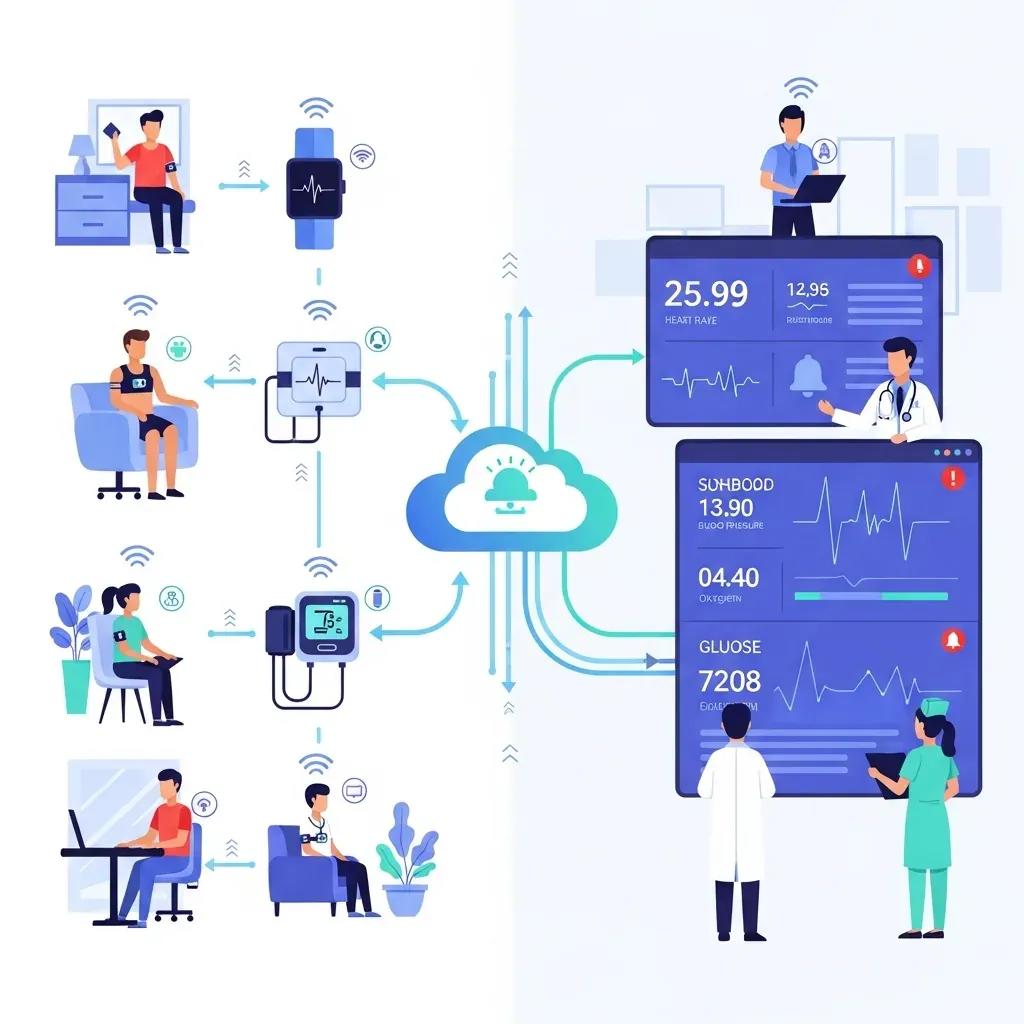
Custom remote patient monitoring software is the platform a provider group, care management company or digital health team uses to run an RPM program under its own brand and rules. We build it end to end: device onboarding, data capture from Bluetooth devices, cellular hubs and vendor APIs, day counting against the 16-day rule and the new 2 to 15 day code, clinician-approved alert thresholds and triage queues, time tracking for treatment management, FHIR write-back to your EHR and a monthly billing export to your RCM system.

The difficult part of RPM software is not the dashboard. It is proving each billable month: that the device meets the FDA definition of a medical device, that readings arrived on enough distinct days in the 30-day period, that a real-time interactive conversation happened, that minutes were not also counted for CCM, and that only one practitioner billed the patient. We engineer that evidence into the data model, so billing is a query, not a reconstruction.

Running CCM or APCM as well? See our chronic care management software service. Need the device or EHR connection alone? Start with medical device integration or EHR integration services, delivered on Interoply, our integration platform.

Primary sources: CY 2026 Physician Fee Schedule final rule, CMS Telehealth and Remote Patient Monitoring booklet (MLN901705), FDA policy for device software functions, US Core Vital Signs profile, FHIR R4 Device and Bluetooth Blood Pressure Profile.

Talk through your requirements ↗

Define the right scope

RPM software features we build

Each feature maps to a step of the RPM program and the evidence a billed month needs.
01 / CAPABILITY

Device onboarding and setup (99453)

Assign a device to a patient, ship or hand it over, pair it, confirm the first reading and record the education session. The setup record carries the device serial, the ordering practitioner, the diagnosis and the date, so 99453 is billed once per episode of care with evidence attached.

02 / CAPABILITY

Device data capture: Bluetooth, cellular and vendor APIs

Bluetooth Low Energy devices through a patient app using the standard GATT profiles for blood pressure, glucose, weight and pulse oximetry; cellular-embedded devices and cellular hubs that need no phone; and vendor cloud APIs such as Tenovi, Smart Meter, Withings and Dexcom, plus Apple HealthKit and Google Health Connect for consumer wearables. Every reading keeps its device, timestamp and source.

03 / CAPABILITY

Day counting for the 16-day rule and 99445

Each patient runs on a rolling 30-day device period. The platform counts distinct days with a transmitted reading and maps the period to 99454 for 16 to 30 days or 99445 for 2 to 15 days, one device code per patient per period however many devices they use. Patients at risk of missing their days get a reminder before the period closes.

04 / CAPABILITY

Alert thresholds and triage queues

Per-patient thresholds set by the ordering clinician, trend and missed-reading rules, and queues ranked by clinical priority. Duplicate readings are merged, repeat alerts are suppressed until acknowledged, and every alert records who reviewed it, what they did and when.

05 / CAPABILITY

Treatment management time (99457, 99458, 99470, 99091)

A time ledger per calendar month for clinical staff and practitioner time, with the real-time interactive communication that 99457 and 99470 require logged as its own event. 99470 covers the first 10 minutes, 99457 the first 20 and 99458 each additional 20. The same ledger is shared with CCM, so no minute is billed twice.

06 / CAPABILITY

FHIR write-back to the EHR

Readings written to the EHR as FHIR Observation on the US Core Vital Signs profiles with LOINC codes (85354-9 blood pressure panel, 8867-4 heart rate, 29463-7 body weight, 59408-5 SpO2), linked to a FHIR Device and Provenance, or sent as HL7 v2 ORU where the EHR expects messages. Clinicians see RPM data in the chart they already use.

07 / CAPABILITY

Billing export to your RCM system

At period and month end the platform produces charge-ready lines with codes, dates of service, rendering and billing provider and diagnosis, and sends them to your practice management system or clearinghouse as HL7 DFT, FHIR ChargeItem or through your 837P workflow.

08 / CAPABILITY

Patient and caregiver app

Pairing, reading reminders, trend views, education content and secure messaging, designed for older patients with large type, few steps and caregiver access.

Explore the service in detail

Remote patient monitoring software development services

Device integration layer

One normalized device API in front of Bluetooth devices, cellular hubs and vendor clouds.

  • Bluetooth GATT profiles
    Blood Pressure, Glucose, Weight Scale and Pulse Oximeter profiles read by the patient app
  • Cellular devices and hubs
    Readings posted without a smartphone, the common choice for older patients
  • Vendor APIs
    Tenovi, Smart Meter, Withings, Dexcom, HealthKit and Health Connect behind one interface
Explore medical device integration ↗

RPM EHR integration

Readings, alerts and monthly summaries in the EHR your clinicians already use.

  • FHIR R4 write-back
    Observation, Device and Provenance on US Core, with SMART on FHIR launch into Epic, Oracle Health and athenahealth
  • HL7 v2 for older EHRs
    ORU results and MDM documents over an interface engine
  • Orders and enrollment
    RPM orders and diagnoses read from the EHR to start enrollment
Explore EHR integration services ↗

Clinical monitoring and alert triage

Queues that surface the patients who need a call today.

  • Clinician-set thresholds
    Per patient and per condition, versioned with the approver
  • Trend and adherence rules
    Rising readings and missed days, not only single out-of-range values
  • Closed-loop acknowledgement
    Every alert reviewed, acted on and documented
Explore RPM data analytics ↗

RPM billing and RCM export

Monthly evidence and charges that stand up to a payer audit.

  • Code selection
    99453, 99454 or 99445, 99457, 99458 or 99470, and 99091, per patient per period
  • Audit pack
    Consent, device, days with data, interactive communication and minutes for every billed month
  • RCM hand-off
    Charges sent to your practice management system or clearinghouse
Explore RPM billing software ↗

RPM with CCM and APCM

One patient record and one time ledger across care management programs.

  • Concurrent billing
    RPM alongside CCM, PCM or APCM, with each minute counted once
  • Care plan feed
    Readings and alerts update goals in the chronic care plan
  • Program rules
    RPM and RTM kept apart; one practitioner bills RPM per period
Explore chronic care management software ↗

Regulatory boundary and device selection

Decisions that keep the software out of unplanned FDA scope.

  • Medical device requirement
    Medicare requires RPM devices to meet the FDA definition of a medical device
  • Software functions
    Transfer, storage and display of device data sit outside FDA device oversight; automated diagnosis does not
  • Clinician in the loop
    Thresholds and escalation set and reviewed by licensed clinicians

What to evaluate in your partner

RPM software decisions to make before you build

Build or buy, device strategy, alert ownership, cost and the proof behind our work.
01

Build, buy or white-label RPM

+

Buy or white-label when you need a program running this quarter with standard devices and one EHR. Build when RPM is your product, when you run it across many practices or EHRs, when you combine RPM with CCM and APCM, or when per-patient platform fees and data terms no longer fit. Many teams keep a device vendor for logistics and build the clinical, billing and EHR layers they want to own.

02

Cellular or Bluetooth devices

+

Cellular devices send readings with no setup on the patient's side, which raises the number of days with data, at a higher device cost. Bluetooth devices cost less but depend on the patient's phone and app. Most programs use cellular for older patients and Bluetooth for app-first populations; our device layer supports both behind one API.

03

Who triages alerts, and when

+

Decide whether your own nurses, a contracted monitoring team or both work the queue, their hours, and what happens after hours. The software enforces the escalation path you approve and records every hand-off.

04

What drives RPM software cost

+

Cost follows the number of device types and vendors, the EHRs you write back to, whether the platform is multi-tenant, the billing path and the patient app. We give a fixed-scope estimate after discovery, broken down by module and integration, with no per-patient fees on software you own.

05

Security and compliance built in

+

We sign BAAs, and Nirmitee is ISO 27001:2022 certified. Readings are encrypted in transit and at rest, access is role based, and audit logs record every view, alert acknowledgement and change to a patient's record.

06

Remote monitoring and device work we have delivered

+

Client names are withheld; each is a real engagement. An offline-first screening EMR that captures readings from connected devices and reconciles when the network returns (live in production). A contactless health-check kiosk with private results for public venues (live). A consumer health-records app that unifies provider records with the user's wearable data (live in the app stores). A chronic pain platform with patient-reported outcomes and a clinician portal (live in production). Our open-source RPM platform foundation, nirmitee-rpm, provides multi-tenant workspaces, role-based access, single sign-on, audit logging, patient and device views and time logging. And our open-source headless EHR on FHIR R4, which passed 47 of 47 ONC (g)(10) SMART App Launch tests in Inferno on 11 June 2026 (github.com/Nirmitee-tech/headless-ehr-fhir).

A reviewable delivery approach

How a remote patient monitoring software project runs

Device layer first, clinical workflow second, billing proven on a pilot cycle before scale.

  1. 01

    RPM program discovery

    Map the program: conditions, devices, who orders and who triages, the EHRs and the billing path. Confirm device vendors and integration access.

    Explore this stage

    Deliverables: program workflow, device and vendor shortlist, EHR interface list, billing rules inventory, fixed-scope estimate.

  2. 02

    Device layer and data model

    Device onboarding, Bluetooth, cellular and vendor API ingestion, and the patient, device, reading and 30-day period model the rest depends on.

    Explore this stage

    Deliverables: normalized device API, day counting, patient app pairing and reminders.

  3. 03

    Clinical workspace, alerts and EHR write-back

    Thresholds, triage queues, time ledger and interactive communication logging, then FHIR or HL7 write-back to the EHR.

    Explore this stage

    Deliverables: care team workspace, alert rules, EHR interface tested against real payloads.

  4. 04

    Billing, pilot and scale

    Billing export to RCM, a pilot cohort through one full billing cycle, reconciliation, then more practices and devices.

    Explore this stage

    Deliverables: audit pack per billed month, reconciled first cycle, monitoring and support.

A working model for your priorities

Start with a Milestone.
Build a Lasting Partnership.

Define the scope, ownership, and delivery responsibilities together. Commercial terms and team availability follow that conversation.

Prepare for the next conversation

Remote patient monitoring engineering guides

Explore all articles ↗
Epic

Epic Connectors and Agent Factory: How to Get Your App Ready for 2027

Read the article ↗
Asset Management

Juniper Mist Asset Tracking Integration: How It Works

Read the article ↗
Healthcare

InterSystems IRIS vs Caché, Health Connect and HealthShare: 2026 Guide

Read the article ↗

Before you choose a partner

Custom remote patient monitoring software FAQs

What is custom remote patient monitoring software?+

It is an RPM platform built for your program rather than rented from a vendor: device onboarding and data capture, day counting for billing, alert thresholds and triage, time tracking for treatment management, EHR write-back and billing export, under your brand and rules. You own the code, the data model and the patient history.

How much does remote patient monitoring software development cost?+

Cost depends on the number of device types and vendors, the EHRs you write back to, whether the platform serves one organization or many, the billing path and the patient app. We give a fixed-scope estimate after discovery, broken down by module and integration, so you can phase the build.

Which RPM CPT codes does the software need to support in 2026?+

99453 for setup and education, 99454 for device supply with 16 to 30 days of data, 99445 for device supply with 2 to 15 days, 99457 for the first 20 minutes of treatment management, 99458 for each additional 20 minutes, 99470 for the first 10 minutes, and 99091 for 30 minutes of practitioner data review. Remote therapeutic monitoring uses separate 989xx codes and is not billed with RPM for the same period.

What changed for RPM billing in 2026?+

The CY 2026 Physician Fee Schedule final rule added 99445 for 2 to 15 days of device data in a 30-day period and 99470 for the first 10 minutes of treatment management in a calendar month, both from 1 January 2026. Programs no longer lose the device payment when a patient transmits on fewer than 16 days, and short months of management time are billable. Software has to count days and minutes against both thresholds.

What is the 16-day rule in remote patient monitoring?+

99454 is billable only when the patient transmits data on at least 16 days in a 30-day period. From 2026, periods with 2 to 15 days are billed with 99445 instead. The platform counts distinct days per patient per period and reminds patients before a period closes.

Which devices can you integrate with RPM software?+

Blood pressure cuffs, weight scales, pulse oximeters, glucose meters, continuous glucose monitors, thermometers and spirometers, over Bluetooth Low Energy, cellular connections or hubs, and vendor APIs such as Tenovi, Smart Meter, Withings and Dexcom. Consumer wearables come in through Apple HealthKit and Google Health Connect.

Do RPM devices and RPM software need FDA clearance?+

Medicare requires the monitoring device to meet the FDA definition of a medical device, and most programs use FDA-cleared devices. Software that only transfers, stores, converts or displays device data falls outside FDA device oversight under section 520(o)(1)(D) of the FD&C Act. Software that analyzes readings to diagnose or drives time-critical alarms can be a device function, so we design alerting around clinician-set thresholds and plan any regulated feature explicitly.

How does RPM data get into Epic or another EHR?+

We write readings as FHIR Observation resources on the US Core Vital Signs profiles with LOINC codes, linked to a FHIR Device, through the EHR's FHIR API where it accepts writes, or as HL7 v2 ORU messages through an interface engine. Monthly RPM summaries can be filed as a document, and clinicians can open the RPM workspace from inside the EHR with SMART on FHIR.

How do you keep RPM alerts from overwhelming clinicians?+

Thresholds are set per patient by the ordering clinician, repeated readings are merged, alerts stay suppressed until acknowledged, and trend rules replace single-reading alarms where the clinician agrees. Queues are ranked by clinical priority, and each alert records who reviewed it and what they did.

Can RPM be billed with chronic care management?+

Yes. Medicare allows RPM in the same month as CCM, PCM or APCM, provided each minute of work is counted toward one service only. RPM and remote therapeutic monitoring cannot be billed for the same patient in the same period, and only one practitioner can bill RPM for a patient in a 30-day period.

Should we build RPM software, buy a platform or white-label one?+

Buy or white-label for speed with standard devices and one EHR. Build when RPM is your product, when you run it across several practices or EHRs, when you combine it with CCM and APCM, or when per-patient fees and data terms stop making sense. A common path keeps a device logistics vendor and builds the clinical, billing and EHR layers.

How long does it take to build remote patient monitoring software?+

A first release with device onboarding, data capture, alerts, time tracking and billing export for one program is planned in months. EHR write-back and additional device vendors follow in phases. EHR vendor access and device vendor contracts run on outside calendars, so we start them in the first week.

Let’s make the next step useful

Bring the Challenge.
We’Ll Bring the Engineering Questions.

Discuss your workflows, systems, and delivery priorities with the Nirmitee team.