
The Most Consequential Architecture Decision You'll Make
Multi-tenancy is the most consequential architecture decision for a healthcare SaaS product. It's not the flashiest decision — nobody writes blog posts about it for fun — but it's the one that follows you for years. Get it wrong and you'll spend six months migrating later. Or worse: you'll lose an enterprise hospital deal because your isolation story doesn't hold up in a security review.
The stakes in healthcare are higher than in generic SaaS. You're not just isolating user preferences and billing data. You're isolating Protected Health Information across organizational boundaries, with HIPAA enforcement actions that can reach into the millions. A cross-tenant data leak in a project management tool is embarrassing. A cross-tenant PHI leak in a healthcare platform is a federal violation.
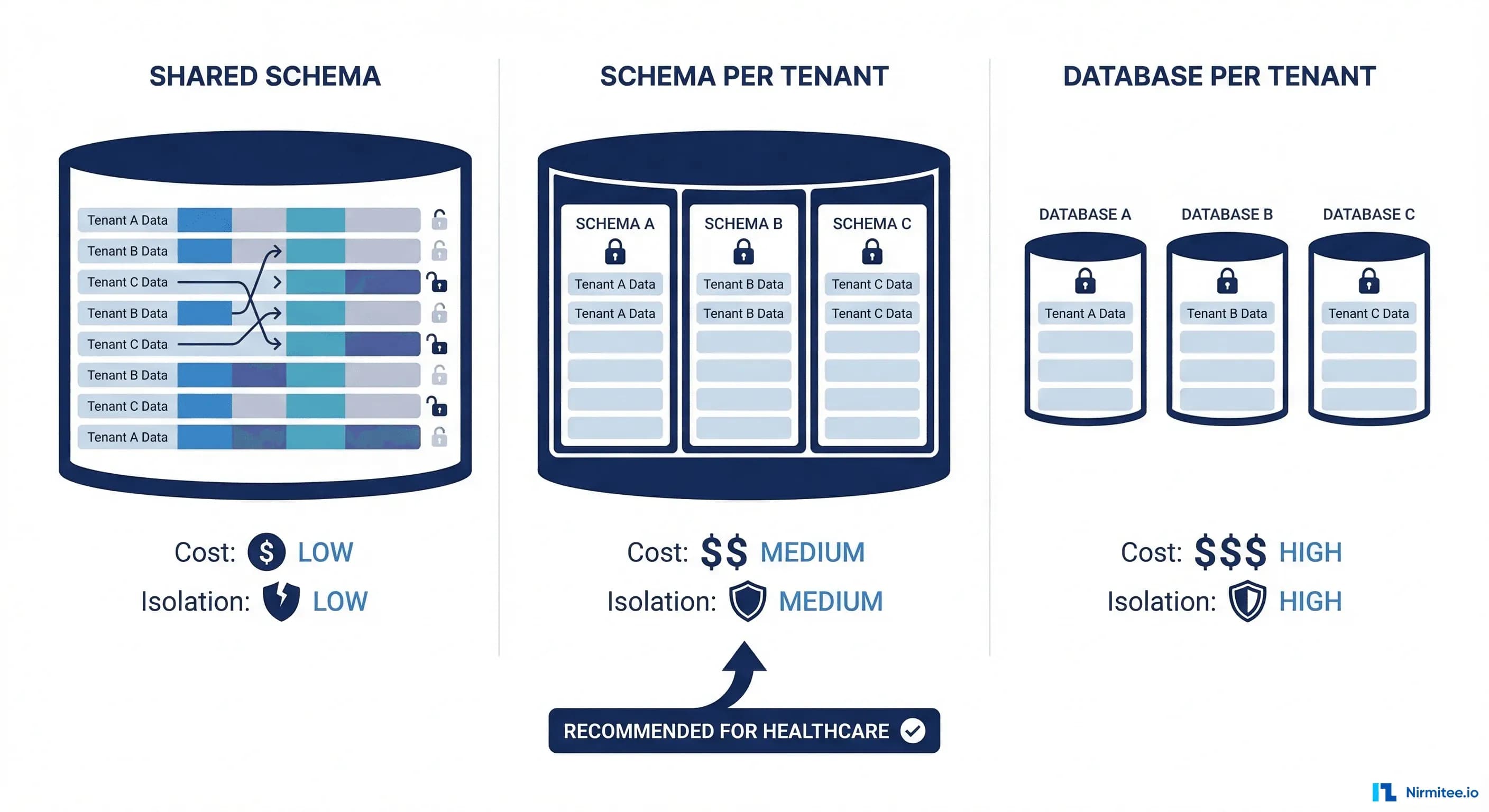
There are three multi-tenancy models for PostgreSQL-backed healthcare SaaS. Each has a clear use case. Here's when to use each, what healthcare specifically demands, and our concrete recommendation for most startups.
Model 1: Shared Schema (tenant_id Column)
How It Works
Single database, single schema, every table has a tenant_id column. Every query includes WHERE tenant_id = ?. All tenants share the same tables, indexes, and connection pool.
This is the simplest model. It's what you get when you add multi-tenancy to a single-tenant application as an afterthought — add a column, add a filter, ship it.
Pros
- Cheapest infrastructure cost: One database, one connection pool, one set of indexes. At 10 tenants, your database bill is identical to a single-tenant deployment.
- Simplest to build: No schema routing, no connection switching, no migration orchestration. Add a column, add a middleware that sets a context value, filter on it.
- Fastest to ship: You can go from single-tenant to multi-tenant in a week. This matters when you have three months of runway and need to close your fourth customer.
- Cross-tenant analytics are trivial: Want to know aggregate usage across all tenants? It's a single query. No UNION ALL across schemas, no federation across databases.
Cons
- One bad query leaks cross-tenant data: Forget the
WHERE tenant_id = ?clause in one query — just one — and you've exposed Org A's patient records to Org B. In healthcare, that's a reportable breach under the HIPAA Breach Notification Rule (45 CFR 164.400-414). - Per-tenant backup and restore is nearly impossible: You can't restore Hospital A's data from yesterday without also restoring Hospital B and Hospital C to yesterday's state. This is a deal-breaker for enterprise contracts that require tenant-specific disaster recovery.
- Noisy neighbor problems: One tenant running a massive analytics query can degrade performance for all tenants. PostgreSQL's resource management doesn't operate at the tenant level.
- PostgreSQL Row-Level Security is mandatory, not optional: Without RLS, you're relying entirely on application-level filtering. That means every ORM query, every raw SQL statement, every database function must correctly filter by tenant. RLS is your safety net — but it adds complexity.
When to Use
Early-stage startup with non-PHI data, or as a deliberate architectural choice paired with rigorous Row-Level Security enforcement. If you choose this model for healthcare data, RLS is not a nice-to-have — it's the only thing standing between you and a breach notification.
PostgreSQL RLS Policy Example
-- Enable RLS on the patients table
ALTER TABLE patients ENABLE ROW LEVEL SECURITY;

-- Force RLS even for table owners
ALTER TABLE patients FORCE ROW LEVEL SECURITY;

-- Create policy: users can only see rows matching their tenant
CREATE POLICY tenant_isolation ON patients
  USING (tenant_id = current_setting('app.current_tenant')::uuid);

-- Set tenant context at connection level (in your middleware)
-- SET app.current_tenant = 'tenant-uuid-here';

-- Now this query automatically filters by tenant:
-- SELECT * FROM patients;
-- Only returns rows where tenant_id matches app.current_tenant
Model 2: Schema-per-Tenant
How It Works
Single database, but each tenant gets its own PostgreSQL schema. Tenant A's data lives in tenant_alpha, Tenant B's in tenant_beta. Your application sets the search path at the connection level: SET search_path = tenant_alpha. The same table definitions exist in each schema, but the data is physically separated.
Pros
- Good isolation without the cost of separate databases: Tenant data is logically separated at the schema level. A query in
tenant_alphacannot accidentally accesstenant_beta's tables — there's notenant_idcolumn to forget. - Moderate cost: Still one database, one connection pool (with routing), one backup target. Infrastructure cost scales linearly, not multiplicatively.
- Per-tenant migrations are possible: You can roll out a schema change to one tenant first, validate it, then roll it out to others. This is invaluable for enterprise customers who want change control over their environment.
- HIPAA-auditable boundaries: You can clearly demonstrate to an auditor that Organization A's data exists in a separate schema from Organization B's. The isolation story is clean and verifiable.
- Per-tenant pg_dump: You can
pg_dump --schema=tenant_alphato back up or restore a single tenant without touching others.
Cons
- Schema count can get large: At 500 tenants, you have 500 schemas. PostgreSQL handles this fine technically, but tooling (psql, pgAdmin, migration scripts) can get unwieldy. Connection routing logic needs to be robust.
- Migrations must run per-schema: A schema change that takes 2 seconds per schema takes 16 minutes at 500 schemas. You need migration orchestration tooling — a simple
ALTER TABLEbecomes a loop. - Cross-tenant queries require explicit joins: Aggregate analytics across tenants require
UNION ALLacross schemas or a separate analytics schema that aggregates data. - Connection pool management: Each connection must be routed to the correct schema. Connection pool contamination (a connection with the wrong search_path being reused) is a subtle and dangerous bug.
When to Use
This is our recommended default for Series A healthcare SaaS. It balances cost, compliance, and isolation. You get clear tenant boundaries without the operational overhead of multiple databases. Most healthcare SaaS products will have 10-500 tenants (clinics, hospitals, health systems) — a range where schema-per-tenant is efficient and manageable.
Schema Routing Middleware Example
// Go middleware for Echo framework — schema-per-tenant routing
func TenantSchemaMiddleware(db *sql.DB) echo.MiddlewareFunc {
    return func(next echo.HandlerFunc) echo.HandlerFunc {
        return func(c echo.Context) error {
            // Extract tenant from JWT claims or subdomain
            tenantID := c.Get("tenant_id").(string)

            // Validate tenant ID format (prevent SQL injection)
            if !isValidTenantID(tenantID) {
                return echo.NewHTTPError(403, "invalid tenant")
            }

            schemaName := fmt.Sprintf("tenant_%s", tenantID)

            // Get connection and set search_path
            conn, err := db.Conn(c.Request().Context())
            if err != nil {
                return echo.NewHTTPError(500, "database connection failed")
            }
            defer conn.Close()

            _, err = conn.ExecContext(
                c.Request().Context(),
                fmt.Sprintf("SET search_path = %s, public",
                    pq.QuoteIdentifier(schemaName)),
            )
            if err != nil {
                return echo.NewHTTPError(500, "tenant schema not found")
            }

            // Store connection in context for downstream handlers
            c.Set("db_conn", conn)

            return next(c)
        }
    }
}

func isValidTenantID(id string) bool {
    // Only allow alphanumeric and hyphens
    matched, _ := regexp.MatchString(`^[a-zA-Z0-9-]+$`, id)
    return matched
}
Model 3: Database-per-Tenant
How It Works
Each tenant gets its own PostgreSQL database. Completely separate: separate connection strings, separate credentials, separate backup schedules, separate encryption configurations. Your application maintains a registry of tenant-to-database mappings and routes connections accordingly.
Pros
- Maximum isolation: There is no mechanism — accidental or otherwise — for one tenant's query to access another tenant's data. The databases are physically separate. This is the strongest possible isolation story.
- Per-tenant encryption keys: Each database can use a different encryption key. If a key is compromised, only one tenant's data is at risk. This is increasingly a requirement in enterprise healthcare contracts.
- Simplest backup and restore: Back up one database, restore one database. No schema filtering, no data extraction. Disaster recovery is straightforward and testable.
- Simplest HIPAA compliance story: "Each customer's data is in a separate, encrypted database with separate credentials and separate encryption keys." This sentence makes security review meetings very short.
- Independent scaling: A large health system generating 10x the data of other tenants can have its database on a larger instance. No noisy neighbor problems.
Cons
- Expensive at scale: At 100 tenants, you're managing 100 databases. Even with managed PostgreSQL (RDS, Cloud SQL), the cost adds up — each database has baseline compute and storage costs.
- Connection management complexity: Your application needs a connection pool per database, or a connection router that can dynamically connect to the right database. At scale, this becomes a significant infrastructure component.
- Cross-tenant analytics require ETL: You can't query across databases natively. You need a data warehouse (BigQuery, Redshift, Snowflake) that aggregates data from all tenant databases. This adds infrastructure, latency, and cost.
- Migrations multiply: Every schema change must be applied to every database. You need robust migration orchestration, rollback capability per database, and monitoring for migration failures across the fleet.
- Operational overhead: Monitoring, alerting, patching, and upgrading 100 databases is fundamentally different from managing one. You need infrastructure automation that most Series A teams don't have.
When to Use
Enterprise hospital contracts that explicitly require it — and they often do. Series B+ companies that can afford the infrastructure and operations team. Situations where per-tenant encryption key management is a hard requirement (not a nice-to-have). If you're selling to large health systems with dedicated security teams that will audit your architecture, database-per-tenant makes the security conversation simple.
Healthcare-Specific Requirements
Generic multi-tenancy advice stops at "isolate your data." Healthcare demands more. These requirements apply regardless of which model you choose.
Audit Trails at Tenant Boundaries
HIPAA requires audit trails that can answer: who in Organization A accessed what data, and when? These logs must never be mixed with Organization B's audit trail. In a shared-schema model, your audit log table also needs tenant_id filtering. In schema-per-tenant, audit logs live in the tenant's schema. In DB-per-tenant, it's naturally isolated.
This isn't just a compliance checkbox. During a breach investigation, you need to produce a complete access log for the affected organization — and only that organization — within 72 hours (per HIPAA Breach Notification Rule timelines).
BAA Scope Per Tenant
Your Business Associate Agreement with each customer should clearly define the scope of data handling. In a shared-schema model, your BAA must address the fact that multiple customers' PHI resides in the same database. Some enterprise legal teams will not accept this. Schema-per-tenant and DB-per-tenant have cleaner BAA narratives.
Encryption Key Isolation
The ideal: per-tenant KMS keys. If Tenant A's encryption key is compromised, Tenant B's data remains encrypted with a different key. This is straightforward with DB-per-tenant (different TDE key per database), possible with schema-per-tenant (application-level encryption with per-tenant keys), and complex with shared-schema (column-level encryption with key routing).
Backup and Restore Granularity
Can you restore one hospital's data from yesterday without affecting the other 49 hospitals on your platform? With DB-per-tenant, yes — trivially. With schema-per-tenant, yes — via pg_dump --schema. With shared-schema, no — not without extracting and re-inserting rows filtered by tenant_id, which is error-prone and slow.
Row-Level Security: Non-Negotiable for Shared Schema
If you choose the shared-schema model for any table containing PHI, PostgreSQL RLS is not optional. It's your last line of defense against the inevitable query that forgets the WHERE tenant_id = ? clause.
-- Complete RLS setup for a healthcare multi-tenant table

-- 1. Create the table with tenant_id
CREATE TABLE clinical_notes (
    id UUID PRIMARY KEY DEFAULT gen_random_uuid(),
    tenant_id UUID NOT NULL,
    patient_id UUID NOT NULL,
    encounter_id UUID NOT NULL,
    note_text TEXT NOT NULL,
    author_id UUID NOT NULL,
    created_at TIMESTAMPTZ DEFAULT now(),
    updated_at TIMESTAMPTZ DEFAULT now()
);

-- 2. Create index on tenant_id (critical for RLS performance)
CREATE INDEX idx_clinical_notes_tenant
    ON clinical_notes (tenant_id);

-- 3. Enable RLS
ALTER TABLE clinical_notes ENABLE ROW LEVEL SECURITY;
ALTER TABLE clinical_notes FORCE ROW LEVEL SECURITY;

-- 4. Create tenant isolation policy
CREATE POLICY tenant_isolation ON clinical_notes
    FOR ALL
    USING (tenant_id = current_setting('app.current_tenant')::uuid)
    WITH CHECK (tenant_id = current_setting('app.current_tenant')::uuid);

-- 5. Create audit policy (log all access)
CREATE OR REPLACE FUNCTION audit_clinical_note_access()
RETURNS TRIGGER AS $$
BEGIN
    INSERT INTO audit_log (tenant_id, table_name, record_id, action, user_id, accessed_at)
    VALUES (
        current_setting('app.current_tenant')::uuid,
        'clinical_notes',
        COALESCE(NEW.id, OLD.id),
        TG_OP,
        current_setting('app.current_user')::uuid,
        now()
    );
    RETURN COALESCE(NEW, OLD);
END;
$$ LANGUAGE plpgsql;

CREATE TRIGGER trg_audit_clinical_notes
    AFTER INSERT OR UPDATE OR DELETE ON clinical_notes
    FOR EACH ROW EXECUTE FUNCTION audit_clinical_note_access();
The Migration Tax
Here's the uncomfortable truth that nobody tells you at the whiteboard session: the multi-tenancy model you choose at 10 tenants will be with you at 1,000 tenants.
Migrating from shared-schema to schema-per-tenant costs 3-6 months of engineering time. You're not just moving data — you're rewriting every database query, every migration script, every backup procedure, every monitoring dashboard. You're doing this while the platform is live and serving patients. You're doing this without a single minute of downtime because healthcare systems don't get maintenance windows.
The reverse migration — database-per-tenant to schema-per-tenant or shared-schema — is equally painful. You're consolidating databases, resolving ID collisions, merging schemas, and rebuilding connection routing. And you're doing it because your infrastructure costs are unsustainable at your current tenant count.
Both migrations introduce risk. Data migration bugs can cause data loss or corruption. Connection routing changes can cause outages. Schema changes can break application queries. And every one of these failures happens in a healthcare context where "we'll fix it tomorrow" isn't acceptable.
The decision you make today is the decision you'll live with for years. Choose deliberately.
Our Recommendation
Schema-per-tenant for most healthcare SaaS startups.
It's the Goldilocks option. Enough isolation for HIPAA compliance and enterprise security reviews. Affordable enough for a Series A budget. Scalable enough to handle hundreds of tenants without operational collapse. And it provides a clean upgrade path to database-per-tenant for specific enterprise customers who demand it.
Here's the decision framework:
- Pre-seed / MVP with no PHI: Shared schema is fine. You need to move fast and validate product-market fit. But plan your schema so that migrating to schema-per-tenant later is feasible — use a
tenant_idcolumn from day one. - Seed to Series A with PHI: Schema-per-tenant. This is where most healthcare SaaS lives. You have enough tenants to need isolation, not so many that operational complexity is prohibitive.
- Series B+ or enterprise hospital contracts: Offer database-per-tenant as a premium tier. Some customers will require it. Price it accordingly — the infrastructure cost is real, and enterprise customers expect to pay for dedicated resources.
The hybrid approach works: schema-per-tenant as your default, with the option to provision database-per-tenant for customers who require it. Your tenant routing middleware needs to handle both cases, but the additional complexity is manageable and commercially valuable.
Implementation Checklist
If you're implementing schema-per-tenant (or any multi-tenancy model), this is the practical checklist. Every item is drawn from real implementation experience, not theory.
Tenant-Aware Connection Middleware
Your middleware must extract tenant identity from the request (JWT claim, subdomain, or header), validate it, and set the database connection's schema context. This middleware runs on every request. It must be fast, correct, and impossible to bypass. Use framework-level middleware (Echo, Gin, Express) — not application-level checks that can be forgotten.
Schema Migration Tooling
Build or adopt tooling that can run migrations across all tenant schemas. Each migration should be idempotent (safe to re-run), reversible, and logged. Consider tools like golang-migrate, Atlas, or custom scripts that iterate over a tenant registry. Monitor migration status per tenant — a migration that fails on 1 out of 200 tenants needs to be detected and resolved, not silently ignored.
RLS Policies Even With Schema Isolation (Defense in Depth)
Even if you're using schema-per-tenant, add RLS policies. This is defense in depth. If a connection pool bug routes a query to the wrong schema, RLS catches it. If a developer accidentally hard-codes a schema name in a query, RLS catches it. The cost is minimal. The protection is significant.
Tenant-Scoped Audit Logging
Every data access, modification, and deletion must be logged with tenant context. Audit logs must be queryable per tenant for compliance reporting. Store audit logs in the tenant's schema (for schema-per-tenant) or with a tenant_id filter (for shared schema). Retention: minimum 6 years for HIPAA, 7 years if you're also subject to state regulations.
Per-Tenant Feature Flags
Different tenants will be on different plans, different contract terms, and different feature rollout schedules. Your feature flag system must be tenant-aware. Use a feature flag service (LaunchDarkly, Unleash, or a custom implementation) that can target by tenant ID. This also enables safe rollouts — deploy a new feature to one tenant, validate, then roll out broadly.
Monitoring Per Tenant (Not Just Aggregate)
Aggregate metrics hide tenant-specific problems. Monitor query latency, error rates, storage growth, and connection usage per tenant. Set up alerts when a single tenant's metrics deviate from the norm — this catches both noisy neighbor problems and tenant-specific bugs. Use tenant ID as a label/tag in your metrics system (Prometheus, Datadog, CloudWatch).
Tenant Provisioning Automation
Creating a new tenant should be a single API call or CLI command. It should create the schema (or database), run all migrations, seed reference data, configure feature flags, and register the tenant in your routing table. Manual tenant provisioning is a scaling bottleneck and an error source. Automate it on day one.
Tenant Offboarding and Data Deletion
When a customer churns, you need to delete their data completely — not just soft-delete it. HIPAA requires that you can demonstrate data destruction upon contract termination. With schema-per-tenant, this is DROP SCHEMA tenant_xyz CASCADE. With shared schema, it's a carefully validated DELETE FROM ... WHERE tenant_id = ? across every table. Know which one you'd rather execute at 2 AM.
Multi-tenancy isn't glamorous architecture work. It's infrastructure that disappears when done right and becomes a crisis when done wrong. Make the decision deliberately, implement it rigorously, and you'll have a foundation that supports your product from first customer to enterprise scale.
If you're building healthcare SaaS and need architecture guidance on multi-tenancy, database design, or HIPAA compliance engineering, talk to our team. We've implemented all three models in production healthcare systems.
Looking to build a robust healthcare platform? Our Healthcare Software Product Development team turns complex requirements into production-ready systems. We also offer specialized Agentic AI for Healthcare services. Talk to our team to get started.