
Why Your Healthtech MVP Took 2× Longer Than Expected

CTO & Co-Founder
CTO & Co-Founder at Nirmitee.io. Architects healthcare integrations across FHIR, SMART on FHIR, ABDM and NHCX, writing from production experience taking hospital software from sandbox to go-live.
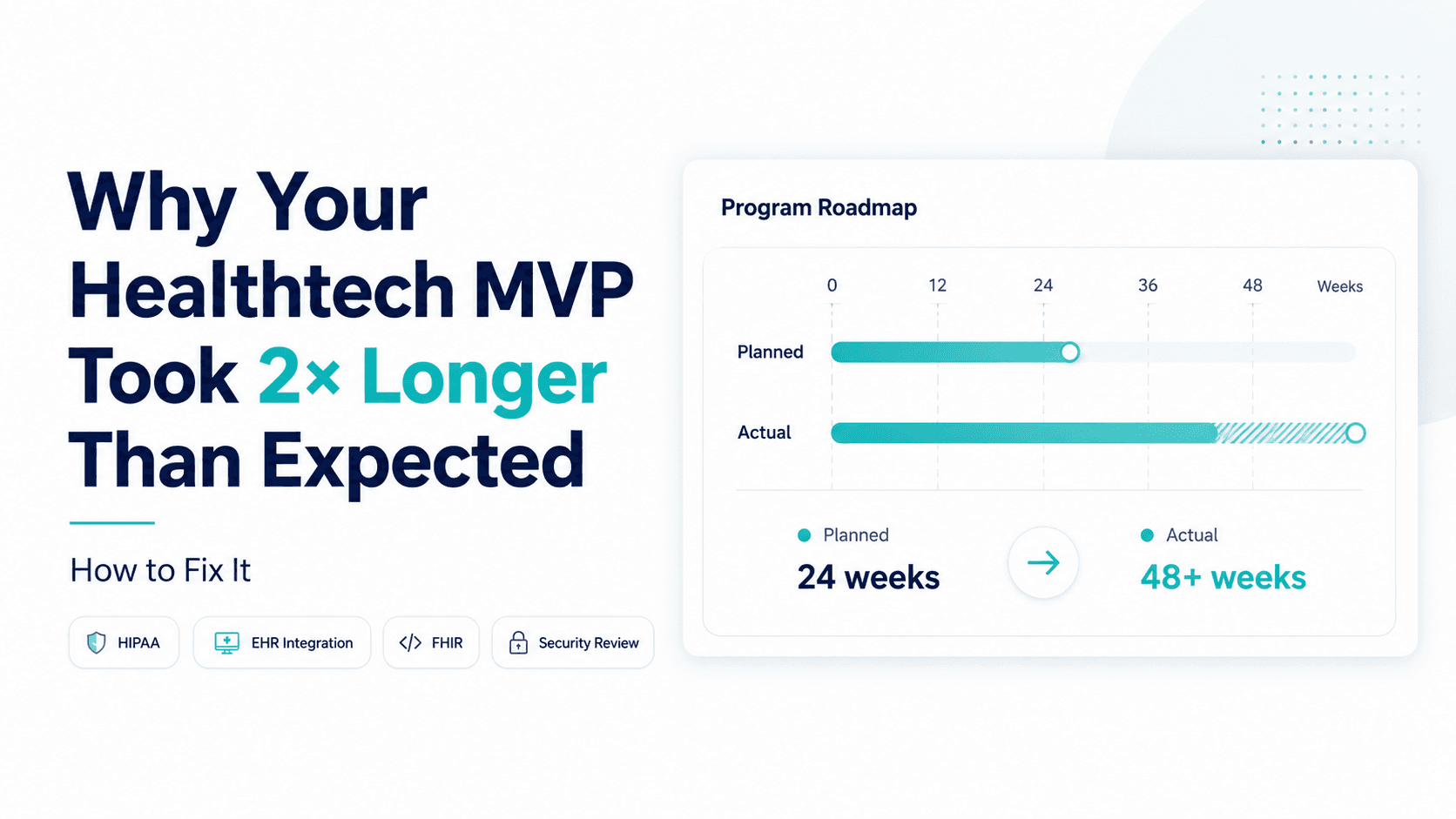
You got the funding. You hired the team. You had a go-live date on a slide deck. And somehow, nine months later, the MVP still isn't in front of a hospital.
This isn't a story about bad engineers. It's a story about healthcare. Building software in this space has compounding constraints that don't exist in any other vertical — and they don't announce themselves until you're deep enough into a sprint that unwinding is genuinely painful.
Related: see how we approach this in our healthcare product engineering.
Here are the eight reasons healthcare MVPs take twice as long as founders plan, what each one actually costs, and how to prevent them before your next build starts.
The 8 Root Causes of Delayed Healthcare MVPs
1. HIPAA Was Treated as a Feature, Not an Architecture
The most expensive mistake in healthcare software development isn't a bad architecture decision — it's making a good architecture decision and then trying to layer HIPAA compliance on top of it six weeks in. HIPAA is not a feature. It's an architectural posture that changes how you design your data model, your access control layer, your audit trail, and your API surface.
When founders treat HIPAA as a sprint item ("we'll handle compliance in Q3"), what they're actually scheduling is a full rebuild. The data model needs encryption and pseudonymization at the field level, not the table level. The access control layer needs minimum necessary access baked in, not bolted on. The audit trail needs to capture every PHI read, write, and failed attempt at the service layer — not via application-level logging added after the fact.
A HIPAA retrofit after the first sprint review typically adds two to four months and a complete data model revision. That's not a compliance fix. That's a rebuild.
2. The EHR Scope Expanded Mid-Build
"We just need Epic" is how almost every healthtech build starts. It's also how most of them encounter their first timeline crisis. The hospital your clinical champion works at runs Epic. The hospital two miles down the road — the one that agreed to be your backup pilot site — runs Cerner. The rural critical access hospital your VP of sales just closed runs athenahealth.
Each EHR vendor has a different API architecture, a different authentication flow, and a different sandbox environment. SMART on FHIR covers some of the abstraction, but implementation varies enough that adding a second EHR mid-build isn't additive work — it's a new integration project that often requires revisiting your data model. For what happens when those connections expand across hospitals, read our guide to scaling EMR connections. Our analysis of post-MVP EHR growth barriers follows this problem beyond the initial build.
Lock the EHR list before sprint 1. Not "probably Epic plus maybe Cerner." One primary EHR, confirmed by name, with a sandbox credential in hand. Additional EHRs go on the post-launch roadmap unless they're contractually required for the pilot.
3. The Hospital IT Security Review Failed
Hospital IT security reviews are not rubber stamps. They're structured evaluations of your security architecture, PHI data flows, access controls, encryption standards, and vendor risk posture. They take weeks. And they fail.
The failure rate for first-time submissions from teams without prior hospital IT review experience is high. The reasons are consistent: missing penetration test documentation, incomplete PHI data flow diagrams, access controls that don't meet minimum necessary access standards, or logging gaps that create HIPAA audit trail deficiencies.
A failed review doesn't mean you fix a bug and resubmit. It means you address the findings, sometimes rebuild the underlying component, and schedule a new review cycle — which itself takes four to eight weeks. That's two to three months of timeline impact from a single review failure.
Teams that have been through hospital security reviews before know what the checklist looks like. They design toward it from sprint 1. Teams that haven't discover it when the hospital IT contact sends back a twenty-page remediation list.
4. The FHIR Engineer Took Three Months to Hire
FHIR R4 engineers with production experience — meaning they've shipped an integration that a hospital IT team accepted into their EHR environment, not a sandbox demo — are genuinely scarce in the US market. HIMSS data puts chronic IT staffing shortages at 77% of healthcare organizations. That's the demand side. The supply side is engineers who spent years learning healthcare-specific tooling rather than building commercial SaaS.
Most founders who decide to build EHR integration in-house start by posting a FHIR engineering role. That role takes three to six months to fill. By the time the engineer is onboarded and ramped, the pilot window the CTO promised the sales team has closed. The investor update that was supposed to say "pilot live" now says "pilot delayed."
5. The BAA Was Stuck in Legal for Two Months
A Business Associate Agreement is a legally required contract between a covered entity (the hospital or health system) and any vendor whose software or services touch Protected Health Information. Without an executed BAA, your engineering team legally cannot start building against real PHI — which means no production EHR data, no real patient records in your dev environment, and no integration testing against live data.
Most founders don't put BAA execution on the critical path until they need it. Legal review at a hospital takes six to twelve weeks. Add negotiation time if the hospital's standard BAA has terms that don't align with your data processing model and you're facing a two- to three-month legal hold before meaningful integration work can begin.
Start BAA discussions the same week you start the pilot conversation. Don't wait for a technical milestone to trigger the legal conversation. The two workstreams need to run in parallel.
6. PHI Scope Wasn't Defined Before Architecture
Mid-sprint discoveries about PHI scope are among the most disruptive events in a healthcare build. The team is three weeks into building a patient data flow when someone asks: does this field count as PHI? The answer — yes, the date of birth combined with the ZIP code is a quasi-identifier that creates PHI risk — triggers a scope review, a data model revision, and a compliance reassessment.
PHI scope needs to be documented before the data model is designed. Specifically: what fields does the application store, transmit, or display? Which of those fields, individually or in combination, constitute PHI under HIPAA's 18 identifiers? What is the minimum data set necessary for each clinical workflow?
This is not a legal exercise. It's an engineering prerequisite. The answers change your schema, your access controls, your API surface, and your retention policies.
7. The Epic Sandbox Worked Fine — Production Didn't
Epic's developer sandbox and Epic's production environment are different in ways that matter. Authentication flows behave differently. Rate limits are different. Data volumes are different. The App Orchard approval process — which is required before your application can connect to a real Epic instance — adds eight to sixteen weeks to any Epic integration timeline, independent of how well the sandbox integration worked.
Founders who haven't been through the App Orchard process before typically discover it one of two ways: either a salesperson promises a hospital a live integration, and the hospital IT team asks for the App Orchard certification number, or the team finishes the sandbox integration and then learns that production access requires a separate application, review, and approval cycle.
The App Orchard process isn't optional, and it isn't fast. Build it into your timeline from day one.
8. The Hospital Changed EHR Vendors Mid-Pilot
This one is less common but not rare. Hospital EHR migrations happen. They take years to plan, and months to execute — but from the outside, as a vendor in the middle of a pilot, they can appear suddenly. The hospital is switching from Cerner to Epic. The go-live is in four months. Your Cerner integration needs to become an Epic integration, or your pilot gets delayed until after the migration settles.
The mitigation is a FHIR-first architecture that abstracts the EHR vendor layer behind a standards-based interface. If your integration speaks FHIR R4 at the API layer and uses an integration engine (Mirth Connect, Azure Health Data Services) to handle vendor-specific translation, a vendor switch becomes a configuration change rather than a rebuild.
The HIPAA Retrofit Problem — In Detail
The most expensive problem on the list above is also the most preventable. HIPAA retrofit adds cost and time at every layer of the stack. At the data model layer, retrofitting field-level encryption after the schema is built means migrating existing data, updating every query that touches encrypted fields, and rebuilding the access control layer that controls who can see what. At the API layer, retrofitting minimum necessary access controls means auditing every endpoint for PHI exposure and adding authorization checks that should have been designed in from the start.
The pattern we see consistently: a team builds fast, gets to a hospital demo, and the hospital's IT team asks for a PHI data flow diagram. The team produces one. The IT team identifies six flows where PHI exposure isn't adequately controlled. The team spends three months fixing them. The demo becomes a pilot six months later than planned.
HIPAA-first architecture doesn't slow down the build. It changes the order of decisions. The data model review happens before the schema is written. The access control design happens before the first API is built. The audit trail is part of the service layer, not a middleware added later. None of this takes more time than the retrofit — it takes less.
The Pre-Flight Checklist: 10 Things to Validate Before Sprint 1
Before the first line of production code is written, these ten items need to be confirmed — not estimated, not planned, but confirmed.
PHI scope documented. BAA in execution. Primary EHR locked by name. FHIR version confirmed. Hospital IT contact identified (the security team, not just the clinical champion). Hospital vendor risk assessment template received. Sandbox credentials in hand. Data model reviewed by someone with production HIPAA experience. Audit trail architecture documented. HIPAA-enabled cloud infrastructure configured (AWS HIPAA BAA, Azure HIPAA, or equivalent).
Every item on this list that goes unchecked before sprint 1 will surface as a blocker sometime between sprint 3 and sprint 8. The question isn't whether these issues will come up — it's whether they come up during planning, when they're cheap to address, or during build, when they're expensive.
What the Fast Path Actually Looks Like
For reference: we've shipped a HIPAA-compliant mobile app with Apple Health integration in under eight weeks for PainPal — a chronic-pain startup with no internal tech team. We've built a zero-to-Epic integration in five weeks. We can spin up a team within twenty-four hours of NDA.
None of that is unusual speed for a healthcare-focused team that has done this thirty times. It's just what happens when the HIPAA architecture decisions are made before sprint 1, the EHR scope is locked before architecture, and the team already knows what a hospital security review looks like because they've been through dozens of them.
The two-times-longer problem is a domain expertise problem, not an engineering capacity problem. More engineers building faster in the wrong direction doesn't fix it.
Ready to scale?
Talk to our healthcare engineering team about building, integrating, and shipping faster.
Frequently Asked Questions
Why do healthcare MVP builds consistently take longer than planned?
What is the HIPAA retrofit problem and why is it so expensive?
What is Epic's App Orchard and why does it affect my timeline?
How long should a healthcare MVP actually take to build?
What should I validate before starting a healthcare MVP build?
