EHR System Cost in 2026: What Digital Health Startups Actually Pay

Digital Growth Lead
Writes about healthcare technology, interoperability, and AI-driven transformation across modern care systems.
Part of our complete guide to developer HIPAA compliance checklist.
Most founders researching EHR costs hit one of two walls: a vendor quote locked behind a demo request, or a blog with ranges so wide they tell you nothing. Neither helps you build a real budget nor defend a build-versus-buy call to your board.
This is the actual cost structure of EHR systems in 2026 — broken down by deployment model, company stage, and the costs most vendors keep quiet about until contract negotiation. It is written for CTOs and founder-CTOs at seed-to-Series B digital health companies who need a real number, not a placeholder.
Why EHR costs are so hard to pin down
EHR pricing is opaque on purpose. Vendors price by module, by user seat, by patient volume, and by integration, often all at once. A single Epic implementation at a mid-size health system can run anywhere from $1.5 million to over $10 million once you add implementation, training, and year-one support. That number is useless to a 20-person healthtech startup.
Cost is only one axis — for the full picture of what trips up new health products, see the top challenges in healthcare software development.
EHR cost really comes down to four variables that most pricing guides blur together:
- Deployment model: SaaS subscription, on-premise, or custom-built.
- Scope: a standalone EHR versus an EHR with FHIR R4 integrations, billing, a patient portal, and clinical decision support.
- Compliance infrastructure: HIPAA, HL7, ABDM, built-in or bolted-on.
- Stage: MVP versus production-grade versus enterprise scale.
Get these wrong, and your estimate is off by a factor of three.
EHR cost by deployment model in 2026
SaaS EHR subscriptions
Off-the-shelf SaaS EHRs like Athenahealth, DrChrono, or Kareo charge per provider per month. The 2026 ranges look like this:
- Single provider: $200 to $500 per month.
- Mid-size clinic (5 to 20 providers): $1,000 to $5,000 per month.
- Enterprise tier: custom pricing, usually $50,000 to $200,000+ annually.
These numbers feel manageable until you add implementation fees ($5,000 to $50,000), data migration ($10,000 to $100,000 depending on record volume), and integration costs for every external system you need to connect.
Red flag: a SaaS EHR quote that does not include integration fees. Every connection to a lab, pharmacy, or payer is a separate line item.
On-premise EHR
On-premise is a hospital-system pattern, not a startup pattern. Upfront licensing alone runs $100,000 to $500,000 for mid-tier systems. Add hardware, IT staffing, and ongoing maintenance, and you are looking at $500,000 to $2 million over three years before the system is fully operational.
For digital health startups, on-premise is rarely the right answer. The operational overhead alone needs a dedicated IT team.
Custom-built EHR
This is where most digital health startups land, either because their clinical workflow is too specialized for off-the-shelf products, or because they need direct EHR integration (not EHR replacement) inside a larger patient-facing application.
Custom EHR development costs in 2026 vary a lot by scope and team:
Related case study: a specialty build on a FHIR-native stack — our neonatal and maternity EHR on Medplum with NICU growth.
| Scope | Estimated cost range |
|---|---|
| MVP with basic FHIR R4 integration | $40,000 to $100,000 |
| Production-grade EHR with HIPAA compliance | $100,000 to $300,000 |
| Full-featured EHR with AI clinical decision support | $250,000 to $500,000+ |
| Enterprise EHR with multi-system interoperability | $500,000 to $1,500,000 |
These ranges assume a healthcare-specialist development partner, not a general software agency. A general agency building healthcare software from scratch adds 30 to 60 percent to the timeline and cost, because they are learning the compliance requirements on your budget.
The compliance cost most startups underestimate
HIPAA compliance is not a one-time checkbox. It is ongoing infrastructure that touches PHI encryption, audit logging, access control, breach notification, and Business Associate Agreements with every vendor in your stack.
Building HIPAA compliance from scratch adds $30,000 to $80,000 to a custom EHR project when it is done right. That covers:
- PHI encryption at rest and in transit.
- Role-based access control (RBAC) with audit trails.
- Automated audit logging for every data-access event.
- Security risk assessments and documentation.
If you are also building for the Indian market under Ayushman Bharat Digital Mission (ABDM) rules, that is a separate compliance layer. ABDM mandates specific data formats, consent management workflows, and integration with NHA APIs, none of which overlap with HIPAA in any meaningful way.
Most development partners treat compliance as a post-build addition. That is the wrong approach. Retrofitting HIPAA controls into an application that was not designed for them costs more than building them in from day one, and it introduces clinical risk.
FHIR R4 integration: what it actually costs
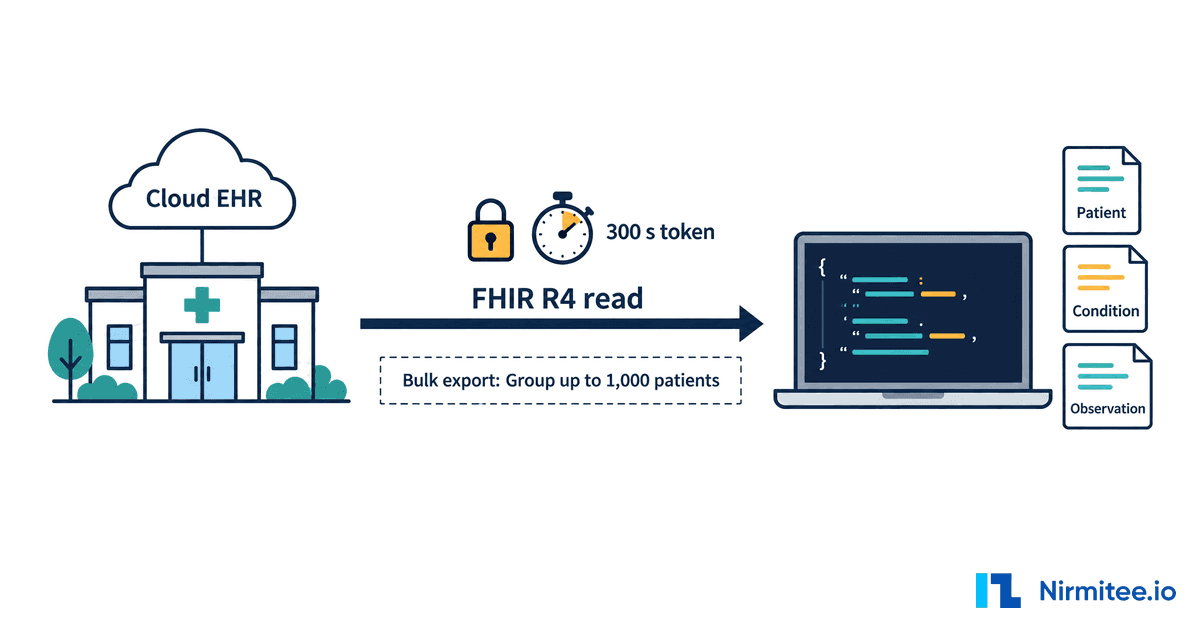
If your application needs to read from or write to an existing EHR (Epic, Cerner, Athenahealth), you need FHIR R4 integration. This is not optional if you are building anything that touches clinical data in a US health system.
Integration cost depends on which systems you connect:
- Epic FHIR API: $15,000 to $50,000 for initial implementation; $5,000 to $15,000 per year for maintenance.
- Cerner FHIR: similar range. Cerner's developer program has its own certification requirements.
- Athenahealth API: $10,000 to $30,000 depending on scope.
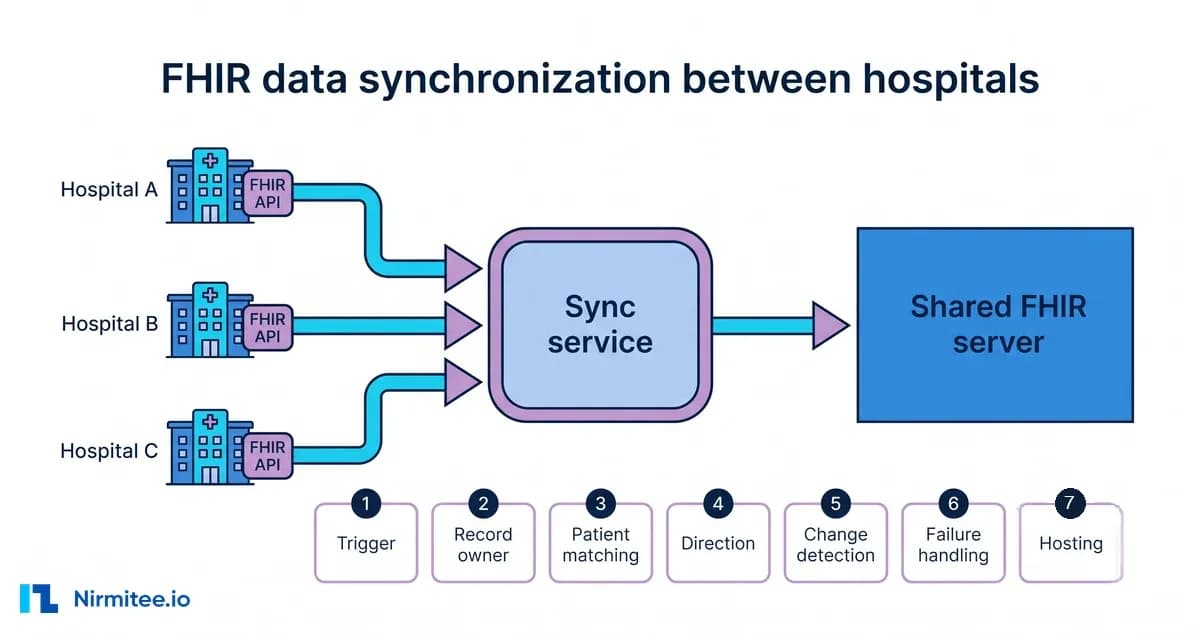
These are per-integration costs. Connecting to three EHR systems multiplies them, unless your architecture uses a FHIR R4-native layer that abstracts the connections. That is where the build approach matters as much as the budget.
Red flag: any partner quoting EHR integration without specifying FHIR R4 compliance and HL7 message handling. "API integration" without those specifics usually means custom point-to-point connectors that break every time the EHR vendor updates its schema.
AI features in EHR systems: cost and what you actually get
AI is now a standard line item in EHR proposals. But "AI features" hide a wide range of real clinical value, from simple autocomplete to agentic automation that processes prior authorizations without a human in the loop.
Tier 1, assistive AI ($10,000 to $40,000 to implement): natural language processing for clinical notes, basic coding suggestions, appointment scheduling automation.
Tier 2, clinical decision support ($40,000 to $120,000): drug-interaction alerts, diagnostic imaging interpretation assistance, patient triage scoring, chronic care management protocols. These need integration with clinical knowledge bases and careful validation against real patient outcomes.
Tier 3, agentic automation ($100,000 to $300,000+): autonomous claims processing, prior-authorization workflows, real-time patient safety monitoring. Agentic systems act on clinical data without a human checking each step, which pushes compliance and validation requirements much higher.
AI is one of the fastest-growing areas of healthcare investment, and the growth is coming from Tier 2 and Tier 3 work, not chatbots. If you are building AI into your EHR, be specific about which clinical function it serves, and budget for the validation and compliance that come with it.
Hidden costs that blow EHR budgets
Data migration
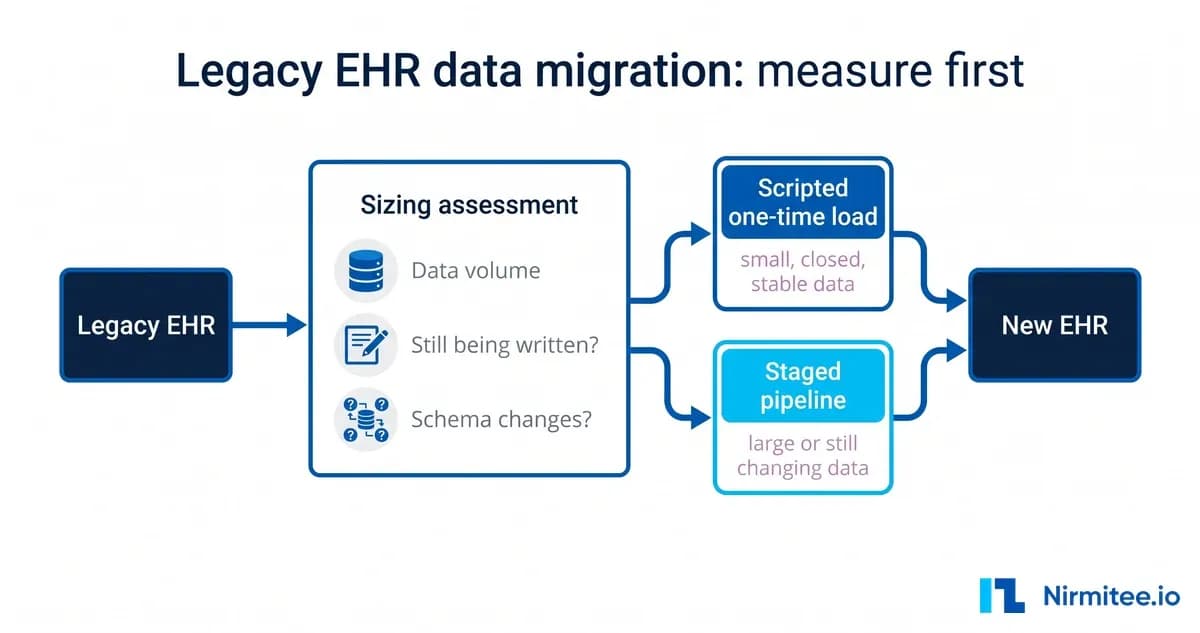
Moving patient records from a legacy system into a new EHR is expensive and slow. Expect $15,000 to $100,000 depending on record volume, data quality, and the format of the source system. HL7 v2 to FHIR R4 migration is a common pattern, and it needs careful mapping to avoid data loss.
Staff training
Clinical staff adoption is the most common reason EHR implementations fail. Budget $5,000 to $30,000 for training, depending on team size and system complexity. This is separate from implementation cost.
Ongoing maintenance and support
A production EHR needs continuous maintenance: security patches, compliance updates, integration fixes when upstream EHR vendors change their APIs, and feature work as your clinical workflows evolve. Budget 15 to 20 percent of initial development cost annually.
Interoperability testing
Before go-live, you need interoperability testing: verifying that your FHIR R4 resources map correctly, that HL7 messages parse without errors, and that edge cases in patient data do not cause clinical errors. This is often scoped separately and runs $10,000 to $40,000 for a thorough engagement.
Build vs. buy: the real decision framework
The build-versus-buy question for EHR systems in 2026 is not binary. Most digital health startups end up in a hybrid: buying a base EHR or FHIR R4 infrastructure layer, then building the clinical workflows and patient-facing features that set their product apart.
Buy (SaaS EHR) when:
- Your clinical workflow maps closely to an existing product.
- You have fewer than 10 providers and do not need custom integrations.
- Speed to market matters more than differentiation.
Build (custom EHR or EHR integration layer) when:
- Your clinical workflow is specialized or novel.
- You need direct FHIR R4 integration with multiple EHR systems.
- HIPAA compliance and audit logging need to live in your architecture, not get added on.
- You are building for both the US and India markets (HIPAA plus ABDM at the same time).
- You are adding AI clinical decision support or agentic automation.
For most seed-to-Series B digital health startups, the answer is build, but with a partner who ships pre-built compliance infrastructure and FHIR R4-native architecture rather than a general agency starting from zero.
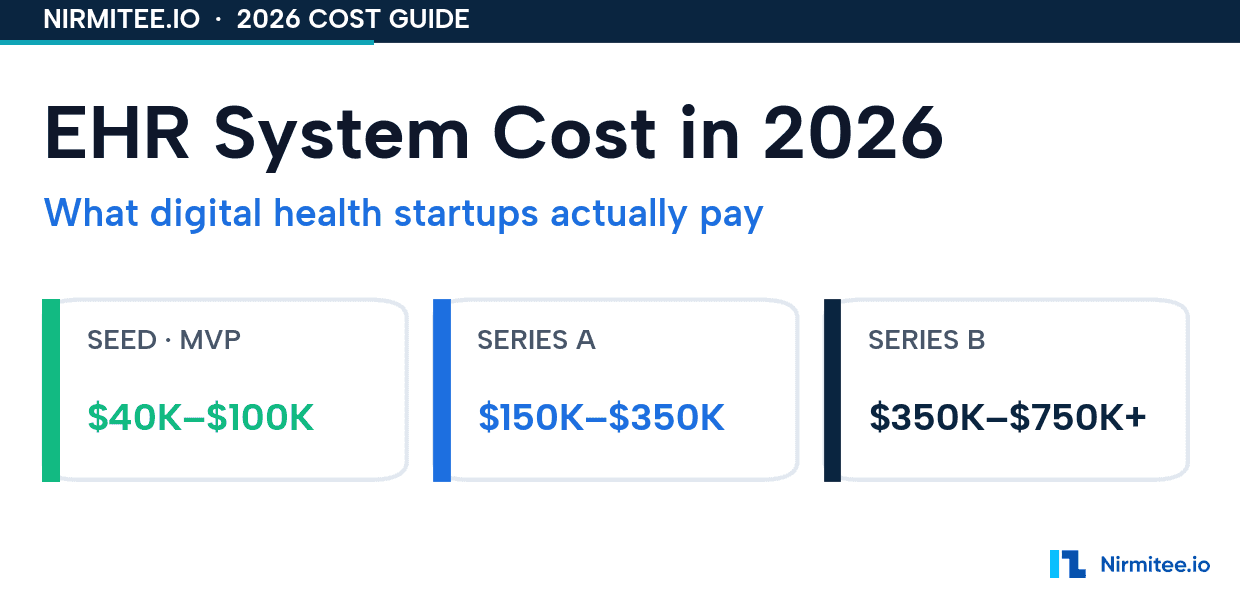
What a realistic EHR budget looks like by stage
Seed stage (MVP)
Budget: $40,000 to $100,000. Scope: core clinical data model, FHIR R4 API layer, HIPAA-compliant data storage, one EHR integration (Epic or Cerner), basic patient and provider views.
What you are not building yet: AI features, multi-system interoperability, advanced reporting, billing integration.
Series A (production-grade)
Budget: $150,000 to $350,000. Scope: full HIPAA compliance infrastructure (PHI encryption, audit logging, RBAC), two to three EHR integrations, clinical decision support (Tier 1 to 2 AI), patient portal, basic billing integration.
Series B (scale)
Budget: $350,000 to $750,000+. Scope: multi-system FHIR R4 interoperability, agentic automation for claims or prior authorization, advanced clinical analytics, SOC 2 continuous monitoring, and ABDM compliance for India-market expansion.
How Nirmitee.io approaches EHR development cost
At Nirmitee.io, every engagement ships with HIPAA compliance infrastructure built in by default. PHI encryption, audit logging, and access control are not line items you negotiate into the contract; they are part of the architecture from day one.
The FHIR R4-native architecture means direct integration with Epic, Cerner, and Athenahealth without custom middleware for each connection. That removes a whole category of integration costs and ongoing maintenance.
Pre-built healthcare components and AI-assisted development let us ship roughly 10x faster than a standard build. For a chronic-pain startup with no in-house tech team, that looked like a HIPAA-compliant MVP with Apple Health integration shipped in under eight weeks, compliance infrastructure included rather than retrofitted three months later.
For India-market healthtech companies, our open-source ABDM Node.js SDK (published on npm) provides NHA API integration without building ABDM compliance from scratch.
What to do with this information
EHR system cost is not a single number. It is a function of your deployment model, compliance requirements, integration scope, and the clinical workflows you are building for.
The most expensive mistake a digital health startup makes is treating compliance as optional at MVP stage and retrofitting it before Series A. The second most expensive is hiring a general software agency that learns FHIR R4 and HIPAA on your budget.
If you are evaluating EHR development partners, ask the specific questions: Does HIPAA compliance ship by default or as an add-on? Is the architecture FHIR R4-native, or does each integration need custom middleware? What does maintenance cost in year two? Those answers decide whether your EHR budget holds or doubles.
To talk through your specific scope and get a realistic cost estimate, book a call with the Nirmitee.io team.
Ready to scale?
Talk to our healthcare engineering team about building, integrating, and shipping faster.
Frequently Asked Questions
What is the average cost of an EHR system for a startup in 2026?
Is HIPAA compliance included in EHR development costs?
How much does FHIR R4 integration with Epic or Cerner cost?
What is the difference between an EHR integration and a custom EHR build?
How much do AI features add to EHR development cost?
What hidden costs should I budget for in an EHR project?
Does EHR cost differ for India-market healthtech companies?