
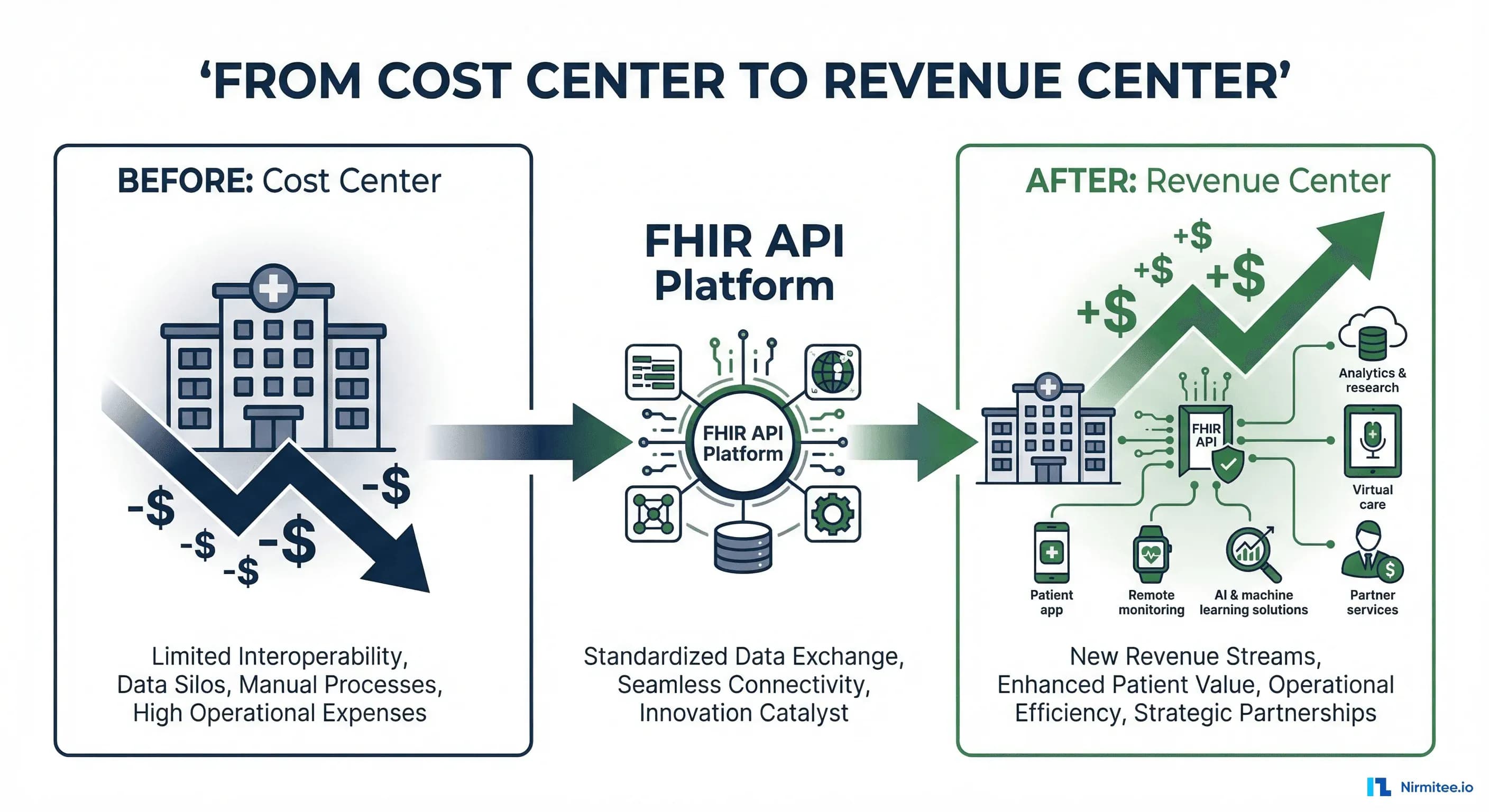
Between 2020 and 2025, U.S. health systems collectively spent an estimated $12 billion building FHIR-compliant API infrastructure. The 21st Century Cures Act, ONC's final rule on information blocking, and CMS interoperability mandates left them no choice. For most organizations, this was a compliance cost — a massive capital expenditure filed under "regulatory necessity" and quietly absorbed into IT budgets.
Related Reading
For more insights, explore our guides on FHIR-First AI Strategy for Healthcare and FHIR in Modern Healthcare.
You may also find value in EHR Software Development Guide and Building a Healthtech App.
But a growing number of health system executives are asking a different question: What if this infrastructure we were forced to build is actually an asset we can monetize?
The answer is yes — and the health systems that figure this out first will create a durable competitive advantage that compounds over time. According to a McKinsey analysis, the U.S. healthcare data market could reach $370 billion by 2030. Health systems sit on the richest clinical data in existence. The only question is whether they will be the ones to capture that value — or cede it to intermediaries.
This article outlines three proven revenue models, the infrastructure required to operationalize them, the compliance guardrails you must respect, and a framework for calculating your return on FHIR investment.
The Compliance-to-Commerce Pivot
Most health systems built their FHIR APIs in a rush. The ONC Cures Act Final Rule required certified health IT to support standardized FHIR APIs by December 31, 2022. CMS extended interoperability requirements to payers through the CMS-0057-F rule, effective January 2027. The result: billions spent on infrastructure that, for most organizations, does exactly one thing — satisfy regulators.
That is a waste of a strategic asset. Your FHIR infrastructure already handles authentication, authorization, data normalization, consent management, and audit logging. These are the same capabilities required to run a commercial data platform. The marginal cost of adding revenue-generating use cases to existing infrastructure is a fraction of the original build cost.
The pivot from compliance to commerce requires three things: a clear monetization model, a developer-facing platform, and rigorous compliance guardrails. Let us examine each.
Three Revenue Models for Health System FHIR APIs
Model 1: Data-as-a-Service (DaaS) — $1M to $5M/Year Potential
Health systems generate terabytes of structured clinical data daily — diagnoses, lab results, medication histories, procedure outcomes, vital sign trends, imaging reports. De-identified and aggregated, this data is extraordinarily valuable to pharmaceutical companies, clinical researchers, population health analytics firms, and payers.
How it works: Your FHIR server already stores clinical data in standardized FHIR R4 resources (Patient, Condition, Observation, MedicationRequest, Procedure). You build a de-identification pipeline — applying either the HIPAA Safe Harbor method (removing 18 identifier types) or the Expert Determination method (a qualified statistician certifies re-identification risk is "very small") — and expose curated, de-identified datasets through a controlled API or secure data enclave.
Real-world example: A 12-hospital system in the Midwest partnered with a clinical research organization to provide de-identified oncology datasets covering 180,000 cancer patients across 8 years of treatment history. The licensing arrangement generates approximately $3.2 million annually in recurring revenue, with minimal incremental infrastructure cost because the data already flows through their FHIR server.
Buyer personas:
- Pharmaceutical companies — real-world evidence (RWE) for drug development, post-market surveillance, and clinical trial site selection
- Life sciences analytics firms — companies like Flatiron Health, Tempus, and Veracyte pay premium prices for high-quality, longitudinal clinical data
- Payers and ACOs — risk stratification models, utilization pattern analysis, and network adequacy assessments
- Academic researchers — population-level studies, comparative effectiveness research, and health disparities analysis
Model 2: API-as-a-Platform (AaaP) — $500K to $3M/Year Potential
This is the app store model applied to healthcare. You open your SMART on FHIR API to third-party application developers — clinical decision support tools, patient engagement apps, remote monitoring platforms, specialty-specific workflows — and charge per API call, per user, or per transaction.
How it works: You deploy a developer portal with self-service registration, sandbox environments, API documentation, usage analytics, and tiered pricing. Developers build applications against your FHIR API, patients and clinicians use those applications, and you collect revenue on every interaction.
Real-world example: A large academic medical center on the East Coast launched a developer portal in 2024 with three pricing tiers: Free (1,000 API calls/month for sandbox testing), Standard ($0.05/call for production use), and Enterprise (custom pricing with SLA guarantees). Within 18 months, 47 third-party applications were live on their platform, generating an average of 4 million API calls per month and approximately $2.4 million in annual recurring revenue.
Key insight: The revenue per API call matters less than the volume. At $0.05/call, you need 1.67 million calls per month to hit $1M/year. A single popular patient-facing app with 50,000 active users making 40 API calls per session can generate that volume alone.
Model 3: Integration-as-a-Service (IaaS) — $200K to $1M/Year Potential
If your health system operates a regional network — affiliated practices, post-acute care facilities, behavioral health partners, rural clinics — you can offer integration services as a managed offering. Smaller organizations in your network lack the resources to build and maintain their own FHIR infrastructure. You already have it.
How it works: You extend your FHIR API platform to network partners, providing managed connectivity, data exchange, and interoperability services. Partners pay a monthly subscription based on volume and complexity. You handle the TEFCA compliance, security, and ongoing maintenance.
Real-world example: A 6-hospital system in the Pacific Northwest offers a managed integration package to 34 affiliated primary care practices. Each practice pays between $2,000 and $8,000/month depending on patient volume and integration complexity. Total annual revenue: approximately $680,000 — with operating margins above 60% because the core infrastructure costs are already covered.
Building the Developer Portal: Your Revenue Platform
Monetizing your FHIR APIs requires more than exposing endpoints. You need a developer-facing platform that handles the full lifecycle — from discovery to production deployment to billing. Here is what that architecture looks like:
Core Components
| Component | Purpose | Build vs. Buy |
|---|---|---|
| API Gateway | Rate limiting, authentication (OAuth 2.0 / SMART), request routing, analytics | Buy (Kong, Apigee, AWS API Gateway) |
| Developer Portal | API docs (OpenAPI/Swagger), sandbox, API key management, usage dashboard | Buy + Customize |
| FHIR Server | Core data access layer, FHIR R4 resources, SMART on FHIR authorization | Build or Buy (HAPI, Smile CDR, Firely) |
| Business Layer | Pricing tiers, usage metering, invoicing, BAA management, contract lifecycle | Build (custom, Stripe integration) |
| De-identification Engine | HIPAA Safe Harbor / Expert Determination, data masking, synthetic data generation | Buy (Privitar, Datavant) or Build |
| Consent Management | Patient consent tracking, granular access controls, audit trail | Build (FHIR Consent resource) |
Pricing Strategy Considerations
The most successful health system API platforms use tiered pricing with clear value differentiation:
- Sandbox Tier (Free) — synthetic data, rate-limited, self-service registration. Reduces friction for developer onboarding.
- Standard Tier ($0.03-$0.10/call) — production access, standard SLA (99.5% uptime), basic support, BAA required.
- Enterprise Tier (Custom) — dedicated throughput, premium SLA (99.9%), dedicated support, custom data feeds, bulk pricing discounts.
- Data Licensing (Annual contracts) — de-identified datasets, custom cohort extractions, research enclaves. Priced per dataset, per query, or as annual subscriptions.
Compliance Guardrails: What You Can and Cannot Monetize
This is where most health system executives hesitate — and rightfully so. The regulatory landscape around health data monetization is nuanced, and the penalties for getting it wrong are severe. But the rules are clearer than most people think.
What You CAN Monetize
- De-identified data — Data that has been de-identified per HIPAA 45 CFR 164.514 (Safe Harbor or Expert Determination) is no longer PHI and can be sold, licensed, or shared without patient authorization.
- Aggregate analytics — Population-level insights (e.g., "23% of diabetic patients in this ZIP code are on GLP-1 agonists") contain no individual-level data and can be freely commercialized.
- API access to authorized applications — Charging third-party apps for API access is permissible, provided a BAA is in place and the app has appropriate authorization (patient consent via SMART on FHIR scopes).
- Research data with IRB approval — Under the HIPAA research exception, a covered entity may use or disclose PHI for research purposes with IRB or Privacy Board approval and appropriate patient consent or waiver.
What You CANNOT Monetize
- Individually identifiable PHI for marketing — HIPAA prohibits the sale of PHI without patient authorization, and the definition of "sale" is broad (any disclosure for direct or indirect remuneration).
- Data shared without adequate consent — Even for de-identified data, state laws (particularly California's CCPA/CPRA and Washington's My Health My Data Act) may impose additional consent requirements.
- Unrestricted data downloads — Any monetization model must include access controls. Allowing bulk, unrestricted downloads of clinical data — even de-identified — creates re-identification risk and potential liability.
- Bypassing information blocking rules — The ONC information blocking rules require that you do not use fees as a mechanism to prevent or materially discourage access to EHI. Your pricing must be reasonable, non-discriminatory, and based on objective criteria.
Critical nuance: The ONC information blocking exceptions (specifically the Fees Exception at 45 CFR 171.302) allow you to charge reasonable fees for API access — but those fees cannot be designed to deter access. The line between "reasonable API pricing" and "information blocking through fees" is a judgment call your compliance and legal teams must make carefully.
The API Platform Flywheel: Why First Movers Win
The most compelling reason to monetize your FHIR infrastructure is not the direct revenue — it is the competitive flywheel it creates.
Health systems with robust, well-documented, developer-friendly FHIR APIs attract better third-party applications. Better apps improve clinical workflows and patient experiences. Better workflows attract top clinicians who want to practice at institutions with modern tooling. Top clinicians attract patients. More patients generate more data, more revenue, and more resources to reinvest in the platform.
This flywheel effect creates a compounding advantage that is extremely difficult for competitors to replicate. It is the same dynamic that made Apple's App Store, Salesforce's AppExchange, and Stripe's developer platform so dominant — applied to healthcare.
The data proves it: According to HIMSS research, health systems with high digital maturity scores (which correlate strongly with API readiness) report 15-20% higher physician satisfaction and 12% lower clinician turnover. The API platform is not just a revenue center — it is a talent retention strategy.
ROI Framework: Calculate Your Break-Even Point
Before presenting a business case to your board, you need credible numbers. Here is a framework for estimating the ROI of monetizing your existing FHIR infrastructure.
Step 1: Calculate Your Sunk Investment
Total FHIR infrastructure cost to date — including the FHIR server, API gateway, identity management, developer tooling, and team effort. For a mid-size health system (5-15 hospitals), this typically ranges from $1.5M to $4M.
Step 2: Estimate Incremental Costs
The additional investment needed to turn compliance infrastructure into a revenue platform:
- Developer portal build-out: $150K-$300K
- De-identification pipeline: $100K-$250K
- Business/billing layer: $50K-$150K
- Annual platform maintenance: $200K-$400K
- Compliance and legal review: $50K-$100K
Step 3: Project Revenue Streams
| Revenue Stream | Conservative (Year 1) | Moderate (Year 2) | Aggressive (Year 3) |
|---|---|---|---|
| Data licensing | $500K | $1.2M | $2.5M |
| API call revenue | $200K | $800K | $2.0M |
| Integration services | $150K | $400K | $700K |
| Total | $850K | $2.4M | $5.2M |
Step 4: Break-Even Calculation
For a health system with a $2M sunk FHIR investment and $500K in incremental platform costs (total: $2.5M), the break-even point at moderate revenue projections is approximately 18-22 months from platform launch. By Year 3, the cumulative ROI exceeds 200%.
The key insight: the FHIR investment is already spent. The incremental cost to add monetization capabilities is typically 15-25% of the original infrastructure investment. You are not building a new platform — you are adding a revenue layer to an existing one.
Getting Started: A 90-Day Playbook
If you are a CIO, VP of Digital, or health system strategy leader evaluating this opportunity, here is a practical starting point:
Days 1-30: Assessment
- Audit your current FHIR API capabilities (which resources are exposed, what auth mechanisms are in place, what is your current call volume)
- Identify your highest-value data assets (specialty-specific datasets, longitudinal records, rare disease cohorts)
- Engage legal and compliance to review your state's health data monetization laws
- Survey your network for integration service demand
Days 31-60: Strategy
- Select your initial monetization model (DaaS is typically the fastest to revenue; AaaP has the highest long-term potential)
- Define pricing tiers and target customers
- Scope the developer portal build (or identify a partner — Nirmitee builds these platforms for health systems, from FHIR server to developer portal to monetization layer)
- Build a financial model with conservative, moderate, and aggressive scenarios
Days 61-90: Pilot
- Launch a limited pilot with 2-3 external partners or data buyers
- Deploy usage analytics and metering
- Validate pricing assumptions with real transaction data
- Present results and full business case to the board
Building interoperable healthcare systems is complex. Our Healthcare Interoperability Solutions team has deep experience shipping production integrations. We also offer specialized Healthcare Software Product Development services. Talk to our team to get started.
Frequently Asked QuestionsCan a health system legally sell patient data?
A health system cannot sell individually identifiable PHI without explicit patient authorization. However, de-identified data (per HIPAA Safe Harbor or Expert Determination methods) is no longer considered PHI and can be licensed or sold. Additionally, aggregate analytics and API access fees are permissible revenue streams.
What is the difference between the HIPAA Safe Harbor and Expert Determination methods?
Safe Harbor requires removing 18 specific identifier types (names, dates, ZIP codes, etc.) and is more straightforward to implement. Expert Determination requires a qualified statistician to certify that the risk of re-identification is "very small" — this method preserves more data utility but is more expensive and time-consuming to implement.
How does information blocking regulation affect API pricing?
The ONC Fees Exception (45 CFR 171.302) permits reasonable fees for API access, but fees cannot be designed to deter access or discriminate against specific requestors. Pricing must be based on objective, verifiable criteria and must be reasonably related to the costs of providing access.
What infrastructure do I need beyond my existing FHIR server?
At minimum: an API gateway with metering capabilities, a developer portal with documentation and sandbox, a de-identification pipeline (if pursuing DaaS), a business/billing layer, and enhanced consent management. Most health systems can build this incrementally for $300K-$700K on top of existing infrastructure.
How long does it take to see revenue from a healthcare API platform?
Data licensing deals can close within 3-6 months of platform readiness. API-as-a-Platform revenue typically takes 6-12 months to build meaningful volume as third-party developers build and deploy applications. Integration-as-a-Service can generate revenue within 2-3 months if you have an existing provider network.