
Every healthcare product has manual workflows hiding in plain sight. Staff spend hours on eligibility checks, prior authorizations, patient intake forms, and claims processing — repetitive tasks that follow predictable patterns but consume unpredictable amounts of time.
These are not edge cases. They are core operational workflows that directly impact your unit economics, patient experience, and ability to scale. And 3 to 5 of them in every healthcare product are prime candidates for AI agents.
Not chatbots. Not dashboards with AI labels. Actual autonomous agents that pursue goals, use tools, handle exceptions, and know when to escalate to humans.
This blog gives you a structured framework to identify which workflows in your product should become agents, how to evaluate them, and in what order to build them.
The 7 Universal Healthcare Agent Opportunities
After building healthcare products for over a decade and working with 20+ healthcare applications, we have identified seven workflows that appear in virtually every healthcare product. Each one follows the same pattern: structured inputs, repeatable steps, measurable outcomes, and a human currently doing it manually.
1. Eligibility Verification — Staff spend 12-15 minutes per patient checking insurance coverage across multiple payer portals. An agent queries all relevant payers in parallel and returns structured results in 30 seconds. This is the single highest-ROI agent for most healthcare products.
2. Prior Authorization Status Tracking — Someone on your team checks authorization statuses daily, logging into portals and updating records manually. An agent monitors all pending authorizations and surfaces only the ones that need human attention — denials, requests for additional information, or approaching deadlines.
3. Patient Intake Pre-Population — New patients fill out 8-12 pages of forms, most of which duplicates data you already have. An agent pre-populates intake forms from existing FHIR records, insurance data, and referral information, reducing a 12-minute process to a 3-minute verification.
4. Clinical Document Extraction — Referral letters, discharge summaries, and lab results arrive as PDFs, faxes, and unstructured text. A human reads each one and manually enters data into the EHR. An agent extracts structured data from these documents, maps it to FHIR resources, and flags anything that needs clinical review.
5. Scheduling Optimization — No-shows cost healthcare organizations 150 billion dollars annually. An agent analyzes patient history, appointment patterns, travel time, and engagement signals to predict no-show risk and proactively reschedule or send targeted reminders. Organizations see 20-30% fewer no-shows.
6. Claims Scrubbing — Claims get denied because of coding errors, missing documentation, or payer-specific requirements that change quarterly. An agent reviews claims before submission, cross-references current payer rules, and flags issues before they become denials. First-pass acceptance rates improve 5-15%.
7. Care Gap Outreach — Quality measures require proactive patient outreach for screenings, vaccinations, and follow-ups. An agent identifies patients with care gaps, generates personalized outreach messages, and schedules follow-up based on patient preferences and clinical priority.
The Assessment Framework: Is This Workflow Agent-Ready?
Not every workflow should be an agent. Some are too complex, too variable, or too clinically risky for autonomous operation today. Use this decision framework to evaluate each candidate.
Question 1: Are the inputs and outputs structured?
Agents work best when they can receive well-defined inputs and produce well-defined outputs. Eligibility verification takes a patient record and produces a coverage status — structured in, structured out. A complex clinical decision that requires interpreting ambiguous symptoms across multiple body systems is not structured enough for autonomous operation.
This does not mean the data must be perfectly clean. Agents can handle messy inputs — that is part of what makes them valuable. But there must be a clear definition of what goes in and what comes out.
Question 2: Are the steps repeatable?
If a workflow follows roughly the same steps every time, an agent can learn that pattern. Eligibility verification always involves: extract demographics, identify payer, format request, query API, parse response, update record. The specific data changes, but the workflow structure is stable.
If every instance requires a fundamentally different approach — like diagnosing a rare condition — it is not a good agent candidate today.
Question 3: Is the outcome measurable?
You need to be able to tell whether the agent did the right thing. Eligibility verification either returns the correct coverage status or it does not. Claims scrubbing either catches the error or it does not. These are measurable.
If success is subjective or requires deep clinical judgment to evaluate, the workflow needs human-in-the-loop design rather than full autonomy.
Question 4: Is the clinical risk low enough?
This is the most important filter. An eligibility check that returns wrong results wastes time but does not harm patients. A medication dosing agent that gets it wrong could be fatal.
Low clinical risk does not mean zero risk. It means the consequences of an error are recoverable — they cost time or money, not patient safety. Any agent that touches clinical decisions needs human-in-the-loop design with confidence-based escalation.
The Prioritization Matrix: Build Order Matters
Once you have identified your agent candidates, you need to decide what to build first. The wrong order wastes months. The right order creates compounding returns.
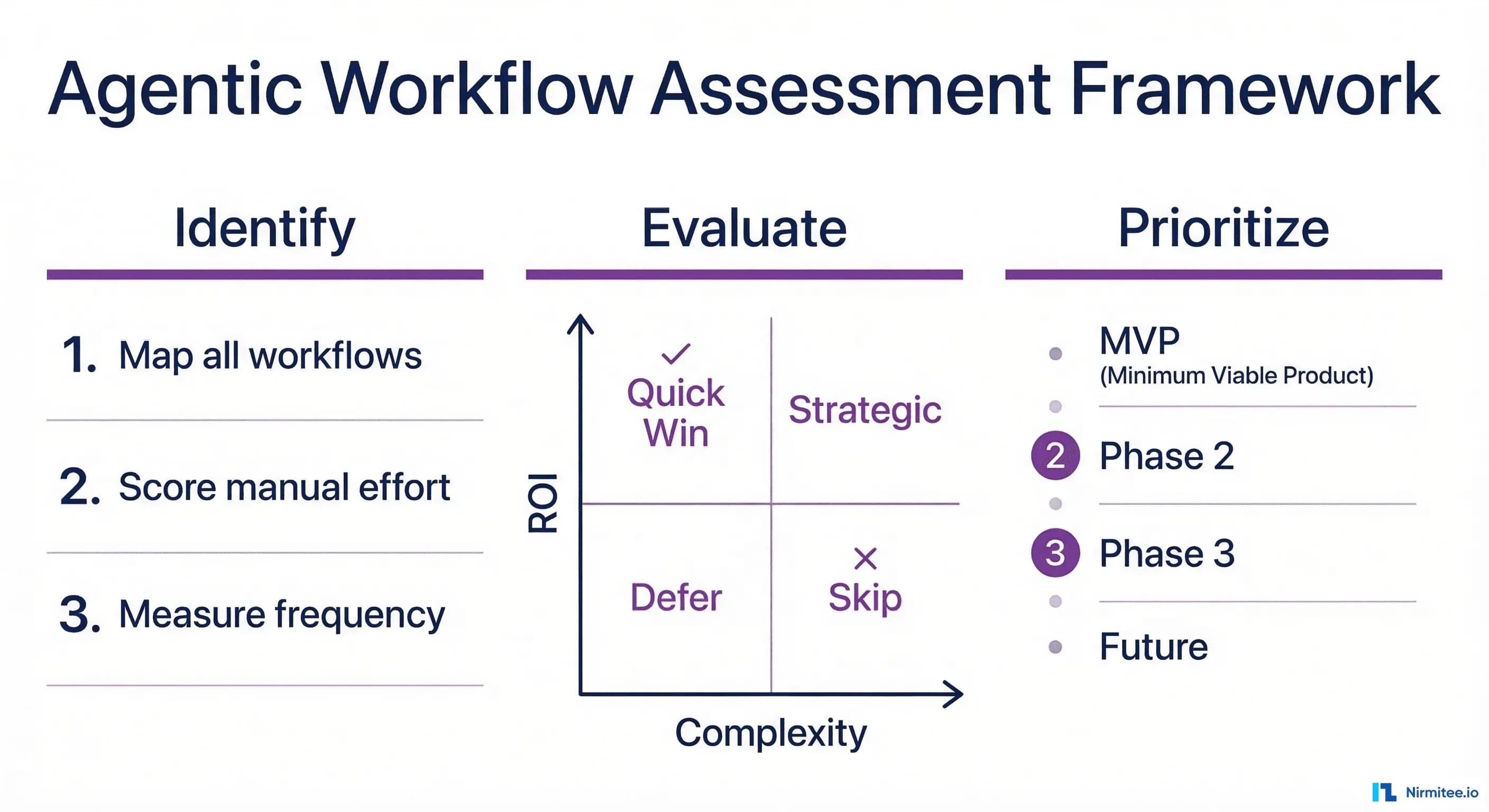
We use a 2x2 matrix with ROI on one axis and implementation complexity on the other:
- Quick Wins (High ROI, Low Complexity) — Build these first. Eligibility verification and prior auth status tracking almost always land here. They deliver immediate, measurable value and build organizational confidence in agents.
- Strategic Bets (High ROI, High Complexity) — Build these second. Claims scrubbing and clinical document extraction require more sophisticated NLP and domain knowledge, but the payoff is substantial.
- Defer (Low ROI, Low Complexity) — Easy to build but limited impact. Do these when you have spare capacity, not as priorities.
- Skip (Low ROI, High Complexity) — Not worth the investment today. Revisit when the technology matures or the business case changes.
The ROI Math: What These Agents Are Actually Worth
Abstract discussions about AI value do not convince CFOs or investors. Here is the concrete math for a mid-size practice processing 200 patients per day.
Eligibility Verification Agent
Manual cost: 15 minutes per patient at 25 dollars per hour fully loaded staff cost. That is 6.25 dollars per check. At 200 patients per day, 250 working days per year: 312,500 dollars per year in direct labor. The agent costs approximately 0.04 dollars per check in LLM tokens and API calls — 2,000 dollars per year. Factor in development, maintenance, and oversight staff, and the all-in annual cost is roughly 50,000 dollars. Net savings: approximately 260,000 dollars per year for a single workflow.
Prior Authorization Agent
Staff spend 30-45 minutes per authorization, and a typical practice handles 20-30 per day. At the conservative end, that is 10 hours of daily labor dedicated to checking portals, calling payers, and updating records. Annual savings: 350,000-520,000 dollars depending on volume.
The Compound Effect
The real value is not in any single agent — it is in the compound effect of running multiple agents on shared infrastructure. Your first agent costs the most because you are building the platform: FHIR connectors, LLM orchestration, compliance logging, and human-in-the-loop routing. Your second agent reuses 60-70% of that infrastructure. By your fourth agent, you are assembling from existing components in days, not weeks.
For a Series A healthcare startup processing 200 patients per day, three well-chosen agents can save 800,000 to 1.2 million dollars annually in operational costs — or equivalently, allow you to scale to 3-4x your current volume without proportionally scaling your operations team.
How to Start: The 30-Day Agent Assessment
You do not need to commit to building agents today. Start with a structured assessment:
Week 1: Workflow Mapping — Document every workflow in your product that involves a human doing something repetitive. Include time estimates, frequency, error rates, and downstream impact. You will likely find 8-12 candidates.
Week 2: Scoring — Run each candidate through the four-question framework above. Score them on structured I/O, repeatability, measurability, and clinical risk. Eliminate anything that scores poorly on clinical risk — that is your hard filter.
Week 3: ROI Modeling — For your top 5 candidates, build the unit economics model. What does this workflow cost today per instance? How many instances per day? What would the agent cost in LLM tokens, API calls, and oversight? Build a conservative case (50% of projected savings) and an optimistic case.
Week 4: Architecture Review — For your top 2-3 candidates, map the technical requirements. What data sources does the agent need? What APIs does it call? What is the FHIR integration surface? What does the human-in-the-loop design look like?
By the end of 30 days, you will have a prioritized backlog of agent opportunities with concrete ROI projections and technical requirements. Whether you build them internally or work with a healthcare product partner, you will be making decisions based on data, not hype.
The Bottom Line
Every healthcare product has 3-5 workflows that are burning cash on manual labor right now. The question is not whether to automate them — it is whether to do it with fragile RPA scripts, basic if-then rules, or actual AI agents that reason about context, handle exceptions, and improve over time.
The technology to build these agents exists today. The ROI math is compelling. The healthcare domain knowledge required to build them correctly is the real differentiator — not the AI itself, but understanding the messy reality of payer portals, FHIR data quality, compliance requirements, and clinical workflows that no foundation model was trained on.
Start with the assessment. Find your 3-5. Build the highest-ROI one first. Let the compound effect do the rest.
Ready to deploy AI agents in your healthcare workflows? Explore our Agentic AI for Healthcare services to see what autonomous automation can do. We also offer specialized Healthcare AI Solutions services. Talk to our team to get started.