
Model Drift in Clinical AI: Why Your Sepsis Predictor Gets Worse Every Month and How to Detect It

CTO & Co-Founder
CTO & Co-Founder at Nirmitee.io. Architects healthcare integrations across FHIR, SMART on FHIR, ABDM and NHCX, writing from production experience taking hospital software from sandbox to go-live.
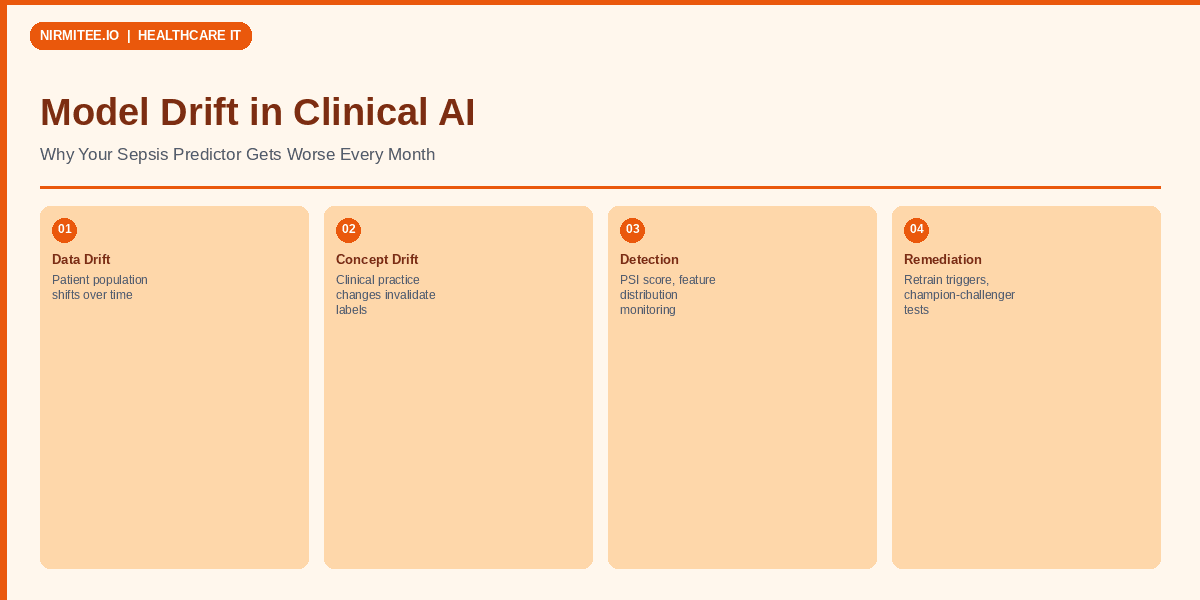
You trained a sepsis prediction model. It achieved 0.89 AUROC on your validation set. Clinicians approved it. You deployed it to the ICU. For three months, it performed beautifully -- catching early sepsis cases that nurses might have missed, reducing time-to-antibiotics by 40 minutes on average.
Then it started getting worse. Slowly, silently. The alert-to-true-positive ratio crept upward. Nurses began ignoring alerts. By month six, the model's effective AUROC had dropped to 0.74. By month nine, clinicians had mentally classified it as another source of alert fatigue and stopped paying attention entirely.
When you are ready to implement it, our healthcare AI team covers the build, testing and go-live.
This is model drift, and it is the single most dangerous failure mode for production clinical AI. Unlike a system crash, drift does not announce itself. There is no error message, no stack trace, no pager alert. The model continues to produce predictions -- they are just increasingly wrong. In healthcare, where those predictions influence treatment decisions, undetected drift is a patient safety issue.
Related Reading
For more insights, explore our guides on Healthcare LLM Landscape 2026: MedGemma, Meditron, and FHIR in Modern Healthcare.
You may also find value in EHR Software Development Guide and Building a Healthtech App.
This guide covers what drift is, why it is uniquely severe in healthcare, how to detect it with statistical methods and production code, and how to build automated monitoring that catches degradation before clinicians lose trust.
Understanding the Three Types of Drift
Model drift is an umbrella term covering three distinct phenomena. Each has different causes, different detection methods, and different remediation strategies. Conflating them leads to wasted effort -- you cannot fix concept drift by retraining on fresher data alone.
Data Drift (Covariate Shift)
Data drift occurs when the statistical distribution of input features changes between training and production. The relationship between features and the target variable remains the same, but the model sees input values it was not trained on.
Healthcare example: Your sepsis model was trained on data from a 400-bed community hospital. After a merger, patients from a 200-bed rural hospital are now in your EHR. The rural population is older, has higher rates of chronic kidney disease, and presents later in illness course. The model's features (age distribution, baseline creatinine, hours-since-symptom-onset) have shifted, even though the biological relationship between those features and sepsis has not changed.
Concept Drift
Concept drift occurs when the relationship between input features and the target variable changes. The features look the same, but they no longer predict the outcome the same way. This is the most dangerous type because it means the model's learned patterns are fundamentally wrong.
Healthcare example: COVID-19 changed the relationship between respiratory rate, oxygen saturation, and sepsis. Pre-pandemic, a patient with SpO2 below 92% and elevated respiratory rate had a high probability of bacterial sepsis. During and after the pandemic, the same vital sign pattern was frequently viral pneumonia, not sepsis. The model's learned association between these features and the sepsis label became incorrect -- classic concept drift.
Label Drift (Prior Probability Shift)
Label drift occurs when the prevalence of the target class changes. The model was trained assuming 8% of ICU admissions develop sepsis. If a new antibiotic stewardship program reduces that to 5%, or if a change in admission criteria increases it to 12%, the model's calibration becomes incorrect even if its discrimination is unchanged.
Healthcare example: A hospital implements a new rapid diagnostic test for bloodstream infections. Clinicians begin diagnosing sepsis earlier and more accurately. The sepsis prevalence in the training data was based on the old diagnostic criteria. With the new test, more cases are caught (higher prevalence) and the timing of diagnosis changes, shifting the label distribution.
Why Healthcare Drift Is Worse Than Other Domains
Model drift affects every production ML system, but healthcare has five structural factors that make it more frequent, harder to detect, and more dangerous than drift in e-commerce, finance, or advertising.
Seasonal Disease Patterns
Influenza, RSV, and other respiratory viruses create seasonal variation in ICU admissions, vital sign patterns, and laboratory values. A model trained on spring data will encounter different distributions in winter. Unlike retail seasonality (predictable, stable year-over-year), disease seasonality varies in timing, severity, and dominant pathogen each year.
EHR System Upgrades
When an EHR vendor releases a major version update, the way data is recorded can change. Field mappings shift, new fields appear, deprecated fields become null, and documentation templates change. A model that relied on a specific vital sign field may find that field empty after an upgrade, with the same data now in a differently named field. This creates instant, catastrophic data drift.
Coding Practice Changes
ICD-10 coding is influenced by billing incentives, regulatory requirements, and coder training. CMS guideline changes can shift diagnosis coding patterns overnight. When ICD-10-CM codes for sepsis were reorganized in 2016 (removing "severe sepsis" as a standalone code), models trained on the old coding scheme saw massive label drift. Similar shifts happen regularly at smaller scales.
Population Demographics
Hospital patient populations change through mergers, service line expansions, insurance network changes, and community demographic shifts. A model trained on a predominantly commercially insured population will drift when the hospital joins a Medicaid managed care plan and its patient demographics shift toward younger, lower-income populations with different comorbidity profiles.
New Treatment Protocols
When clinical practice guidelines change, treatment patterns shift, which changes outcomes. The Surviving Sepsis Campaign updates its guidelines every 4-5 years. Each update changes the timing and type of interventions (fluid resuscitation volumes, vasopressor selection, antibiotic timing), which changes the outcomes that the model was trained to predict.
The COVID-19 Case Study: Catastrophic Drift in Real Time
COVID-19 provided the most dramatic real-world demonstration of model drift in clinical AI. Multiple published studies documented the phenomenon:
A 2021 study in the Journal of the American Medical Informatics Association (JAMIA) found that the Epic Sepsis Model, deployed across hundreds of US hospitals, saw its AUROC drop from 0.82 to 0.67 during the first COVID-19 surge. The model was not wrong about sepsis per se -- it was that the ICU population had fundamentally changed. Patients who would previously have been admitted to general medical wards were now in the ICU with COVID pneumonia, presenting with vital sign patterns that triggered the sepsis model.
A University of Michigan study published in npj Digital Medicine showed that their readmission prediction model's performance degraded by 8-12% across all patient subgroups during the pandemic, with the largest drops in surgical populations where elective procedures were cancelled and only emergent cases remained.
These were not edge cases. They were mainstream, well-validated, widely deployed models that failed simultaneously across the healthcare system. The lesson is clear: any clinical AI system without drift monitoring is operating on borrowed time. For teams building healthcare MLOps pipelines, drift detection is not a nice-to-have -- it is a patient safety requirement.
Related reading: Model Drift and Why Should Healthcare Teams Care.
Statistical Methods for Drift Detection
Drift detection requires comparing the distribution of production data against a reference distribution (typically the training or validation data). Four statistical methods are standard in production healthcare ML.
Population Stability Index (PSI)
PSI quantifies how much a variable's distribution has shifted. It divides the variable into bins, compares the proportion in each bin between reference and production data, and produces a single score. PSI below 0.1 indicates no significant drift. PSI between 0.1 and 0.25 indicates moderate drift requiring investigation. PSI above 0.25 indicates severe drift requiring action.
PSI is the most widely used drift metric in regulated industries because it is interpretable, bin-based (works with any distribution shape), and has well-established threshold guidelines.
Kolmogorov-Smirnov (KS) Test
The KS test compares two continuous distributions by finding the maximum difference between their cumulative distribution functions. It produces a test statistic (D) and a p-value. It is distribution-free (makes no assumptions about the underlying distributions) and sensitive to changes in location, scale, and shape. The limitation is that it works only for univariate continuous features.
Jensen-Shannon Divergence (JSD)
JSD measures the similarity between two probability distributions. Unlike KL divergence, JSD is symmetric and bounded between 0 and 1 (when using base-2 logarithm). JSD above 0.1 typically indicates meaningful drift. It works well for both continuous and categorical features.
ADWIN (Adaptive Windowing) for Streaming Data
ADWIN is designed for streaming data scenarios where you need to detect drift in real-time without storing the full reference distribution. It maintains a variable-length window and detects when the mean of the current window differs significantly from a historical window. This is particularly useful for vital sign streams and real-time clinical monitoring.
Production Drift Detection with Python and Evidently
Here is a complete Python implementation for production drift detection using Evidently AI, the leading open-source drift monitoring library. This code is designed for a healthcare context with FHIR-extracted features.
import pandas as pd
import numpy as np
from evidently import ColumnMapping
from evidently.report import Report
from evidently.metric_preset import DataDriftPreset, TargetDriftPreset
from evidently.metrics import (
    DataDriftTable,
    DatasetDriftMetric,
    ColumnDriftMetric
)
from datetime import datetime, timedelta
import json
import logging

logger = logging.getLogger("drift_monitor")

class ClinicalDriftMonitor:
    """
    Production drift monitoring for clinical AI models.
    Compares current production data against reference (training) distribution.
    """

    def __init__(self, reference_data: pd.DataFrame,
                 feature_columns: list,
                 target_column: str = "sepsis_label",
                 prediction_column: str = "sepsis_probability"):
        self.reference = reference_data
        self.features = feature_columns
        self.target = target_column
        self.prediction = prediction_column

        self.column_mapping = ColumnMapping(
            target=target_column,
            prediction=prediction_column,
            numerical_features=[
                "age", "heart_rate", "systolic_bp", "respiratory_rate",
                "temperature", "spo2", "wbc_count", "creatinine",
                "lactate", "platelet_count"
            ],
            categorical_features=[
                "sex", "admission_source", "primary_diagnosis_category",
                "insurance_type"
            ]
        )

    def compute_psi(self, reference_col: pd.Series,
                    production_col: pd.Series,
                    n_bins: int = 10) -> float:
        """Compute Population Stability Index for a single feature."""
        # Create bins from reference distribution
        bins = np.quantile(
            reference_col.dropna(),
            np.linspace(0, 1, n_bins + 1)
        )
        bins[0] = -np.inf
        bins[-1] = np.inf

        # Bin both distributions
        ref_counts = np.histogram(reference_col.dropna(), bins=bins)[0]
        prod_counts = np.histogram(production_col.dropna(), bins=bins)[0]

        # Convert to proportions (add small epsilon to avoid log(0))
        eps = 1e-8
        ref_pct = ref_counts / ref_counts.sum() + eps
        prod_pct = prod_counts / prod_counts.sum() + eps

        # PSI formula
        psi = np.sum((prod_pct - ref_pct) * np.log(prod_pct / ref_pct))
        return float(psi)

    def run_drift_report(self, production_data: pd.DataFrame) -> dict:
        """Generate comprehensive drift report using Evidently."""
        report = Report(metrics=[
            DatasetDriftMetric(),
            DataDriftTable(),
        ])

        report.run(
            reference_data=self.reference,
            current_data=production_data,
            column_mapping=self.column_mapping
        )

        # Extract results
        results = report.as_dict()
        drift_summary = {
            "timestamp": datetime.utcnow().isoformat(),
            "production_samples": len(production_data),
            "reference_samples": len(self.reference),
            "dataset_drift_detected": False,
            "drifted_features": [],
            "feature_details": {},
            "severity": "none"  # none, low, moderate, severe
        }

        # Parse Evidently results
        for metric_result in results.get("metrics", []):
            metric_id = metric_result.get("metric", "")
            result = metric_result.get("result", {})

            if "DatasetDriftMetric" in metric_id:
                drift_summary["dataset_drift_detected"] = result.get(
                    "dataset_drift", False
                )
                drift_summary["drift_share"] = result.get(
                    "drift_share", 0.0
                )

        # Compute PSI for each numerical feature
        for feature in self.column_mapping.numerical_features:
            if feature in production_data.columns:
                psi = self.compute_psi(
                    self.reference[feature],
                    production_data[feature]
                )
                drift_summary["feature_details"][feature] = {
                    "psi": round(psi, 4),
                    "status": self._psi_status(psi)
                }
                if psi > 0.25:
                    drift_summary["drifted_features"].append(feature)

        # Determine overall severity
        n_drifted = len(drift_summary["drifted_features"])
        if n_drifted == 0:
            drift_summary["severity"] = "none"
        elif n_drifted <= 2:
            drift_summary["severity"] = "low"
        elif n_drifted <= 5:
            drift_summary["severity"] = "moderate"
        else:
            drift_summary["severity"] = "severe"

        return drift_summary

    def _psi_status(self, psi: float) -> str:
        if psi < 0.1:
            return "stable"
        elif psi < 0.25:
            return "moderate_drift"
        else:
            return "severe_drift"

    def should_retrain(self, drift_report: dict) -> bool:
        """Determine if drift warrants model retraining."""
        if drift_report["severity"] in ["moderate", "severe"]:
            return True
        # Check critical clinical features specifically
        critical_features = ["lactate", "creatinine", "wbc_count"]
        for feat in critical_features:
            detail = drift_report["feature_details"].get(feat, {})
            if detail.get("psi", 0) > 0.2:
                return True
        return False
Running Weekly Drift Checks
In production, drift checks should run on a schedule. Weekly is the minimum for most clinical models; daily is recommended for high-acuity models (ICU, ED).
def weekly_drift_check(monitor: ClinicalDriftMonitor,
                       db_connection, model_name: str):
    """Weekly drift monitoring job for production clinical models."""
    # Pull last 7 days of production predictions
    query = """
        SELECT p.*, o.sepsis_label
        FROM predictions p
        LEFT JOIN outcomes o ON p.encounter_id = o.encounter_id
        WHERE p.model_name = %s
        AND p.prediction_time >= NOW() - INTERVAL '7 days'
    """
    production_data = pd.read_sql(query, db_connection, params=[model_name])

    if len(production_data) < 100:
        logger.warning(f"Insufficient production data: {len(production_data)} samples")
        return

    # Run drift report
    report = monitor.run_drift_report(production_data)

    # Log results
    logger.info(f"Drift report: severity={report['severity']}, "
                f"drifted_features={report['drifted_features']}")

    # Take action based on severity
    if report["severity"] == "severe":
        send_alert(
            channel="#clinical-ai-alerts",
            message=f"SEVERE DRIFT detected in {model_name}. "
                    f"Features: {', '.join(report['drifted_features'])}. "
                    f"Immediate review required.",
            priority="high"
        )
    elif report["severity"] == "moderate":
        send_alert(
            channel="#clinical-ai-monitoring",
            message=f"Moderate drift in {model_name}. "
                    f"Features: {', '.join(report['drifted_features'])}. "
                    f"Review within 48 hours.",
            priority="medium"
        )

    # Check if retraining is warranted
    if monitor.should_retrain(report):
        logger.info(f"Retraining recommended for {model_name}")
        trigger_retraining_pipeline(model_name, report)

    # Store report for audit trail
    store_drift_report(report, model_name, db_connection)

    return report
Monitoring Tool Comparison
Three platforms lead the healthcare ML monitoring space. Each addresses drift detection differently, with distinct trade-offs for regulated environments.
| Capability | Evidently AI | NannyML | WhyLabs |
|---|---|---|---|
| Deployment | Open-source, self-hosted | Open-source + cloud | SaaS + on-prem |
| HIPAA Suitability | Excellent (self-hosted) | Good (self-hosted option) | Good (on-prem option) |
| Data Drift Detection | PSI, KS, Wasserstein, Jensen-Shannon | PSI, KS, Chi-squared, Hellinger | Profile-based statistical tests |
| Concept Drift | Via target drift metrics | CBPE (performance estimation without labels) | Limited |
| Performance Estimation | Requires ground truth labels | Estimates without labels (CBPE, DLE) | Requires ground truth labels |
| Alerting | Custom (integrate with Slack, PagerDuty) | Built-in thresholds + webhooks | Built-in with integrations |
| Visualization | HTML reports, Grafana integration | Built-in dashboard | Built-in dashboard |
| Cost | Free (open-source) | Free tier + paid cloud | Free tier + enterprise pricing |
| Best For | Teams wanting full control, Python-native workflows | Teams needing performance estimation without ground truth | Teams wanting managed monitoring with minimal code |
Key insight for healthcare: NannyML's ability to estimate model performance without ground truth labels is uniquely valuable in healthcare. Clinical outcomes (ground truth) often arrive days or weeks after prediction -- a sepsis model predicts at admission, but the sepsis diagnosis may not be confirmed for 48-72 hours. NannyML's Confidence-Based Performance Estimation (CBPE) lets you detect performance degradation during this gap period.
Automated Retraining: When and How
Drift detection answers "is the model degrading?" The next question is "what do we do about it?" Automated retraining pipelines must balance responsiveness (fix drift quickly) with safety (do not deploy an untested model).
Retraining Triggers
Define explicit triggers rather than retraining on a calendar schedule. Calendar-based retraining (monthly, quarterly) either retrains too often (wasting compute when no drift exists) or too infrequently (missing drift between scheduled retrains).
| Trigger | Threshold | Rationale |
|---|---|---|
| PSI on any critical feature | > 0.25 | Severe data drift requiring model update |
| Rolling AUROC drop | > 0.03 below validated threshold | Confirmed performance degradation |
| Label prevalence change | > 20% relative change | Prior probability shift affecting calibration |
| Feature availability change | Any feature missing > 10% increase | Data pipeline or EHR change affecting features |
| Clinical feedback rate | > 15% false positive reports | Clinician-reported degradation |
Safe Retraining Pipeline
Automated retraining is not "automatically deploy the retrained model." It is "automatically retrain and hold for validation." The pipeline should: (1) pull fresh data from the feature store, (2) retrain using the same hyperparameters and architecture, (3) validate against the same clinical thresholds as the original model, (4) run fairness checks to ensure no demographic group performance regression, (5) generate a model card documenting changes, and (6) hold for approval if the model is under FDA SaMD oversight.
def safe_retrain_pipeline(model_name: str, drift_report: dict):
    """Automated retraining with safety gates."""

    # Step 1: Pull fresh training data (last 12 months)
    fresh_data = pull_training_data(
        lookback_months=12,
        deidentified=True
    )

    # Step 2: Retrain with same architecture
    new_model = retrain_model(
        data=fresh_data,
        config=load_model_config(model_name),
        experiment_name=f"{model_name}-retrain-{datetime.now().strftime('%Y%m%d')}"
    )

    # Step 3: Validation gate
    val_results = validate_model(new_model, validation_holdout)

    original_auroc = get_original_auroc(model_name)
    if val_results["auroc"] < original_auroc - 0.02:
        logger.error(
            f"Retrained model AUROC {val_results['auroc']:.3f} "
            f"below threshold {original_auroc - 0.02:.3f}. "
            f"Aborting deployment."
        )
        send_alert(
            channel="#clinical-ai-alerts",
            message=f"Retraining for {model_name} failed validation. "
                    f"Manual review required.",
            priority="high"
        )
        return False

    # Step 4: Fairness check
    fairness = compute_fairness_metrics(
        new_model, validation_holdout, demographics
    )
    for group, metrics in fairness.items():
        if metrics["auroc"] < 0.75:  # Minimum per-group threshold
            logger.error(f"Fairness violation for {group}: AUROC={metrics['auroc']}")
            return False

    # Step 5: Stage for shadow deployment (not direct to production)
    stage_for_shadow(
        model=new_model,
        model_name=model_name,
        drift_report=drift_report,
        validation_results=val_results,
        fairness_results=fairness
    )

    logger.info(f"Retrained {model_name} staged for shadow deployment.")
    return True
Building a Drift-Resilient Architecture
Beyond detection and retraining, you can design your ML system to be structurally resilient to drift. These architectural patterns reduce drift impact and speed recovery.
Ensemble with Recency Weighting
Instead of a single model, deploy an ensemble that weights recent training data more heavily. When drift occurs, the recent-data model adapts faster while the full-data model provides stability. This is particularly effective for seasonal drift in healthcare.
Feature Importance Monitoring
Track SHAP values or permutation importance in production. If a feature's importance ranking changes significantly, it signals concept drift even before aggregate performance metrics show degradation. A feature that was the third most important predictor in training but becomes the eighth most important in production is a clear drift signal.
Stratified Monitoring
Monitor performance separately by patient subgroups: age groups, diagnosis categories, care settings (ICU vs floor vs ED), and time-of-day. Drift often affects subgroups before it affects the overall population metrics. A model that looks stable in aggregate may be severely degraded for elderly patients or nighttime admissions. This connects directly to the observability frameworks that every healthcare AI system should implement.
Frequently Asked Questions
How quickly can drift make a clinical model unsafe?
It depends on the type and magnitude of drift. A sudden event like an EHR system upgrade can cause catastrophic data drift overnight -- features that previously contained valid values become null or change format, and the model produces garbage predictions immediately. Gradual drift from population changes or treatment protocol evolution typically takes 3-6 months to reach clinically meaningful degradation. The COVID-19 experience showed that pandemic-scale events can degrade models within 2-4 weeks. The key principle is that any model without active monitoring is operating with unknown risk.
Can we prevent drift entirely?
No. Drift is inherent to deploying models in dynamic environments. Healthcare is especially dynamic: patients change, treatments evolve, coding practices shift, and rare events (pandemics, natural disasters) alter everything simultaneously. The goal is not prevention but detection and response. A well-monitored model with fast retraining capability is safer than a "perfect" model deployed without monitoring.
How much reference data do we need for reliable drift detection?
For statistical tests like PSI and KS, you need at least 500-1000 samples in both the reference and production windows to get reliable results. For rare-event models (predicting outcomes with less than 5% prevalence), you may need 2000-5000 samples. In healthcare, this often means you need 1-4 weeks of production data before drift detection becomes meaningful, depending on patient volume.
Should we use data drift or performance drift as our primary signal?
Both, but for different purposes. Data drift is a leading indicator -- it detects distributional changes before they affect performance. Performance drift is a lagging indicator -- it confirms that drift has actually impacted model quality, but requires ground truth labels that may arrive days or weeks late. Use data drift for early warning and performance drift for confirmation. NannyML's CBPE approach bridges this gap by estimating performance without labels.
What happens if we detect drift but cannot retrain immediately?
Several interim actions are available. (1) Adjust the decision threshold to account for changed calibration. (2) Add a warning label to model outputs indicating potential degradation. (3) Increase human oversight (require physician confirmation of model recommendations). (4) Temporarily disable the model for the most affected patient subgroups while maintaining it for stable subgroups. (5) Communicate transparently with clinical staff about known limitations. The worst response is to do nothing and let clinicians continue receiving degraded predictions without awareness.
How does drift monitoring relate to FDA requirements for SaMD?
The FDA's Predetermined Change Control Plan (PCCP) framework explicitly anticipates model drift. A PCCP defines the conditions under which a model will be updated, the retraining methodology, and the validation criteria for the updated model. Drift monitoring provides the evidence base for PCCP triggers. Without drift monitoring, you cannot demonstrate that your PCCP triggers are functioning as described in your regulatory submission. Drift monitoring logs also serve as post-market surveillance data, which the FDA requires for all cleared medical devices.
Ready to scale?
Talk to our healthcare engineering team about building, integrating, and shipping faster.
Frequently Asked Questions
What is model drift in clinical AI?
What are the three types of model drift in healthcare ML?
Why does model drift hit healthcare harder than other industries?
How did COVID-19 affect sepsis prediction models?
How do you detect and monitor model drift in production clinical AI?
How does Nirmitee.io approach healthcare software development?