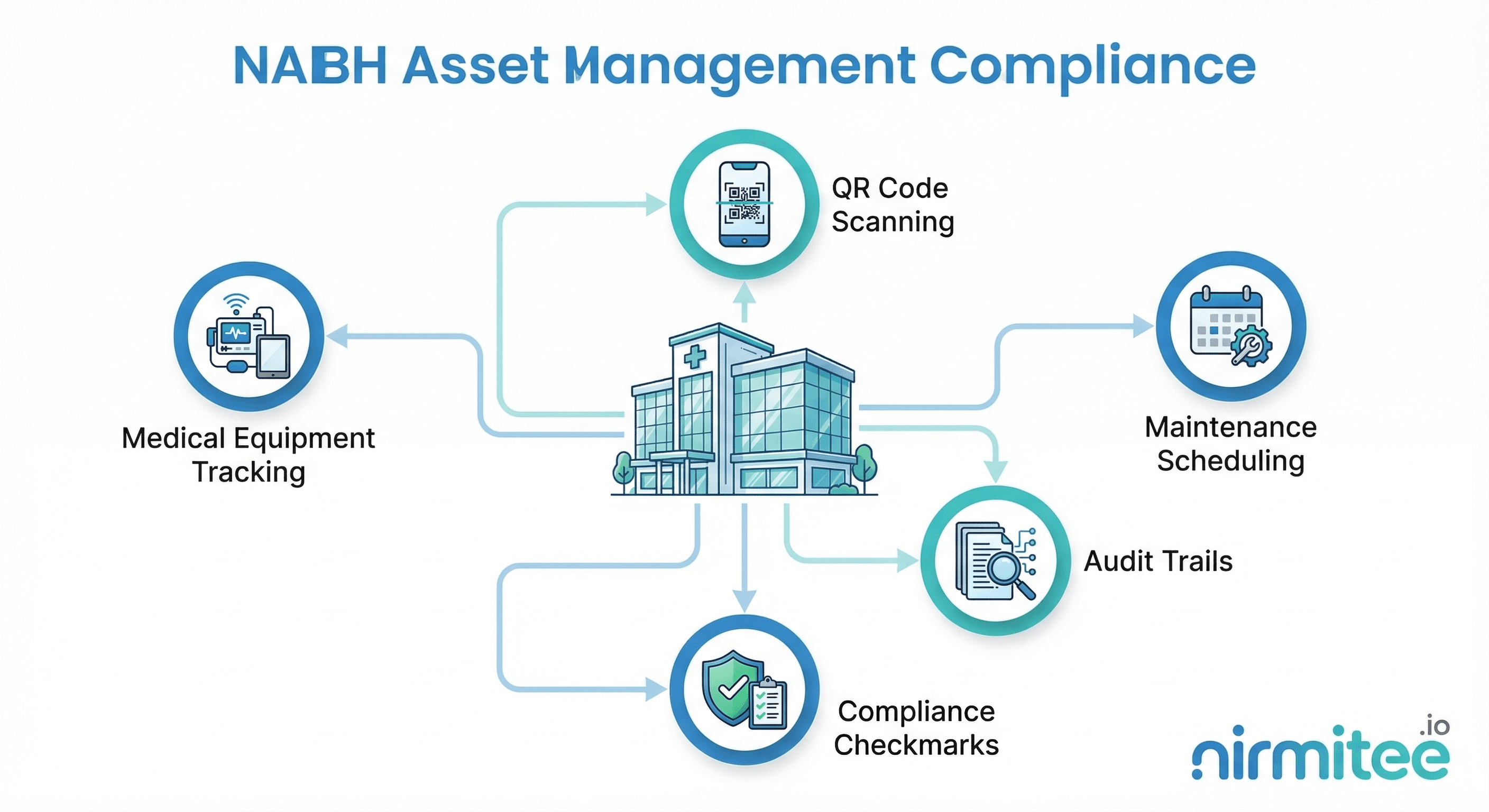
The National Accreditation Board for Hospitals and Healthcare Organizations (NABH) has become the gold standard for quality healthcare in India. With over 1,500 hospitals actively pursuing or maintaining NABH accreditation, compliance with asset management standards is no longer optional — it is a competitive necessity. Poor asset tracking leads to audit failures, patient safety risks, and financial leakage that can cost hospitals crores annually.
This comprehensive guide breaks down the NABH asset management requirements, explains the compliance framework, and shows how digital solutions like Assetly by Nirmitee can transform your hospital's asset management from a compliance burden into a strategic advantage.
What is NABH and Why Does Asset Management Matter?
NABH, a constituent board of the Quality Council of India (QCI), sets the benchmark for hospital quality and patient safety across India. The accreditation process evaluates hospitals across multiple chapters, with Facility Management and Safety (FMS) and Continuous Quality Improvement (CQI) being directly linked to how hospitals manage their physical and biomedical assets.
Asset management is not an isolated compliance checkbox — it touches nearly every NABH chapter:
- FMS (Facility Management & Safety) — Equipment maintenance, calibration, and safety inspections
- CQI (Continuous Quality Improvement) — Data-driven equipment performance monitoring
- AAC (Access, Assessment & Continuity of Care) — Availability of critical medical equipment
- COP (Care of Patients) — Equipment reliability for patient treatment
- MOM (Management of Medication) — Storage equipment compliance for pharmaceuticals
- HIC (Hospital Infection Control) — Sterilization equipment tracking and validation
Key NABH Asset Management Requirements
NABH's 5th Edition standards outline specific expectations for hospital asset management. Here are the critical requirements every hospital must address:
1. Comprehensive Asset Inventory
Hospitals must maintain a complete, up-to-date inventory of all medical equipment, biomedical devices, and critical infrastructure assets. This includes:
- Unique identification for every asset (serial number, asset tag, or QR code)
- Location tracking across departments and facilities
- Asset categorization (biomedical, IT, furniture, infrastructure)
- Ownership and procurement details (purchase, lease, rental, donation)
- Current condition assessment and depreciation tracking
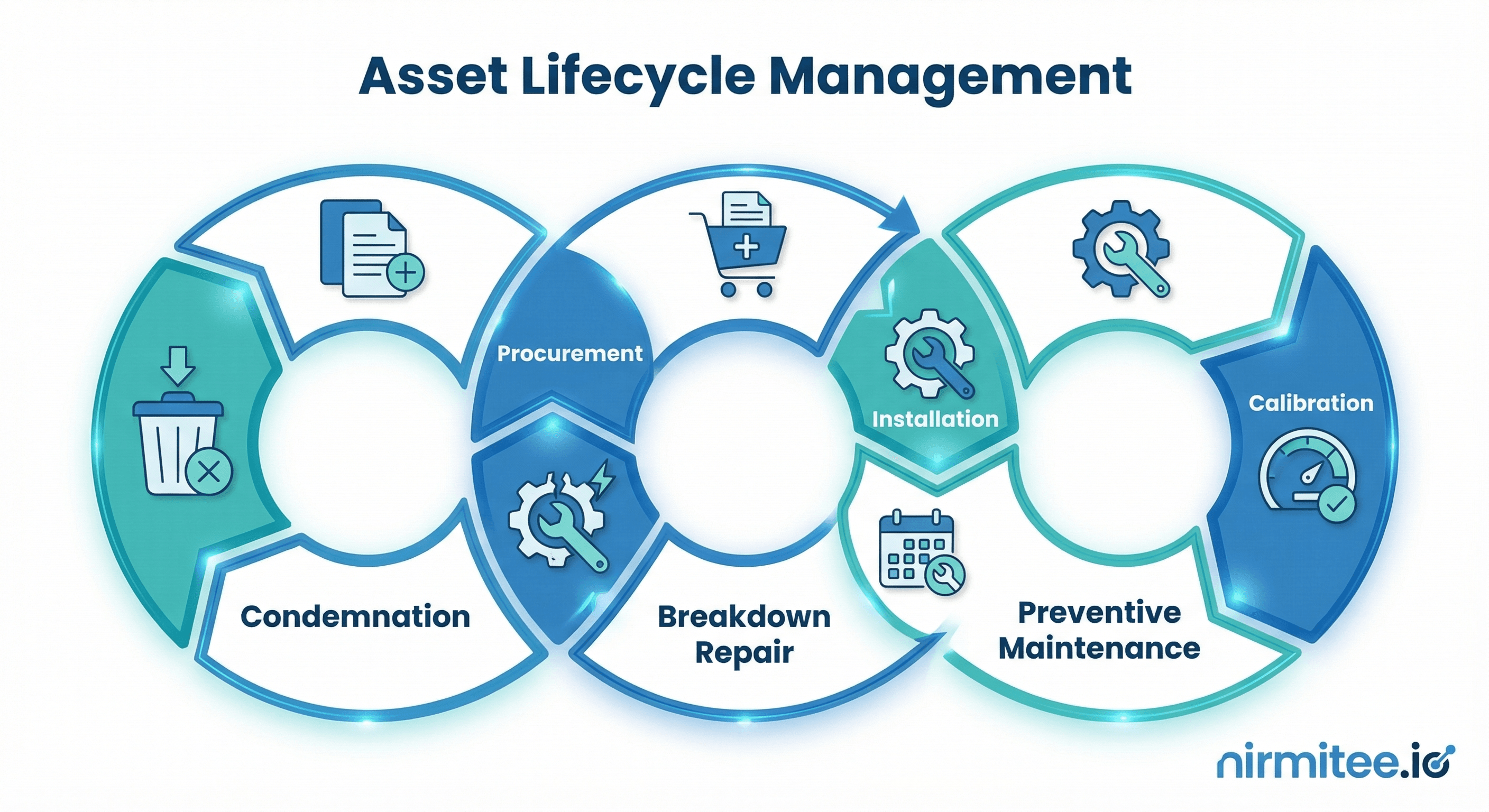
2. Preventive Maintenance Program
NABH mandates a documented preventive maintenance (PM) program for all critical equipment. The standard requires:
- Annual maintenance calendars with scheduled PM for every asset
- Documented maintenance procedures (SOPs) for each equipment type
- Maintenance completion records with technician details and findings
- Breakdown analysis reports and corrective action documentation
- Spare parts inventory management linked to equipment
3. Calibration Management
All measuring and monitoring instruments must be calibrated at defined intervals by NABL-accredited laboratories. The compliance requirements include:
- Calibration schedule for all diagnostic and monitoring equipment
- Calibration certificates stored and linked to individual assets
- Overdue calibration alerts and escalation protocols
- Traceability to national/international measurement standards
4. Equipment Safety & Risk Management
Hospitals must demonstrate a proactive approach to equipment safety:
- Risk assessment for high-criticality equipment (ventilators, defibrillators, anaesthesia machines)
- Electrical safety testing records
- Equipment recall tracking and response documentation
- Incident reporting linked to specific assets
- End-of-life and condemnation protocols with documentation trail
5. Audit Trail & Documentation
Perhaps the most critical requirement — NABH assessors expect a complete audit trail for every asset throughout its lifecycle:
- Procurement and installation records
- Complete maintenance history (preventive + breakdown)
- Movement and transfer records between departments
- User training records linked to specific equipment
- Depreciation and financial lifecycle data
- Condemnation and disposal documentation
The Compliance Gap: Why Most Hospitals Struggle
Despite understanding the requirements, most Indian hospitals face significant challenges in achieving and maintaining NABH asset compliance:
Paper-Based Systems Fail at Scale
Hospitals managing 5,000+ assets across multiple departments simply cannot maintain accurate records using paper registers and Excel spreadsheets. Common failures include:
- Data silos — Biomedical engineering, finance, and department heads each maintain separate records that never reconcile
- Missing maintenance records — PM completion is not tracked in real time, leading to gaps discovered only during audits
- Untraceable assets — Equipment moves between departments without documentation, creating "ghost assets" in the inventory
- Expired calibrations — Without automated alerts, calibration deadlines are missed, putting patient safety at risk
The Cost of Non-Compliance
NABH non-compliance in asset management has real consequences:
- Accreditation denial or suspension — Direct impact on hospital reputation and CGHS/insurance empanelment
- Financial penalties — Untracked assets lead to duplicate purchases, missed warranty claims, and inflated insurance premiums
- Patient safety incidents — Unmaintained equipment is the leading cause of preventable adverse events
- Operational inefficiency — Staff spend hours searching for equipment or filling manual forms instead of patient care
Digital Solution: How Assetly Enables NABH Compliance
Assetly, built by Nirmitee.io, is a purpose-built hospital asset management platform designed specifically for NABH compliance. Here is how it addresses each requirement:
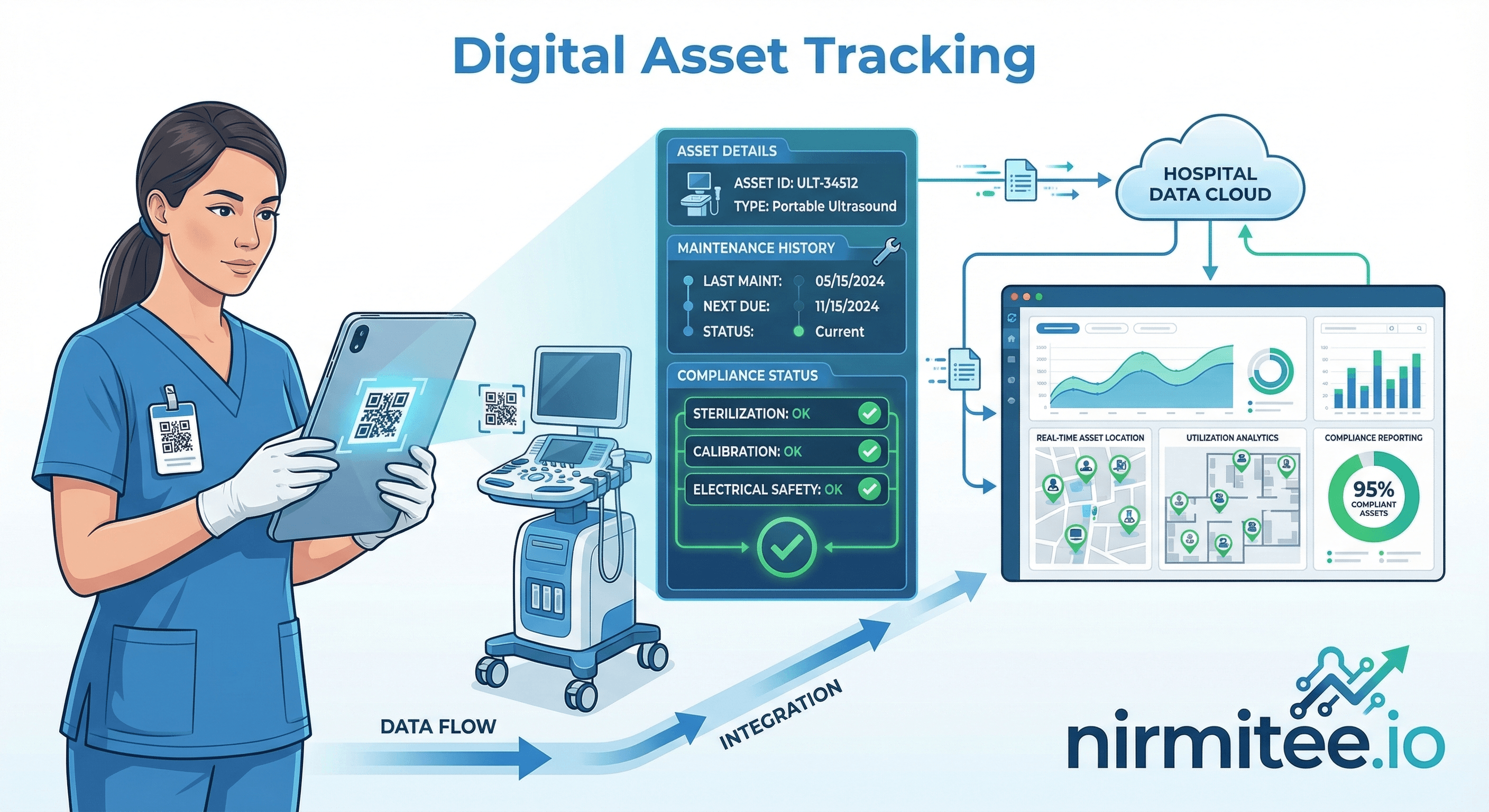
QR Code-Based Asset Tracking
Every asset gets a unique QR code that links to its complete digital profile. Staff can scan any asset with a mobile device to instantly view:
- Asset details (make, model, serial number, purchase date)
- Current location and assigned department
- Maintenance history and next scheduled PM date
- Calibration status and certificate links
- Warranty and AMC information
Automated Maintenance Scheduling
Assetly's maintenance work order system ensures no PM is ever missed:
- Automated PM scheduling based on manufacturer recommendations and NABH requirements
- Real-time work order assignment with priority and SLA tracking
- FDA and HIPAA compliance fields for regulated equipment
- Complete maintenance history with technician notes, parts used, and time logged
- Dashboard analytics showing PM completion rates, MTBF, and MTTR metrics
Role-Based Access Control (RBAC)
NABH requires that only authorized personnel manage and maintain equipment. Assetly implements:
- 60+ granular permission codes across 13 modules
- Role hierarchy: Super Admin, Admin, Nursing Staff, Operations, Inventory Manager
- Department-level access restrictions
- Complete activity logging — every action is tracked with user, timestamp, and details
Asset Audit Module
Purpose-built for NABH audit preparation:
- Create audit sessions by department with asset condition checks (Pass/Fail/Pending)
- Real-time audit progress tracking across facilities
- Discrepancy reports generated automatically
- Historical audit records for trend analysis across accreditation cycles
Asset Movement Tracking
Assetly eliminates ghost assets with comprehensive movement tracking:
- Facility-to-facility transfers (controlled by Super Admin)
- Department-to-department movements (managed by Admin)
- Approval workflows with reason documentation
- Complete movement history linked to each asset
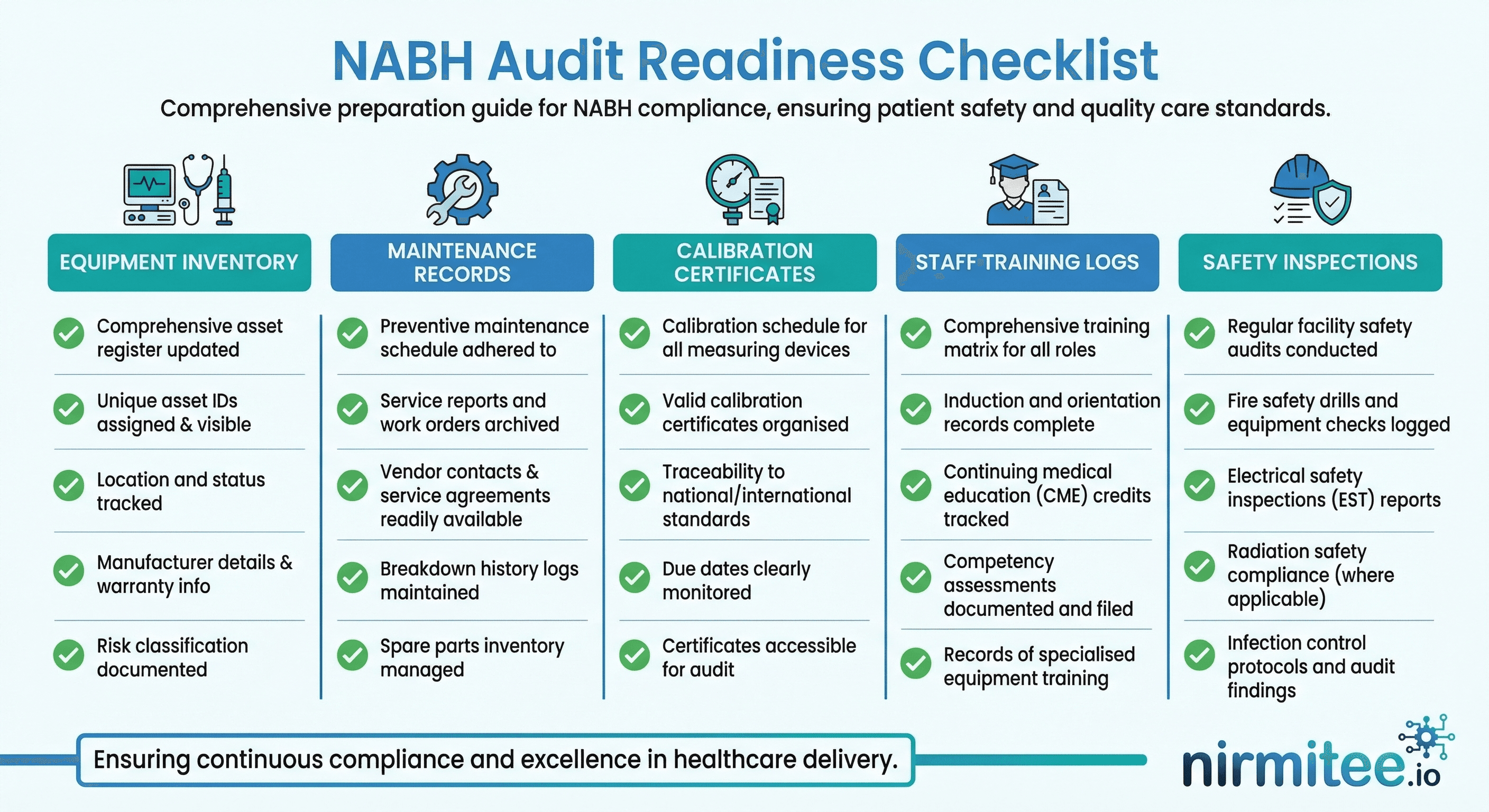
NABH Audit Preparation Checklist
Use this checklist to evaluate your hospital's readiness for a NABH asset management assessment:
| Requirement | Standard | What Assessors Look For |
|---|---|---|
| Complete asset inventory | FMS.1 | 100% of assets tagged and tracked digitally |
| Preventive maintenance program | FMS.4 | PM schedules, completion rates above 90%, breakdown analysis |
| Calibration management | FMS.5 | Valid NABL certificates, no overdue calibrations |
| Equipment safety testing | FMS.6 | Electrical safety records, risk assessments for critical equipment |
| Maintenance staff training | FMS.7 | Training records linked to equipment types handled |
| Condemnation process | FMS.8 | Documented condemnation committee decisions, disposal records |
| Equipment downtime tracking | CQI.2 | MTBF/MTTR metrics, trend analysis, improvement actions |
| Incident reporting | CQI.7 | Equipment-related incidents linked to specific assets |
Implementation Roadmap: 12-Week Path to Compliance
For hospitals starting their digital asset management journey, here is a practical 12-week implementation roadmap:
Weeks 1-3: Discovery & Setup
- Complete physical audit of all assets across departments
- Configure Assetly with hospital's organizational structure (facilities, departments, categories)
- Define role-based access permissions aligned with existing staff hierarchy
- Import existing asset data via bulk CSV upload
Weeks 4-6: Tagging & Digitization
- Generate and affix QR codes to all assets
- Verify asset details through department-wise physical verification
- Upload maintenance contracts, warranty documents, and calibration certificates
- Configure automated maintenance schedules based on OEM recommendations
Weeks 7-9: Process Integration
- Train biomedical engineering team on work order management
- Train department heads on asset audit and movement workflows
- Establish escalation protocols for overdue maintenance and calibrations
- Integrate with existing HMIS/HIS systems where applicable
Weeks 10-12: Validation & Go-Live
- Conduct mock NABH audit using Assetly's audit module
- Generate compliance reports and identify remaining gaps
- Address findings and establish continuous monitoring dashboards
- Document SOPs for ongoing asset management processes
ROI of Digital Asset Management
Hospitals that implement digital asset management systems like Assetly typically see measurable returns within the first year:
- 30-40% reduction in equipment downtime through proactive maintenance
- 20-25% savings on maintenance costs through optimized PM schedules and reduced emergency repairs
- 15-20% reduction in duplicate asset purchases through accurate inventory visibility
- 90%+ first-attempt NABH accreditation success rate with proper documentation
- 50% reduction in audit preparation time — from weeks to days
Conclusion
NABH accreditation is a journey, not a destination. Asset management compliance requires not just the right tools, but a systematic approach to tracking, maintaining, and auditing every piece of equipment in your hospital. The days of paper-based registers and Excel trackers are over — hospitals that embrace digital asset management platforms gain a decisive advantage in both compliance and operational efficiency.
Assetly by Nirmitee is built specifically for Indian hospitals navigating the NABH compliance landscape. From QR code-based asset tracking to automated maintenance scheduling and purpose-built audit modules, it provides everything you need to achieve and maintain NABH accreditation with confidence.
Ready to transform your hospital's asset management? Contact Nirmitee.io for a free compliance assessment and demo.
Share
Related Posts
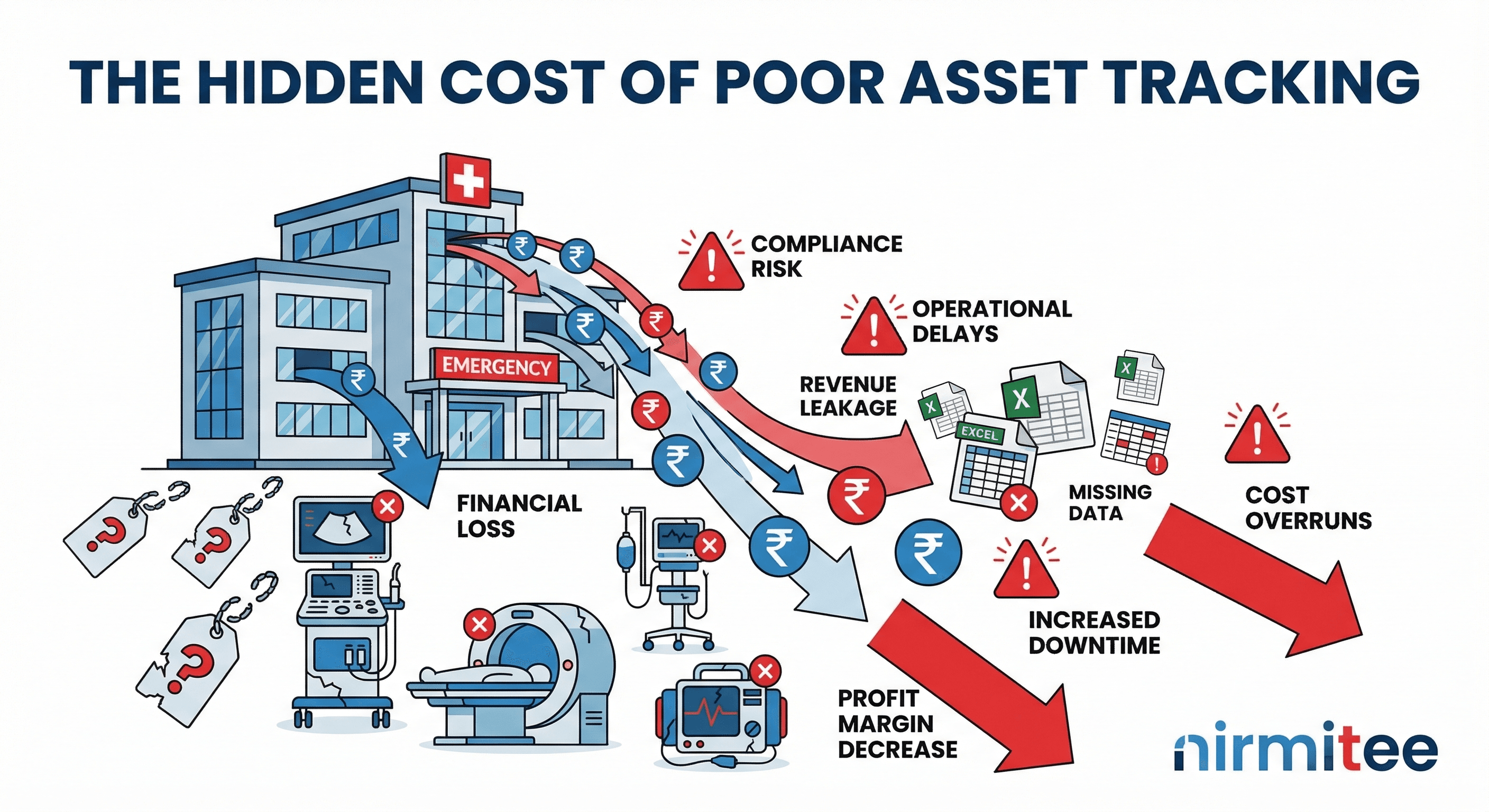
Why Indian Hospitals Lose Crores Every Year to Poor Equipment Tracking
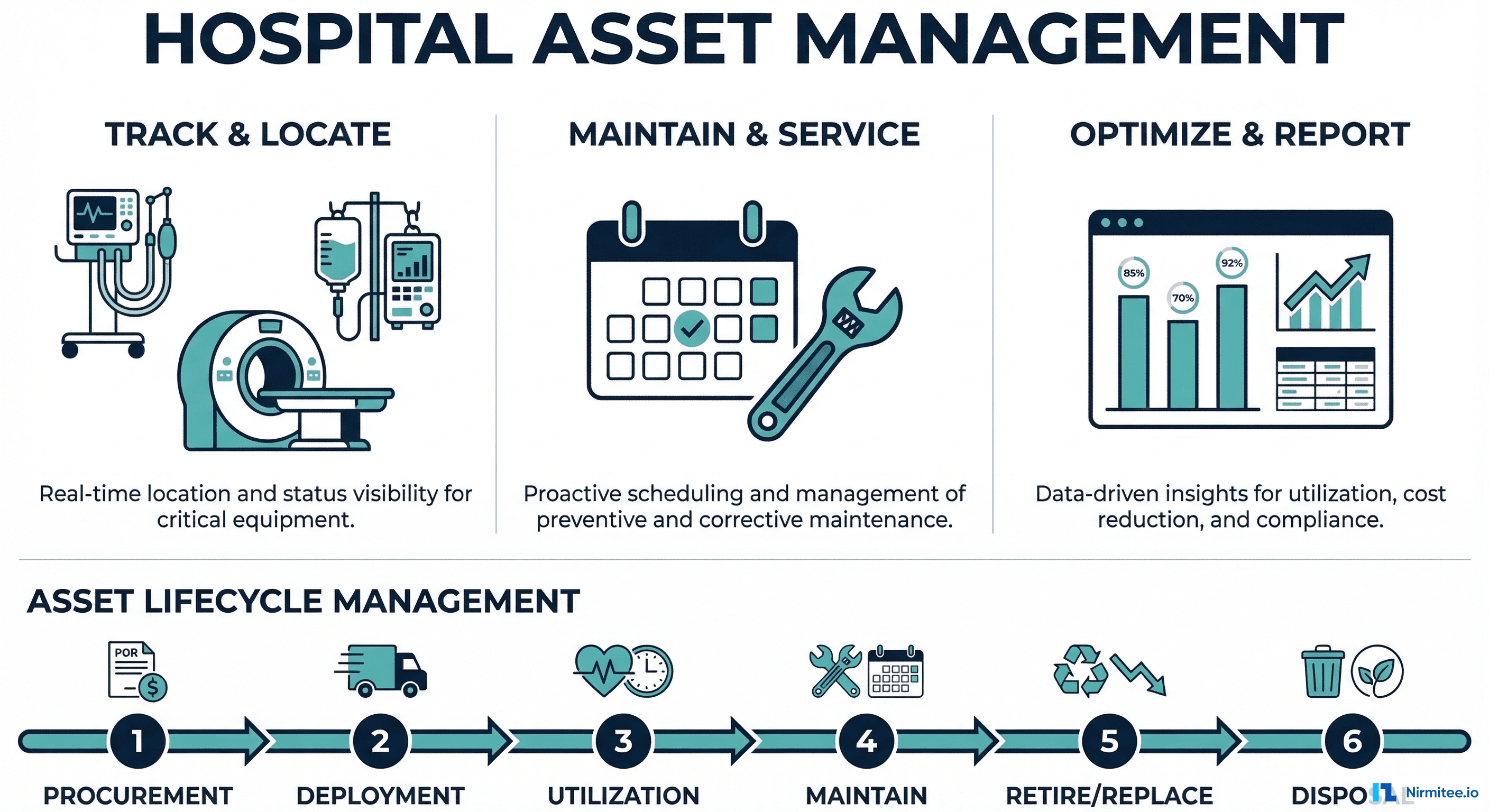
The Complete Guide to Hospital Asset Management in 2026