No-Code AI Agent Builders for Healthcare: 10 Platforms Evaluated for HIPAA Compliance

Digital Growth Lead
Writes about healthcare technology, interoperability, and AI-driven transformation across modern care systems.
Part of our complete guide to HIPAA requirements for healthcare software.
The promise of no-code AI is irresistible: build intelligent agents in hours instead of months, empower non-technical staff to automate workflows, and pilot AI use cases without committing $200,000 to a custom engineering project. For healthcare organizations, this promise is especially compelling. The AI in healthcare market has surpassed $51 billion in 2026, growing at 36.8% CAGR, and the pressure to adopt AI for operational efficiency, patient engagement, and revenue cycle optimization is mounting from every direction: from board rooms, from payers demanding interoperability, and from patients expecting Amazon-level digital experiences.
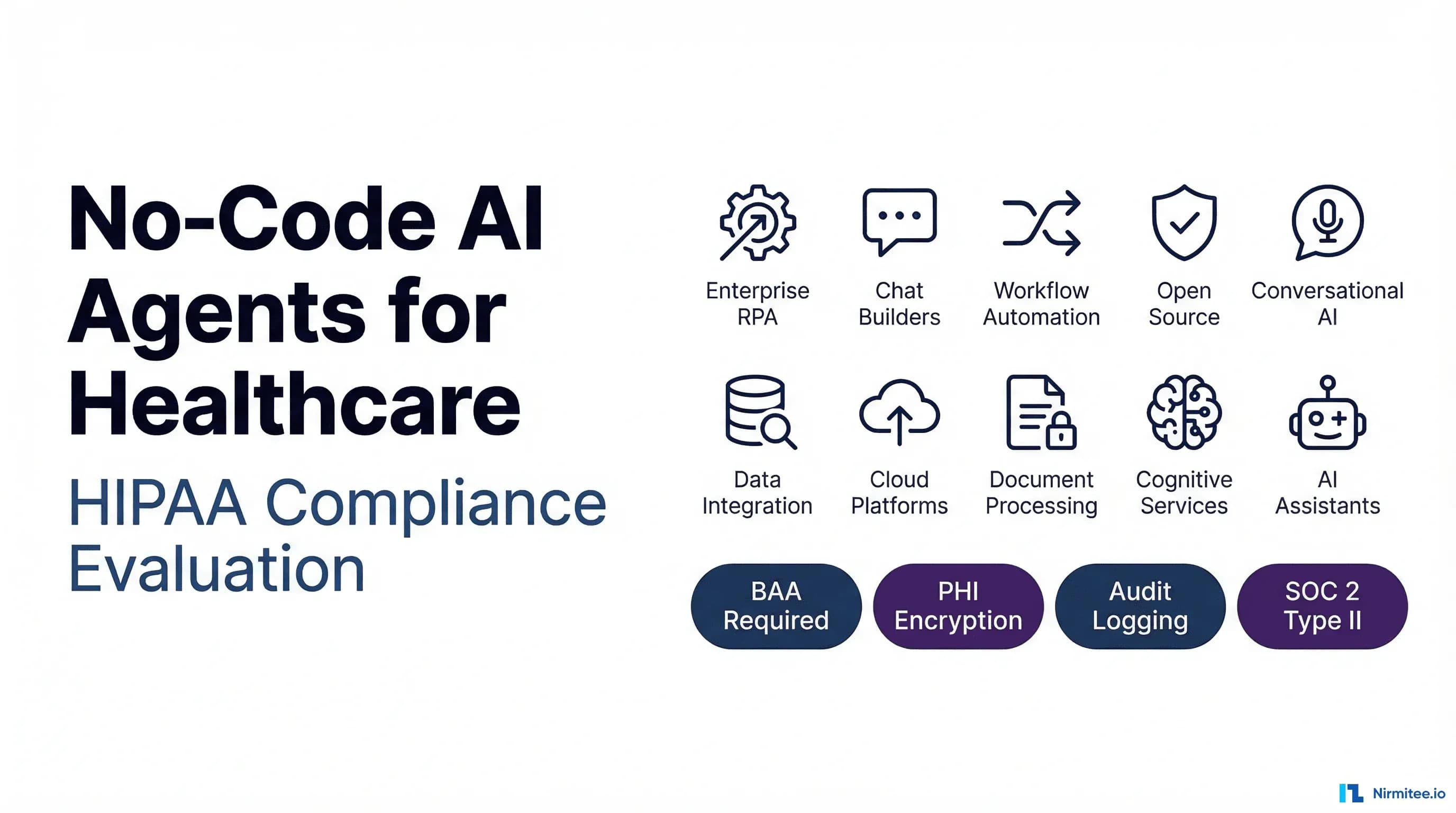
But here is the problem that generic "best no-code AI builder" lists ignore entirely: most no-code AI platforms cannot legally handle Protected Health Information (PHI). Without a Business Associate Agreement (BAA), SOC 2 Type II certification, end-to-end encryption, and audit logging, deploying a no-code AI agent in a healthcare setting is not just risky, it is a federal compliance violation under HIPAA. A single breach involving an uncovered platform can result in penalties ranging from $100 to $50,000 per violation, up to $1.5 million annually per violation category.
If compliance itself is the bottleneck, our healthcare compliance software services cover HIPAA, SOC 2, and audit-readiness end to end.
Related Reading
For more insights, explore our guides on HIPAA Was Not Built for AI: Legal & Technical Gaps and FHIR in Modern Healthcare.
You may also find value in EHR Software Development Guide and Building a Healthtech App.
This guide evaluates 10 of the most popular no-code AI agent builders against healthcare-specific requirements. For each platform, we assess BAA availability, SOC 2 certification, PHI handling capabilities, healthcare use cases, limitations, and pricing. If you are a healthcare CIO, IT director, compliance officer, or innovation lead evaluating no-code AI tools, this is the only comparison that tells you which platforms you can actually use with patient data and which ones will put your organization at risk.
Why Healthcare Teams Want No-Code AI
Before we evaluate platforms, it is worth understanding why no-code AI has become a strategic priority for healthcare organizations, not just a technology curiosity.
Speed to Value
Traditional custom AI development for healthcare takes 6 to 12 months from requirements gathering to production deployment, factoring in HIPAA security controls, penetration testing, and compliance audits. No-code platforms compress this timeline to 2 to 6 weeks. For a hospital system evaluating whether AI-driven prior authorization triage can reduce denial rates, the difference between a 2-week pilot and a 9-month build project is the difference between acting on the opportunity and watching it evaporate during budget season.
Empowering Non-Technical Staff
The people who understand healthcare workflows best, revenue cycle managers, clinical operations leads, patient access directors, are rarely engineers. No-code platforms put AI agent creation in their hands. A denial management supervisor who knows exactly which CARC/RARC code patterns indicate preventable denials can build an agent to flag those patterns automatically, without filing a Jira ticket and waiting three sprints for engineering bandwidth. This is not just about convenience; it is about capturing domain expertise that would otherwise be lost in translation between business requirements documents and engineering specifications.
Pilot Without Commitment
Healthcare IT budgets are notoriously tight and approval cycles are long. No-code platforms let teams prove value with a $500/month tool before requesting $300,000 for custom development. The pilot data, ROI numbers, and workflow improvements from a no-code prototype become the business case for the larger investment. As we explored in our guide on building HIPAA-compliant AI agents, understanding the architecture decisions early, even in a no-code context, prevents costly rework later.
HIPAA Requirements for AI Platforms: The Non-Negotiable Checklist
Before evaluating any no-code AI platform for healthcare use, you need to understand the five non-negotiable HIPAA requirements that apply to any technology that creates, receives, maintains, or transmits electronic Protected Health Information (ePHI). The HHS HIPAA Security Rule mandates specific administrative, physical, and technical safeguards that every covered entity and business associate must implement.
1. Business Associate Agreement (BAA)
Any vendor that handles PHI on behalf of a covered entity is a business associate under HIPAA. The BAA is a legally binding contract that specifies how the vendor will protect PHI, report breaches, and comply with HIPAA obligations. Without a signed BAA, it is illegal to transmit, store, or process PHI through the vendor's platform. This is the single most important criterion. No BAA means the platform is disqualified for any workflow involving patient data, regardless of how good its security features are.
2. Encryption at Rest and In Transit
ePHI must be encrypted both when stored (at rest) and when transmitted (in transit). Industry standards require AES-256 for storage encryption and TLS 1.2 or higher for data in transit. Some platforms encrypt data at the application layer, while others rely on infrastructure-level encryption from cloud providers like AWS or Azure. Both approaches can satisfy HIPAA requirements, but the covered entity must verify the specifics.
3. Audit Logging
HIPAA requires covered entities and business associates to maintain logs of all access to ePHI, including who accessed what data, when, from where, and what actions they performed. These audit logs must be immutable (tamper-proof), retained for a minimum of six years, and available for compliance audits and breach investigations. For AI platforms, this means logging every interaction between the AI agent and any PHI-containing system or data field.
4. Access Controls and Role-Based Permissions
The principle of least privilege applies: users and AI agents should only have access to the minimum PHI necessary to perform their function. This requires role-based access control (RBAC), multi-factor authentication (MFA), automatic session timeouts, and unique user identification for audit trail purposes. For no-code platforms where multiple team members may be building and editing agents, granular access controls become especially important.
5. SOC 2 Type II / HITRUST Certification
While not explicitly required by HIPAA, Both SOC 2 Type II and HITRUST certifications are the industry-standard evidence that a vendor has implemented and maintained the security controls necessary for HIPAA compliance. A SOC 2 Type II audit evaluates controls over an extended period (typically 6 to 12 months), providing assurance that security is operational, not just documented. HITRUST CSF is specifically designed for healthcare and maps directly to HIPAA requirements. Vendors with neither certification require significantly more due diligence from your compliance team.
10 No-Code AI Agent Builders Evaluated for HIPAA Compliance
We evaluated each platform against the five HIPAA requirements above, plus healthcare-specific capabilities like EHR integrations, healthcare workflow templates, and healthcare customer references. The evaluation reflects publicly available information as of March 2026. For deeper architectural context on what healthcare AI agents require, see our analysis of 5 healthcare workflows that agentic AI will transform.
1. Magical
What it does: Magical is a Chrome extension and desktop agent that uses RPA-style automation to move data between browser tabs, auto-fill forms, and execute repetitive tasks. It is popular in healthcare revenue cycle settings for tasks like transferring patient data between EHR screens and payer portals.
HIPAA status: Magical claims HIPAA compliance on its Trust & Privacy page and states that it never stores personal health information on its servers. The platform pulls data directly from one system into another, acting as a conduit rather than a data store. Magical does offer BAAs to healthcare customers on its enterprise plans.
Healthcare use cases: Prior authorization form filling, eligibility verification data transfer, claims status checking, patient charting data entry, payment posting across systems.
Limitations: Magical operates as a browser extension, which introduces unique security considerations. Browser extensions have broad access to page content and could theoretically capture PHI displayed on screen. The RPA approach is inherently fragile, breaking when payer portals or EHR interfaces change their layout. It is a task automation tool, not an AI agent builder in the traditional sense; it cannot reason, make decisions, or handle complex multi-step workflows with branching logic.
Pricing: Free tier for basic automation. Enterprise plans with HIPAA compliance and BAA start at custom pricing (contact sales). Estimated $15 to $30 per user per month for healthcare plans.
HIPAA verdict: Partial compliance. BAA available on enterprise plans. However, the browser extension model requires careful deployment controls and IT governance to ensure PHI is not inadvertently captured or exposed.
2. UiPath
What it does: UiPath is the largest enterprise RPA platform, offering both attended and unattended robotic process automation, AI document understanding, process mining, and increasingly, AI-powered agent capabilities through its Automation Cloud. UiPath has a dedicated healthcare vertical with pre-built automation templates.
HIPAA status: UiPath is fully HIPAA compliant. According to UiPath Security, the platform has current HIPAA Type 2 attestation covering Automation Cloud Platform, Action Center, AI Center, Apps, Document Understanding, Orchestrator, and additional services. UiPath has also achieved HITRUST Risk-based, 2-year (r2) Certified status. BAAs are available and actively signed with healthcare customers.
Where it fits in healthcare: Claims processing automation, prior authorization workflows, patient scheduling optimization, clinical documentation extraction, revenue cycle management automation, insurance eligibility verification, medical records requests, coding and billing automation.
Limitations: UiPath is complex. The learning curve for building sophisticated healthcare automations is significant, often requiring dedicated UiPath developers (a "citizen developer" can handle simple automations, but complex healthcare workflows need expertise). Pricing is enterprise-grade, which puts it out of reach for small practices and clinics. It is primarily RPA-focused; while AI capabilities are growing, it is not a native AI agent builder in the way that LLM-based platforms are.
What it costs: Automation Developer starts at $420/month. Automation Cloud Robot (unattended) at $1,380/month. Enterprise packages with full healthcare compliance features are custom-priced, typically $50,000 to $200,000+ annually depending on robot count and modules.
The HIPAA call: Fully compliant. BAA, HIPAA Type 2 attestation, HITRUST r2 certification, SOC 2 Type II. The gold standard for enterprise healthcare automation, but with matching enterprise complexity and cost.
3. Relevance AI
What it does: Relevance AI is an API-first AI agent builder that lets teams create custom AI agents using a visual workflow builder with drag-and-drop interface. The platform supports memory, variables, vector databases, and integrates with tools like Slack, Google Workspace, HubSpot, and Notion. It is designed for business teams automating internal operations.
HIPAA status: Relevance AI has SOC 2 Type II certification and offers enterprise features including SSO, RBAC, and data residency controls. However, there is no publicly available information confirming BAA availability or specific HIPAA compliance claims for healthcare use cases.
Healthcare applications: Internal operations automation (non-PHI), patient feedback analysis (de-identified data only), provider credentialing workflow support, administrative task automation.
Limitations: Without a confirmed BAA, Relevance AI cannot be used for any workflow that touches PHI. It is not designed with healthcare-specific features; there are no EHR integrations, no healthcare workflow templates, and no published healthcare customer case studies. The API-first architecture, while flexible, requires more technical skill than truly no-code drag-and-drop tools.
Price point: Free tier with limited actions. Team plan at $199/month includes 7,000 actions and $70 in vendor credits. Business and Enterprise plans with SOC 2 and advanced controls at custom pricing.
Compliance verdict: Not compliant for PHI workflows. The SOC 2 Type II attestation is a positive signal, but the absence of a BAA and healthcare-specific compliance documentation means this platform should only be used for non-PHI healthcare operations.
4. Voiceflow
What it does: Voiceflow is a conversational AI platform that lets teams build voice and chat AI agents using a drag-and-drop editor. It is popular for customer service chatbots, interactive voice response (IVR) systems, and conversational interfaces across industries.
HIPAA status: Voiceflow is not HIPAA compliant. The platform does not sign BAAs and is not designed for handling PHI. This has been confirmed in multiple third-party compliance assessments.
Typical healthcare workflows: Limited to non-PHI scenarios: general health information chatbots, appointment scheduling (without patient data), facility wayfinding, FAQ bots for hospital websites, symptom checkers with appropriate disclaimers (no diagnosis, no PHI collection).
Limitations: The inability to handle PHI eliminates most high-value healthcare use cases. Any conversational AI that asks for patient name, date of birth, insurance information, medical history, or symptoms potentially involves PHI and cannot use Voiceflow. The platform also lacks healthcare-specific integrations (no EHR connectors, no FHIR APIs).
Pricing model: Free sandbox tier. Pro at $60/month. Enterprise with custom pricing. Note that even at Enterprise tier, HIPAA compliance and BAA are not available.
HIPAA status: Not compliant. No BAA, no HIPAA documentation. Cannot be used for any healthcare workflow that involves or might involve PHI.
5. Botpress
What it does: Botpress is an open-source chatbot and conversational AI platform. Originally designed for developers, it has added visual flow builders and low-code capabilities. The key differentiator for healthcare is that Botpress can be self-hosted, giving organizations full control over data handling.
HIPAA status: The Botpress cloud service is not HIPAA compliant and does not sign BAAs. However, because Botpress is open-source, organizations can self-host the platform on their own HIPAA-compliant infrastructure (AWS GovCloud, Azure with BAA, or on-premises servers). Self-hosted Botpress inherits the compliance posture of the underlying infrastructure.
Healthcare use cases (self-hosted only): Patient intake chatbots, symptom triage conversations, appointment scheduling with patient identification, medication reminder bots, post-discharge follow-up conversations, clinical trial screening questionnaires.
Limitations: Self-hosting eliminates the "no-code" simplicity that makes these platforms attractive in the first place. You need DevOps engineers to deploy, secure, monitor, and maintain the infrastructure. The organization becomes responsible for encryption, audit logging, access controls, penetration testing, and all other HIPAA technical safeguards. This effectively turns a "no-code" solution into a "no-code application layer on top of a custom infrastructure project."
What it costs: Open-source (free) for self-hosted. Cloud plans start at $79/month (not HIPAA compliant). Self-hosting infrastructure costs vary: $500 to $2,000/month on AWS/Azure with proper security configurations.
Our HIPAA read: Compliant only when self-hosted on HIPAA-eligible infrastructure with proper security controls implemented by the organization. The cloud version is not compliant.
6. Zapier
What it does: Zapier is the most widely used workflow automation platform, connecting 7,000+ apps through trigger-action "Zaps." It has added AI features including natural language automation creation and AI-powered data transformation. Zapier is ubiquitous in business operations for connecting SaaS tools.
HIPAA status: Zapier does not support HIPAA compliance and does not sign BAAs. According to Zapier's own documentation, the platform explicitly does not support the use of regulated healthcare data including PHI. This position has not changed despite years of customer requests. The reason is architectural: Zapier integrates with thousands of third-party apps and sub-processors, many of which are themselves not HIPAA compliant, making it impractical to guarantee end-to-end PHI protection.
Use cases: Strictly non-PHI workflows only: marketing automation for healthcare organizations, staff scheduling notifications, facility management alerts, vendor management workflows, financial reporting aggregation (without patient-level data).
Limitations: The prohibition on PHI handling eliminates the majority of healthcare automation use cases. Any Zap that touches patient records, billing data, clinical notes, insurance information, or appointment details involving patient identifiers is off-limits. Even apparently harmless automations like "when a new patient books an appointment, send a confirmation" involve PHI (patient name + appointment details) and cannot use Zapier.
Price point: Free tier (100 tasks/month). Starter at $19.99/month. Professional at $49/month. Team at $69/month. Enterprise at custom pricing. No HIPAA tier exists at any level.
Bottom line on HIPAA: Not compliant. Explicitly prohibits PHI. No BAA available. Do not use for any healthcare workflow involving patient data.
7. Make (formerly Integromat)
What it does: Make is a visual workflow automation platform similar to Zapier but with more complex branching logic, data transformation, and multi-step scenario capabilities. Its visual builder uses a node-based canvas that many users find more intuitive for complex workflows than Zapier's linear approach.
HIPAA status: Make does not comply with HIPAA and does not sign BAAs. The company is based in Prague and operates under EU regulations where HIPAA is not applicable. While Make supports GDPR compliance (EU data protection), this is not equivalent to HIPAA compliance. There is no indication that Make plans to introduce HIPAA support.
Where healthcare teams use it: Non-PHI operations only: marketing campaign automation, social media management, vendor invoice processing, facility maintenance request routing, HR onboarding workflows for healthcare staff.
Limitations: Same fundamental limitation as Zapier: no PHI handling. The EU regulatory focus means HIPAA is not on the product roadmap. Healthcare organizations using Make for operational workflows must implement strict controls to ensure no PHI ever enters a Make scenario, which requires ongoing training and monitoring.
Pricing model: Free tier (1,000 ops/month). Core at $9/month. Pro at $16/month. Teams at $29/month. Enterprise at custom pricing. No HIPAA tier available.
Compliance verdict: Not compliant. No BAA, no HIPAA documentation, no plans to support healthcare data regulations. EU-focused compliance only.
8. Microsoft Power Automate
What it does: Power Automate (formerly Microsoft Flow) is Microsoft's enterprise workflow automation platform, part of the Power Platform alongside Power BI, Power Apps, and Power Virtual Agents. It offers cloud flows, desktop flows (RPA), and AI Builder for intelligent automation. Deep integration with Microsoft 365, Azure, Dynamics 365, and third-party connectors.
HIPAA status: Fully HIPAA compliant. Power Automate is an in-scope cloud service covered by Microsoft's HIPAA BAA. The BAA is included by default in Microsoft Product Terms for all customers who are covered entities or business associates. Microsoft services undergo independent audits for ISO/IEC 27001 and HITRUST CSF certifications. With the March 2026 launch of Microsoft Copilot Health, the healthcare AI capabilities have expanded significantly, integrating EHR data, wearable information, and clinical notes into AI-powered workflows.
Healthcare scenarios: Patient appointment reminders and scheduling, clinical documentation workflows, claims processing and follow-up automation, care coordination notifications, referral management, lab result routing, medication refill request processing, patient intake form processing with AI Builder, integration with Epic and Cerner through Azure FHIR service.
Limitations: Power Automate's strengths are also its constraints. It is most powerful within the Microsoft ecosystem; organizations not already invested in Microsoft 365 and Azure face a steep onboarding curve. AI capabilities through AI Builder are more limited than dedicated AI agent builders. Complex healthcare AI agents (multi-turn reasoning, clinical decision support, dynamic care pathway navigation) exceed what Power Automate can natively do. Licensing complexity is a real issue: healthcare organizations must carefully audit which licenses and services are covered by the HIPAA BAA.
What it costs: Per-user plan at $15/user/month. Per-flow plan at $100/flow/month for unlimited users. Process plan at $150/bot/month for RPA. Azure AI Builder credits purchased separately. Enterprise agreements typically negotiated at organizational level, $50,000 to $500,000+ annually depending on scope.
HIPAA status: Fully compliant. BAA included by default. HITRUST certified. SOC 2 Type II. The most accessible HIPAA-compliant automation platform for organizations already in the Microsoft ecosystem.
9. n8n
What it does: n8n is an open-source workflow automation platform often described as a "self-hostable Zapier." It provides a visual node-based editor for building complex automation workflows, supports 400+ integrations, includes AI agent capabilities with LLM integrations, and offers both cloud and self-hosted deployment options.
HIPAA status: The n8n cloud service is not HIPAA certified and does not sign BAAs. However, n8n's self-hosted deployment model is where healthcare compliance becomes possible. When deployed on HIPAA-eligible infrastructure (AWS with BAA, Azure with BAA, or on-premises) with appropriate security hardening, n8n can be part of a HIPAA-compliant automation stack. The organization takes responsibility for all compliance controls.
Healthcare use cases (self-hosted): EHR data extraction and transformation, patient appointment workflow automation, clinical document processing with AI, insurance verification automation, medical records request routing, FHIR API integration workflows, discharge follow-up automation, lab result notification pipelines.
Limitations: Self-hosting requires significant DevOps capability. You need to configure encryption at rest and in transit, implement audit logging, enforce RBAC with MFA, conduct regular penetration testing, and manage ongoing security patching. The n8n community has published guides for HIPAA-compliant deployment on AWS EKS, but the responsibility and effort are substantial. AI agent capabilities, while powerful, require connecting external LLM providers that must also be HIPAA compliant (Azure OpenAI with BAA, AWS Bedrock with BAA).
Price point: Self-hosted Community Edition is free (MIT license with Commons Clause). Self-hosted Enterprise at custom pricing. Cloud Starter at $20/month. Cloud Pro at $50/month (not HIPAA compliant). Infrastructure costs for self-hosting: $200 to $1,500/month depending on scale and redundancy requirements.
Our HIPAA read: Compliant only when self-hosted on HIPAA-eligible infrastructure with comprehensive security controls. The cloud version is not compliant. Best option for technical teams that want Zapier-like flexibility with full data sovereignty.
10. Flowise
What it does: Flowise is an open-source AI agent builder powered by LangChain that transforms complex AI development into a visual drag-and-drop experience. Unlike workflow automation tools (Zapier, Make, n8n), Flowise is specifically designed for building AI agents with LLM integration, RAG (Retrieval-Augmented Generation) pipelines, and conversational AI applications. It is backed by Y Combinator and used by Fortune 500 companies including Thermo Fisher and Deloitte.
HIPAA status: Flowise offers HIPAA compliance through its Enterprise plan, which includes compliance certifications, on-premises or air-gapped deployment options, and advanced security controls. The open-source self-hosted version can also be deployed on HIPAA-compliant infrastructure, similar to n8n and Botpress. The Enterprise plan specifically targets regulated industries.
Healthcare use cases (self-hosted or Enterprise): Clinical documentation AI assistants, patient-facing health information chatbots with RAG over medical knowledge bases, medical records summarization, prior authorization support agents, clinical trial matching, provider directory search agents, drug interaction checking agents.
Limitations: Flowise is the most specialized AI agent builder in this list, which means it lacks the broad workflow automation capabilities of tools like n8n or Power Automate. It excels at LLM-powered agents but is not designed for general business process automation like form filling, data transfer between systems, or RPA-style browser automation. Self-hosting requires familiarity with Node.js deployment and the LangChain ecosystem. Healthcare organizations need to ensure that the underlying LLM provider (OpenAI, Anthropic, Azure) also has HIPAA coverage.
Pricing model: Open-source self-hosted is free. Cloud Starter at $35/month. Cloud Pro at $65/month. Enterprise with HIPAA compliance at custom pricing (contact sales). Self-hosting infrastructure costs: $100 to $800/month plus LLM API costs.
Verdict: Compliant through Enterprise plan or self-hosted deployment on HIPAA-eligible infrastructure. The best option for healthcare organizations specifically looking to build LLM-powered AI agents rather than general workflow automation.
HIPAA Compliance Decision Matrix
The following matrix plots all 10 platforms across two axes that matter most for healthcare AI adoption: HIPAA readiness (can you legally use it with PHI?) and ease of use (can non-technical staff operate it?). The ideal quadrant is top-right: fully HIPAA compliant and easy to use. The reality is that very few platforms live there.
| Platform | BAA | SOC 2 Type II | Self-Host | Healthcare Focus | Ease of Use | HIPAA Verdict |
|---|---|---|---|---|---|---|
| Magical | Yes (Enterprise) | Not confirmed | No | High (RCM focus) | Very Easy | Partial |
| UiPath | Yes | Yes + HITRUST | No (Cloud) | High | Moderate | Fully Compliant |
| Relevance AI | Not confirmed | Yes | No | None | Moderate | Not Compliant |
| Voiceflow | No | Not confirmed | No | Low | Very Easy | Not Compliant |
| Botpress | No (Cloud) | Not confirmed | Yes (OSS) | Moderate | Moderate | Self-Host Only |
| Zapier | No | Yes | No | None | Very Easy | Not Compliant |
| Make | No | Not confirmed | No | None | Easy | Not Compliant |
| Power Automate | Yes (Default) | Yes + HITRUST | No (Cloud) | High | Moderate | Fully Compliant |
| n8n | No (Cloud) | Not confirmed | Yes (OSS) | Moderate | Moderate | Self-Host Only |
| Flowise | Yes (Enterprise) | Enterprise only | Yes (OSS) | Moderate | Moderate | Enterprise/Self-Host |
Key Takeaways from the Matrix
Only 2 platforms are HIPAA-compliant out of the box: UiPath and Microsoft Power Automate. Both are enterprise-grade, both carry enterprise pricing, and both require significant organizational investment to deploy effectively. They are the safest choices for healthcare organizations that want compliance without taking on infrastructure management responsibilities.
3 platforms can achieve compliance through self-hosting: Botpress, n8n, and Flowise. This path requires DevOps capability, HIPAA-eligible infrastructure (AWS/Azure with BAA), and the organization accepting responsibility for all security controls. The trade-off is flexibility and cost savings at the expense of operational complexity.
Magical occupies a unique middle ground with claimed HIPAA compliance and a browser-extension model that works well for specific RCM tasks but does not provide the breadth of a full AI agent platform.
4 platforms are categorically non-compliant for PHI: Zapier, Make, Voiceflow, and Relevance AI. Healthcare organizations can still use these tools for workflows that do not involve patient data (marketing, HR, facility management), but they must implement strict data governance controls to prevent PHI from ever entering these systems.
When to Use No-Code vs. Custom Development
Not every healthcare AI use case should be built on a no-code platform. The decision depends on the complexity of the workflow, the sensitivity of the data, the integration requirements, and the organization's long-term AI strategy. For organizations considering the custom route, our healthcare AI solutions page details how custom architectures address the limitations that no-code platforms cannot.
Choose No-Code When:
- The workflow is well-defined and repetitive: Prior authorization status checks, eligibility verification, claims follow-up, appointment reminders. These are automation candidates, not AI agent candidates.
- You are piloting a concept: Before committing to custom development, a no-code prototype proves the value proposition and generates the data needed for a business case.
- The data does not involve PHI: Marketing automation, staff communication, vendor management, and facility operations can safely use non-HIPAA platforms like Zapier or Make.
- You need results in weeks, not months: If the use case has a time-sensitive business need (a new payer contract requiring specific claim formatting, a regulatory reporting deadline), no-code delivers faster.
- A HIPAA-compliant platform supports your use case: If Power Automate or UiPath can handle the workflow and you are already in their ecosystem, the compliance burden is minimal.
Choose Custom Development When:
- The AI agent needs clinical reasoning: Diagnostic support, treatment recommendation, clinical risk scoring, and care pathway navigation require purpose-built AI models, fine-tuned on clinical data, with explainability requirements that no-code platforms cannot satisfy.
- Deep EHR integration is required: If the agent needs to read and write to Epic, Cerner, or other EHR systems through FHIR R4 APIs, handle CDS Hooks, process SMART on FHIR authorization flows, and maintain persistent patient context across sessions, no-code platforms lack the integration depth.
- You need full audit trail control: Clinical decision support systems require comprehensive audit trails that document not just what data was accessed but what reasoning the AI applied and what recommendation it generated. No-code platforms do not provide this level of auditability.
- Regulatory requirements demand it: FDA Software as a Medical Device (SaMD) classification, Clinical Decision Support (CDS) criteria under 21st Century Cures Act, and state-specific telehealth regulations may require documentation, testing, and validation processes that only custom development can support.
- Scale and performance matter: A no-code platform handling 100 interactions per day is fine. An AI agent processing thousands of clinical documents, managing real-time bed management, or coordinating care across a 20-hospital system needs architecture designed for scale.
Implementation Recommendations by Organization Type
Small Practices and Clinics (1 to 50 Providers)
Recommended: Microsoft Power Automate (if already on Microsoft 365) or Magical (for specific RCM tasks). Small practices rarely have the DevOps capacity for self-hosted solutions and need turnkey HIPAA compliance. Power Automate's per-user pricing at $15/month is accessible, and the BAA is included by default.
Mid-Size Health Systems (50 to 500 Providers)
Recommended: UiPath or Power Automate for workflow automation; n8n self-hosted for flexible AI agent workflows. Mid-size organizations typically have IT teams capable of managing self-hosted infrastructure and benefit from the cost savings and flexibility of open-source platforms. UiPath's healthcare vertical provides pre-built templates that accelerate implementation.
Large Health Systems and IDNs (500+ Providers)
Recommended: A hybrid approach. Use Power Automate or UiPath for operational workflow automation. Deploy Flowise or n8n self-hosted on Azure/AWS for AI agent capabilities. Invest in custom development for clinical AI agents that require deep EHR integration, clinical reasoning, and regulatory compliance. Large systems have the engineering capacity to manage multiple platforms and the scale to justify custom development ROI.
Health Tech Startups and Digital Health Companies
Recommended: Flowise self-hosted for AI agent prototyping, n8n self-hosted for workflow automation, custom development for production. Startups need speed and flexibility but also need to build compliance into the product from day one. Self-hosted open-source platforms provide the best balance of rapid development, cost efficiency, and compliance readiness.
Related reading
- how AI agents are transforming care delivery
Ready to scale?
Talk to our healthcare engineering team about building, integrating, and shipping faster.
Frequently Asked Questions
What is a no-code AI agent builder for healthcare?
Can no-code AI platforms be HIPAA compliant?
What are the penalties for using a non-compliant AI platform with patient data?
Why are healthcare organizations adopting no-code AI tools?
How should a healthcare CIO evaluate no-code AI agent platforms?
How does Nirmitee.io approach healthcare software development?