
Despite decades of digital transformation in healthcare, fax technology continues to play a central role in medical communication workflows. Studies show that approximately 70% of healthcare providers still rely on fax machines for critical information exchange, a figure that rises to 90% when considering fax integration with Electronic Health Record (EHR) systems.
This blog explores why fax technology persists in healthcare, the technical architecture of fax-EHR integration, challenges associated with it, and modern solutions that healthcare organizations can adopt to enhance efficiency while maintaining compliance.
The Current State of Fax in Healthcare
Despite the rise of digital alternatives, fax remains prevalent in healthcare, creating what many experts call a technology paradox. Some key statistics illustrate the scope of fax usage:
- 70% of healthcare communication is still conducted via fax.
- 90% integration rate exists for faxes flowing in and out of EHR systems.
- 56% of referrals are faxed despite electronic referral capabilities.
- 30% of diagnostic tests are re-ordered due to lost or missing faxes.
- 25% of faxes fail to arrive before patient appointments.
- Annual revenue loss per physician due to communication inefficiencies ranges from $821K to $971K.
- For healthcare systems with 100 affiliated providers, revenue leakage can reach between $78 million and $97 million annually.
- 80% of serious medical mistakes are linked to poor or inadequate communication, with fax-related delays contributing significantly to these errors.
Why Fax Remains Mandatory in Healthcare
HIPAA Compliance and Regulatory Requirements
While HIPAA does not explicitly mandate fax usage, it has inadvertently cemented fax as a reliable communication method. Fax is considered a safe harbor for transmitting Protected Health Information (PHI), offering built-in audit trails and point-to-point transmission that reduces security vulnerabilities.
Key compliance benefits include:
-
- Established legal precedent for HIPAA-compliant fax transmission.
- Built-in audit trail capabilities.
- Reduced liability exposure compared to email or cloud alternatives.
EHR Interoperability Challenges
Interoperability gaps between EHR systems are a significant driver of continued fax usage. Despite widespread adoption, systems such as Epic and Oracle Cerner often cannot communicate effectively with each other. Key barriers include:
Approximately 30% of healthcare organizations cannot fully participate in sending, receiving, finding, and integrating data across systems, making fax a necessary fallback.
Industry Inertia and Cultural Factors
Healthcare's risk-averse culture prioritizes patient safety over operational efficiency. Cultural and operational factors reinforce fax usage:
-
- Fax processes are deeply embedded in clinical workflows.
- Staff are familiar and comfortable with fax procedures.
- Implementing new systems requires significant training.
- Resistance to change discourages technology adoption.
Technical Architecture of Fax-EHR Integration
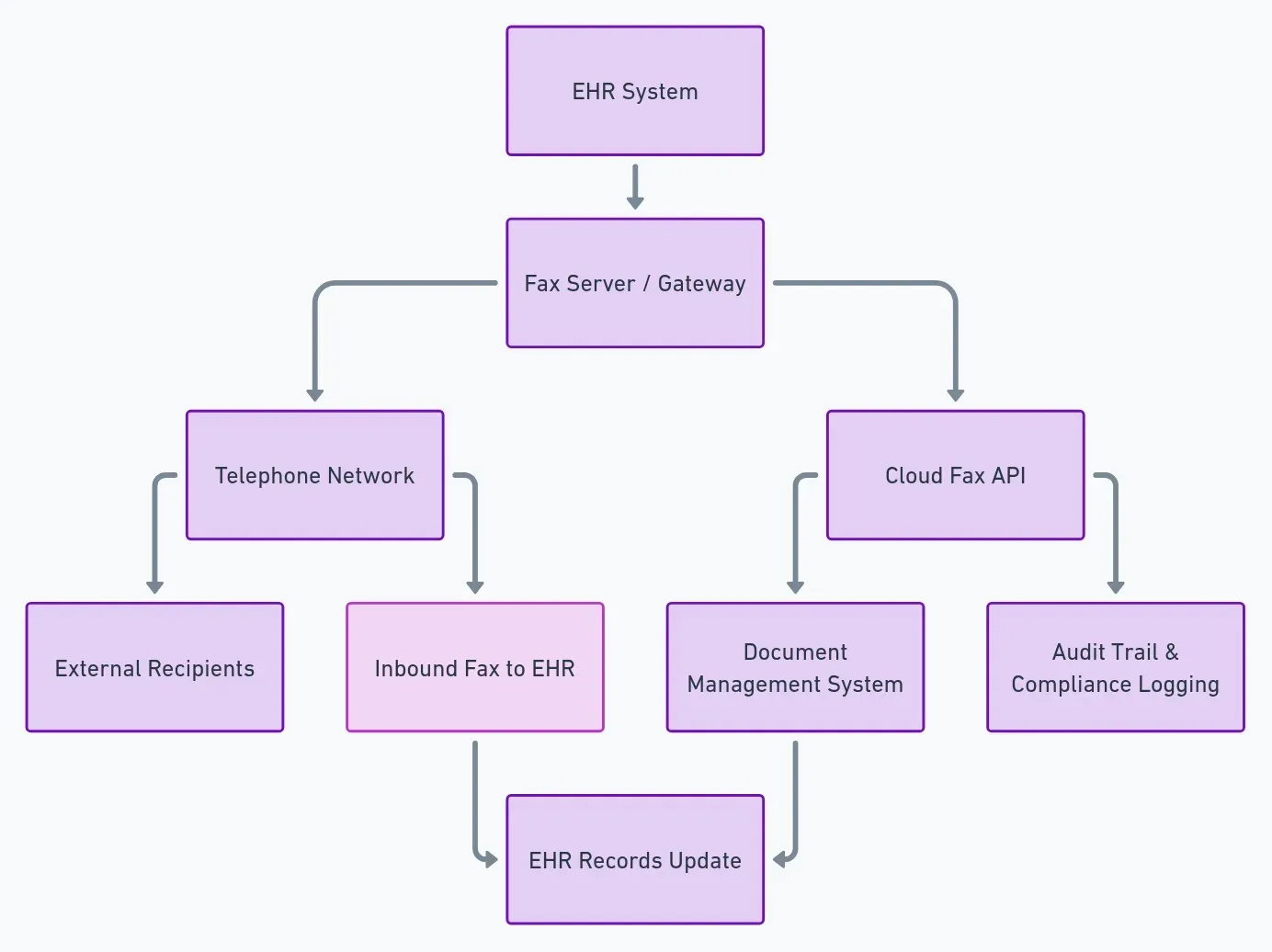
Integration Types
Traditional On-Premise Fax Servers
-
- Physical servers with dedicated phone lines.
- Direct API connections to EHRs.
- Limited scalability and higher maintenance requirements.
Hybrid Fax Solutions
-
- Combines on-premise servers with cloud telephony.
- APIs enable EHR connectivity and internet-based transmission.
- Enhanced scalability and reliability.
Cloud-Based Fax-as-a-Service (FaaS)
-
- Fully cloud-hosted, no on-premise hardware needed.
- RESTful APIs for seamless EHR integration.
- Virtually unlimited capacity and vendor-managed maintenance.
Key Integration Components
| Component | Function |
|---|---|
| Fax Gateway | Converts digital documents to analog fax and vice versa |
| Routing Engine | Distributes inbound faxes intelligently and triggers workflows |
| OCR Processing | Extracts text from faxed documents for structured EHR entry |
| Audit Logging | Tracks transmission and integrates with EHR compliance logs |
Challenges and Pain Points
Operational Inefficiencies
Traditional fax systems create bottlenecks that slow healthcare delivery:
-
- Manual processing and distribution.
- Physical document loss or misplacement.
- Routing delays between departments.
- Poor transmission quality is affecting document legibility.
Security and Compliance Risks
-
- The largest HIPAA fine for fax-related violations reached $2.5 million.
- Unencrypted transmission and physical access to printed faxes pose risks.
- Limited delivery confirmation capabilities.
Cost and Resource Impact
-
- Infrastructure costs, including POTS line fees, have increased post-deregulation.
- Maintenance expenses for hardware and supplies.
- Staff time devoted to manual document processing.
- Delayed information affects revenue and patient care.
Modern Digital Fax Solutions
Digital fax solutions address traditional limitations while remaining compliant and compatible with EHR systems. Leading platforms include:
-
- eFax Corporate: Enterprise-grade security, HIPAA compliance, RESTful APIs.
- SRFax: Privacy-focused, HL7, and FHIR integration.
- Concord Cloud: OCR and automated routing, EHR API integration.
- Notifyre: Programmable fax APIs, FHIR, and webhook support.
API Integration Functions
-
- Send, receive, and status APIs for automated fax processing.
- Document API for formatting and conversion.
- Webhook integration for real-time EHR workflow triggers.
- OCR and patient matching for structured data population.
- Built-in audit logging for compliance.
Recommendation
Cloud-based fax solutions with robust API capabilities maximize EHR integration benefits while reducing infrastructure overhead.
FHIR Integration Possibilities
Fast Healthcare Interoperability Resources (FHIR) enables bridging legacy fax systems with modern interoperability standards. FHIR-based integration supports:
- Standardized metadata for document classification.
- Automated workflows for document handling.
- Improved searchability and patient record updates.
- Audit trails for compliance and provenance tracking.
Cost Analysis and ROI
Traditional Fax Costs
- Hardware: $5,000 - $50,000
- Telephony: $200 - $500 per line monthly
- Staff: 2 - 4 FTEs for document processing
Cloud Fax Costs
- Service Fees: $0.03 - $0.10 per page
- API Usage: $0.01 - $0.05 per call
- Storage: $0.02 - $0.05 per document monthly
- Integration: $10,000 - $50,000 one-time
ROI Benefits
- 70 - 85% reduction in processing time per document.
- 90% improvement in document loss rates.
- 100% visibility in delivery confirmation.
- 75% reduction in compliance violations.
- Faster referrals, decreased test reordering, improved patient satisfaction, and reduced HIPAA risks contribute to tangible revenue improvements.
Security Considerations
Modern solutions enforce end-to-end encryption, AES-256 storage, TLS 1.2+ transmission, multi-factor authentication, role-based access, session management, and audit logging. Compliance with HIPAA, HITECH, and state privacy regulations is critical, alongside regular risk assessments and staff training.
Future Outlook and Migration Strategies
Healthcare Fax Usage Timeline
Healthcare fax usage is expected to gradually transition through:
-
- Short-term (2025 - 2027): Cloud fax adoption, API integration, FHIR pilots.
- Medium-term (2027 - 2030): Widespread FHIR adoption, AI integration, and regulatory updates.
- Long-term (2030+): Legacy fax retirement, blockchain-enabled audit trails, real-time secure interoperability.
Phased Migration Strategy
-
- Assessment & Planning: Workflow analysis, vendor evaluation.
- Digital Fax Implementation: Cloud deployment, EHR integration, staff training.
- Advanced Integration: FHIR API testing, intelligent document processing.
- Alternative Technology Adoption: Direct EHR-to-EHR communication, patient portal integration, legacy fax retirement.
Recommendations for Healthcare Organizations
-
- Conduct a comprehensive assessment of the current fax infrastructure.
- Migrate to cloud-based solutions with API integration and intelligent routing.
- Standardize workflows and establish KPIs for performance monitoring.
- Implement robust security and compliance controls.
- Develop structured staff training and change management programs.
- Select vendors with HIPAA compliance, integration capabilities, and scalability.
- Embrace FHIR readiness, AI capabilities, and mobile integration for future-proofing.
Conclusion
Fax technology remains deeply embedded in healthcare due to interoperability gaps, regulatory compliance, and operational inertia. However, modern digital fax solutions, API integration, and FHIR adoption provide a pathway to enhanced efficiency, security, and workflow automation.
Healthcare organizations should not abandon fax immediately, but strategically modernize it into a secure, integrated component of the communication ecosystem. By prioritizing cloud-based platforms, robust EHR integration, and intelligent automation, organizations can optimize operational efficiency, reduce compliance risks, and improve patient care coordination.
Organizations that proactively modernize fax infrastructure today will be well-positioned for the fully interoperable healthcare ecosystem of tomorrow.
Struggling with healthcare data exchange? Our Healthcare Interoperability Solutions practice helps organizations connect clinical systems at scale. We also offer specialized Healthcare Software Product Development services. Talk to our team to get started.