
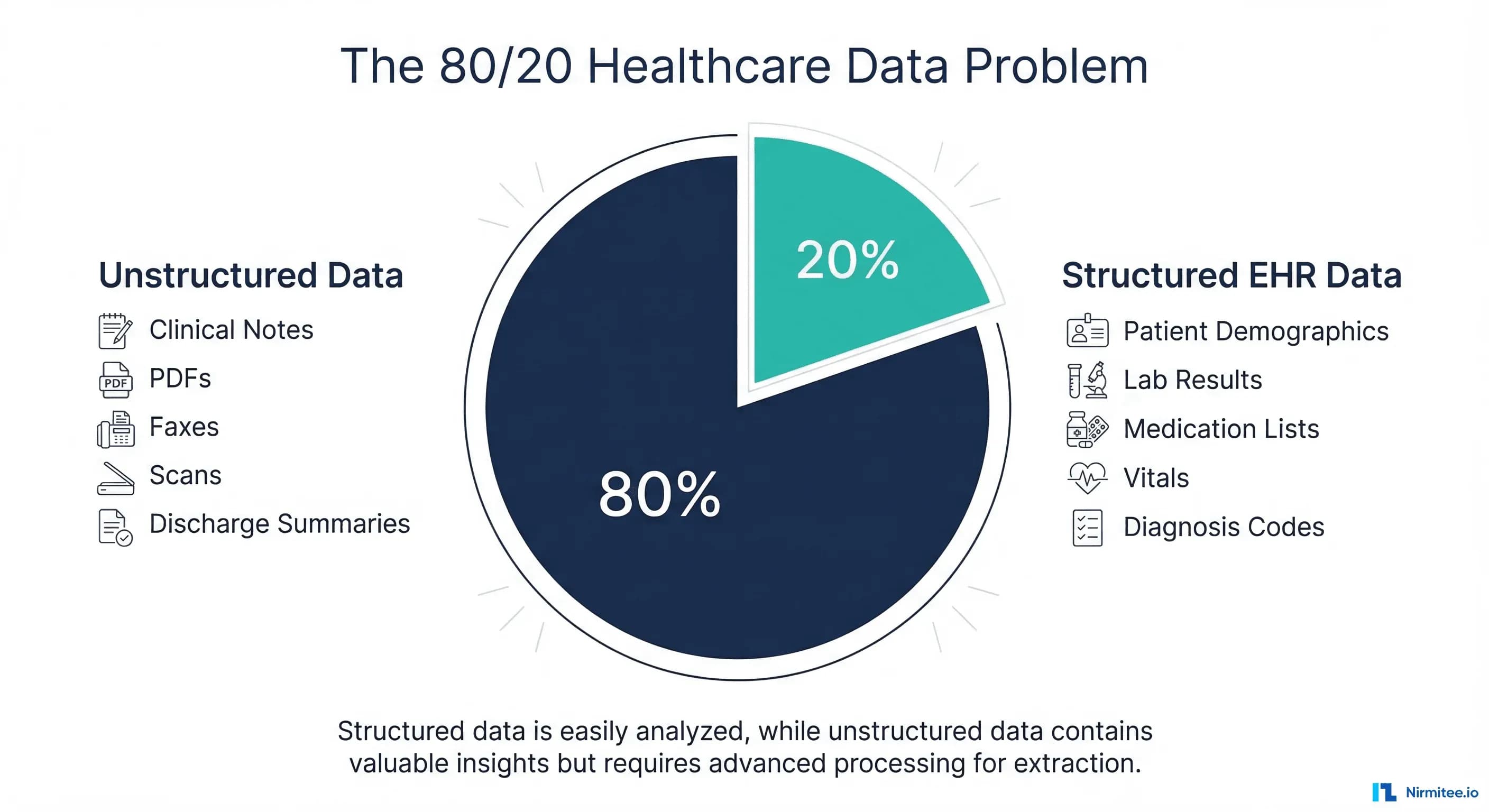
Healthcare organizations generate an estimated 80% of their clinical data in unstructured formats -- physician notes, discharge summaries, faxed referral letters, scanned consent forms, radiology reports, and pathology narratives. Yet most healthcare AI agents, clinical decision support tools, and interoperability pipelines operate exclusively on the remaining 20% of structured data: coded diagnoses, lab results in discrete fields, and medication lists in standardized tables.
This is the 80/20 healthcare data problem, and it is the defining challenge for healthcare AI in 2026. Google Health, Deloitte, and McKinsey have all identified unstructured clinical data as the single largest barrier to effective AI deployment in healthcare settings. If your AI agent only reads structured EHR fields, it is making clinical recommendations based on a fraction of the patient story.
In this guide, we will break down exactly what unstructured clinical data exists, how to extract structured information from it using NLP pipelines, how to represent it in FHIR, and how to build a RAG architecture that gives your AI agent the full picture. We will include production Python code, FHIR mapping tables, and real-world failure cases from agents that missed critical clinical context.
What Unstructured Clinical Data Actually Exists
Before building extraction pipelines, you need to understand the landscape. Unstructured clinical data falls into six major categories, each with distinct challenges for NLP processing.
Discharge Summaries
Discharge summaries are the richest single document in a patient's record. They contain the admission diagnosis, hospital course, procedures performed, medications at discharge, follow-up instructions, and often social context ("patient lives alone, has limited mobility"). A 2024 study in the Journal of the American Medical Informatics Association found that 34% of medication allergies documented in discharge summaries were not captured in the structured allergy list.
Progress Notes (Daily Clinical Notes)
Progress notes follow the SOAP format (Subjective, Objective, Assessment, Plan) and contain the physician's clinical reasoning. The Assessment section often includes differential diagnoses, clinical impressions, and treatment rationale that never make it into structured problem lists. These notes are generated multiple times per day during inpatient stays.
Referral and Consultation Letters
Specialist opinions arrive as faxed or scanned letters. A cardiologist's recommendation to "avoid beta-blockers due to documented bronchospasm" may exist only in a referral letter, never coded as a contraindication. In the US, over 75% of specialist-to-PCP communication still occurs via fax (see our analysis of why fax remains mandatory).
Consent Forms and Legal Documents
Advanced directives, DNR orders, and surgical consent forms contain critical clinical context. A patient's documented refusal of blood transfusion buried in a scanned consent form won't appear in structured EHR fields, but an AI agent recommending a surgical procedure needs to know about it.
Radiology Reports
While radiology orders and some findings are coded, the narrative interpretation -- "2cm nodule in the right upper lobe, recommend follow-up CT in 3 months" -- lives in free text. Incidental findings, which occur in up to 40% of CT scans, are documented only in the report narrative.
Pathology Reports
Pathology results include staging information, margin status, molecular markers, and pathologist commentary. Synoptic reporting has improved structured capture, but many pathology reports remain semi-structured with critical details in narrative sections.
The Clinical NLP Extraction Pipeline
Extracting structured data from clinical text requires a multi-stage pipeline. Unlike general-purpose NLP, clinical text has unique challenges: heavy abbreviations ("pt c/o SOB x 2d"), negation patterns ("denies chest pain"), and domain-specific terminology. Here is the pipeline architecture.
Stage 1: Clinical Named Entity Recognition (NER)
Clinical NER identifies medical entities in text: conditions, medications, procedures, anatomical locations, and lab values. The gold standard tools include:
- spaCy + scispaCy: Open-source, with pre-trained biomedical NER models
- Amazon Comprehend Medical: Managed service with HIPAA eligibility
- Google Cloud Healthcare NLP API: Entity extraction with SNOMED CT and RxNorm linking
- John Snow Labs Spark NLP for Healthcare: Enterprise-grade with 2,000+ pre-trained clinical models
Here is a production Python implementation using scispaCy for clinical NER with UMLS entity linking:
import spacy
import scispacy
from scispacy.linking import EntityLinker
from dataclasses import dataclass
from typing import List, Optional

@dataclass
class ClinicalEntity:
    text: str
    label: str  # PROBLEM, TREATMENT, TEST
    start: int
    end: int
    umls_cui: Optional[str] = None
    snomed_code: Optional[str] = None
    is_negated: bool = False
    confidence: float = 0.0

class ClinicalNERPipeline:
    def __init__(self):
        # Load the biomedical NER model
        self.nlp = spacy.load("en_ner_bc5cdr_md")

        # Add UMLS entity linker
        self.nlp.add_pipe(
            "scispacy_linker",
            config={"resolve_abbreviations": True,
                    "linker_name": "umls"}
        )
        self.linker = self.nlp.get_pipe("scispacy_linker")

    def extract_entities(self, clinical_text: str) -> List[ClinicalEntity]:
        doc = self.nlp(clinical_text)
        entities = []

        for ent in doc.ents:
            # Get UMLS concept if available
            umls_cui = None
            if ent._.kb_ents:
                umls_cui = ent._.kb_ents[0][0]  # Top match CUI

            entity = ClinicalEntity(
                text=ent.text,
                label=ent.label_,
                start=ent.start_char,
                end=ent.end_char,
                umls_cui=umls_cui,
                confidence=ent._.kb_ents[0][1] if ent._.kb_ents else 0.0
            )
            entities.append(entity)

        return entities

# Usage
pipeline = ClinicalNERPipeline()
note = """Patient is a 65yo M with history of Type 2 Diabetes,
currently on Metformin 500mg BID. Allergic to Penicillin
(anaphylaxis). Denies chest pain or shortness of breath."""

entities = pipeline.extract_entities(note)
for e in entities:
    print(f"{e.text} [{e.label}] CUI:{e.umls_cui} neg:{e.is_negated}")
Stage 2: Relation Extraction
After identifying entities, relation extraction connects them: which medication treats which condition, which dosage belongs to which drug, which symptom is associated with which body system. This is critical for building a complete clinical picture.
from dataclasses import dataclass
from typing import List, Tuple

@dataclass
class ClinicalRelation:
    subject: ClinicalEntity
    predicate: str  # TREATS, CAUSES, CONTRAINDICATES
    obj: ClinicalEntity
    confidence: float

def extract_relations(
    entities: List[ClinicalEntity],
    text: str
) -> List[ClinicalRelation]:
    relations = []
    medications = [e for e in entities if e.label == "CHEMICAL"]
    conditions = [e for e in entities if e.label == "DISEASE"]

    for med in medications:
        for cond in conditions:
            # Check proximity (within same sentence)
            med_sent = get_sentence(text, med.start)
            cond_sent = get_sentence(text, cond.start)

            if med_sent == cond_sent:
                # Use context clues for relation type
                context = text[min(med.start, cond.start):max(med.end, cond.end)]
                if any(w in context.lower() for w in ["for", "treats", "managing"]):
                    relations.append(ClinicalRelation(
                        subject=med,
                        predicate="TREATS",
                        obj=cond,
                        confidence=0.85
                    ))
                elif any(w in context.lower() for w in ["allergic", "allergy", "reaction"]):
                    relations.append(ClinicalRelation(
                        subject=med,
                        predicate="CONTRAINDICATES",
                        obj=cond,
                        confidence=0.90
                    ))
    return relations
Stage 3: Negation Detection
Negation detection is where clinical NLP diverges most from general NLP. The phrase "denies chest pain" means the patient does NOT have chest pain. Missing negation means your AI agent treats every mentioned condition as present -- a dangerous failure mode. The NegEx algorithm and its successor, ConText, are the standard approaches:
import re
from typing import List

# Standard clinical negation patterns
NEGATION_TRIGGERS = [
    r"\bno\b", r"\bnot\b", r"\bdenies\b", r"\bdenied\b",
    r"\bnegative\b", r"\bwithout\b", r"\babsence of\b",
    r"\brules? out\b", r"\bunlikely\b", r"\bno evidence of\b",
    r"\bfailed to reveal\b", r"\bfree of\b"
]

def detect_negation(
    entities: List[ClinicalEntity],
    text: str,
    window: int = 6  # words
) -> List[ClinicalEntity]:
    words = text.split()

    for entity in entities:
        # Get word position of entity
        entity_pos = len(text[:entity.start].split())

        # Check preceding window for negation triggers
        window_start = max(0, entity_pos - window)
        preceding = " ".join(words[window_start:entity_pos])

        for trigger in NEGATION_TRIGGERS:
            if re.search(trigger, preceding, re.IGNORECASE):
                entity.is_negated = True
                break

    return entities
Structuring Extracted Data into FHIR
Once you have extracted structured entities from clinical text, you need to represent them in FHIR for interoperability. The key FHIR resources for unstructured data are:
| Unstructured Source | FHIR Resource | Key Fields | Use Case |
|---|---|---|---|
| Clinical notes (any) | DocumentReference | type, content.attachment, context | Store original document + metadata |
| Radiology reports | DiagnosticReport | presentedForm, conclusion, result | Link narrative to structured findings |
| Extracted conditions | Condition | code (SNOMED), clinicalStatus, evidence | NLP-extracted diagnoses |
| Extracted medications | MedicationStatement | medicationCodeableConcept (RxNorm) | Medications found in notes |
| Extracted allergies | AllergyIntolerance | code, reaction, criticality | Allergies from discharge summaries |
| Extracted vitals/labs | Observation | code (LOINC), value, interpretation | Values extracted from narrative |
A critical pattern is to maintain provenance -- always link extracted resources back to the source DocumentReference using Provenance resources. This creates an audit trail showing that a Condition was extracted via NLP from a specific clinical note, not directly entered by a clinician. This distinction matters for clinical decision support systems that need to weight data by reliability.
RAG Architecture for Unstructured Clinical Data
Retrieval-Augmented Generation (RAG) is the architecture pattern that lets AI agents query unstructured clinical data at inference time without requiring full NLP extraction upfront. This is particularly valuable for complex clinical questions that span multiple documents.
Healthcare RAG Pipeline Components
A production healthcare RAG pipeline has five components, each with healthcare-specific considerations:
- Document Ingestion: Clinical documents arrive as HL7 CDA, FHIR DocumentReference, PDF, or scanned images. OCR quality varies dramatically -- thermal fax prints degrade, handwritten notes require specialized models. Consider using Mirth Connect and Kafka for reliable document ingestion at scale.
- Clinical Chunking: Standard text chunking (by character count or paragraph) fails for clinical documents. Section-aware chunking that respects SOAP note structure, report sections (Findings, Impression, Recommendations), and clinical context boundaries produces far better retrieval results.
- Biomedical Embedding: General-purpose embeddings (OpenAI, Cohere) underperform on clinical text. Use domain-specific models: PubMedBERT, BioLORD, or ClinicalBERT produce embeddings that understand "MI" means "myocardial infarction" not "Michigan."
- Vector Store with Metadata Filtering: Store embeddings with rich metadata: patient ID, document type, encounter date, authoring clinician, section type. This enables filtered retrieval: "Find all cardiology consult notes for this patient from the last 6 months."
- Clinical Context Assembly: Retrieved chunks need clinical context injection before LLM processing. Add patient demographics, active problem list, current medications as system context so the LLM can interpret retrieved text accurately.
Real-World Failures: When AI Agents Miss Unstructured Data
These are documented scenarios where AI agents operating on structured data alone produced incorrect or dangerous recommendations:
Case 1: Missed Allergy in Discharge Summary
An AI-powered medication reconciliation agent recommended restarting amoxicillin for a patient with documented penicillin allergy. The allergy was recorded in a discharge summary from an outside hospital transfer but never entered into the structured allergy list. The agent, reading only the AllergyIntolerance resources, found no contraindication. A nurse caught the error during the verification step.
Case 2: Social Determinants Invisible to Clinical Decision Support
A population health AI flagged a diabetic patient as "non-compliant" based on A1C trends and missed appointments. The patient's social worker notes (unstructured) documented housing instability, food insecurity, and transportation barriers -- all explaining the clinical patterns. The structured EHR had none of this context. This is exactly the kind of scenario where understanding integration prerequisites would have prevented the failure.
Case 3: Specialist Recommendation Lost in Fax
A rheumatologist's recommendation to avoid TNF-alpha inhibitors due to latent tuberculosis was faxed to the PCP office. The fax was scanned and stored as a PDF in the EHR. An AI agent recommending treatment options for rheumatoid arthritis never saw this contraindication because it only queried structured medication and condition resources.
Building Your Extraction Pipeline: A Decision Framework
Not every organization needs a full NLP extraction pipeline on day one. Here is a maturity model for approaching the 80/20 problem:
| Stage | Approach | Investment | Coverage |
|---|---|---|---|
| 1. Structured Only | Use existing coded data | Low | ~20% of clinical data |
| 2. Document Retrieval | Index documents for keyword search | Low-Medium | ~40% accessible |
| 3. NLP Extraction | Extract entities from high-value documents | Medium | ~65% accessible |
| 4. RAG Integration | Vector search + LLM for on-demand extraction | Medium-High | ~80% accessible |
| 5. Full Multi-Modal | OCR + NLP + image analysis + structured | High | ~95% accessible |
For most organizations building EHR systems, Stage 3 (targeted NLP extraction on discharge summaries, radiology reports, and referral letters) provides the highest ROI. These three document types contain the most clinically actionable unstructured data.
Practical Implementation Checklist
If you are starting an unstructured data initiative today, here is the priority order:
- Audit your unstructured data: What document types exist? What percentage are digital-born vs scanned? What is the OCR quality?
- Start with discharge summaries: Highest information density, most standardized format, greatest impact on care transitions
- Deploy negation detection first: Before extracting any entities, ensure your pipeline handles negation. False positives from negated findings are more dangerous than missing data
- Use FHIR DocumentReference as your anchor: Store every original document as a FHIR DocumentReference. Link all extracted resources back via Provenance. This maintains the audit trail
- Validate against structured data: Compare NLP-extracted entities against existing structured records. Discrepancies reveal both NLP errors and gaps in structured documentation
- Build monitoring dashboards: Track extraction accuracy, negation detection rates, entity linking coverage, and document processing latency. Observability for AI in healthcare is non-negotiable in production
Frequently Asked Questions
What percentage of clinical data is actually unstructured?
Studies consistently cite 70-80% across healthcare organizations. The exact figure depends on the institution's documentation practices, specialty mix, and EHR configuration. Academic medical centers with heavy research documentation tend toward the higher end. Community hospitals with templated charting may be closer to 60-65%.
Can LLMs replace dedicated clinical NLP pipelines?
Large language models (GPT-4, Claude, Gemini) can extract clinical entities with impressive accuracy in research settings. However, production healthcare NLP still favors dedicated pipelines for three reasons: (1) latency -- LLM inference is too slow for real-time extraction at scale, (2) cost -- processing millions of clinical documents through LLM APIs is prohibitively expensive, (3) determinism -- dedicated NER models produce consistent, reproducible results required for clinical validation.
How does HIPAA affect unstructured data processing?
HIPAA applies equally to structured and unstructured PHI. The key considerations are: (1) de-identification -- clinical notes contain names, dates, and locations that must be removed for secondary use, (2) BAAs -- any NLP vendor processing clinical text needs a Business Associate Agreement, (3) minimum necessary -- your pipeline should extract only the data elements needed for its purpose, not bulk-process entire notes.
What is the accuracy of clinical NER in production?
State-of-the-art clinical NER achieves F1 scores of 85-92% for common entity types (medications, conditions, procedures) on benchmark datasets like i2b2 and n2c2. Production accuracy depends heavily on note quality, specialty, and how well the model matches your institution's documentation style. Plan for a 3-6 month validation period before relying on NLP-extracted data for clinical decisions.
Should we use RAG or full extraction for our AI agent?
Use full extraction when you need: (1) structured data for analytics and reporting, (2) real-time alerts based on extracted values, (3) data that will be queried repeatedly. Use RAG when you need: (1) answers to ad-hoc clinical questions, (2) context from rarely-accessed documents, (3) flexibility to handle new document types without retraining extraction models.
How do we handle scanned documents and handwritten notes?
Modern OCR services (Google Document AI, AWS Textract, Azure AI Document Intelligence) achieve 95%+ accuracy on printed text. Handwritten clinical notes remain challenging, with accuracy in the 70-85% range depending on handwriting quality. For handwritten documents, consider a human-in-the-loop workflow where OCR output is reviewed by clinical staff before entering the NLP pipeline.