
Mental healthcare faces unique challenges in the digital world. Unlike general healthcare, which often relies on clear, measurable data like lab tests or scans, mental health involves complex and personal data that changes over time. Capturing these details digitally without losing important information has been difficult for many platform developers.
As mental health becomes a bigger focus worldwide, digital tools need to be not just advanced but also clinically useful. This means they must keep data accurate, work well with other systems, and put patients at the center of care. Traditional data systems often lack the flexibility and depth needed for mental health.
This is where openEHR makes a difference. It is a standard designed to build clinical systems that are rich in meaning, adaptable, and future-ready. openEHR offers the structure and control needed to create mental health solutions that are both complete and compliant with regulations. In this blog, we explain why openEHR is the best choice for building modern mental health platforms.
Why Mental Health Needs Specialized Digital Platforms
- Unique Challenges in Mental Health Data.
Mental health records include stories, behavior patterns, lifestyle details, and emotions-many of which are hard to measure with numbers. Patients may have symptoms like anxiety, mood swings, or hallucinations that change over time. It is important to capture this information accurately to make good diagnoses and treatment plans. Clinicians also need space to write notes, therapy details, and patient feedback in a way that is both structured and flexible. - Importance of Flexibility and Standardization.
Even though mental health data is very personal, it still needs to follow some standards to support evidence-based care. A good platform should allow clinicians to record unique patient details while keeping data organized so it can be analyzed, shared, and audited. openEHR's approach with archetypes (standard data models) offers this balance by allowing clinical input without losing structure. - Growing Demand for Personalized, Long-Term Care.
Mental health care often lasts months or years, involving medicines, therapy, and lifestyle changes. Platforms must track changes over time to help clinicians make informed decisions. Digital systems should store and show historical data in a way that makes sense to both patients and clinicians. openEHR is excellent at keeping this kind of long-term data.

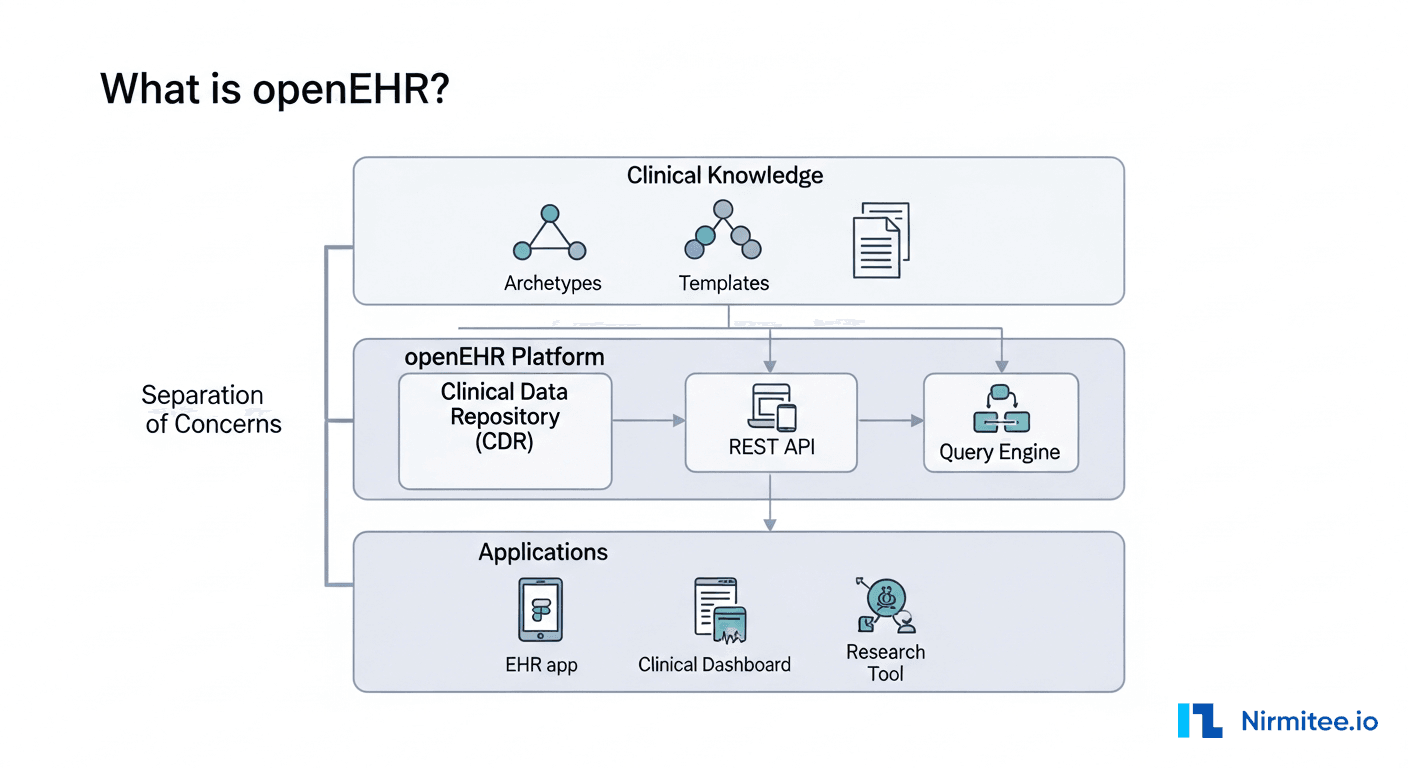
What is openEHR?
openEHR is an open standard that supports creating, storing, and sharing health data in a meaningful and interoperable way. It separates clinical knowledge from the technical system using two levels:
- Archetypes: Reusable models that define what kind of data can be collected (e.g., mood tracking, suicide risk).
- Templates: Groups of archetypes combined for specific clinical uses (e.g., therapy session notes).
This layered design allows easy customization without changing the core system. Clinicians and experts work together to define the clinical content, ensuring it fits real healthcare needs. Developers then build software that uses these models. This flexibility and accuracy are especially valuable in mental health software development.
Advantages of Using openEHR in Mental Health Platforms

Interoperability
Mental health often overlaps with other medical fields like primary care, neurology, or substance abuse treatment. A patient's mental health affects their overall health and vice versa.Platforms built on openEHR can easily share structured data with other health systems using standards like HL7 & FHIR. This helps providers see the full health picture, avoid repeating tests, and coordinate care better.
Custom Data Modeling
OpenEHR lets you create mental health-specific archetypes, such as mood disorder assessments, suicide risk checks, or therapy progress notes.These models can be refined and reused across different apps. Since clinicians help create these archetypes, the data models reflect real mental health workflows and thinking.
- Patient-Centric Records
Unlike systems focused on single visits, openEHR supports data that covers a patient's entire care journey. This is important in mental health, where progress can be slow and uneven. Platforms can show timelines of therapy sessions, medication changes, symptom patterns, and lifestyle changes in context. - Compliance and Governance
OpenEHR has strong rules for managing clinical content, version control, and audit trails. It supports data security, access controls, and follows regulations like HIPAA (USA) and GDPR (Europe). This is crucial for protecting sensitive mental health information. - Scalability
Mental health platforms often start small, maybe just therapy scheduling, and later on include diagnostics, telehealth, or wearable device integration. openEHR allows you to add new features and templates without rebuilding the whole system, making it adaptable and future-proof.
Real-World Use Case: Building the Platform Step-by-Step

Step 1: Gathering Mental Health Requirements from Clinicians.
Start by talking to psychologists, psychiatrists, therapists, and care coordinators to learn what data they need. This includes formal assessments (like PHQ-9 for depression), therapy notes, behavior observations, and patient self-reports. These discussions help define what archetypes and templates to create.
Step 2: Designing Archetypes and Templates for Clinical Forms.
Using tools like the openEHR Archetype Editor or Clinical Knowledge Manager (CKM), developers and clinicians work together to build archetypes for mental health needs. For example, you might create models for Daily Mood Tracking or Psychiatric Intake Assessment. These are then combined into templates used in the app's forms.
Step 3: Integration with EHR Systems and Third-Party Tools
To provide complete care, the platform should connect with external EHRs, pharmacy systems, lab results, and appointment software. openEHR's standard APIs and data formats make it easier to integrate with EHR systems, EHR platforms, and telehealth solutions.
Step 4: Creating User Interfaces for Patients and Providers.
The platform should have easy-to-use interfaces for both patients and clinicians. Patients can track moods, get therapy reminders, and communicate with providers. Clinicians need dashboards with summaries, history charts, and decision support. Because openEHR standardizes the data, front-end teams can focus on usability without worrying about data problems.
Step 5: Ensuring Data Privacy and HIPAA/GDPR Compliance.
Before launching, implement access controls, encryption, and audit logs. openEHR supports detailed access rules for remote patient monitoring software and mental health data.
Key Features of an OpenEHR based Mental Health Platform.
Custom clinical forms for symptoms, moods, and therapy notes
- Long-term view of patient progress
- Patient self-reporting and journaling tools
- Role-based access to protect sensitive data
- Easy sharing with hospitals and general practitioners
- Alerts and reminders for medication or appointments
- Analytics dashboards for care teams
- Support for multiple languages and cultural adaptations
These features work together to provide a complete mental health experience, from the first visit through ongoing care.
Challenges to Expect and How to Overcome Them
Building with openEHR is powerful, but it comes with some challenges:
- Learning Curve:
Clinicians may not be familiar with structured data modeling. Solve this by involving clinical informatics experts who can bridge the gap between medical and technical teams. - Integration Complexity:
Connecting with proprietary EHR systems can be tricky. Investing early in interoperability standards like HL7 FHIR helps reduce problems later. - User Adoption:
Clinicians might resist new systems if they seem too complex. Pair openEHR platforms with good user experience design, training, and ongoing support to ease the transition.
Conclusion
Building a mental health platform needs more than technology; it needs a system that understands the complex nature of mental care. openEHR provides that foundation with its flexible, structured, and patient-focused design. It supports long-term insights, compliance, and growth, meeting the many demands of modern mental healthcare.
As healthcare digital transformation speeds up, platforms that focus on lasting patient outcomes, easy data use, and open standards will succeed. Mental health organizations should see openEHR not just as a tech tool but as a clinical partner for better patient care.
Struggling with healthcare data exchange? Our Healthcare Interoperability Solutions practice helps organizations connect clinical systems at scale. We also offer specialized Healthcare Software Product Development services. Talk to our team to get started.