
Why Consent Is the Hardest Problem in Health Data Exchange
Every health data exchange framework—TEFCA, CMS-0057-F, state HIEs—eventually hits the same wall: who controls what data gets shared, with whom, and for what purpose? The answer is consent management, and the FHIR Consent resource is the standard mechanism for capturing and enforcing these decisions electronically.
Yet most implementations treat consent as a checkbox. A patient signs a paper form, someone scans it into the EHR, and the system either shares everything or nothing. This approach fails when regulations require granular control—when a patient wants to share lab results but not mental health records, or permit data access for treatment but deny it for research.
This guide covers the FHIR Consent resource structure in depth, shows how to build three real-world consent scenarios with working JSON examples, explains how consent integrates with SMART on FHIR authorization, and walks through the IHE Privacy Consent on FHIR (PCF) profile that brings it all together for TEFCA-scale exchange.
FHIR Consent Resource: Structure and Semantics
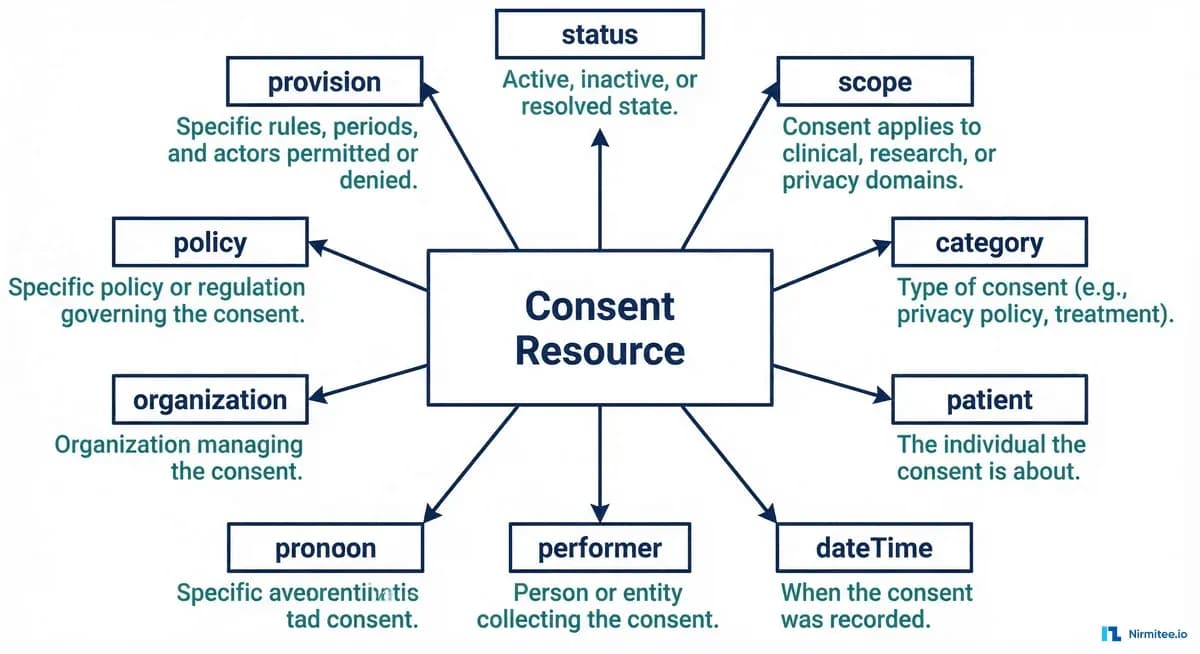
The FHIR R4 Consent resource captures a patient's choices about how their health data may be used or disclosed. Understanding each element is critical before building consent workflows.
Core Elements
| Element | Purpose | Required |
|---|---|---|
status | draft, proposed, active, rejected, inactive, entered-in-error | Yes |
scope | What the consent covers: patient-privacy, research, treatment, adr | Yes |
category | Classification using LOINC codes (e.g., 64292-6 for release of info) | Yes |
patient | Reference to the Patient resource | Yes |
dateTime | When consent was recorded | No |
performer | Who gave consent (patient, guardian, legal representative) | No |
organization | Organization that received the consent | No |
policy | Reference to the applicable regulation or policy | No |
provision | The actual rules: permit or deny, with filters | No |
The provision element is where consent gets powerful. It supports nested rules with filters by data type, actor, purpose, time period, and security label. A single Consent resource can express complex policies like "permit all data sharing for treatment, but deny substance use disorder records for any purpose except emergency treatment."
Consent Scenario 1: Permit All Data Sharing
The simplest case—a patient consents to share all their health data with any authorized recipient for any permitted purpose. This is the baseline consent for healthcare interoperability exchanges.
{
  "resourceType": "Consent",
  "id": "consent-permit-all",
  "status": "active",
  "scope": {
    "coding": [{
      "system": "http://terminology.hl7.org/CodeSystem/consentscope",
      "code": "patient-privacy",
      "display": "Privacy Consent"
    }]
  },
  "category": [{
    "coding": [{
      "system": "http://loinc.org",
      "code": "64292-6",
      "display": "Release of information consent"
    }]
  }],
  "patient": {
    "reference": "Patient/patient-jane-doe"
  },
  "dateTime": "2026-03-01T09:00:00Z",
  "performer": [{
    "reference": "Patient/patient-jane-doe"
  }],
  "organization": [{
    "reference": "Organization/metro-health-system"
  }],
  "policyRule": {
    "coding": [{
      "system": "http://terminology.hl7.org/CodeSystem/v3-ActCode",
      "code": "OPTIN"
    }]
  },
  "provision": {
    "type": "permit",
    "period": {
      "start": "2026-03-01",
      "end": "2027-03-01"
    }
  }
}
Key points: the policyRule of OPTIN signals this is an affirmative consent. The provision.type of permit without additional filters means all data types are included. The period sets a one-year validity window—consent should always have an expiration.
Consent Scenario 2: Deny Mental Health Records
A patient shares all data except mental health records. This is common in states with heightened mental health privacy protections and is a critical use case for TEFCA exchanges where data crosses jurisdictional boundaries.
{
  "resourceType": "Consent",
  "id": "consent-deny-mental-health",
  "status": "active",
  "scope": {
    "coding": [{
      "system": "http://terminology.hl7.org/CodeSystem/consentscope",
      "code": "patient-privacy"
    }]
  },
  "category": [{
    "coding": [{
      "system": "http://loinc.org",
      "code": "64292-6",
      "display": "Release of information consent"
    }]
  }],
  "patient": {
    "reference": "Patient/patient-jane-doe"
  },
  "dateTime": "2026-03-01T09:00:00Z",
  "policyRule": {
    "coding": [{
      "system": "http://terminology.hl7.org/CodeSystem/v3-ActCode",
      "code": "OPTIN"
    }]
  },
  "provision": {
    "type": "permit",
    "period": {
      "start": "2026-03-01",
      "end": "2027-03-01"
    },
    "provision": [{
      "type": "deny",
      "class": [{
        "system": "http://hl7.org/fhir/resource-types",
        "code": "Condition"
      },
      {
        "system": "http://hl7.org/fhir/resource-types",
        "code": "Observation"
      }],
      "code": [{
        "coding": [{
          "system": "http://terminology.hl7.org/CodeSystem/v3-ActCode",
          "code": "MH",
          "display": "Mental Health"
        }]
      }]
    }]
  }
}
The nested provision structure is key. The outer provision permits all data. The inner provision denies specific resource types (Condition, Observation) when they carry the mental health (MH) security label. This requires your FHIR server to tag resources with security labels during ingestion—a prerequisite many organizations overlook.
Consent Scenario 3: Permit for Treatment, Deny for Research
A patient permits data sharing when the purpose is treatment but denies it when the purpose is research. This scenario directly maps to the TEFCA Permitted Purposes framework.
{
  "resourceType": "Consent",
  "id": "consent-treatment-only",
  "status": "active",
  "scope": {
    "coding": [{
      "system": "http://terminology.hl7.org/CodeSystem/consentscope",
      "code": "patient-privacy"
    }]
  },
  "category": [{
    "coding": [{
      "system": "http://loinc.org",
      "code": "64292-6"
    }]
  }],
  "patient": {
    "reference": "Patient/patient-jane-doe"
  },
  "dateTime": "2026-03-01T09:00:00Z",
  "provision": {
    "type": "deny",
    "provision": [
      {
        "type": "permit",
        "purpose": [{
          "system": "http://terminology.hl7.org/CodeSystem/v3-ActReason",
          "code": "TREAT",
          "display": "Treatment"
        }]
      },
      {
        "type": "permit",
        "purpose": [{
          "system": "http://terminology.hl7.org/CodeSystem/v3-ActReason",
          "code": "ETREAT",
          "display": "Emergency Treatment"
        }]
      }
    ]
  }
}
Notice the structure inversion: the outer provision is deny (default deny everything), and the inner provisions explicitly permit specific purposes. This deny-by-default pattern is more secure than permit-with-exceptions because any new purpose of use is automatically blocked until explicitly allowed.
Integrating Consent with SMART on FHIR OAuth
Consent capture should be part of the authorization flow, not a separate process. When a patient authorizes a third-party app through SMART on FHIR, the consent decision can be captured simultaneously.
Consent-Aware Authorization Flow
- App redirects to authorization server: Standard SMART launch with requested scopes (e.g.,
patient/Condition.read,patient/Observation.read). - Patient authenticates: Login through the organization's identity provider.
- Consent screen presented: Instead of a generic "authorize this app" screen, show granular consent options—which data categories to share, for what purposes, for how long.
- Consent resource created: The authorization server creates a FHIR Consent resource capturing the patient's choices.
- Token issued with consent-scoped claims: The access token includes claims that reference the Consent resource, allowing downstream services to enforce the consent.
- FHIR server enforces consent: On each data request, the server checks the referenced Consent resource and filters responses accordingly.
# Access token JWT payload with consent reference
{
  "iss": "https://auth.example.com",
  "sub": "patient-jane-doe",
  "aud": "https://fhir.example.com",
  "scope": "patient/Condition.read patient/Observation.read",
  "consent_reference": "Consent/consent-deny-mental-health",
  "exp": 1773652800
}
IHE Privacy Consent on FHIR (PCF) Profile
The IHE Privacy Consent on FHIR (PCF) profile standardizes how consent is captured, stored, and enforced across health information exchanges. It defines three levels of consent sophistication, and is directly relevant to TEFCA implementations.
PCF Consent Levels
| Level | Capability | Use Case |
|---|---|---|
| Basic | Opt-in or opt-out for all data sharing | Simple consent for HIE participation |
| Intermediate | Filters by data sensitivity category (mental health, substance use, HIV) | State law compliance, sensitive data protection |
| Advanced | Filters by data type, actor, purpose, time period | Granular patient preferences, research consent |
PCF defines specific actors in the consent enforcement chain:
- Consent Recorder: Captures the patient's consent decision and creates the FHIR Consent resource.
- Consent Registry: Stores Consent resources and makes them available for lookup.
- Consent Authorization Server: Evaluates data access requests against stored consent policies and issues authorization decisions.
- Consent Enforcement Point: Filters data responses based on authorization decisions.
TEFCA and Consent: What Changes
TEFCA introduces a national consent framework through its Qualified Health Information Networks (QHINs). By July 2026, TEFCA participants must support FHIR-based exchange aligned with US Core, which includes consent management for sensitive data categories.
TEFCA Permitted Purposes
TEFCA defines specific Permitted Purposes for data exchange—treatment, payment, health care operations, public health, benefits determination, and individual access. Each purpose maps to consent provisions that patients can control. For example, a patient who participates in TEFCA can permit data sharing for treatment while denying it for payment purposes.
Sensitive Data Under TEFCA
Certain data categories require explicit consent under federal and state law, regardless of TEFCA participation:
- Substance Use Disorder (42 CFR Part 2): Requires specific patient consent for any disclosure, with strict re-disclosure restrictions.
- Mental Health: Many states impose additional consent requirements beyond HIPAA.
- HIV/AIDS: State-specific consent requirements for disclosure.
- Reproductive Health: Post-Dobbs privacy concerns have led to new state-level protections.
- Genetic Information (GINA): Restrictions on use for insurance and employment decisions.
Your consent enforcement engine must understand these sensitivity categories and apply the correct consent rules. This is where security labels on FHIR resources become essential—each resource must be tagged with its sensitivity level so the consent engine can filter appropriately.
Consent Enforcement Architecture
Building a working consent enforcement system requires four components working together. Here is a practical architecture for organizations building healthcare integration platforms.
# Consent Enforcement Service (Python pseudocode)

def evaluate_consent(patient_id, requested_resources, purpose_of_use, requesting_actor):
    """Evaluate whether access is permitted based on active consent."""

    # 1. Retrieve active consent for patient
    consents = fhir_client.search('Consent', {
        'patient': patient_id,
        'status': 'active',
        'scope': 'patient-privacy'
    })

    if not consents:
        return apply_default_policy(patient_id)  # Opt-in vs opt-out jurisdiction

    consent = consents[0]  # Most recent active consent

    # 2. Evaluate provision rules
    filtered_resources = []
    for resource in requested_resources:
        decision = evaluate_provision(
            consent.provision,
            resource=resource,
            purpose=purpose_of_use,
            actor=requesting_actor
        )
        if decision == 'permit':
            filtered_resources.append(resource)

    # 3. Log the access decision (required for audit)
    create_audit_event(patient_id, purpose_of_use, requesting_actor,
                       total=len(requested_resources),
                       permitted=len(filtered_resources))

    return filtered_resources
Security Labels: The Missing Prerequisite
Consent enforcement only works if resources are tagged with security labels. Without labels, the consent engine cannot distinguish a mental health Condition from a diabetes Condition. You need a labeling pipeline that tags resources at ingestion time based on diagnosis codes, encounter types, and ordering context.
| Security Label | Category | ICD-10 Range | Regulation |
|---|---|---|---|
MH | Mental Health | F01-F99 | State mental health laws |
ETH | Substance Use Disorder | F10-F19 | 42 CFR Part 2 |
HIV | HIV/AIDS | B20-B24, Z21 | State HIV disclosure laws |
PSY | Psychiatry | F20-F29 (psychotic) | State-specific |
SDV | Sexual/Domestic Violence | T74-T76 | State-specific |
SEX | Reproductive/Sexual Health | O00-O99, Z30-Z39 | Post-Dobbs state laws |
Each resource ingested into the FHIR server should pass through a labeling service that evaluates its clinical content against this mapping table and applies the appropriate meta.security labels. Resources may carry multiple labels—a Condition for opioid use disorder would receive both MH and ETH labels, requiring consent evaluation against both categories.
Consent Versioning and Lifecycle Management
Consent is not a one-time event—it is a living document that changes over time. A robust consent management system must handle the full lifecycle: creation, activation, modification, revocation, and expiration. When a patient updates their consent preferences, you should not modify the existing Consent resource. Instead, create a new Consent resource with status: active and set the previous one to status: inactive. This preserves an audit trail showing what consent was in effect at any point in time—critical for compliance investigations and litigation.
Consent expiration is equally important. The provision.period element should always have an end date. When consent expires, your system must either block data sharing until the patient re-consents (in opt-in jurisdictions) or fall back to a default policy (in opt-out jurisdictions). Build automated re-consent workflows that notify patients 30 days before expiration and provide a simple digital mechanism to renew.
For organizations participating in TEFCA, consent versioning becomes even more complex because consent decisions may need to be communicated to multiple QHINs. Consider implementing a consent event bus that publishes consent changes to all downstream consumers—ensuring that revocation takes effect across the entire network, not just at the originating organization. This pattern aligns well with event-driven healthcare architectures that use message queues for cross-system coordination.
Common Pitfalls in Consent Implementation
- Paper consent without digital enforcement: Scanning a consent form into the EHR provides documentation but no automated enforcement. You need computable consent—FHIR Consent resources that the system can evaluate programmatically.
- All-or-nothing consent: Many systems only support opt-in or opt-out for all data. Patients increasingly want granular control, and regulations like 42 CFR Part 2 require it for specific data categories.
- Missing security labels: Without sensitivity labels on FHIR resources, granular consent enforcement is impossible. Build the labeling pipeline before building the consent engine.
- Consent drift: Consent decisions expire or change. Your system must handle consent revocation, expiration, and updates. An expired consent should trigger a re-consent workflow, not silently fail to share data.
- Ignoring state law variations: Each US state has different consent requirements for sensitive data. A national exchange like TEFCA must apply the most restrictive applicable law—which may be the patient's home state, the provider's state, or both.
Frequently Asked Questions
What is the FHIR Consent resource used for?
The FHIR Consent resource captures a patient's decisions about how their health data can be used or disclosed. It supports granular controls—patients can permit or deny access by data type, purpose of use, recipient, and time period. The resource is used for privacy consent, research consent, treatment consent, and advance directive documentation.
How does TEFCA handle patient consent?
TEFCA requires participants to comply with applicable federal and state consent laws. For most treatment purposes, HIPAA's minimum necessary standard applies without explicit patient consent. For sensitive data categories (substance use disorder, mental health), explicit patient consent is required before disclosure. TEFCA's FHIR roadmap includes consent management as a core capability by July 2026.
What is the IHE PCF profile?
The IHE Privacy Consent on FHIR (PCF) profile standardizes consent capture, storage, and enforcement using FHIR resources. It defines three levels (Basic, Intermediate, Advanced) for different granularity needs, and specifies actors like Consent Recorder, Consent Registry, and Consent Authorization Server.
Can patients revoke consent?
Yes. Setting the Consent resource status to inactive or creating a new Consent with status: active that supersedes the previous one. Your system should immediately stop sharing data when consent is revoked and log the revocation for audit purposes.
How do security labels work with consent?
Security labels are metadata tags on FHIR resources that classify their sensitivity level (e.g., MH for mental health, ETH for substance use disorder). The consent enforcement engine checks these labels against the consent provisions to determine whether each resource should be included in a response. Without security labels, granular consent enforcement is not possible.