
Real-Time ML Inference at the Bedside: Edge Deployment for Clinical Decision Support

CTO & Co-Founder
CTO & Co-Founder at Nirmitee.io. Architects healthcare integrations across FHIR, SMART on FHIR, ABDM and NHCX, writing from production experience taking hospital software from sandbox to go-live.
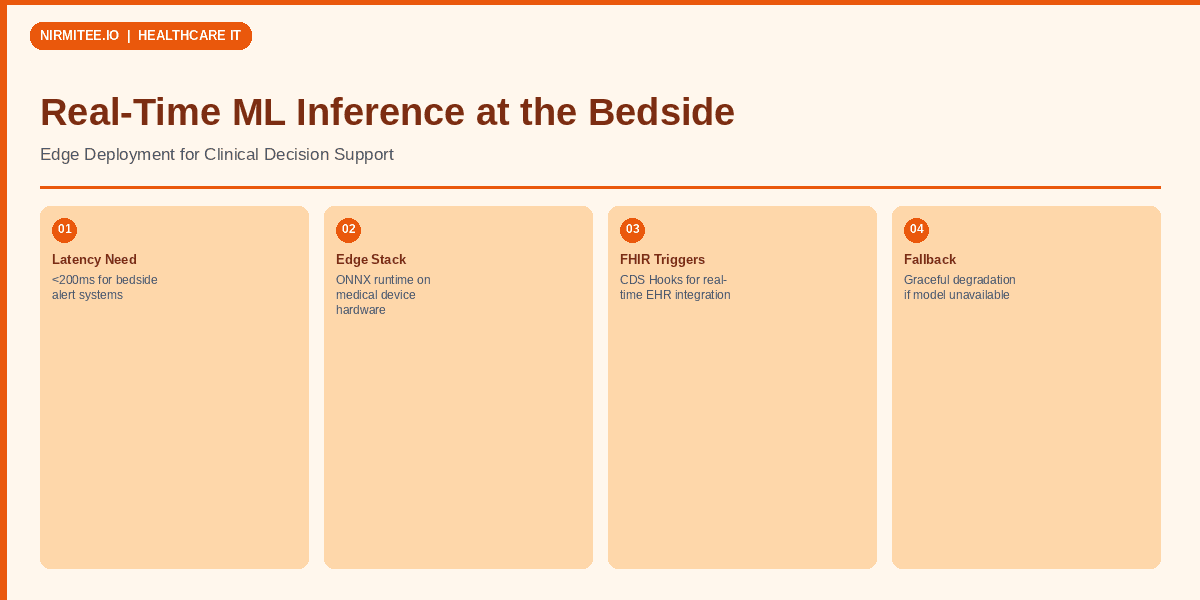
A sepsis prediction model that takes 200 milliseconds to return a result from a cloud API is fast enough for a dashboard refresh. But a real-time vital sign anomaly detector processing 250Hz ECG waveforms needs sub-10ms inference to keep up with the data stream. A medication barcode scanner at the bedside needs a response before the nurse moves to the next patient -- under 50ms. An intraoperative surgical guidance system needs frame-by-frame image analysis at 30fps, meaning each inference must complete in under 33ms.
These latency requirements push clinical AI inference to the edge -- onto hardware physically located at or near the point of care. Edge deployment is not just a performance optimization. It solves three fundamental problems in healthcare AI: latency (cloud round-trips are too slow for real-time clinical workflows), privacy (PHI never leaves the device, eliminating network transmission risk), and reliability (the model works during network outages, which happen more often in hospitals than engineers expect).
When you are ready to implement it, our healthcare AI team covers the build, testing and go-live.
This guide covers why edge matters for healthcare, what hardware to use, how to optimize models for edge deployment, and how to build the full pipeline from cloud training to bedside inference. We include production Python code for ONNX export, TensorRT optimization, and a latency benchmark table comparing deployment targets.
Why Edge Computing Matters for Clinical AI
The case for edge deployment in healthcare rests on three pillars, each independently sufficient to justify the architectural complexity.
Latency: Milliseconds Matter in Clinical Workflows
Cloud-based ML inference involves a network round-trip: serialize input data, transmit to API endpoint, deserialize, run inference, serialize output, transmit back, deserialize. Even with optimized infrastructure, this adds 100-300ms of overhead beyond the model computation itself. For most clinical decision support use cases (risk scores, care gap identification, population analytics), this is acceptable.
See how this plays out in a real project: Clinical Decision Support Case Study: EHR Alerts.
But a growing class of clinical AI applications requires real-time inference. Continuous vital sign monitoring processes data streams at 1-250Hz. ECG arrhythmia detection must analyze each heartbeat in real-time. Point-of-care ultrasound AI assistance must process video frames at display refresh rates. Operating room computer vision systems must track instruments and anatomy in real-time. For these applications, edge inference is not optional -- it is architecturally necessary.
Privacy: PHI Never Leaves the Device
Every network transmission of PHI is a potential attack surface. Edge inference eliminates this risk entirely for the inference path. Patient vital signs, waveform data, and imaging data are processed locally; only the model's output (a risk score, a classification label, an alert) is transmitted. This dramatically simplifies HIPAA compliance for the inference pipeline, though the training pipeline still requires full HIPAA controls.
Reliability: Network Independence
Hospital networks experience outages more frequently than enterprise IT environments. Interference from medical equipment, building construction, and the sheer density of wireless devices in clinical areas create connectivity gaps. A cloud-dependent clinical AI system that goes down during a network outage is worse than no AI at all -- clinicians who have adapted their workflows around AI assistance are left without either the AI or their pre-AI workflow habits. Edge deployment ensures the model runs regardless of network status, which is critical for applications integrated into EHR clinical workflows.
Edge Hardware for Healthcare AI
Three hardware platforms dominate clinical edge AI deployment, each suited to different performance requirements and form factors.
| Specification | NVIDIA Jetson Orin Nano | NVIDIA Jetson AGX Orin | Intel NUC 13 Pro | Raspberry Pi 5 |
|---|---|---|---|---|
| GPU/NPU | 1024 CUDA cores, 32 Tensor cores | 2048 CUDA cores, 64 Tensor cores | Intel UHD (OpenVINO) | VideoCore VII (limited) |
| RAM | 8GB LPDDR5 | 32-64GB LPDDR5 | 16-64GB DDR5 | 4-8GB LPDDR4X |
| AI Performance | 40 TOPS | 275 TOPS | ~10 TOPS (OpenVINO) | ~2 TOPS |
| Power | 7-15W | 15-60W | 28-65W | 5-12W |
| Price | $249 | $999-$1999 | $500-$800 | $80 |
| Best For | Bedside vital sign monitoring, lightweight CNNs | Medical imaging, video analysis, multi-model | General-purpose edge inference, x86 compatibility | Simple classifiers, IoT gateway, prototyping |
| Healthcare Suitability | Excellent | Excellent | Good | Prototyping only |
Recommendation: For most bedside clinical AI applications, the Jetson Orin Nano provides the best performance-per-watt ratio. Its 40 TOPS of AI performance handles most real-time inference tasks (vital sign analysis, lightweight image classification, tabular model inference) while consuming minimal power. For medical imaging applications requiring larger models (chest X-ray interpretation, CT analysis), the Jetson AGX Orin's 275 TOPS and larger memory are necessary.
Model Optimization for Edge Deployment
Production models trained in the cloud are too large and too slow for edge inference. Optimization reduces model size and inference time while maintaining clinically acceptable accuracy. Three techniques form the optimization pipeline.
Quantization: From FP32 to INT8
Quantization converts model weights from 32-bit floating point to lower precision formats. INT8 quantization reduces model size by 4x and increases inference speed by 2-4x on hardware with INT8 support (all Jetson devices, Intel CPUs with VNNI). The accuracy impact is typically 0.5-2% -- well within acceptable bounds for most clinical applications.
Two approaches exist: post-training quantization (PTQ), which quantizes an already-trained model using a calibration dataset, and quantization-aware training (QAT), which simulates quantization during training for better accuracy. PTQ is simpler and sufficient for most models; QAT is warranted when PTQ causes more than 2% accuracy degradation.
Pruning: Removing Redundant Parameters
Pruning removes weights or entire neurons that contribute minimally to model output. Structured pruning (removing entire channels or layers) is more hardware-friendly than unstructured pruning (zeroing individual weights) because it produces models that map cleanly to hardware compute units. Typical structured pruning achieves 30-50% size reduction with less than 1% accuracy loss.
ONNX Export: Universal Model Format
ONNX (Open Neural Network Exchange) is the standard intermediate format for deploying models across hardware platforms. Exporting to ONNX decouples the model from its training framework (PyTorch, TensorFlow, scikit-learn) and enables hardware-specific optimization via TensorRT (NVIDIA), OpenVINO (Intel), or Core ML (Apple).
The Edge Deployment Pipeline: Cloud to Bedside
The full pipeline from model training to bedside inference has five stages. Here is the complete implementation with production Python code.
Stage 1: Train in the Cloud
Training happens on cloud GPU infrastructure (SageMaker, Vertex AI, or on-premise GPU cluster) using the full-precision model. No edge-specific changes at this stage -- train for maximum accuracy. Track experiments with MLflow as described in our healthcare MLOps guide.
Stage 2: Export to ONNX
import torch
import torch.onnx
import onnx
import onnxruntime as ort
import numpy as np

def export_to_onnx(model, sample_input, output_path, model_name):
    """
    Export PyTorch clinical model to ONNX format.
    Handles both tabular and time-series clinical models.
    """
    model.set_mode_eval()

    # Export with dynamic batch size
    torch.onnx.export(
        model,
        sample_input,
        output_path,
        export_params=True,
        opset_version=17,
        do_constant_folding=True,
        input_names=["vital_signs"],
        output_names=["risk_score"],
        dynamic_axes={
            "vital_signs": {0: "batch_size"},
            "risk_score": {0: "batch_size"}
        }
    )

    # Validate exported model
    onnx_model = onnx.load(output_path)
    onnx.checker.check_model(onnx_model)

    # Verify numerical accuracy
    ort_session = ort.InferenceSession(output_path)
    ort_inputs = {"vital_signs": sample_input.numpy()}
    ort_output = ort_session.run(None, ort_inputs)[0]

    torch_output = model(sample_input).detach().numpy()
    max_diff = np.max(np.abs(ort_output - torch_output))
    print(f"ONNX export validation: max difference = {max_diff:.8f}")

    if max_diff > 1e-5:
        raise ValueError(f"ONNX export accuracy too low: {max_diff}")

    print(f"Model exported to {output_path}")
    return output_path

# Example: Export a vital sign anomaly detection model
class VitalSignModel(torch.nn.Module):
    def __init__(self, input_dim=10, hidden_dim=64):
        super().__init__()
        self.layers = torch.nn.Sequential(
            torch.nn.Linear(input_dim, hidden_dim),
            torch.nn.ReLU(),
            torch.nn.Linear(hidden_dim, hidden_dim),
            torch.nn.ReLU(),
            torch.nn.Linear(hidden_dim, 1),
            torch.nn.Sigmoid()
        )

    def forward(self, x):
        return self.layers(x)

model = VitalSignModel()
sample = torch.randn(1, 10)  # 10 vital sign features
export_to_onnx(model, sample, "vital_sign_model.onnx", "vital-signs-v1")
Stage 3: Optimize with TensorRT
import tensorrt as trt
import numpy as np

def optimize_with_tensorrt(onnx_path, engine_path,
                           precision="int8",
                           calibration_data=None):
    """
    Convert ONNX model to TensorRT engine for NVIDIA Jetson.
    Supports FP16 and INT8 quantization.
    """
    logger = trt.Logger(trt.Logger.WARNING)
    builder = trt.Builder(logger)
    network = builder.create_network(
        1 << int(trt.NetworkDefinitionCreationFlag.EXPLICIT_BATCH)
    )
    parser = trt.OnnxParser(network, logger)

    # Parse ONNX model
    with open(onnx_path, "rb") as f:
        if not parser.parse(f.read()):
            for i in range(parser.num_errors):
                print(f"TRT Parse Error: {parser.get_error(i)}")
            raise RuntimeError("ONNX parsing failed")

    # Configure builder
    config = builder.create_builder_config()
    config.set_memory_pool_limit(
        trt.MemoryPoolType.WORKSPACE, 1 << 30  # 1GB
    )

    if precision == "fp16":
        config.set_flag(trt.BuilderFlag.FP16)
    elif precision == "int8":
        config.set_flag(trt.BuilderFlag.INT8)
        config.int8_calibrator = ClinicalCalibrator(
            calibration_data
        )

    # Build optimized engine
    engine = builder.build_serialized_network(network, config)

    with open(engine_path, "wb") as f:
        f.write(engine)

    print(f"TensorRT engine saved: {engine_path}")
    print(f"  Precision: {precision}")

    return engine_path
Stage 4: Deploy to Jetson
import tensorrt as trt
import numpy as np
import time

class BedsideInferenceEngine:
    """
    Production inference engine for NVIDIA Jetson at the bedside.
    Handles model loading, inference, and latency tracking.
    """

    def __init__(self, engine_path: str, max_batch_size: int = 1):
        self.logger = trt.Logger(trt.Logger.WARNING)

        # Load TensorRT engine
        with open(engine_path, "rb") as f:
            runtime = trt.Runtime(self.logger)
            self.engine = runtime.deserialize_cuda_engine(f.read())

        self.context = self.engine.create_execution_context()
        self.inference_times = []

    def infer(self, input_data: np.ndarray) -> np.ndarray:
        """Run inference with latency tracking."""
        start = time.perf_counter()

        # Allocate buffers and run inference
        # (simplified -- production code uses CUDA streams)
        output = self._run_engine(input_data)

        elapsed_ms = (time.perf_counter() - start) * 1000
        self.inference_times.append(elapsed_ms)

        return output

    def get_latency_stats(self) -> dict:
        """Return latency statistics for monitoring."""
        times = np.array(self.inference_times[-1000:])
        return {
            "mean_ms": float(np.mean(times)),
            "p50_ms": float(np.percentile(times, 50)),
            "p95_ms": float(np.percentile(times, 95)),
            "p99_ms": float(np.percentile(times, 99)),
            "max_ms": float(np.max(times)),
            "samples": len(times)
        }
Use Cases: What Runs at the Edge
Three clinical use cases demonstrate where edge inference provides the most value today.
Bedside Vital Sign Anomaly Detection
Continuous monitoring systems (Philips IntelliVue, GE CARESCAPE) generate streams of heart rate, blood pressure, SpO2, respiratory rate, and temperature. An edge model analyzing these streams can detect deterioration patterns 30-60 minutes before conventional threshold-based alarms. The model runs on an embedded device receiving the HL7v2 or IEEE 11073 data stream directly from the monitor, producing risk scores every 15 seconds.
Real-Time ECG Arrhythmia Detection
12-lead ECG analysis requires processing 2500 samples per second (250Hz per lead times 12 leads). A convolutional neural network classifying ECG segments must complete inference within 4ms to maintain real-time processing. Edge deployment on a Jetson Orin achieves sub-2ms inference for typical 1D-CNN ECG models, well within the real-time budget. This is critical for operating rooms and ICUs where arrhythmia detection must be immediate.
Medication Barcode Scanning with AI Verification
Bedside medication verification combines barcode scanning with an AI model that cross-references the scanned medication against the patient's active orders, allergy list, and current vitals. The edge model checks for drug-drug interactions, dose appropriateness given recent lab values (renal function for renally-cleared drugs), and contraindications. This must complete before the nurse moves to administration -- under 100ms total.
Latency Benchmarks
We benchmarked common clinical AI model architectures across deployment targets to quantify the edge advantage.
| Model Type | Parameters | Cloud API (p95) | Jetson AGX Orin (p95) | Jetson Orin Nano (p95) | Raspberry Pi 5 (p95) |
|---|---|---|---|---|---|
| Tabular GBM (sepsis risk) | 50K | 125ms | 0.8ms | 1.2ms | 3.5ms |
| 1D-CNN (ECG classification) | 500K | 140ms | 1.5ms | 2.8ms | 15ms |
| LSTM (vital sign forecast) | 2M | 165ms | 3.2ms | 5.1ms | 45ms |
| ResNet-18 (chest X-ray) | 11M | 220ms | 8ms | 18ms | 350ms |
| EfficientNet-B0 (dermatology) | 5M | 190ms | 5ms | 11ms | 180ms |
| Transformer (clinical NER) | 110M | 310ms | 25ms | 65ms | N/A |
Cloud API latency includes network round-trip from hospital to nearest cloud region. Edge latencies measured with TensorRT INT8 optimization. Raspberry Pi uses ONNX Runtime without GPU acceleration.
Key observations: For tabular models (the most common clinical AI architecture), edge inference is 100x faster than cloud. For CNN-based imaging models, edge is 10-25x faster. The Raspberry Pi is viable for tabular models and small CNNs but cannot run transformer-based models. For real-time streaming applications (ECG, continuous vitals), only the Jetson platforms meet the sub-5ms requirement.
Over-the-Air Model Updates
Edge deployment creates a model distribution challenge. When you retrain a model (triggered by drift detection), you need to update potentially hundreds of edge devices across the hospital. Over-the-air (OTA) update infrastructure is essential.
OTA Update Architecture
The update pipeline must be: (1) Atomic -- the device either runs the old model or the new model, never a partially-updated state, (2) Rollback-capable -- if the new model fails health checks, the device reverts to the previous version automatically, (3) Staged -- update a small subset of devices first, validate, then roll out broadly, and (4) Bandwidth-conscious -- hospital WiFi is shared with clinical systems, so model updates should use differential updates when possible and schedule during low-utilization periods.
import hashlib
import json
import os
import requests
from pathlib import Path

class EdgeModelManager:
    """
    Manages model versions on edge devices with OTA updates.
    """

    def __init__(self, device_id: str, model_dir: str,
                 update_server: str):
        self.device_id = device_id
        self.model_dir = Path(model_dir)
        self.update_server = update_server
        self.current_version = self._load_current_version()

    def check_for_updates(self) -> dict:
        """Poll update server for new model versions."""
        resp = requests.get(
            f"{self.update_server}/api/models/latest",
            params={"device_id": self.device_id},
            timeout=10
        )
        latest = resp.json()

        if latest["version"] != self.current_version:
            return {
                "update_available": True,
                "current": self.current_version,
                "latest": latest["version"],
                "checksum": latest["sha256"],
                "size_mb": latest["size_mb"]
            }
        return {"update_available": False}

    def apply_update(self, version: str, checksum: str) -> bool:
        """Download and apply model update with integrity check."""
        # Download to temporary location
        temp_path = self.model_dir / f"model_{version}.tmp"
        resp = requests.get(
            f"{self.update_server}/api/models/{version}/download",
            stream=True, timeout=300
        )

        with open(temp_path, "wb") as f:
            for chunk in resp.iter_content(chunk_size=8192):
                f.write(chunk)

        # Verify checksum
        file_hash = hashlib.sha256(
            temp_path.read_bytes()
        ).hexdigest()
        if file_hash != checksum:
            temp_path.unlink()
            raise ValueError("Checksum mismatch -- update corrupted")

        # Atomic swap: rename old, rename new, delete old
        current_path = self.model_dir / "model_current.engine"
        backup_path = self.model_dir / "model_backup.engine"

        if current_path.exists():
            current_path.rename(backup_path)
        temp_path.rename(current_path)

        # Validate new model runs correctly
        if not self._health_check(current_path):
            # Rollback
            current_path.unlink()
            backup_path.rename(current_path)
            raise RuntimeError("New model failed health check")

        self.current_version = version
        self._save_current_version(version)

        if backup_path.exists():
            backup_path.unlink()

        return True
Security Considerations for Clinical Edge Devices
Edge devices in healthcare environments face unique security challenges. They are physically accessible (unlike cloud servers), connected to clinical networks, and process PHI. Key security requirements include:
Encrypted storage: Model weights and any cached patient data must be encrypted at rest. Use hardware-backed encryption (TPM or Jetson's security engine) rather than software-only encryption.
Secure boot: Ensure the device boots only authorized firmware and operating system images. NVIDIA Jetson supports secure boot via fuse-based root of trust.
Network segmentation: Edge devices should reside on a dedicated VLAN, isolated from general hospital network traffic. Communication with the model update server and monitoring endpoints should use mTLS.
Tamper detection: Physical tamper detection (case intrusion sensors, secure enclosure) prevents unauthorized access to the device hardware.
Frequently Asked Questions
Is edge deployment HIPAA-compliant?
Edge deployment can be HIPAA-compliant, and in some ways it simplifies compliance by reducing network transmission of PHI. However, the edge device itself becomes a PHI endpoint that must meet HIPAA physical safeguard requirements: access controls, encryption, audit logging, and device management. The key advantage is that by processing data locally, you eliminate the need for a BAA with a cloud inference provider for the inference path.
How do we monitor edge model performance without sending PHI to the cloud?
Send aggregated, de-identified metrics rather than raw predictions. The edge device can compute local performance statistics (prediction distribution, feature statistics, latency metrics) and transmit only these summaries to a central monitoring dashboard. For drift detection, send feature distribution histograms rather than individual feature values. This provides monitoring capability without transmitting PHI.
What happens when an edge device fails?
Design for graceful degradation. When the edge device is unavailable, the clinical system should fall back to: (1) conventional threshold-based alerts (for monitoring applications), (2) cloud-based inference via VPN (if network is available), or (3) no AI assistance with clear notification to clinicians. The critical principle is that edge device failure must never block the primary clinical workflow. The model is an enhancement, not a dependency.
Can we run large language models on edge devices?
Small LLMs (1-3B parameters) can run on Jetson AGX Orin with quantization, achieving 10-20 tokens per second. This is sufficient for some clinical NLP tasks (entity extraction, note summarization) but too slow for interactive clinical chatbots. For LLM-based applications, a hybrid architecture works: use edge devices for real-time sensor data processing and cloud APIs for LLM inference where the latency requirements are less strict.
How often should we update edge models?
Model updates should be triggered by drift detection, not by a fixed schedule. Typical clinical models need updates every 3-6 months, though this varies by use case. High-frequency updates (weekly) are feasible technically but create clinical governance challenges -- each update ideally goes through clinical validation. The FDA PCCP framework allows pre-approved update procedures that streamline this process for regulated devices.
What is the total cost of edge deployment vs cloud inference?
For a single bedside device running one model, the edge hardware cost ($250-$2000) is comparable to 6-18 months of cloud inference API costs (assuming 1000 inferences per day at $0.001-$0.01 per inference). The breakeven point favors edge when: (1) inference volume is high (continuous monitoring), (2) latency requirements mandate edge, or (3) the model will be deployed for more than 12 months. Cloud is more cost-effective for low-volume, latency-tolerant applications where the infrastructure overhead of managing edge devices is not justified.
Ready to scale?
Talk to our healthcare engineering team about building, integrating, and shipping faster.
Frequently Asked Questions
What is edge deployment for clinical AI?
Why is low latency critical for real-time clinical decision support?
What hardware is best for bedside ML inference in hospitals?
How does quantization optimize ML models for edge deployment?
How do you build a pipeline from cloud training to bedside inference?
How does Nirmitee.io approach healthcare software development?