
In today's healthcare landscape, building an effective and future-proof healthcare software solution is critical. However, instead of jumping straight into coding after gathering requirements, openEHR offers a smarter, more efficient approach to managing and utilizing health data.
It transforms how we approach Electronic Health Records (EHR) systems by encouraging a separation of clinical content from the software, ensuring interoperability, flexibility, and standardized data management.
What is OpenEHR?
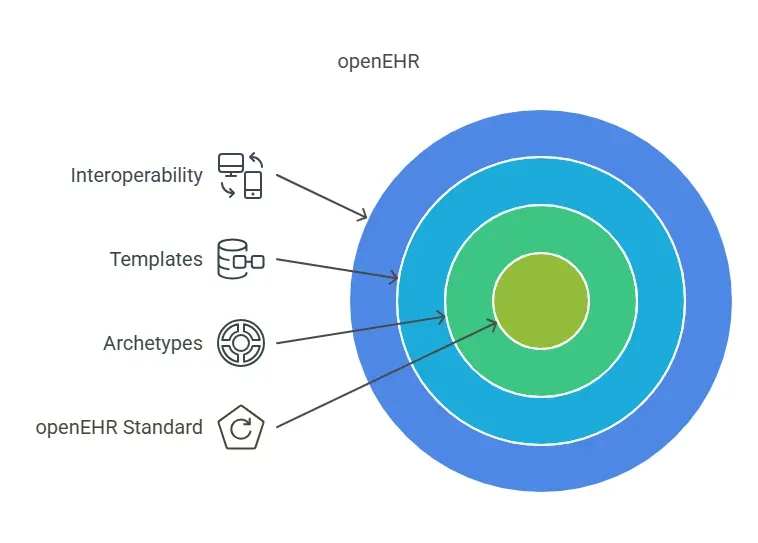
OpenEHR is an open standard specification designed to facilitate the management, storage, and exchange of healthcare data in a structured way. It emphasizes the use of archetypes and templates to represent clinical concepts and organize healthcare data.
By doing so, openEHR aims to ensure that health data is easily accessible, reusable, and interoperable across different systems, institutions, and regions.
The Key Concepts Behind openEHR
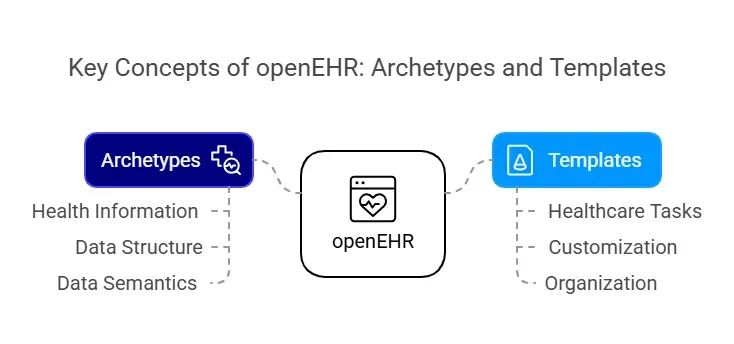
At the heart of openEHR are two main concepts: archetypes and templates. These serve as building blocks for how healthcare information is stored and shared within the system.
Archetypes
These represent individual pieces of health information, such as a patient's pulse rate, blood pressure, or Glasgow Coma Scale (GCS) score. Archetypes define the structure and semantics of data points in a standardized way, ensuring consistency in data collection.
Templates
A template is a higher-level construct that brings together multiple archetypes. It represents a collection of archetypes needed for specific healthcare tasks. For example, an emergency department's patient assessment form might include archetypes for vital signs, GCS, and other relevant clinical data. Templates allow developers to customize and organize archetypes based on the specific needs of healthcare providers.
The Power of Archetypes and Templates
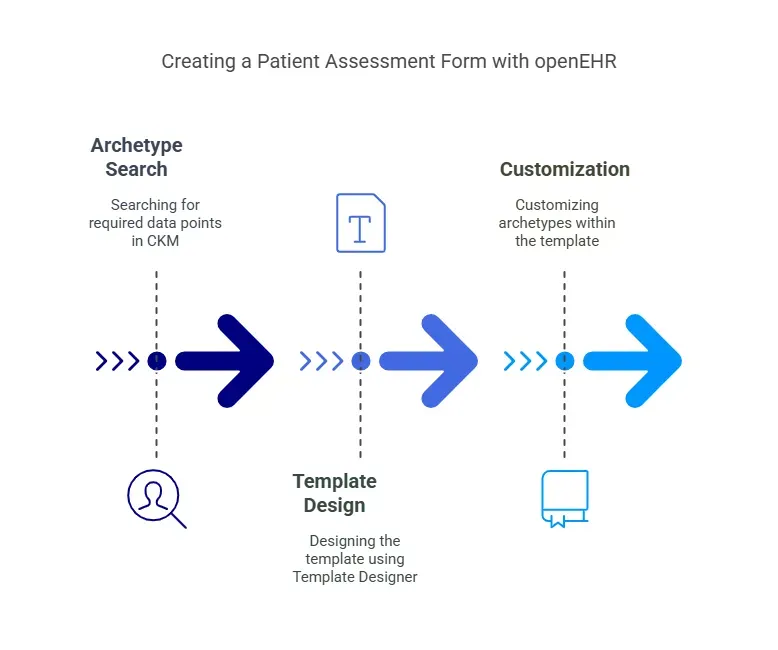
Imagine you're tasked with developing a patient assessment form for an emergency department at a hospital. Traditionally, you would manually code the form based on the requirements provided. However, with openEHR, this process is simplified and more structured.
Archetype Search
First, you search for the required data points, such as "pulse rate" or "GCS," in the Clinical Knowledge Manager (CKM) of openEHR. These data points are pre-defined archetypes, which you can select and reuse across various templates.
Template Design
Next, using tools like the Template Designer on tools.openehr.org, you create a template for the assessment form by dragging and dropping the relevant archetypes (pulse, GCS, etc.) into the workspace. This template forms the blueprint of how data will be collected and stored for patient assessments.
Customization
You can further customize each archetype within the template. For instance, if a particular archetype needs to be collected more than once (like repeated pulse checks), you can adjust the occurrence parameter. Unnecessary fields can be removed to streamline the form.
How to Use OpenEHR in Healthcare Software Development
To use openEHR effectively in your healthcare software development:
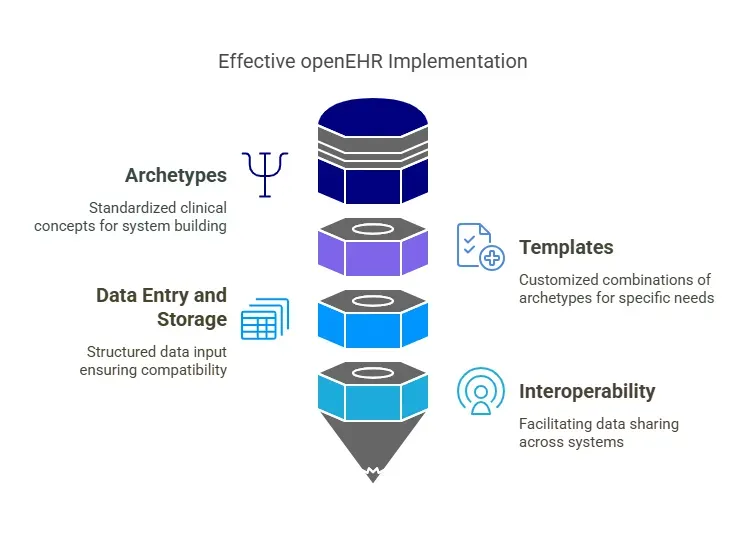
Start with the Archetypes
Use the openEHR Clinical Knowledge Manager to identify and select archetypes relevant to your healthcare application. Archetypes are standardized and reusable, making it easy to build systems based on existing clinical concepts.
Create Templates
Use the Template Designer tool to combine archetypes into cohesive templates tailored to the specific clinical needs. For example, if you're building an EHR module for emergency care, include relevant archetypes like GCS, vital signs, and patient history.
Data Entry and Storage
Once the templates are built, they can be implemented within your software system. As data is entered by healthcare providers, it is structured based on the templates, ensuring a uniform format that is compatible across different systems.
Ensure Interoperability
Since openEHR focuses on interoperability, your software system will be able to share data with other openEHR-compliant systems, which is essential for continuity of care and patient record management.
Advantages of OpenEHR in Healthcare Software
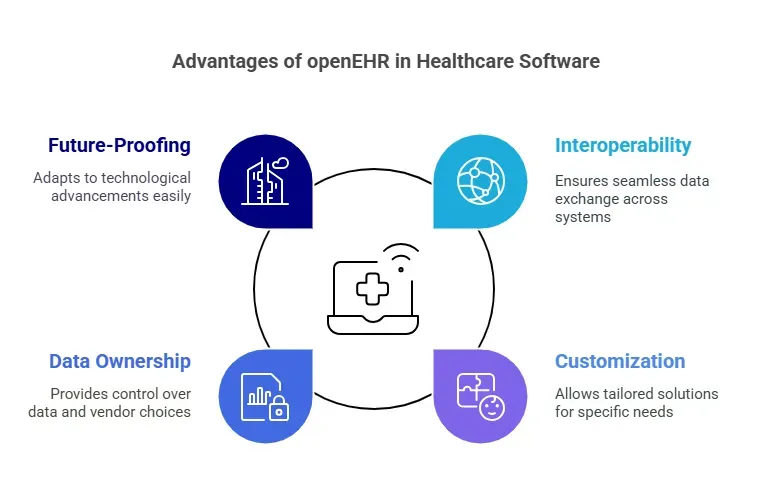
Interoperability
Since data is stored using standardized archetypes and templates, it becomes easy to migrate and share information across different healthcare systems and platforms. For example, when a hospital switches its EHR system, the data remains compatible because of its openEHR-compliant structure.
Customization without Complexity
Developers can quickly build customized templates for different clinical settings without starting from scratch every time. This flexibility allows for healthcare solutions tailored to the exact needs of individual departments or hospitals.
Data Ownership and Control
Hospitals maintain full control over their data, even when switching vendors or systems. This ensures that healthcare providers are not locked into proprietary data storage formats, leading to better competition in terms of pricing and features among software vendors.
Future-Proof Systems
By separating data from software, openEHR enables the creation of more sustainable and scalable health systems. The data can easily adapt to new technologies and systems without needing constant restructuring, making it easier to stay ahead of technological advancements.
OpenEHR Challenges
1. Adoption Barriers
- High Initial Effort: Migrating data from traditional EHRs to openEHR can be time-consuming.
- Resistance to Change: Staff may prefer familiar systems unless the benefits are clear.
- Integration Issues: Existing proprietary EHRs may not easily connect with openEHR.
- Limited Local Support: Few experts in some regions can slow adoption.
2. Training & Learning Curve
- Hands-on Workshops: Practical exercises help IT teams learn effectively.
- Online Training: Platforms like openEHR docs, Coursera, and YouTube tutorials assist self-paced learning.
- Expert Collaboration: Consultants can guide implementation and reduce trial-and-error.
- Start Small: Begin with one department before scaling across the organization.
Customization Complexity
While openEHR allows flexible data management, this can make it more complex than traditional EHRs. Hospitals must balance customization with usability.
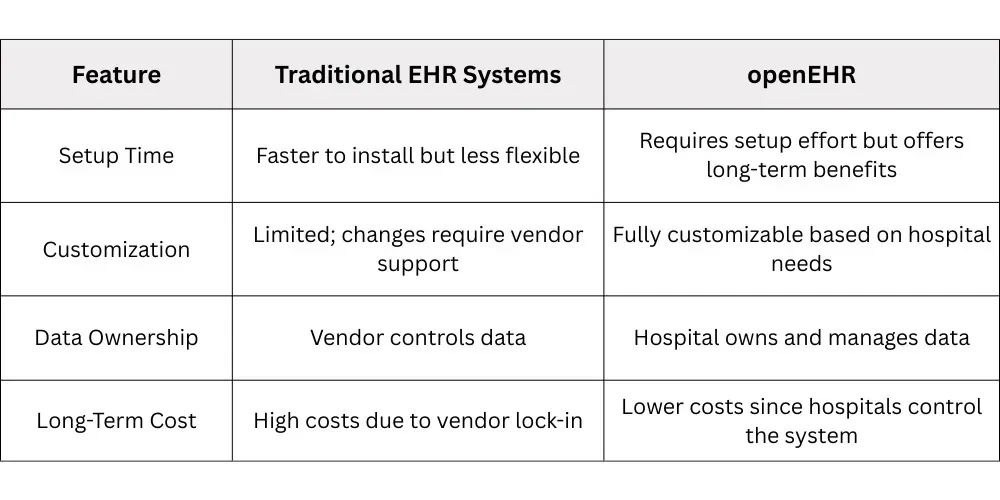
Overall, openEHR takes more effort to set up, but once implemented, it gives hospitals greater control and flexibility over patient data.
Emerging Applications of openEHR
A major advantage of openEHR is its support for advanced technologies like AI and personalized healthcare. Because it stores data in a structured, standardized way, AI models can process information accurately, reducing errors and improving reliability. This ensures AI-driven tools are trustworthy and useful for both doctors and patients.
Beyond AI, openEHR enables personalized healthcare solutions. For example, apps can use patient history and lifestyle data to create customized activity plans rather than generic advice, delivering care tailored to each individual.
By supporting AI integration and personalized solutions, openEHR is helping hospitals and developers build smarter, patient-focused digital health tools that improve outcomes and efficiency.
Conclusion
openEHR presents a smarter, more efficient approach to managing healthcare data. By separating the clinical content from the software through reusable archetypes and templates, developers can build systems that are both flexible and future-proof.
The openEHR framework allows healthcare institutions to maintain control over their data while ensuring that it remains interoperable across systems, ultimately enhancing patient care.
Struggling with healthcare data exchange? Our Healthcare Interoperability Solutions practice helps organizations connect clinical systems at scale. We also offer specialized Custom Healthcare Software Development services. Talk to our team to get started.