AI Wellness Diagnostics: 90-Parameter Facial Analysis Deployed Across 15 Stations in Singapore
Executive Summary
A wellness chain in Singapore wanted to bring health assessment to the masses — without blood draws, doctor visits, or expensive lab work. Their vision: AI-powered wellness stations deployed in shopping malls, office buildings, and gyms where anyone can get an instant health assessment by simply looking at a camera for 90 seconds.
We built an AI facial wellness analysis platform that captures a high-resolution facial image, analyzes 90 distinct facial parameters across skin health, eye vitality, hydration levels, stress indicators, complexion uniformity, and facial symmetry using computer vision and machine learning. The system generates an instant wellness report with scores, trends, and personalized recommendations.
The platform runs on 15 wellness stations across Singapore — in malls, corporate offices, and fitness centers — processing 2,400+ scans per month with a model trained on 50,000+ diverse facial images.

The Problem: Wellness Assessment Is Expensive and Inaccessible
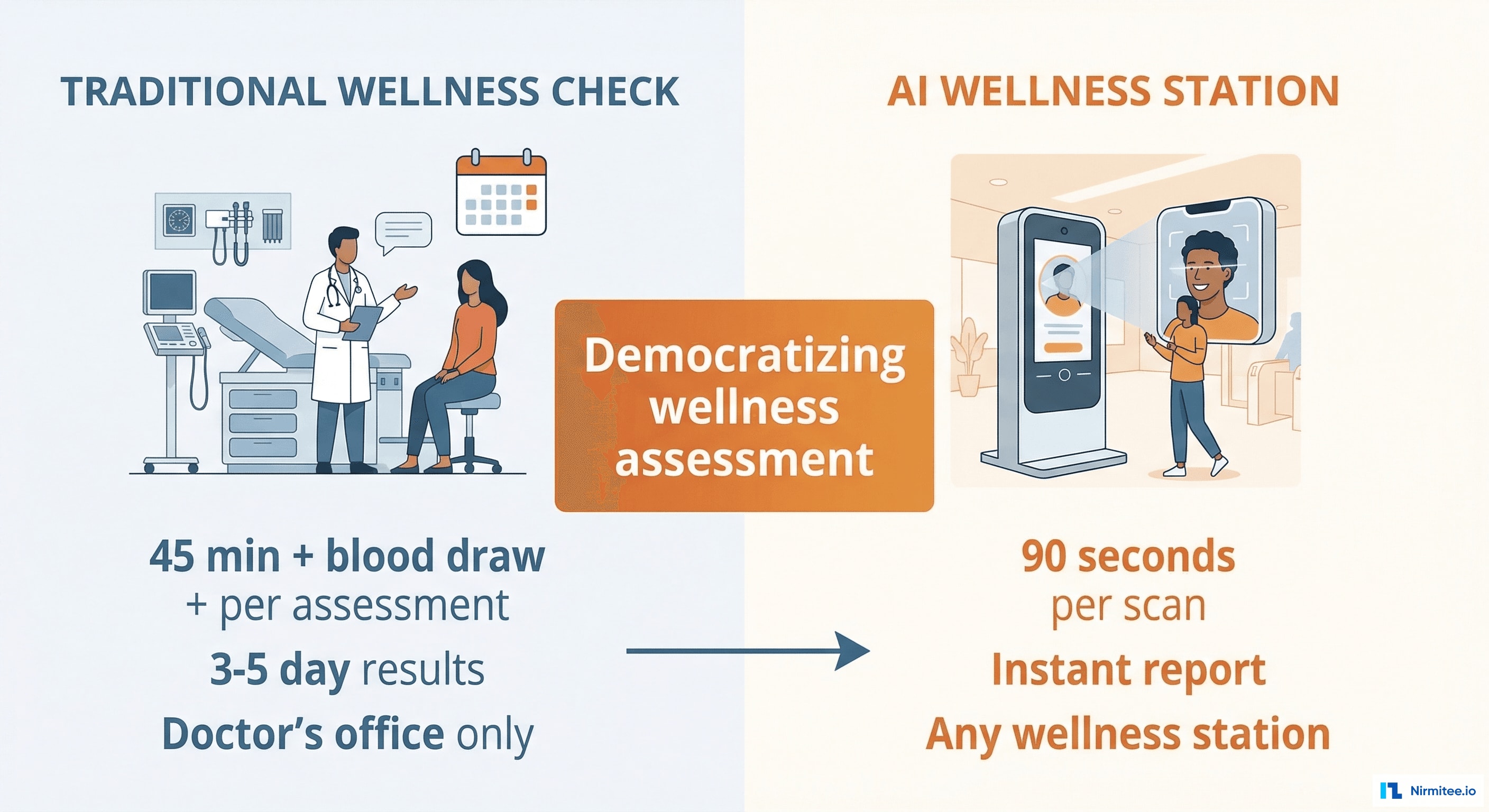
- Traditional wellness checks: $200+, blood draw required, 45-minute doctor visit, results in 3-5 days — most people simply don't do them regularly
- No continuous monitoring: annual checkups miss gradual changes. A person's skin health, hydration, and stress levels change weekly — but they're only assessed once a year (if ever)
- Clinical setting barrier: you need to visit a doctor's office during business hours. Working professionals skip it.
- No personalized tracking: even those who get annual checkups have no way to track wellness trends between visits
The opportunity: bring affordable, instant, non-invasive wellness assessment to where people already are — malls, offices, gyms.
Wellness Station Kiosk
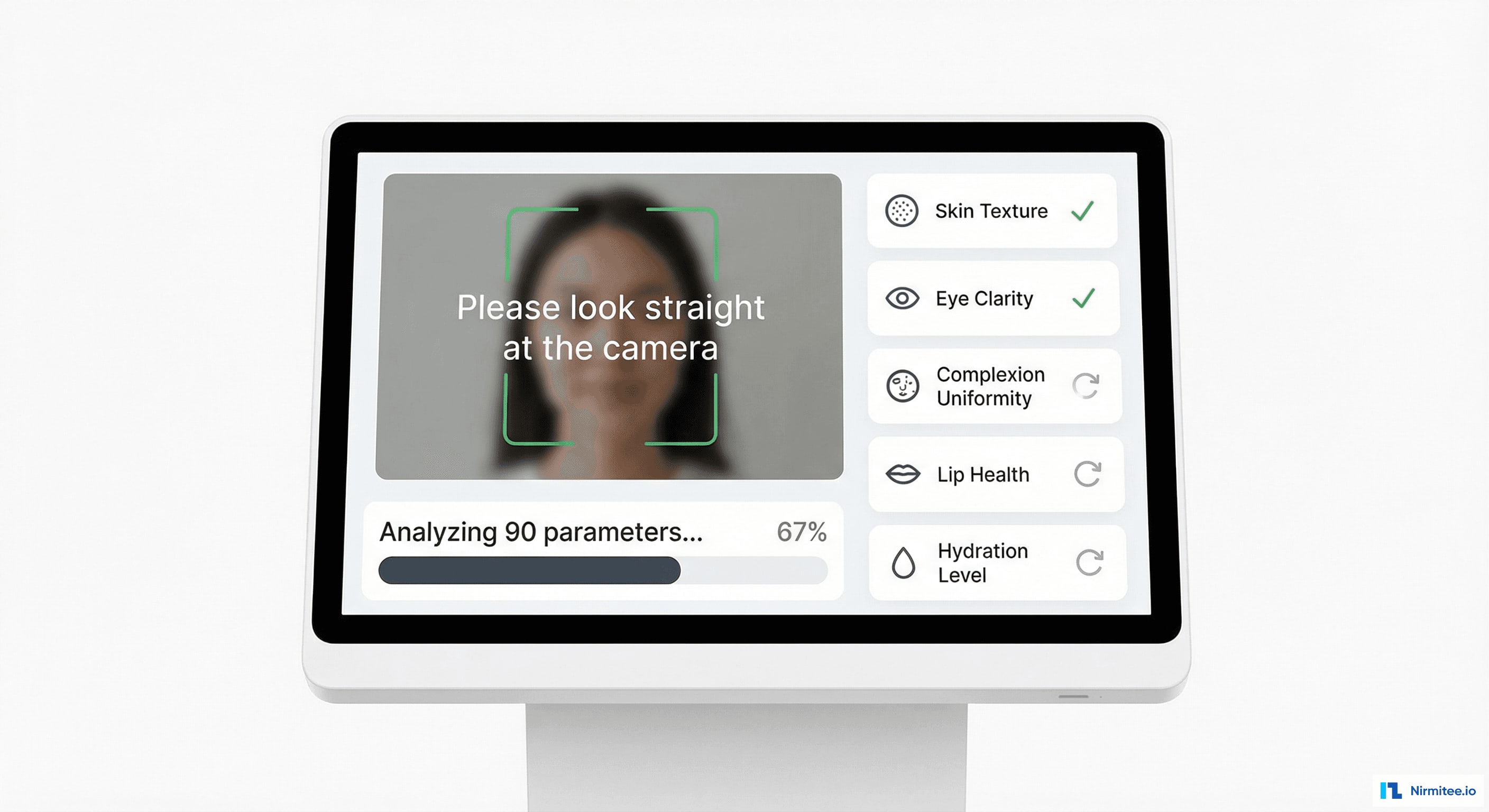
The kiosk experience is designed for public use in under 2 minutes:
- Register: new users create an account (phone number + basic demographics). Returning users scan QR code.
- Position: face detection guide helps user center their face at the correct distance and angle
- Scan: high-resolution camera with controlled LED lighting captures facial image (90 seconds of analysis)
- Results: instant wellness report displayed on screen with option to save to mobile app
The kiosk uses a high-resolution medical-grade camera with ring light to ensure consistent image quality regardless of ambient lighting in malls or offices.
Health Report

The instant report covers 6 wellness categories:
| Category | Parameters | What It Measures |
|---|---|---|
| Skin Health | 18 | Texture, pore size, pigmentation uniformity, blemishes, wrinkle depth, elasticity indicators |
| Eye Vitality | 16 | Sclera clarity, under-eye circles, puffiness, redness, moisture level, pupil responsiveness |
| Hydration | 12 | Skin moisture level across zones, lip dryness, overall dehydration markers |
| Stress Indicators | 14 | Facial tension patterns, jaw clenching signs, forehead furrow depth, asymmetric stress responses |
| Complexion | 18 | Color uniformity, sun damage indicators, vascular patterns, overall radiance score |
| Facial Symmetry | 12 | Left-right symmetry ratios, alignment markers, structural balance |
Each category scored 0-100 with color-coded status. Personalized recommendations based on the specific parameters that need improvement.
Architecture
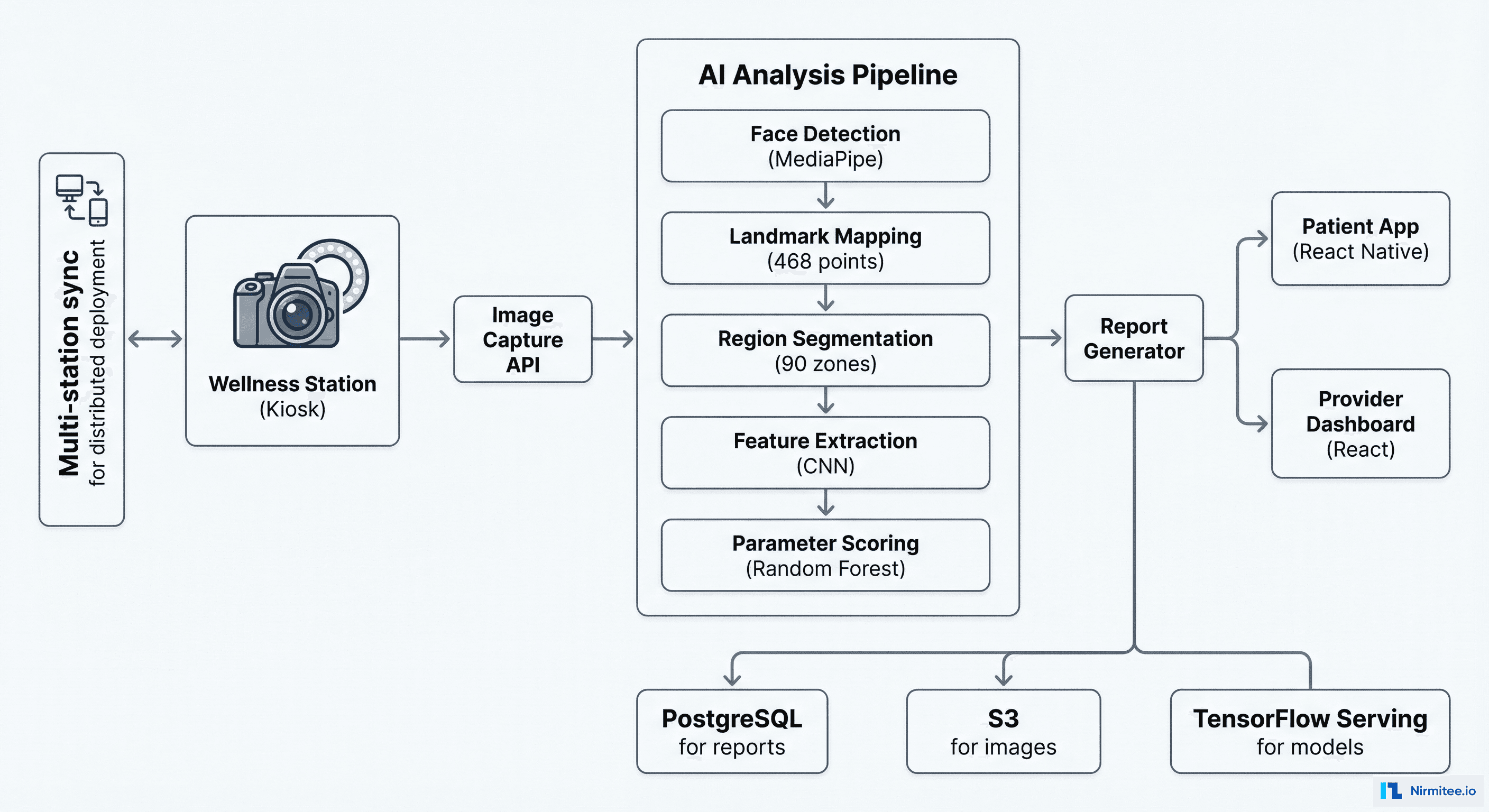
AI Pipeline
- Face Detection (MediaPipe): locates face in frame, rejects images with poor positioning or multiple faces
- Landmark Mapping: identifies 468 facial landmarks for precise region segmentation
- Region Segmentation: divides face into 90 analysis zones based on landmarks
- Feature Extraction (CNN): custom convolutional neural network extracts visual features from each zone — texture patterns, color distributions, structural characteristics
- Parameter Scoring (Random Forest + Gradient Boosting): extracted features scored against trained models for each of the 90 parameters
- Report Generation: scores aggregated into categories, compared to population norms (age/gender-adjusted), recommendations generated
Technology Stack
| Component | Technology |
|---|---|
| Kiosk Software | Electron (desktop app for kiosk hardware) |
| Mobile App | React Native (patient wellness tracking) |
| Station Dashboard | React (operator management) |
| Backend | Python (FastAPI) for AI pipeline, Node.js for business logic |
| AI/ML | TensorFlow (CNN), MediaPipe (face detection), scikit-learn (scoring) |
| Model Serving | TensorFlow Serving (GPU instances) |
| Database | PostgreSQL (reports, users), S3 (facial images encrypted) |
| Infrastructure | AWS Singapore region (data residency compliance) |
90-Parameter Facial Zone Map
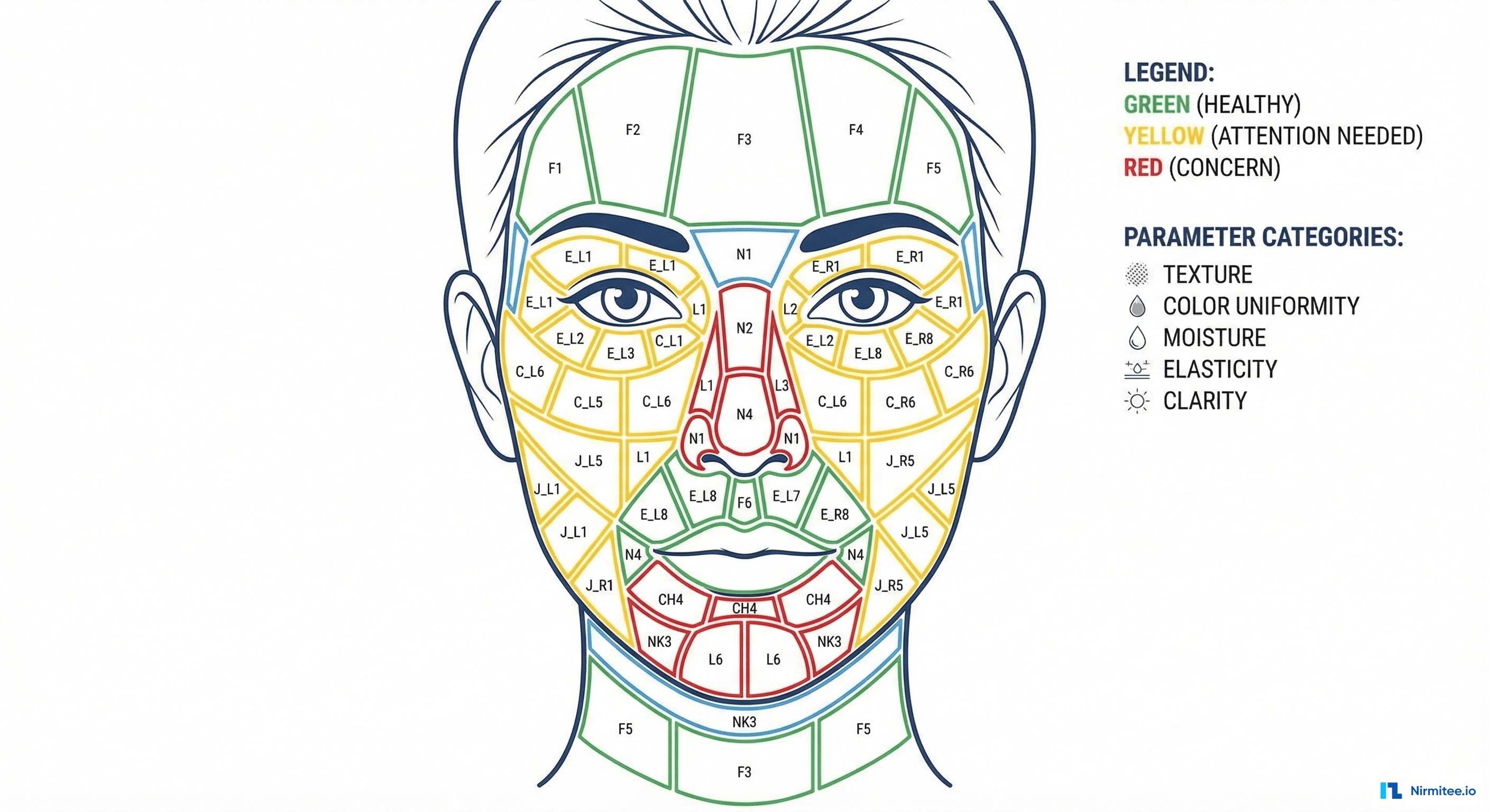
The face is divided into 90 distinct analysis zones, each measuring specific health indicators. This precision allows the system to identify localized issues — like dehydration predominantly in the under-eye area, or stress tension concentrated in the jaw and forehead.
Wellness Trend Tracking

Returning users see their wellness trajectory over time — showing which categories improved (hydration +15 after increasing water intake) and which declined (eye vitality -3 during a stressful work period). The trend data is more valuable than any single scan.
Station Management
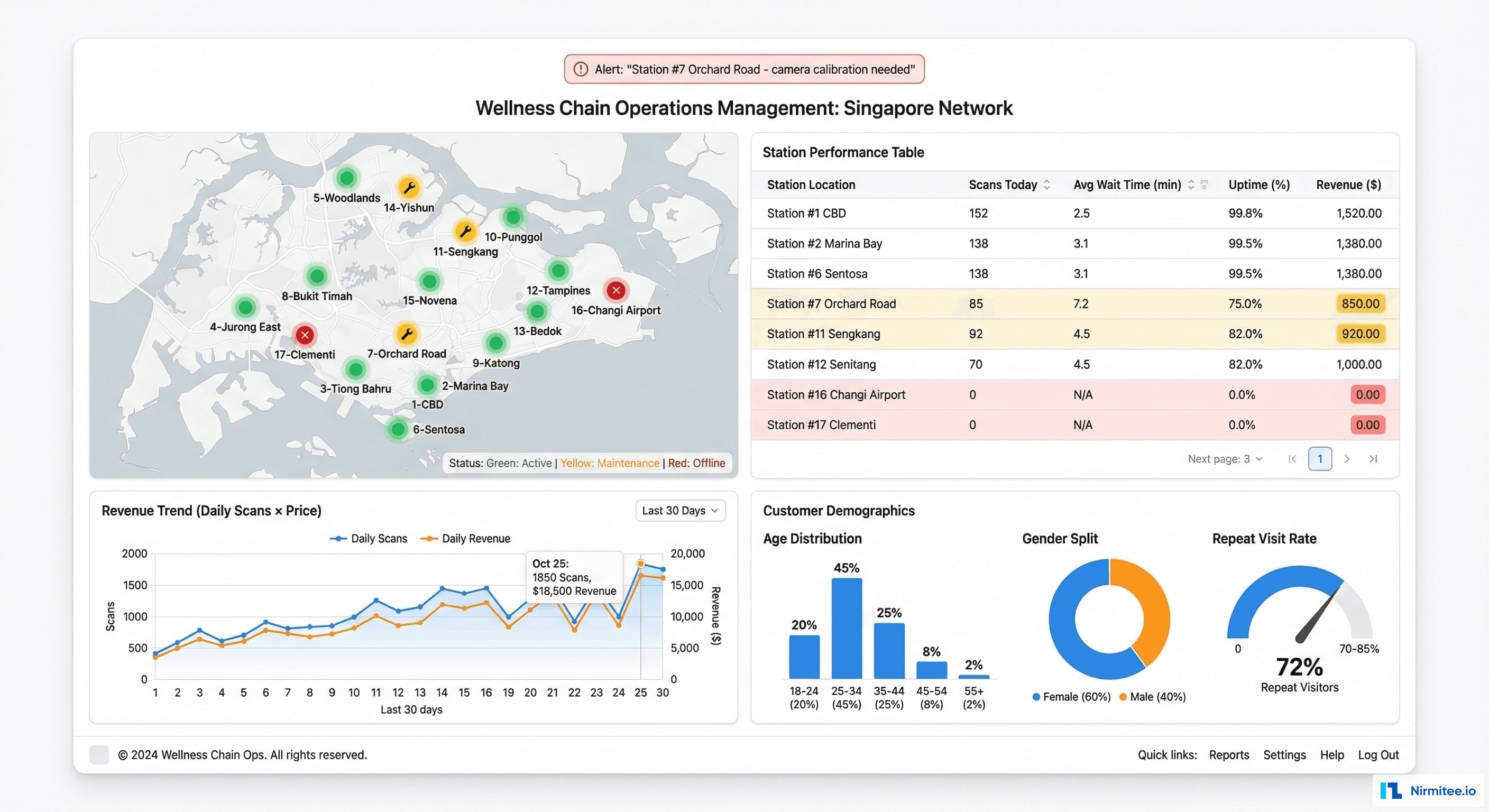
The operator dashboard manages the 15-station network across Singapore: station uptime, daily scan volumes, camera calibration status, revenue tracking, and maintenance scheduling. Alerts for offline stations or calibration drift ensure consistent quality across all locations.
AI Model Performance
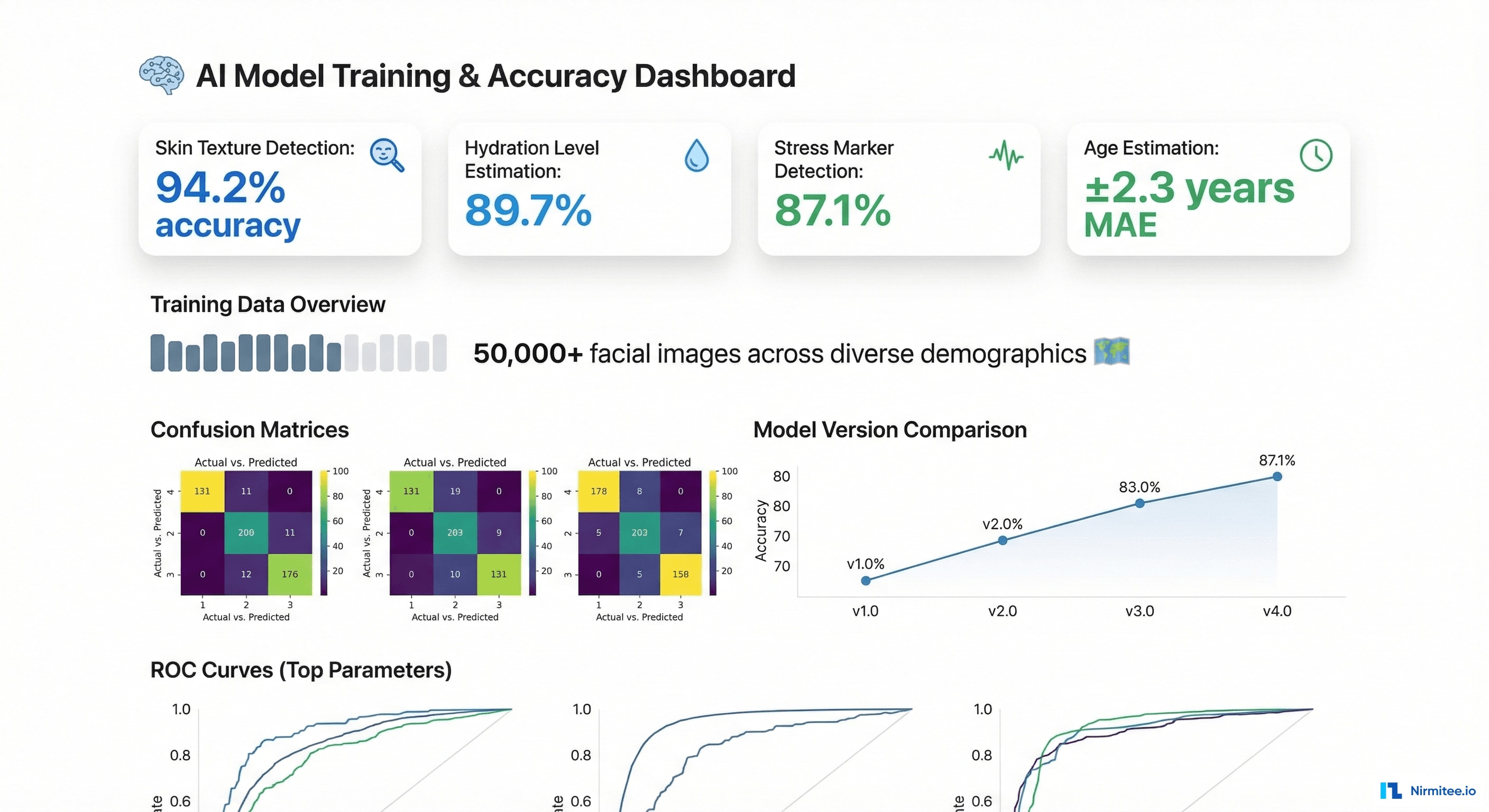
Model accuracy across key parameters: Skin Texture Detection 94.2%, Hydration Estimation 89.7%, Stress Marker Detection 87.1%, Age Estimation ±2.3 years MAE. Trained on 50,000+ facial images across diverse demographics (age, ethnicity, gender) for equitable performance.
Results
| Metric | Result |
|---|---|
| Stations deployed | 15 across Singapore (malls, offices, gyms) |
| Monthly scans | 2,400+ |
| Scan time | 90 seconds (vs. 45 min traditional wellness check) |
| Cost per scan | $15 SGD (vs. $200+ for clinical assessment) |
| Parameters analyzed | 90 per scan |
| Model accuracy (avg) | 91.2% across all parameters |
| Repeat visit rate | 64% (users return for trend tracking) |
| Training dataset | 50,000+ images (diverse demographics) |
| Report delivery | Instant (on-screen + mobile app) |
Timeline
| Phase | Duration | Deliverables |
|---|---|---|
| Phase 1 | 8 weeks | AI model training (50K images), face detection + landmark mapping, kiosk prototype, basic scoring for 30 parameters |
| Phase 2 | 6 weeks | Full 90-parameter model, report generation, mobile app, operator dashboard |
| Phase 3 | 4 weeks | Kiosk hardware integration, LED lighting calibration, pilot with 3 stations |
| Phase 4 | 4 weeks | Network expansion to 15 stations, model tuning on Singapore population data, public launch |
Total: 5.5 months with 2 ML engineers + 2 full-stack engineers + 1 hardware integration specialist.
Lessons Learned
- Lighting is everything. Ambient lighting in malls varies dramatically by location and time of day. The ring light on each kiosk ensures consistent illumination — model accuracy dropped 15% without it.
- Demographic diversity in training data is non-negotiable. Singapore's population is ethnically diverse (Chinese, Malay, Indian, Eurasian). Our initial model trained primarily on one demographic performed poorly on others. Balanced training data fixed this — fairness testing is now part of every model release.
- Trends are the real product. A single scan score is interesting. A trend over 6 months is actionable. Users who see improvement stay engaged. Users who see decline take action. The trend tracking drove 64% repeat visits.
- Privacy by design. Facial images are sensitive data. Images are encrypted at rest, processed in-memory, and deleted within 24 hours of report generation (unless user explicitly opts in to photo storage for trend comparison). Singapore's PDPA compliance was built in from day 1.
Was this case study helpful?