B2B Medical Supply Marketplace: Direct-to-Hospital Sales Platform with Automated Procurement
Executive Summary
A US-based medical device manufacturer specializing in syringes and injection systems needed a direct sales channel to hospitals and clinics. Their existing sales model relied on distributors who took 30-40% margins, offered no visibility into end-customer needs, and created a 2-3 week procurement cycle. The manufacturer wanted to sell directly — both B2B (hospitals, clinics, surgery centers) and B2C (home health, individual practitioners).
We built a full B2B and B2C medical supply marketplace — product catalog with tiered pricing, hospital procurement portal with contract pricing and auto-reorder, manufacturer seller dashboard with inventory management, supply chain tracking, integrated payments (Stripe), and EDI integration for enterprise buyers.
Results: $340K/year in procurement cost savings for hospital buyers, order-to-shipment time reduced from 3 days to 4 hours, and the manufacturer captured 35% higher margins by selling direct.

The Problem: Healthcare Procurement Is Stuck in the 1990s
Medical supply procurement in most US hospitals still works like this:
- Phone and fax ordering: materials management staff call or fax orders to 5-10 different distributors
- No price transparency: hospitals don't know if they're getting the best price. Contract rates buried in PDFs. No real-time comparison.
- 3-day average procurement cycle: from identifying need to shipment. Emergency orders at 15-25% premium.
- Distributor margins eat 30-40%: the manufacturer sells at $X, the distributor marks up to $1.4X, the hospital pays $1.4X. The manufacturer gets less. The hospital pays more. Only the middleman wins.
- Manual inventory management: supply rooms checked visually. Reorders placed when someone notices supplies are low — often too late, triggering expensive emergency orders.
Product Catalog

The product catalog brings Amazon-level search and filtering to medical supplies:
- 847 products across categories: syringes, needles, IV supplies, PPE, surgical instruments, diagnostic equipment
- Tiered bulk pricing: price breaks at 10, 50, 100, and 500+ units — transparent on every product card
- Contract pricing: hospital buyers with negotiated contracts see their special rates automatically applied
- Advanced filtering: by category, manufacturer, FDA clearance status, sterility, gauge/size, packaging type
- Product detail pages: specifications, certifications, SDS documents, FDA 510(k) numbers, compliance documentation
Order Management

The operations dashboard gives the manufacturer complete order lifecycle visibility.
Architecture
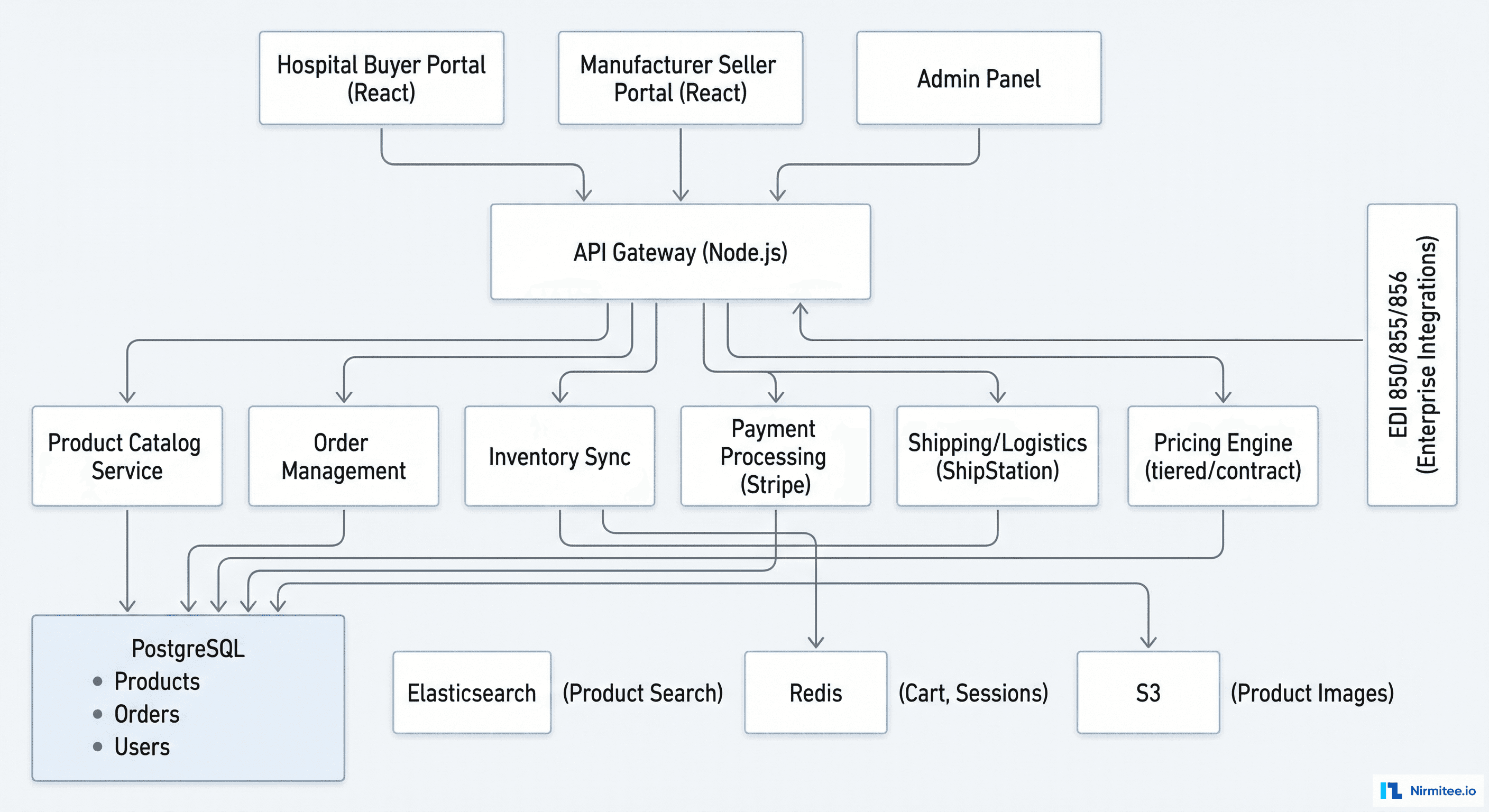
Technology Stack
| Layer | Technology | Purpose |
|---|---|---|
| Buyer Portal | React + TypeScript | Hospital procurement, catalog, ordering |
| Seller Portal | React | Manufacturer inventory, orders, analytics |
| Admin Panel | React | Platform ops, user management, pricing rules |
| Backend | Node.js (Express) | API gateway, business logic, order orchestration |
| Database | PostgreSQL | Products, orders, users, contracts |
| Search | Elasticsearch | Product search with faceted filtering |
| Payments | Stripe (Connect) | Multi-party payments, invoicing, net terms |
| Shipping | ShipStation API | Rate shopping, label gen, tracking |
| EDI | Custom (850/855/856) | Enterprise PO, acknowledgment, ASN |
| Infrastructure | AWS | Auto-scaling, CDN for product images |
Hospital Buyer Portal

Hospital procurement teams get a purpose-built buying experience:
- Quick reorder: one-click reorder of frequently purchased items at the same quantity and pricing
- Contract pricing: negotiated rates automatically applied — savings vs. list price highlighted in green on every product
- Budget tracking: department spending vs. allocated budget in real-time
- Approval workflows: orders above threshold ($5K default) require manager approval before processing
- Purchase history: complete order history with reorder, return, and invoice access
Supply Chain Tracking

Every order tracked from placement through delivery with GPS-enabled carrier tracking.
Manufacturer Seller Dashboard
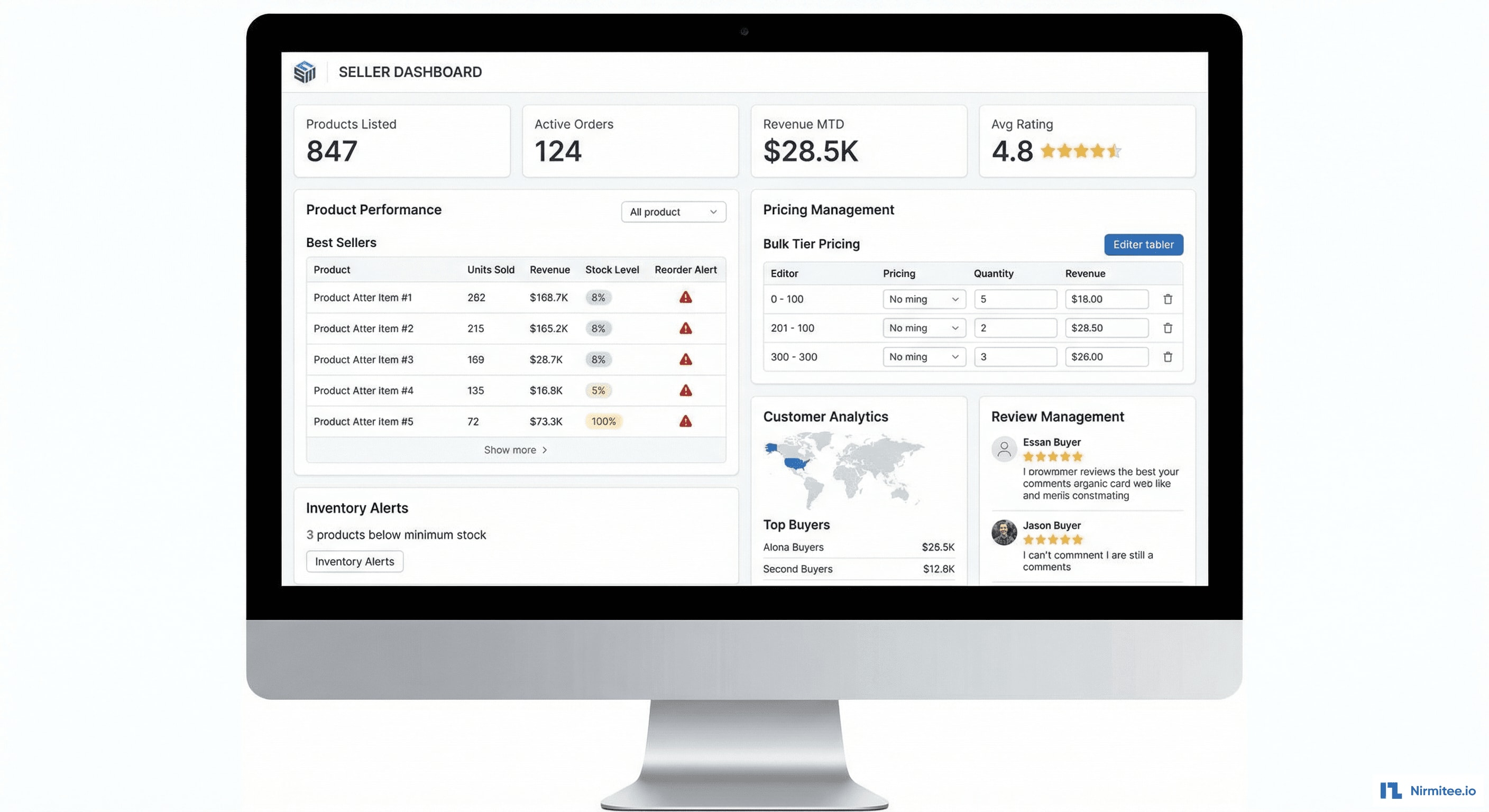
The manufacturer manages their entire direct sales channel from one dashboard — product listings, pricing tiers, inventory levels, order fulfillment, customer analytics, and review management.
Automated Reordering

The platform's automated reordering eliminates emergency orders:
- Par level monitoring: when supply room inventory drops below configured threshold, auto-generates a reorder at contract pricing
- Approval queue: auto-orders go to the procurement team for one-click approval — not fully autonomous, but removes the manual monitoring step
- Consumption forecasting: ML-based prediction of usage rates, alerting before stockouts based on historical consumption patterns
- Cost savings tracking: "Auto-reorder saved $47,000 vs. emergency ordering last quarter" — quantified ROI visible to CFO
Results
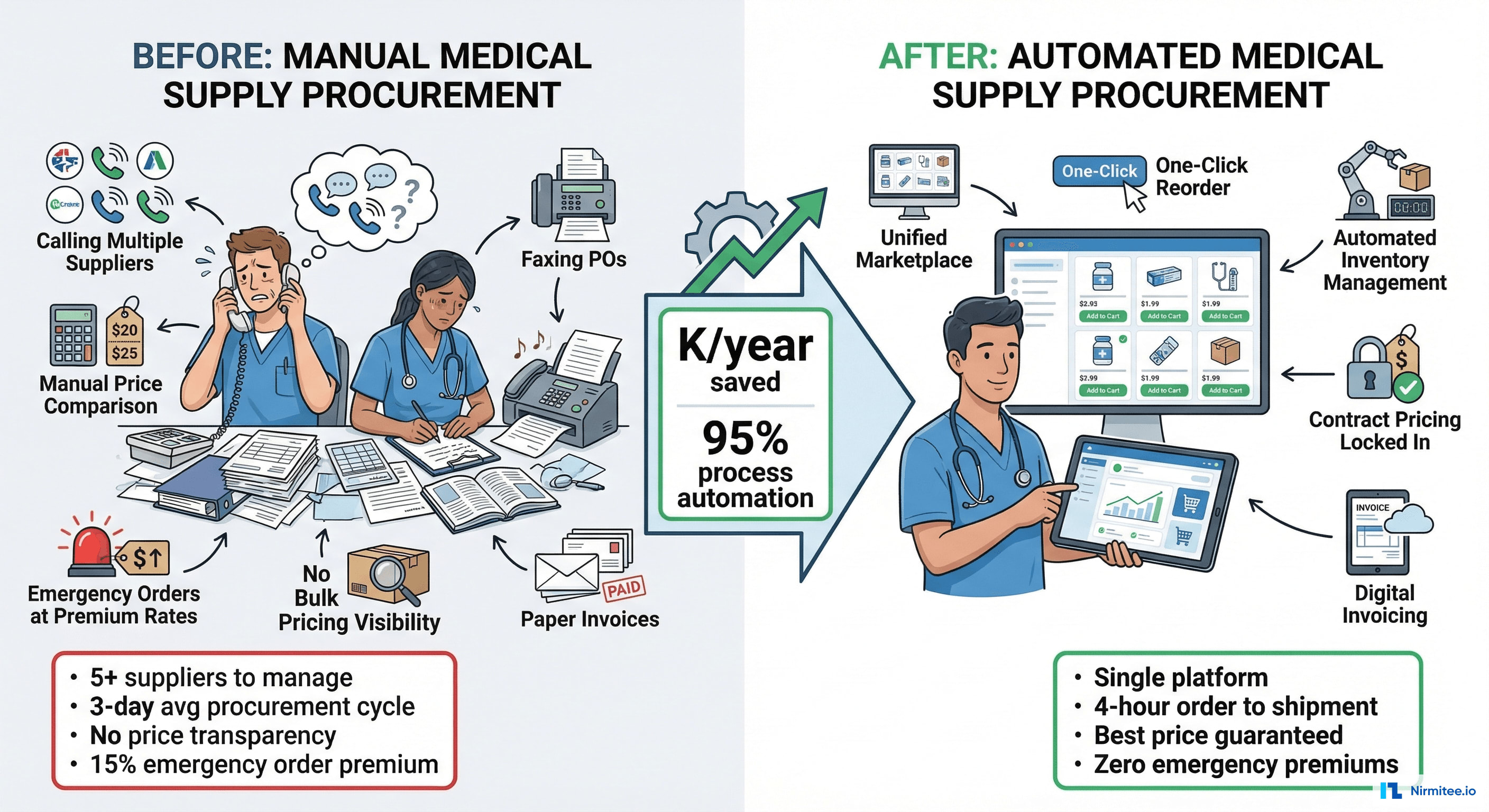
| Metric | Before | After | Impact |
|---|---|---|---|
| Order-to-shipment time | 3 days | 4 hours | 94% faster |
| Procurement cost (hospital) | Distributor markup 30-40% | Direct pricing (contract rates) | $340K/year saved per large hospital |
| Manufacturer margin | 60-70% (after distributor) | 95-100% (direct) | 35% higher margin |
| Emergency order rate | 12% of all orders | 1.8% | 85% reduction |
| Products listed | Paper catalog | 847 searchable products | Digital-first |
| Procurement staff time | 20 hrs/week on ordering | 3 hrs/week | 85% time saved |
| On-time delivery rate | ~82% | 96.3% | 17% improvement |
| Buyer hospitals onboarded | N/A | 180+ facilities | Growing marketplace |
Timeline
| Phase | Duration | Deliverables |
|---|---|---|
| Phase 1 | 6 weeks | Product catalog, buyer registration, cart/checkout, Stripe payments, basic seller dashboard |
| Phase 2 | 6 weeks | Contract pricing engine, approval workflows, order management, ShipStation integration, tracking |
| Phase 3 | 4 weeks | Automated reordering, inventory management, consumption forecasting, EDI integration |
| Phase 4 | 4 weeks | Analytics dashboards, B2C storefront, mobile-responsive optimization, pilot with 20 hospitals |
Total: 5 months with 4 engineers + 1 product manager.
Lessons Learned
- Contract pricing is the moat. Hospitals won't switch from their distributor unless the pricing is demonstrably better AND locked in via contract. The contract pricing engine was the single most important feature for hospital adoption.
- Procurement approval workflows are non-negotiable. Hospitals have purchasing authority limits. Without built-in approval routing, the platform is unusable for institutional buyers. We almost shipped without it — glad we didn't.
- EDI isn't dead. Large hospital systems (500+ beds) still use EDI 850 for purchase orders. Supporting EDI alongside the web portal was essential for enterprise adoption. Not glamorous, but necessary.
- Auto-reorder drives retention. Hospitals that enable auto-reorder have 94% retention. Those that don't: 71%. Once the supply chain is automated, switching costs become high — this is the platform's stickiest feature.
Was this case study helpful?