HIPAA Compliance Automation: From 14 Spreadsheets to Continuous Compliance with SOC 2 Type II in 4 Months
Executive Summary
A healthcare SaaS company with 342 employees handling PHI for 45+ hospital clients was managing HIPAA compliance through spreadsheets, annual audits, and a binder of policies that nobody read. Their compliance officer spent 60% of their time on manual evidence collection and tracking. When their largest hospital client required SOC 2 Type II certification as a contract condition, they realized their manual approach wouldn't scale.
We built a HIPAA compliance automation platform — continuous monitoring of access controls, encryption, and audit logs; automated risk assessments; BAA lifecycle management; employee training tracking; incident response workflows; and evidence collection for SOC 2 audits. All in one platform that replaced 14 spreadsheets and 3 separate tools.
Results: compliance score improved from 72% to 94%, SOC 2 Type II achieved in 4 months (vs. 12-month industry average), and the compliance officer reclaimed 25 hours/week from manual tracking.

The Problem: Compliance by Spreadsheet
- 14 spreadsheets tracking different compliance domains — access controls in one, BAAs in another, training in a third, risk assessment in a fourth
- Annual risk assessment only: gaps discovered once a year, 11 months to accumulate new risks before the next review
- Paper BAA management: 47 vendor agreements tracked in a shared drive folder. Expiration dates managed by calendar reminders (sometimes missed)
- Manual audit trails: access logs existed in AWS CloudTrail and the application, but nobody reviewed them unless an incident occurred
- Training tracked in email: "Did you complete your HIPAA training?" — answered by searching email for completion certificates
- Incident response on the fly: no documented workflow. When a potential breach occurred, the team improvised — leading to inconsistent handling and documentation gaps
Compliance Dashboard
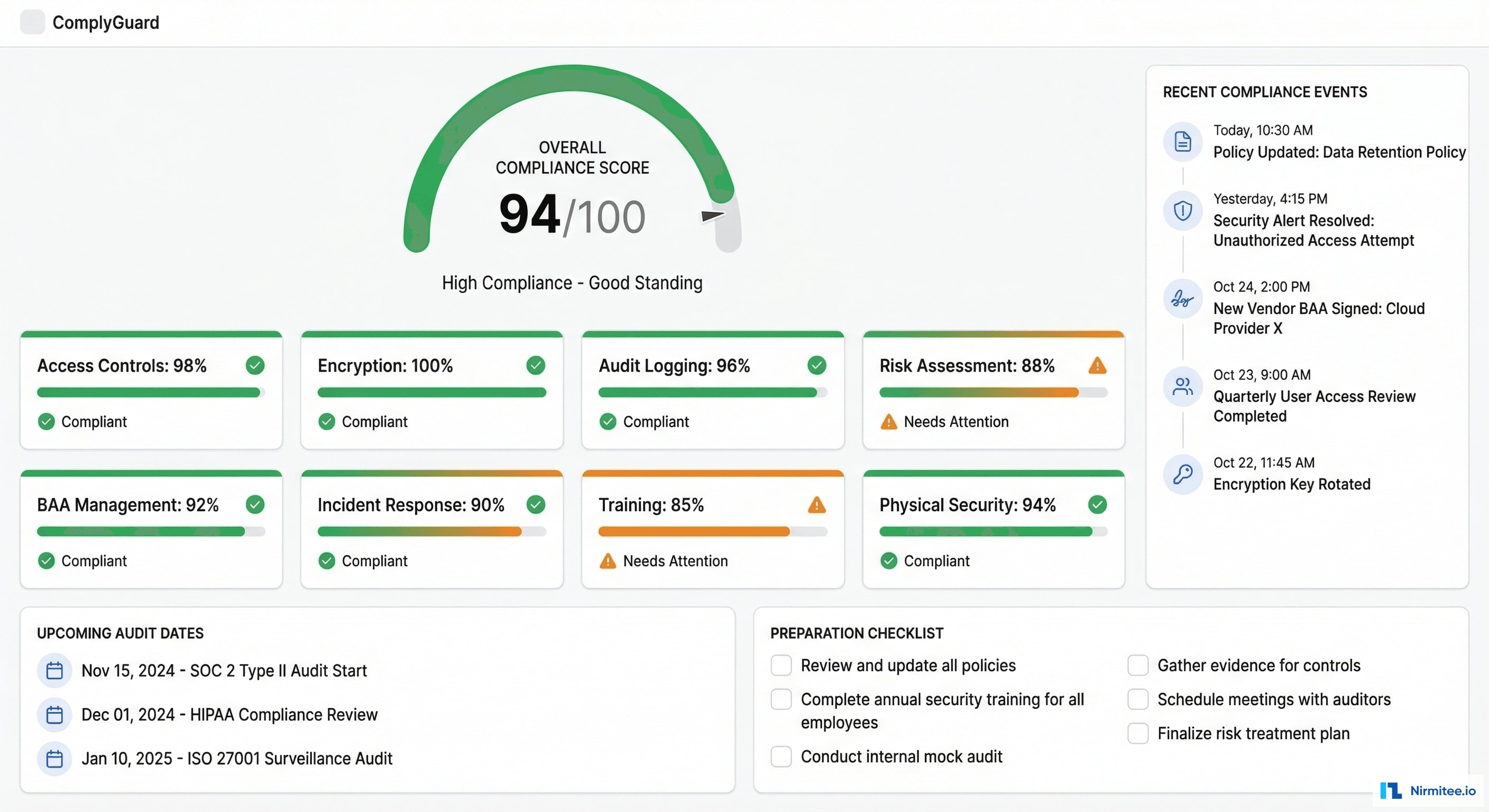
The compliance dashboard provides a single view of the organization's HIPAA posture: overall score (94/100), category-level scores for access controls, encryption, audit logging, risk assessment, BAA management, incident response, training, and physical security. Each category drills down to specific controls with evidence status.
Audit Trail Monitoring
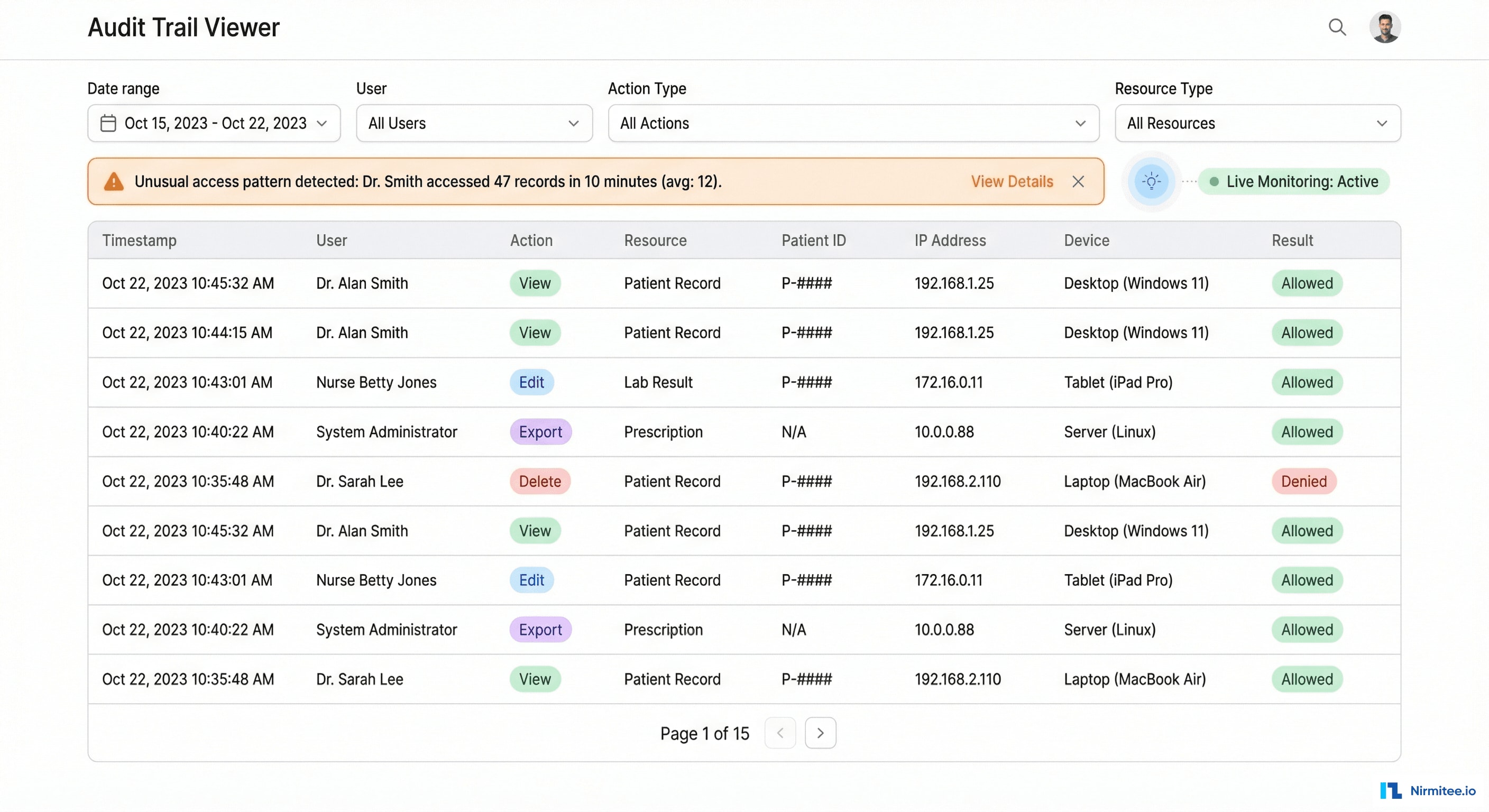
Real-time access monitoring with anomaly detection:
- Every PHI access logged: who, what, when, where, how
- Anomaly detection flags unusual patterns: "Dr. Smith accessed 47 records in 10 minutes (avg: 12)" — potential unauthorized access or legitimate batch review, either way needs investigation
- Failed access attempts tracked: repeated denied access attempts may indicate credential compromise
- Exportable audit reports for OCR (Office for Civil Rights) inquiries — one-click generation
Architecture
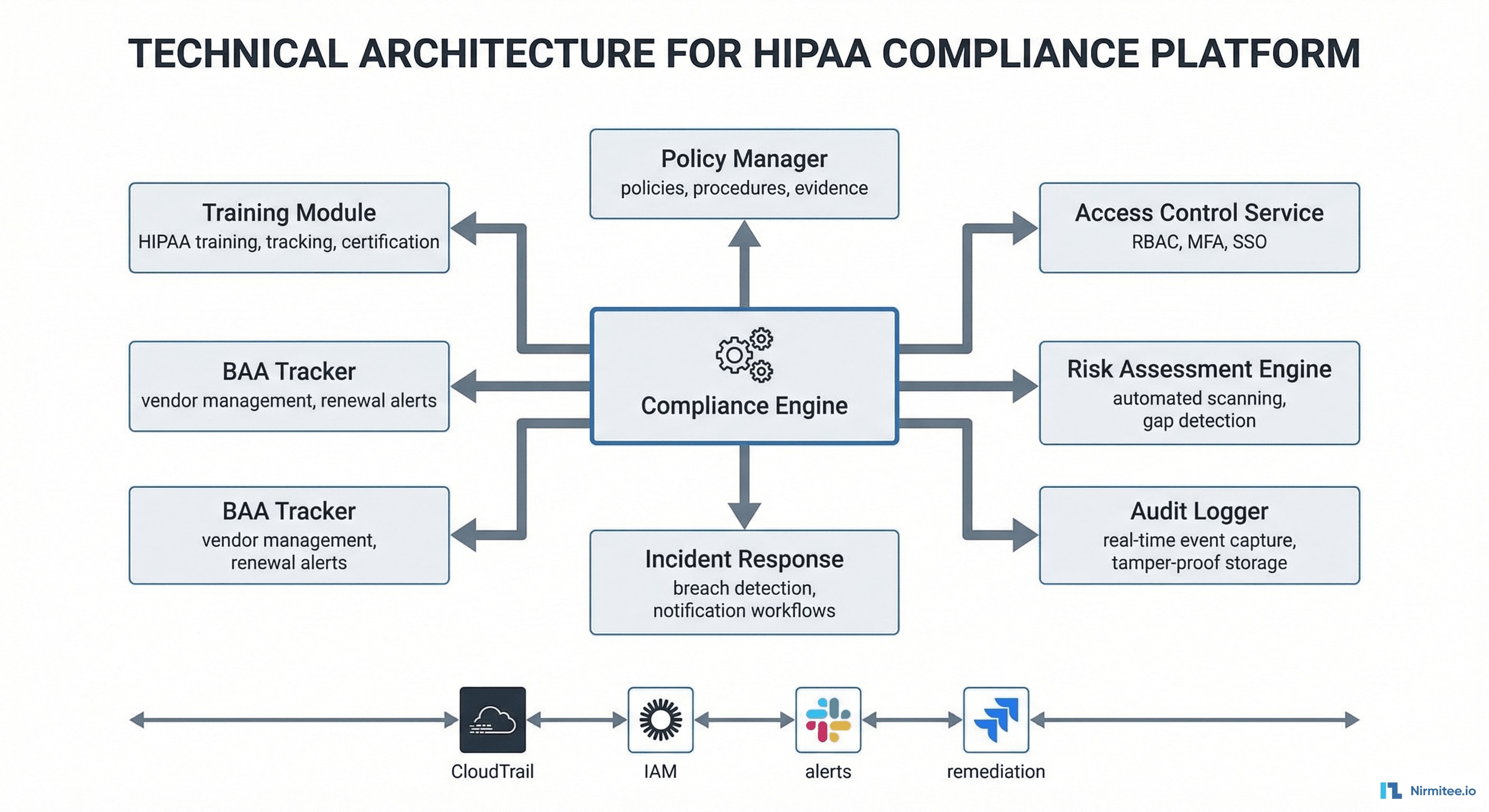
Technology Stack
| Component | Technology | Purpose |
|---|---|---|
| Frontend | React + TypeScript | Compliance dashboard, risk assessment, training portal |
| Backend | Node.js (Express) | API gateway, compliance engine, event processing |
| Database | PostgreSQL | Policies, evidence, BAAs, risk register, training records |
| Audit Ingestion | AWS CloudTrail + custom agents | Access log collection from all systems |
| Anomaly Detection | Python (isolation forest model) | Unusual access pattern detection |
| Identity | Okta integration | SSO, MFA enforcement, access review |
| Notifications | Slack + Email + PagerDuty | Compliance alerts, training reminders, incident escalation |
| Evidence Storage | S3 (encrypted, versioned) | Audit evidence, policy documents, screenshots |
Risk Assessment
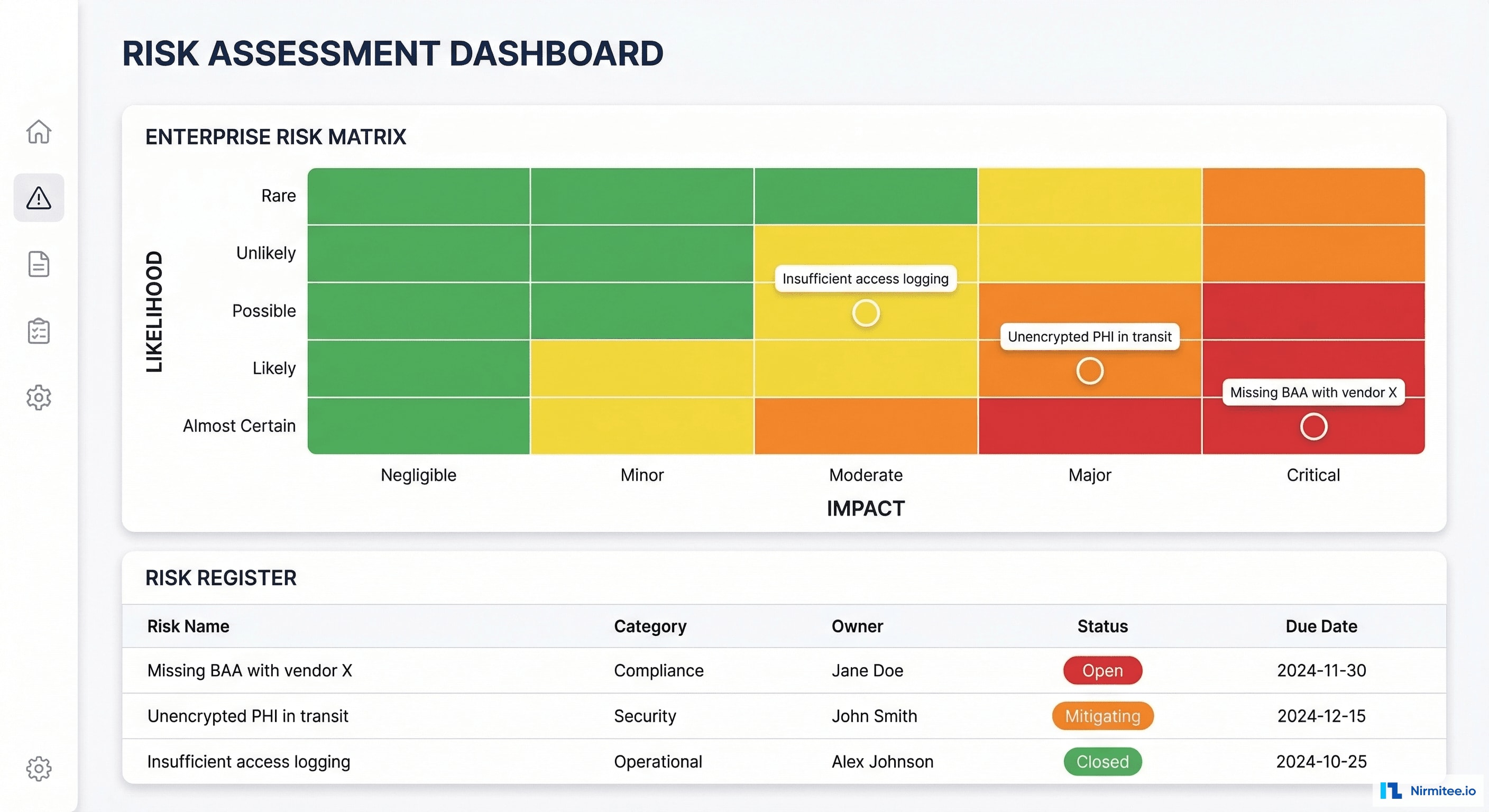
Automated risk assessment replaces the annual spreadsheet exercise with continuous risk monitoring. The risk matrix plots active risks by likelihood and impact. Risk scanning runs weekly, checking for new vulnerabilities, expired certifications, missing controls, and configuration drift.
BAA Management

All 47 vendor BAAs managed digitally with automatic expiration alerts (90/60/30 days), security questionnaire tracking, and incident history per vendor. No more missed renewals.
Employee Training
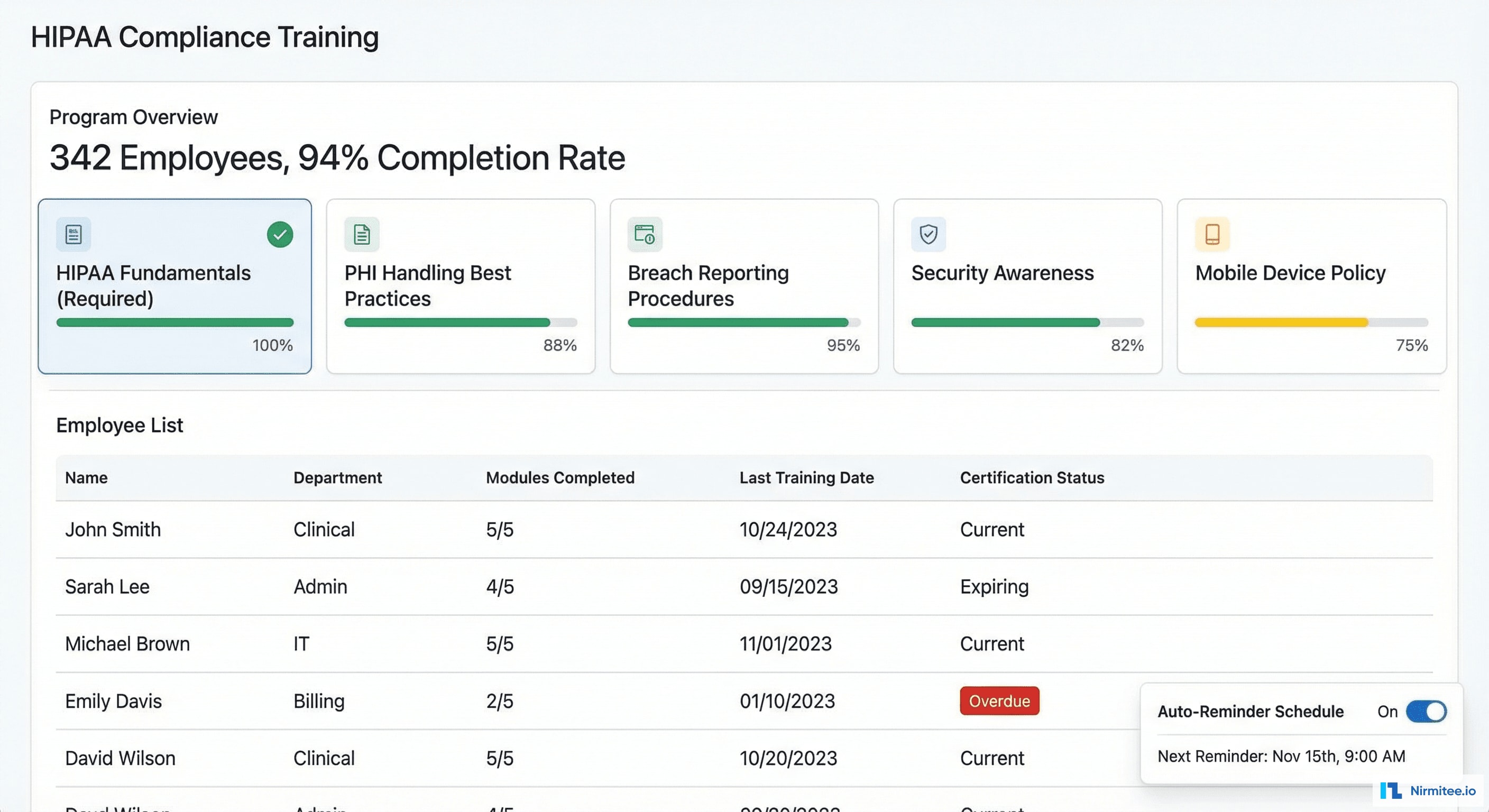
Training compliance for 342 employees — 94% completion rate with automated reminders for overdue modules. HIPAA Fundamentals required annually; role-specific modules (PHI Handling, Breach Reporting) required for clinical staff.
Incident Response

Structured incident response workflow replacing ad-hoc handling: Detection → Triage (severity assessment) → Investigation (scope determination) → Containment → Notification Assessment (HHS threshold analysis) → Remediation → Post-Incident Review. Every step documented with timestamps and responsible parties.
Results
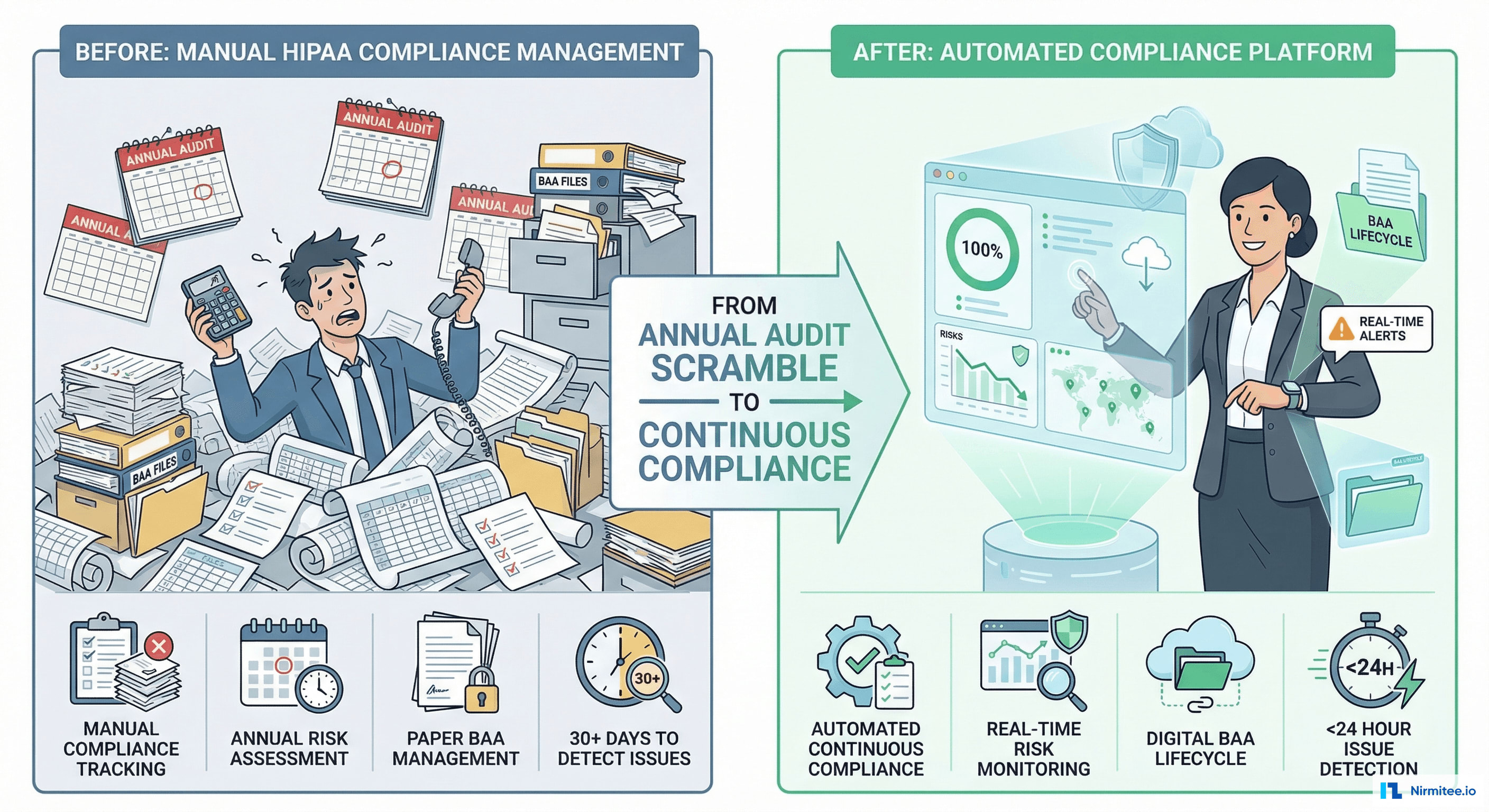
| Metric | Before | After | Impact |
|---|---|---|---|
| Compliance score | 72% | 94% | 31% improvement |
| SOC 2 Type II | Not achieved | Achieved in 4 months | 3x faster than industry avg |
| Compliance officer time on manual work | 25 hrs/week | 5 hrs/week | 80% time reclaimed |
| Risk assessment frequency | Annual | Continuous (weekly scans) | 52x more frequent |
| Issue detection time | 30+ days (next audit) | <24 hours (automated alert) | 30x faster detection |
| BAA expiration misses | 3-4/year | Zero | 100% on-time renewals |
| Training completion rate | 71% | 94% | 32% improvement |
| Spreadsheets eliminated | 14 | 0 | Single platform |
Timeline
| Phase | Duration | Deliverables |
|---|---|---|
| Phase 1 | 4 weeks | Policy manager, compliance dashboard, CloudTrail integration, audit trail viewer |
| Phase 2 | 4 weeks | Risk assessment engine, BAA tracker, anomaly detection, Okta SSO integration |
| Phase 3 | 4 weeks | Training module, incident response workflows, evidence collection automation |
| Phase 4 | 4 weeks | SOC 2 evidence preparation, external auditor coordination, penetration testing, certification |
Total: 4 months with 3 engineers + 1 compliance consultant.
Lessons Learned
- Continuous compliance beats annual compliance. Finding and fixing issues weekly (automated risk scans) prevented the "audit panic" that happens when you discover 6 months of accumulated gaps right before the auditor arrives.
- Evidence collection automation is the ROI driver. The compliance officer's #1 time sink was collecting screenshots, log exports, and policy documents for auditor requests. Automating evidence collection saved 20 hours/week alone.
- Anomaly detection catches things humans miss. Our audit trail anomaly detector flagged an ex-contractor's credentials still being used 3 months after termination. Nobody had noticed because the access logs were never reviewed. That single detection justified the platform's cost.
- SOC 2 and HIPAA overlap 80%. Most HIPAA controls (access management, encryption, audit logging, incident response) directly map to SOC 2 criteria. Building one platform for both saved significant duplicate effort.
Was this case study helpful?