Wellness & Nutrition Management Platform: How a Gym Chain Grew from 2,100 to 3,200 Members with 78% Retention

Executive Summary
A regional fitness chain with 4 locations was struggling with 52% member retention, no nutrition guidance capabilities, paper-based tracking, and generic workout programs that failed to keep members engaged. Their 2,100 members were churning at alarming rates — 48% left within the first 6 months, citing lack of personalized programs and no way to track progress beyond the gym floor.
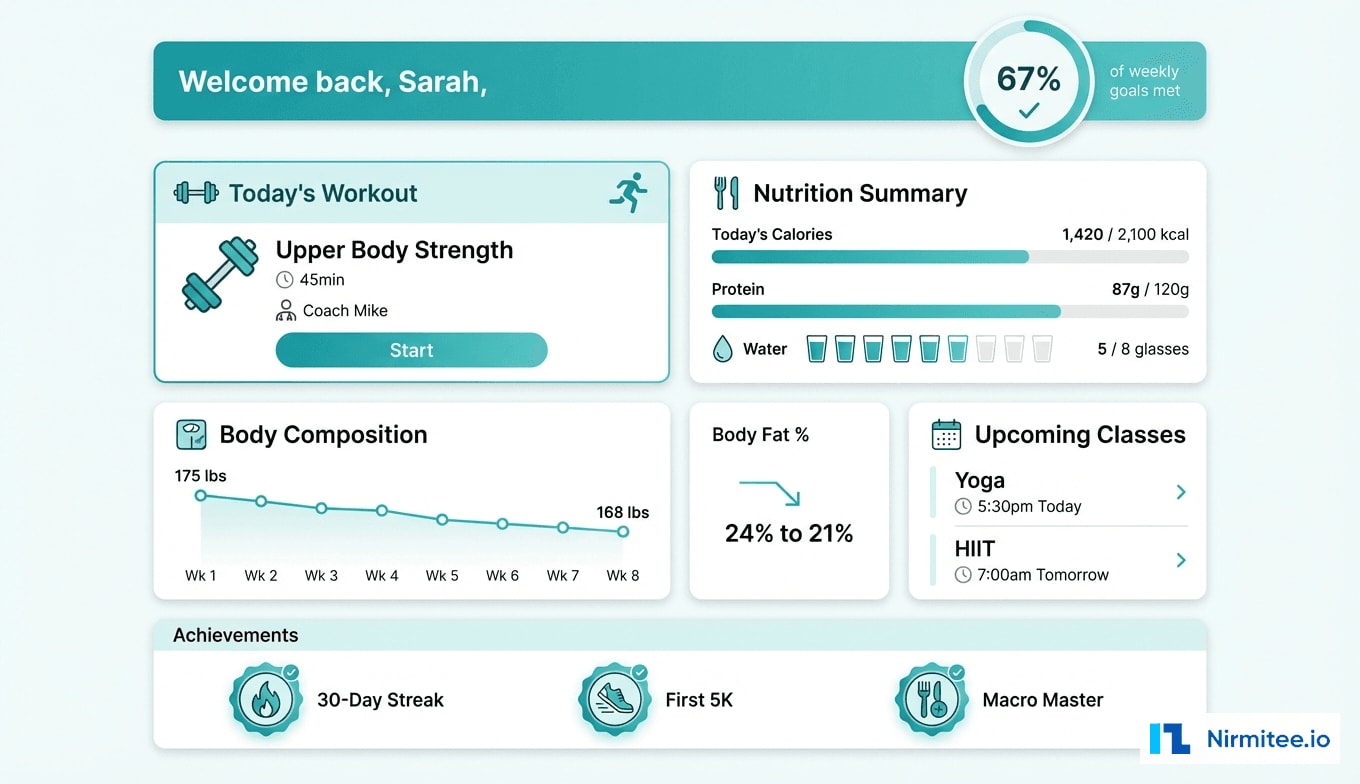
We built an integrated wellness and nutrition management platform that transformed their business from a traditional gym into a comprehensive wellness ecosystem. The platform includes a member-facing mobile app for nutrition tracking, workout logging, and body composition monitoring; a trainer portal for client management, program design, and progress analytics; a meal planning engine with barcode scanning and AI-powered food logging; and a gym management dashboard with real-time business analytics.
Within 12 months, the platform drove 3,200 active members (up from 2,100), 78% retention rate (up from 52%), and a $420K/year revenue increase through higher retention, personal training upsells, and premium nutrition plan subscriptions.
The Problem: A Gym That Could Not Keep Its Members
The fitness chain's challenges were both operational and experiential. Members walked in, did their workout, and left with no connection to the brand or their own progress outside the gym walls. The lack of digital infrastructure created a cascade of problems.
Member Experience Gaps
- No progress tracking: Members had no way to visualize their fitness journey. Weight, body composition, strength gains — all tracked on paper or not at all. Without visible progress, motivation dropped.
- Generic programs: Every new member received the same 4-week starter program regardless of goals, fitness level, or preferences. Trainers created custom programs manually in spreadsheets for premium clients only.
- Zero nutrition support: Nutrition is responsible for 70-80% of body composition results, yet the gym offered no nutrition guidance, meal planning, or food tracking tools. Members pursuing weight loss or muscle gain had no structured dietary support.
- No community: Members trained in isolation. No class booking system, no social features, no challenges or gamification to create accountability and community.
Operational Inefficiencies
- Paper sign-in sheets: Front desk managed check-ins on paper. No automated attendance tracking, no data on peak hours, no way to identify members at risk of churning based on declining visit frequency.
- Trainer scheduling via text: Personal training sessions were booked via text messages and tracked on personal calendars. Double-bookings were common, no-shows had no automated follow-up, and revenue from training was under-tracked.
- Excel financial tracking: Membership revenue, personal training packages, and class attendance were tracked in separate spreadsheets. No unified view of member lifetime value, revenue per service, or churn prediction.
- No retention intelligence: Management had no early warning system for members at risk of leaving. By the time a member had not visited in 3 weeks, the window for re-engagement had typically closed.
The Business Impact
At 52% annual retention, the gym was spending $280 per member on acquisition (marketing, free trials, onboarding) but losing nearly half within a year. The cost of churn was staggering:
| Metric | Value | Impact |
|---|---|---|
| Annual member churn | 1,008 members (48%) | $604K in lost annual revenue |
| Acquisition cost per member | $280 | $282K wasted on churned members |
| Average member lifetime | 7.2 months | Below breakeven of 8 months |
| Personal training attachment | 8% of members | $32K/month (vs. potential $80K) |
| Nutrition plan revenue | $0 | No offering existed |
Solution: An Integrated Wellness Ecosystem
We designed and built a comprehensive platform with four interconnected components: the Member Mobile App, the Trainer Portal, the Nutrition Engine, and the Gym Management Dashboard.
Member Mobile App
The member-facing mobile app (iOS and Android) serves as the personal wellness hub. Every member interaction — from check-in to meal logging to workout tracking — flows through the app, creating a comprehensive picture of their wellness journey.
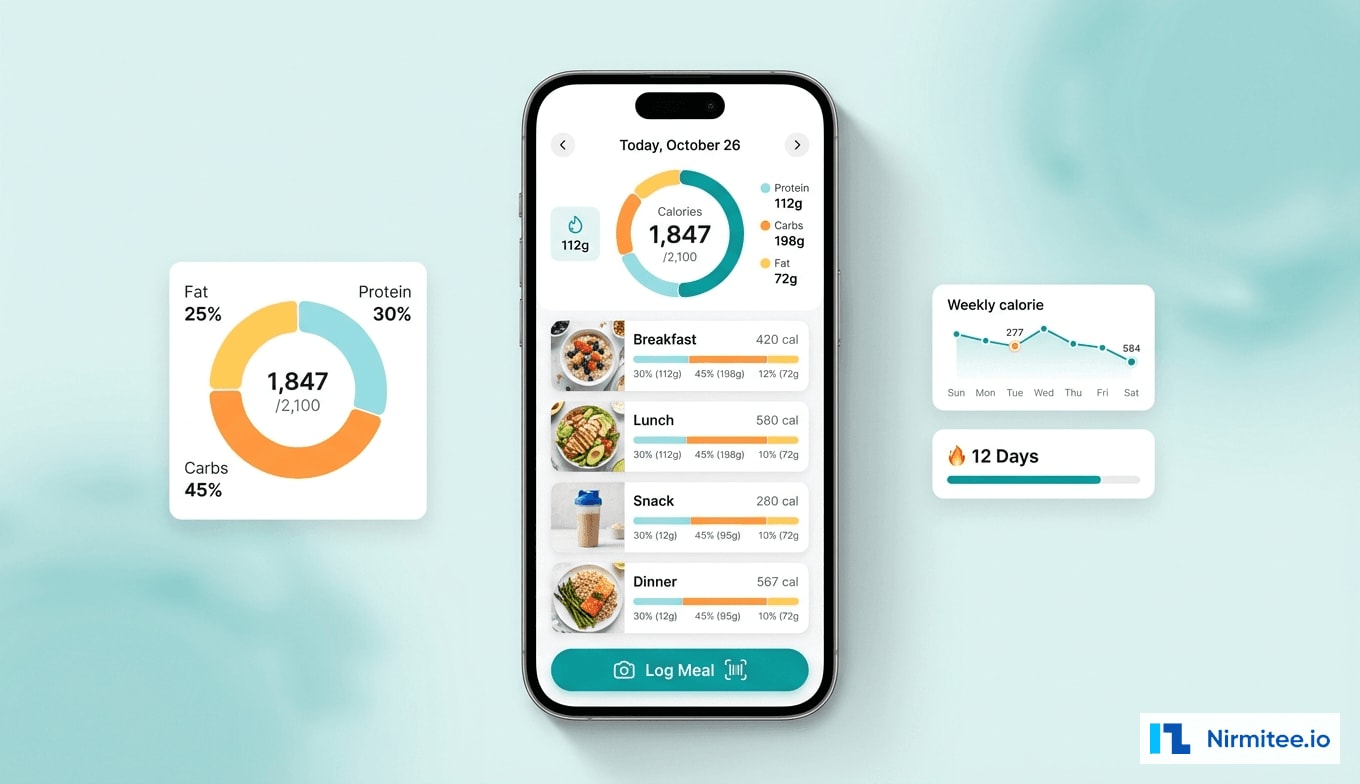
Key features include:
- QR code gym check-in: Members scan a QR code at entry, replacing paper sign-ins. Check-in data feeds the analytics engine for attendance tracking and churn prediction.
- Workout tracking: Guided workout sessions with exercise demonstrations, set/rep tracking, weight progression, and rest timers. Members can follow assigned programs or create custom workouts.
- Nutrition logging: Barcode scanning for packaged foods (database of 900,000+ products), photo-based meal logging with AI calorie estimation, manual entry with autocomplete from food database, and meal photo journaling.
- Body composition tracking: Manual entry of weight, measurements, and body fat percentage with trend visualization. Integrates with smart scales (Withings, Renpho) for automated weight syncing.
- Class booking: Real-time class schedule, capacity tracking, waitlist management, and automated reminders. Members can book, cancel, and rate classes directly from the app.
- Fitness device integration: Syncs with Apple Health, Google Fit, and Fitbit for step counting, heart rate data, sleep tracking, and active calorie burn that supplements gym workout data.
- Achievement system: Gamified milestones — workout streaks, nutrition consistency, body composition goals, class attendance — with badges and leaderboards that drive engagement.
Trainer Portal
The trainer portal gives fitness professionals the tools to manage clients at scale without losing the personal touch.
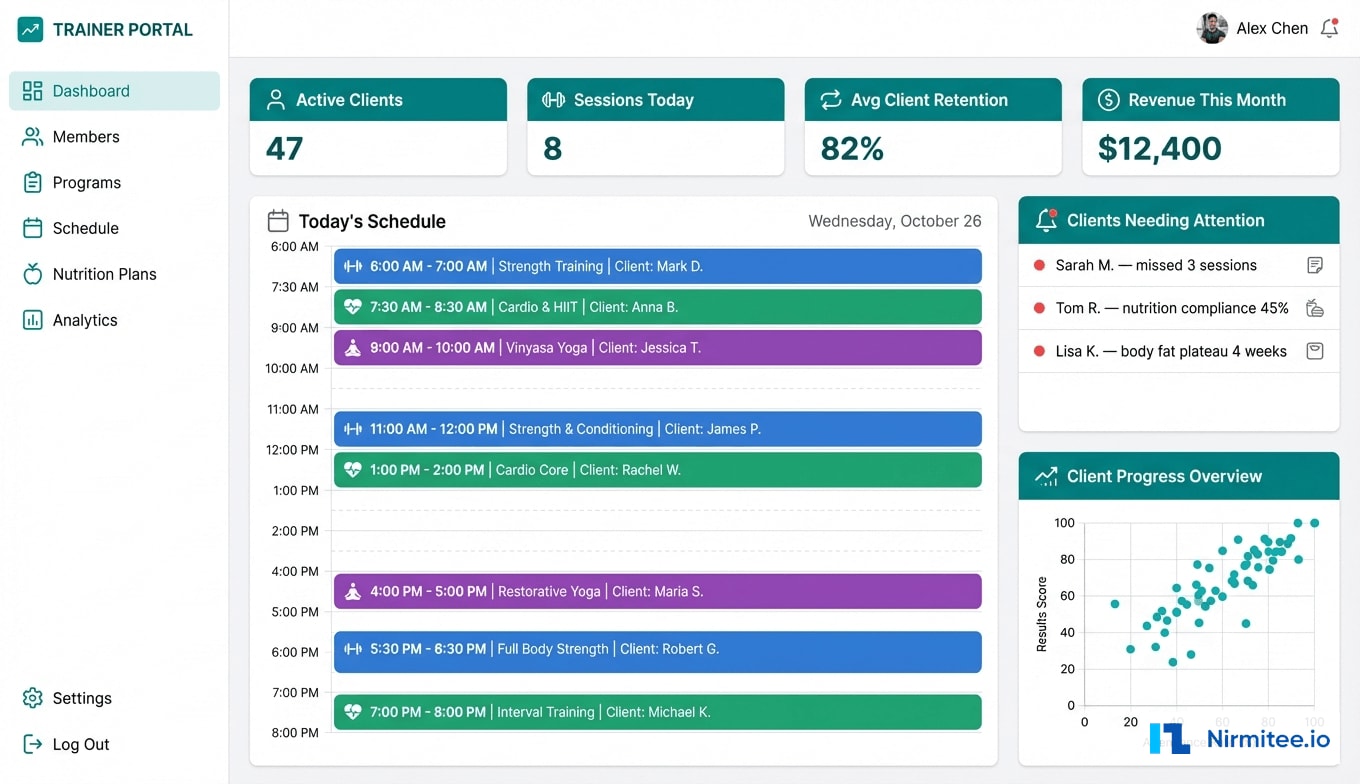
- Client overview dashboard: At-a-glance view of all active clients with color-coded compliance indicators — green (on track), yellow (declining attendance), red (at risk of churning). Clicking into a client shows their full training history, nutrition compliance, and body composition trends.
- Program builder: Drag-and-drop workout program designer with an exercise library of 500+ movements. Trainers build multi-week periodized programs with progressive overload calculations, rest day scheduling, and deload weeks.
- Nutrition plan templates: Pre-built nutrition plan templates by goal (fat loss, muscle gain, maintenance, athletic performance) with macro targets that auto-calculate based on client body weight, activity level, and goals. Trainers can customize or build from scratch.
- Automated check-ins: Scheduled weekly check-in forms sent to clients asking about energy levels, soreness, nutrition compliance, and overall mood. Responses are compiled into a client progress report for the trainer.
- Session scheduling: Calendar-based scheduling with availability management, automatic reminder notifications, no-show tracking, and rescheduling workflows. Integrated with payment processing for session package management.
Nutrition Engine
The nutrition component was the single highest-impact feature, directly responsible for the majority of the retention improvement.
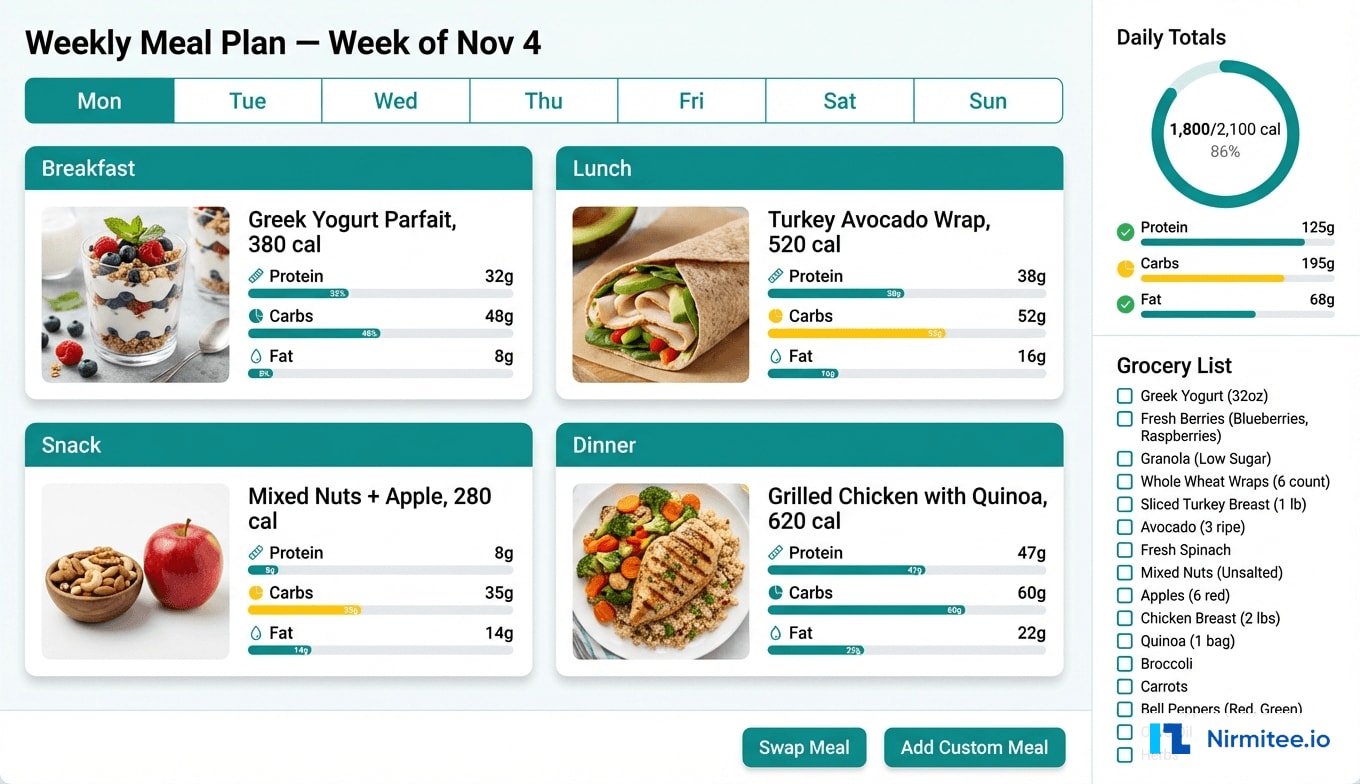
- Personalized macro targets: Based on member profile (age, weight, height, activity level, goal), the system calculates daily calorie and macronutrient targets using the Mifflin-St Jeor equation with activity multipliers. Targets adjust automatically as body composition changes.
- Meal plan generation: Algorithm-generated weekly meal plans that meet macro targets while respecting dietary preferences (vegetarian, vegan, gluten-free, lactose-free, keto, paleo) and food allergies. Generates corresponding grocery lists.
- Barcode scanning: Integrated food database with 900,000+ products. Members scan packaged foods, and nutritional data is automatically logged. Handles unit conversion and serving size adjustments.
- AI photo logging: Computer vision model estimates calories and macros from meal photos. Accuracy is approximately 80% for standard meals, with easy manual correction. The model improves over time with user corrections.
- Recipe database: 2,000+ healthy recipes organized by goal, dietary preference, preparation time, and skill level. Each recipe includes step-by-step instructions, nutritional breakdown, and scaling for different serving sizes.
Body Composition and Progress Tracking
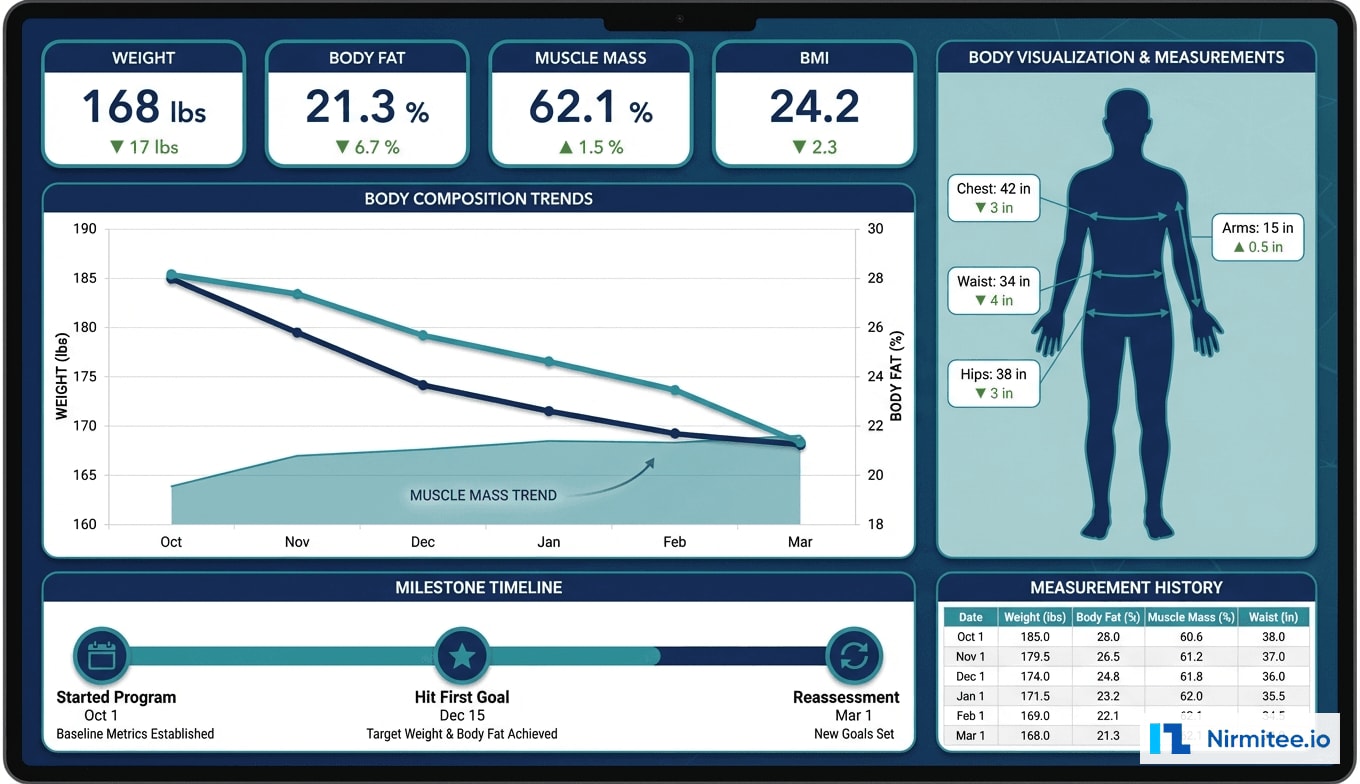
The progress tracking system goes far beyond a simple weight log:
- Multi-metric tracking: Weight, body fat percentage, muscle mass, BMI, waist-to-hip ratio, and individual body measurements (chest, waist, hips, arms, thighs). Supports both manual entry and smart scale integration.
- Trend visualization: Interactive charts showing long-term trends with smoothed moving averages to filter daily weight fluctuations. Overlays workout frequency and nutrition compliance data to help members see correlations.
- Progress photos: Side-by-side photo comparison tool with guided photo capture (front, side, back) and timestamp overlay. Members can see visual transformation alongside numerical data.
- Goal tracking: Members set specific, time-bound goals (lose 15 lbs by March, reach 20% body fat, bench press 225 lbs). The system tracks progress toward goals and sends encouragement or adjustment suggestions.
Architecture and Technical Implementation
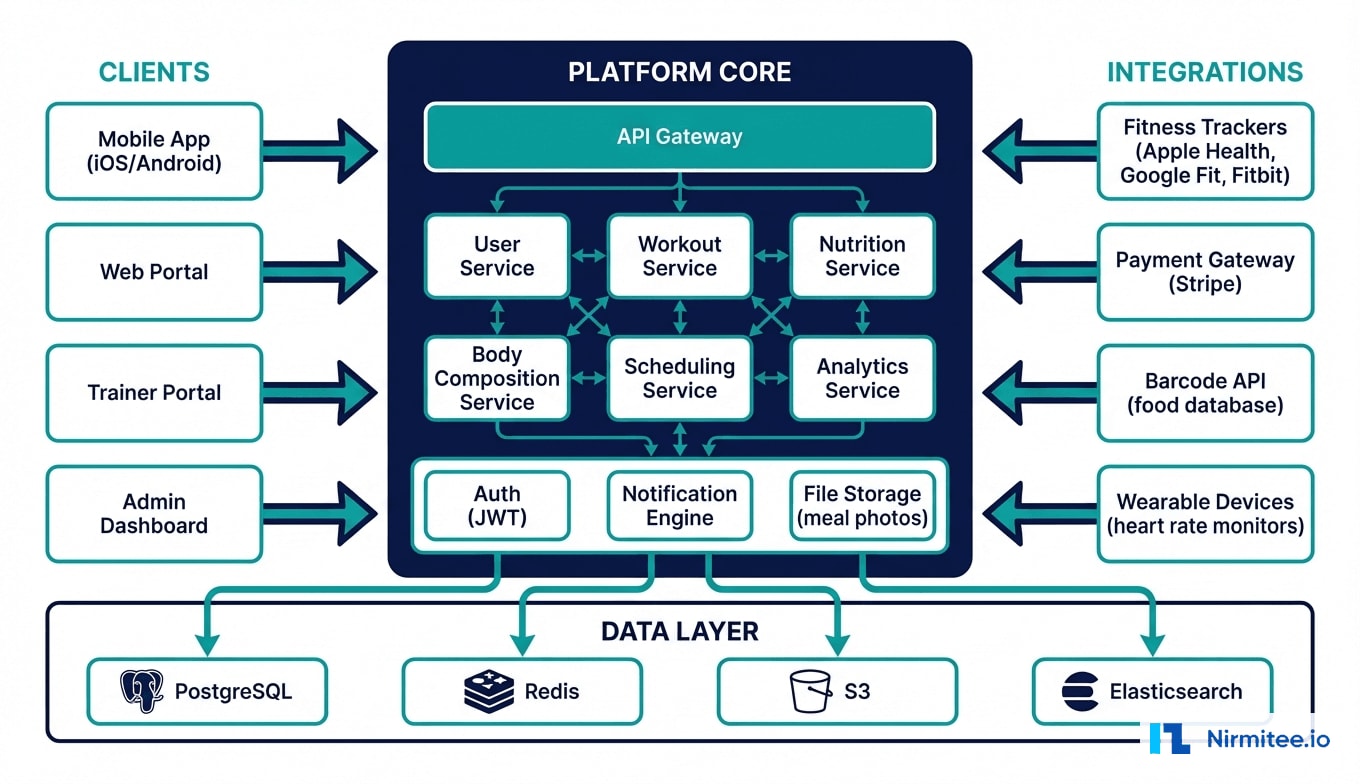
Technology Stack
| Component | Technology | Purpose |
|---|---|---|
| Mobile App | React Native, Expo | Cross-platform iOS/Android app |
| Web Portal | Next.js 14, TypeScript | Trainer portal and admin dashboard |
| API Layer | Node.js, Express, TypeScript | RESTful API with GraphQL for complex queries |
| Database | PostgreSQL 15 | Relational data, member profiles, programs |
| Cache | Redis | Session management, leaderboards, real-time data |
| File Storage | AWS S3 + CloudFront | Meal photos, progress photos, exercise videos |
| Food Database | Nutritionix API + custom DB | 900K+ food items, barcode lookup |
| AI/ML | TensorFlow Lite, custom model | Meal photo calorie estimation |
| Device Integration | Apple HealthKit, Google Fit API | Fitness tracker data sync |
| Payments | Stripe | Subscriptions, session packages, one-time purchases |
| Notifications | Firebase Cloud Messaging | Push notifications, reminders, alerts |
| Analytics | Mixpanel + custom dashboards | User behavior, engagement, business metrics |
Data Architecture
The platform's data model is built around the concept of a Member Journey — every data point connects back to a member's profile and contributes to their holistic wellness picture:
- Activity data: Gym check-ins, workout sessions (exercises, sets, reps, weight), class attendance, device-synced activities (steps, heart rate, sleep)
- Nutrition data: Food log entries (barcode scans, manual entries, photo logs), meal plan adherence, weekly macro averages, hydration tracking
- Body composition data: Weight measurements (manual + smart scale), body fat estimates, circumference measurements, progress photos with timestamps
- Engagement data: App open frequency, feature usage patterns, notification response rates, social interactions (leaderboard views, challenge participation)
This comprehensive data model powers the churn prediction engine — a gradient boosting model trained on 18 months of historical member data that identifies members at risk of cancellation 3-4 weeks before they actually churn, enabling proactive retention interventions.
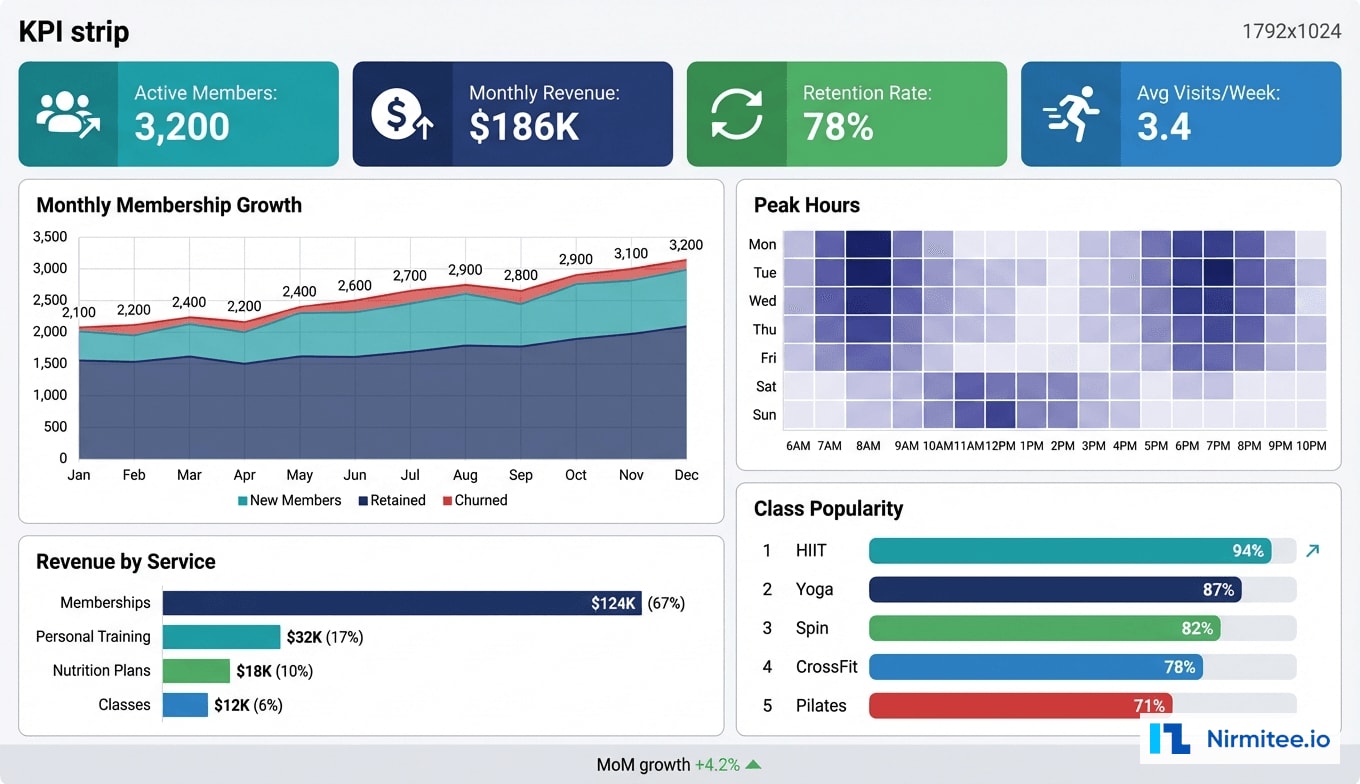
Results: From Gym to Wellness Ecosystem
Key Performance Metrics
| Metric | Before Platform | After (12 Months) | Improvement |
|---|---|---|---|
| Active Members | 2,100 | 3,200 | +52% |
| Member Retention Rate | 52% | 78% | +50% relative |
| Average Member Lifetime | 7.2 months | 14.8 months | +106% |
| Monthly Revenue | $86K | $121K | +41% |
| Annual Revenue Increase | Baseline | +$420K/year | New revenue |
| Personal Training Attachment | 8% | 22% | +175% |
| Nutrition Plan Subscribers | 0 | 640 ($19/mo each) | $146K/year new line |
| Avg Visits per Week | 2.1 | 3.4 | +62% |
| App Daily Active Users | N/A | 1,840 (58% of members) | High engagement |
| Class Attendance | 45% capacity | 82% capacity | +82% |
Revenue Breakdown
The $420K annual revenue increase came from multiple sources:
- Retained members: $198K — members who would have churned under the old model but stayed due to better engagement and tracking
- Nutrition plan subscriptions: $146K — 640 members at $19/month for premium meal planning, recipes, and nutritionist access
- Personal training upsell: $76K — training attachment rate jumped from 8% to 22%, driven by visible progress data that motivated members to invest in coaching
Engagement Metrics
The nutrition tracking feature proved to be the strongest engagement driver. Members who logged meals at least 4 days per week had an 89% retention rate versus 61% for non-trackers. The meal photo logging feature (lower friction than manual entry) was used by 72% of nutrition subscribers. The achievement system created healthy competition — members who participated in at least one challenge had 34% higher visit frequency than non-participants.
Implementation Timeline
| Phase | Duration | Key Activities | Milestone |
|---|---|---|---|
| Discovery and Design | Weeks 1-4 | Member interviews, competitor analysis, UX design, brand identity | Design approved, prototype validated |
| Core Platform | Weeks 3-10 | API, database, auth, member profiles, gym check-in | Core API operational |
| Mobile App v1 | Weeks 6-14 | React Native app, workout tracking, check-in, class booking | App Store submission |
| Nutrition Engine | Weeks 8-16 | Food database, barcode scanning, meal planning, macro tracking | Nutrition features live |
| Trainer Portal | Weeks 10-15 | Client management, program builder, scheduling, analytics | Trainers onboarded |
| Body Composition | Weeks 12-16 | Tracking UI, smart scale integration, progress photos | Full tracking operational |
| Analytics Dashboard | Weeks 14-18 | Business analytics, churn prediction, revenue tracking | Dashboard live for management |
| Launch and Iteration | Weeks 18-22 | Soft launch, member onboarding, feedback collection, iteration | Full production launch |

Lessons Learned
1. Nutrition is the Killer Feature for Retention
We initially prioritized workout tracking and class booking, assuming those were the primary value drivers. Post-launch data showed that nutrition tracking was 3x more correlated with retention than any other feature. Members who tracked nutrition consistently stayed an average of 18 months versus 10 months for workout-only users. Nutrition should have been the first feature shipped, not the fourth.
2. Friction in Food Logging Must Be Minimal
Our first version required manual text search for every food item. Logging a meal took 3-4 minutes, and adoption was only 23%. Adding barcode scanning raised adoption to 48%. Adding photo-based logging (one tap to snap a meal) pushed it to 72%. Every second of friction in daily logging directly impacts long-term compliance.
3. Trainers Are the Distribution Channel
Top-down mandates to use the app had limited effect. The breakthrough was making trainers the advocates — when trainers assigned programs through the app, sent nutrition plans through the app, and reviewed progress through the app, members naturally adopted it. Trainer adoption must precede member adoption.
4. Churn Prediction Needs Early Intervention Protocols
Building a churn prediction model was the easy part. The hard part was defining what happens when a member is flagged as at-risk. We developed a 3-tier intervention protocol: automated re-engagement (push notifications, email with personalized content), trainer outreach (personal text from their trainer), and front-desk intervention (in-person conversation on next visit). The protocol reduced at-risk churn by 41%.
5. Gamification Works, But Subtlety Wins
Our initial gamification was aggressive — constant badges, notifications, leaderboards. Some members found it motivating; others found it annoying and patronizing. We shifted to a subtler approach: progress celebrations only at meaningful milestones, optional leaderboard participation, and quiet streaks that only appear when you check. The refined approach had higher sustained engagement than the noisy version.
Frequently Asked Questions
How accurate is the AI meal photo calorie estimation?
The photo-based calorie estimation achieves approximately 80% accuracy for standard meals with clearly visible food items. Accuracy drops for mixed dishes (casseroles, stews) and heavily sauced foods. The system presents its estimate as a range (e.g., 450-550 calories) rather than a single number, and members can easily adjust. Over time, the model learns from user corrections for frequently logged meals, improving accuracy for each individual's typical diet.
What fitness trackers and smart devices are supported?
The platform integrates with Apple Health (all Apple Watch and iPhone health data), Google Fit (Wear OS devices, Pixel Watch), Fitbit (all models), and direct API integrations with Withings and Renpho smart scales. Heart rate monitors using Bluetooth (Polar, Garmin) can sync workout heart rate data. We add new device integrations based on member demand — currently evaluating Whoop and Oura Ring integrations.
How does the churn prediction model work, and how accurate is it?
The model uses a gradient boosting classifier trained on 18 months of historical member data. Features include visit frequency trend (declining visits is the strongest signal), nutrition logging consistency, class booking patterns, app engagement metrics, payment history (failed payments), and time since last visit. The model achieves 82% precision and 76% recall at a 3-week prediction horizon — meaning when it flags a member as at-risk, it is correct 82% of the time, and it catches 76% of members who actually churn.
Can the platform scale to larger gym chains with 20+ locations?
Yes — the architecture supports multi-location deployment with location-aware features. Each gym location has its own class schedule, trainer roster, and capacity limits, while members can access any location with their account. The analytics dashboard supports both per-location and chain-wide views. We have successfully deployed for chains with up to 12 locations. For 20+ location deployments, we recommend dedicated infrastructure (separate Kubernetes cluster) for data residency and performance requirements.
Was this case study helpful?