
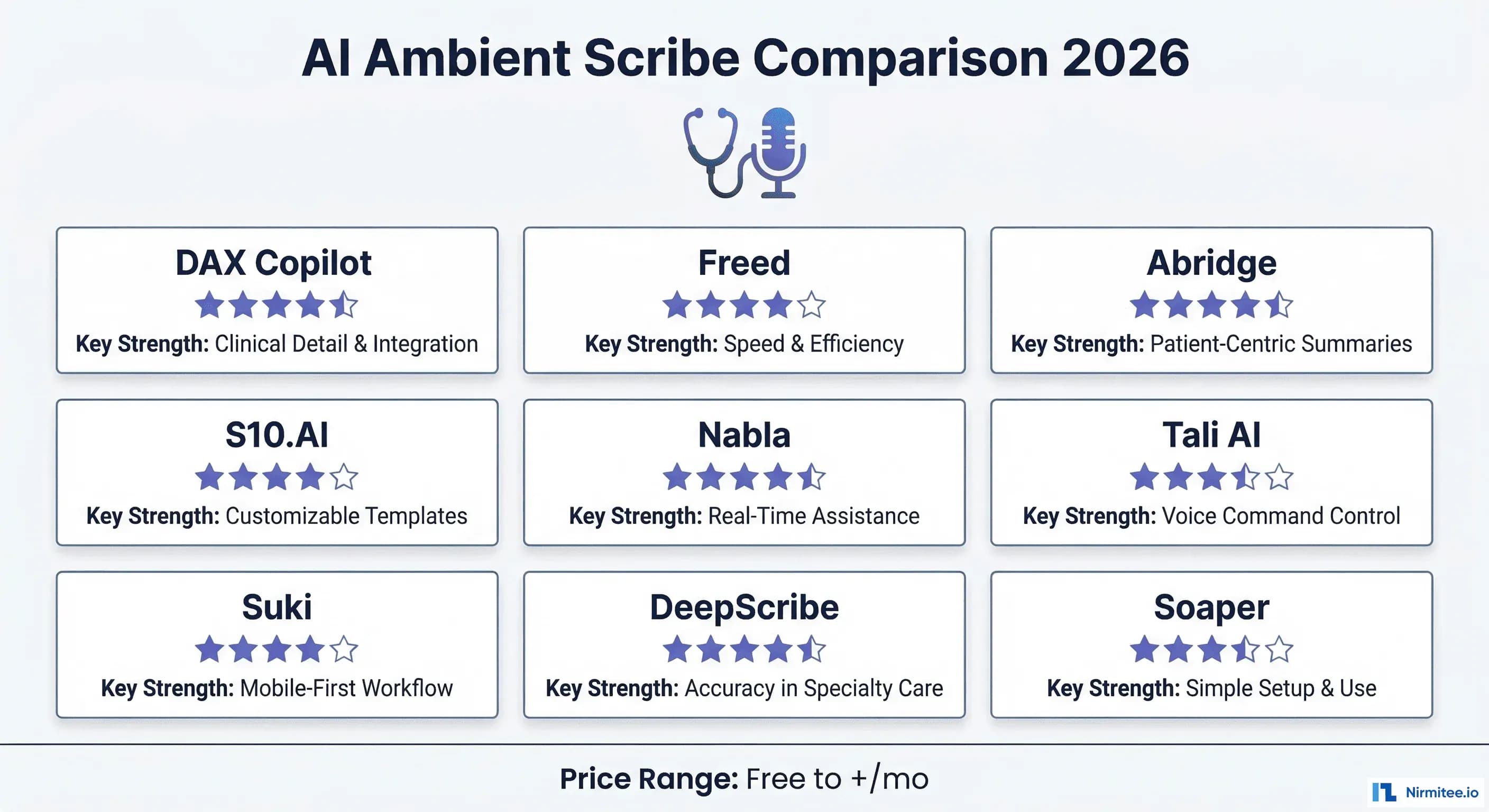
If you have searched for "best AI medical scribe" lately, you have probably noticed something: every vendor claims to be the best. Every landing page promises 90%+ accuracy, massive time savings, and seamless EHR integration. But once you dig past the marketing, the differences between these products are significant, and the wrong choice can cost your practice thousands of dollars per year in wasted licensing fees or, worse, create documentation quality problems that follow you to audits.
We spent weeks evaluating nine of the most prominent AI ambient scribes on the market in early 2026. Our methodology was not limited to vendor demos: we pulled from real physician reviews on Reddit, actual pricing data, specialty-specific accuracy reports, and EHR integration documentation. This is the comparison guide we wish existed when we started.
Why There Is No Clear Winner in AI Scribes (Yet)
The AI clinical documentation market in 2026 has over 15 products vying for clinician attention. The market is fragmented because different products have made fundamentally different architectural decisions about three things: where the AI runs (cloud vs. edge), how deeply it integrates with the EHR (native embedded vs. browser overlay vs. copy-paste), and which specialties get priority tuning.
Microsoft's DAX Copilot (formerly Dragon Ambient eXperience) commands the enterprise segment with deep Epic embedding but carries an $600-800/month price tag that prices out solo practitioners. Meanwhile, Freed AI has captured the independent physician market with $99/month pricing and sub-30-second note generation, but lacks native EHR integration. Abridge has partnered with over 150 health systems for Epic-native workflows but is not available to small practices. DeepScribe earns a 98.8 KLAS spotlight score but costs $350-750/month.
The result: no single product dominates. The "best" scribe depends entirely on your specialty, practice size, EHR system, and budget. That is exactly what this guide helps you figure out.
How We Evaluated: Methodology
Our comparison draws from five data sources:
- Real physician reviews from Reddit communities (r/FamilyMedicine, r/emergencymedicine, r/Psychiatry, r/medicine) and clinician forums. We prioritized reviews from verified physicians who had used products for 3+ months, not first-week impressions.
- Published pricing data from vendor websites, Capterra, GetApp, and direct vendor conversations. Where vendors do not publish pricing, we note the range from multiple third-party sources.
- Specialty accuracy benchmarks from KLAS Research, peer-reviewed studies (including the JAMA Network Open 2025 physician perspectives study), and specialty-specific user feedback.
- EHR integration depth categorized as Native (embedded in EHR workflow), Third-Party (browser extension or API), or Standalone (copy-paste only). This distinction matters enormously for daily workflow friction.
- Template customization rated by ability to match specialty-specific documentation requirements (SOAP, DAP, procedure notes, psychiatric MSE, etc.).
A note on bias: we do not sell or resell any of these products. Nirmitee builds custom healthcare software and EHR integrations, so our interest is in helping clinicians make informed decisions, not pushing a particular vendor.
The Full Comparison Table
Below is the data we compiled across all nine products. We will unpack each row in the sections that follow.
| Product | Monthly Cost | Best For | EHR Integration | Template Customization | Overall Rating |
|---|---|---|---|---|---|
| DAX Copilot | $600-800 | Enterprise, Multi-Specialty | Epic Native (deepest) | High | 4.2 / 5 |
| Freed | $99-119 | Family Medicine, Solo Practice | Browser-Based | Medium | 4.0 / 5 |
| Abridge | ~$208 | Health Systems, Epic Users | Epic Native | High | 4.1 / 5 |
| S10.AI | $49-99 | 40+ Specialties, Budget-Conscious | Epic, Cerner, Athena | High (200+ templates) | 4.3 / 5 |
| Nabla | $100-119 | General Practice, EU Compliance | 20+ EHR Integrations | Medium | 3.8 / 5 |
| Tali AI | Free - $99 | Family Med, Multilingual | Standalone + Dictation | Flexible (new in 2025) | 3.5 / 5 |
| Suki | $299-399 | Voice-First, Large Systems | Epic, Oracle, Athena, MEDITECH | High | 4.0 / 5 |
| DeepScribe | $350-750 | Surgical, Oncology, Cardiology | 3 EHR Integrations | Very High (specialty-tuned) | 4.4 / 5 |
| Soaper | ~$50 | General Dictation, Budget | EMR Export | Low-Medium | 3.3 / 5 |
Pricing as of Q1 2026. Actual costs vary by contract length, volume, and negotiated terms. Enterprise products (DAX, Abridge) often require annual commitments. Always confirm current pricing directly with the vendor.
By Specialty: Which Scribe Fits Best?
This is where generic comparison tables fall apart. A scribe that excels in family medicine may produce mediocre psychiatry notes. Specialty-specific template libraries, terminology models, and workflow fit matter more than headline accuracy numbers.
Family Medicine
Top picks: Freed, S10.AI, Tali AI
Family medicine encounters are high-volume, multi-problem visits where the scribe needs to capture several chief complaints, medication reconciliation, and preventive care reminders in a single note. Freed dominates this space on Reddit. As one physician on r/FamilyMedicine put it, the note generated was precise, comprehensive, and actually sounded like them. At $99/month, the ROI math works even for independent practices seeing 20 patients per day.
S10.AI offers strong competition with over 200 pre-built templates and direct integration with Epic, Cerner, and athenahealth. Physicians praise its "plug-and-play" setup requiring no IT involvement. Tali AI is the budget-conscious choice: its free tier includes 5 AI-generated notes per month, enough to evaluate the technology before committing. Its 2025 accuracy upgrade and support for 28 languages make it particularly strong for practices serving diverse patient populations.
For deeper context on how ambient documentation works under the hood, see our technical deep dive: Ambient Clinical Documentation: Engineering the System That Writes the Doctor's Notes.
Psychiatry
Top picks: Freed, DeepScribe, Nabla
Psychiatry is uniquely challenging for AI scribes. Mental health notes require capturing nuanced patient language, emotional tone, risk assessment observations, and the Mental Status Examination (MSE) in a format that reads like clinical observation rather than a transcript. The conversation style is also fundamentally different: longer, less structured, and more emotionally complex than a typical medical encounter.
Freed has earned strong reviews from therapists and psychiatrists for its mental health templates, which handle initial psychiatric evaluations, therapy progress notes (DAP format), and medication management visits. Multiple psychiatrists on Reddit note that Freed captures the therapeutic nuances that other scribes miss. DeepScribe's specialty-tuned models handle psychiatric terminology with high accuracy, though the $350-750/month pricing is steep for solo practitioners. Nabla's free tier makes it an accessible testing ground, and its GDPR-native architecture appeals to practices concerned about sensitive mental health data handling.
One common critique across all AI scribes in psychiatry: clinicians report occasional "hallucinations" where the AI infers clinical observations that were not explicitly stated. Careful review of generated notes is essential, particularly for risk assessment documentation. This aligns with findings from the JAMA Network Open study on physician perspectives on ambient AI scribes.
Emergency Medicine
Top picks: DAX Copilot, S10.AI, Suki
Emergency medicine demands hands-free, always-on ambient capture. Physicians cannot pause during a trauma resuscitation to tap "start recording." The scribe must handle fast-paced, often chaotic multi-provider conversations, and generate notes that document medical decision-making for high-acuity encounters.
DAX Copilot is the strongest choice for emergency departments running Epic, where notes appear directly in the chart without provider action. A physician on Reddit reported using DAX in the ER and finding it nice to have everything laid out, though they still do a fair amount of editing on complex cases. The deep Epic integration eliminates the copy-paste step that kills productivity in a 30-patient shift.
S10.AI and Suki offer strong alternatives. Suki's voice-first interface lets physicians issue commands like "order a CBC" or "schedule follow-up" hands-free, functioning as a voice-driven EHR interface beyond just documentation. S10.AI's competitive pricing and fast onboarding make it practical for community EDs that cannot wait 3-6 months for a DAX implementation. Physicians in r/emergencymedicine consistently emphasize HIPAA compliance as a top concern, with S10.AI and several others offering instant Business Associate Agreements.
Pediatrics
Top picks: Freed, Abridge, Nabla
Pediatric encounters involve a three-party dynamic: the clinician, the child, and the parent or caregiver. AI scribes must distinguish between who said what and accurately capture developmental milestone assessments, vaccination histories, and growth percentile discussions. The conversation often shifts between clinical history (from the parent) and the physical examination (with the child).
Freed handles multi-speaker conversations well and has pediatric-specific templates for well-child visits, developmental screenings, and acute illness encounters. Abridge's "Linked Evidence" feature is particularly valuable in pediatrics: clinicians can click on any part of the generated note and hear the exact conversation segment, making it easy to verify that developmental concerns raised by a parent were accurately captured. Nabla's multilingual support is a differentiator for pediatric practices in linguistically diverse communities.
A note of caution: AI scribes in pediatric settings require extra review. Dosing references, growth chart percentiles, and developmental milestones carry significant liability if documented incorrectly. The AAFP's 2025 report on AI scribes in healthcare delivery specifically calls out pediatric documentation as requiring enhanced clinician oversight.
Surgical Specialties
Top picks: DeepScribe, DAX Copilot, Suki
Surgical documentation is a different beast. Pre-operative assessments, intra-operative findings, and post-operative notes each have distinct documentation requirements. The AI needs to understand surgical anatomy terminology, procedure-specific language, and instrument names without confusing similar-sounding terms.
DeepScribe leads surgical specialties with a 98.8 KLAS spotlight score and specialty-tuned models for oncology, cardiology, urology, orthopedics, and neurology. Its quality scoring feedback system shows surgeons exactly where the AI is confident vs. uncertain, enabling faster review. Physicians report charts closed within 1.6 minutes and documentation time decreased by 75%. The $350-750/month price is easier to justify for surgical practices with higher per-encounter revenue.
DAX Copilot's enterprise deployment handles surgical workflows well within Epic environments, and Suki's voice-first interface is practical in pre-op and post-op settings where hands-free operation matters. For context on how AI enters clinical workflows beyond documentation, see our analysis of how AI enters the hospital through CDS Hooks.
Enterprise vs. Solo: DAX's $600/mo vs. Freed's $99/mo
The pricing gap between enterprise and independent-practice AI scribes is not just about features. It reflects fundamentally different go-to-market strategies and total cost of ownership.
What You Get for $600-800/month (DAX Copilot)
- Deep EHR embedding: Notes auto-populate directly in Epic without any copy-paste. This is not a browser overlay; it is a native workflow integration that IT teams spend 3-6 months implementing.
- Enterprise compliance: BAA, SOC 2 Type II, HITRUST certification, and data residency controls that large health system security teams require.
- Microsoft ecosystem: Backed by Microsoft's GPT-4 infrastructure, Azure cloud, and the former Nuance clinical NLP expertise that has powered Dragon Medical for two decades.
- Order suggestions: Beyond documentation, DAX suggests orders inside Epic, drafts referral letters, and generates after-visit summaries with one click.
- Scale support: Dedicated implementation team, ongoing training, and clinician adoption specialists. Microsoft reports 70% of clinicians say DAX reduces feelings of burnout.
What You Get for $99/month (Freed)
- Instant setup: Sign up, open the web app or Chrome extension, and start documenting. No IT department required. No implementation timeline.
- Sub-30-second drafts: Freed generates clinical notes within seconds of ending the encounter, not minutes.
- Physician-ready templates: Covers SOAP, DAP, therapy notes, and specialty formats. Clinicians report the notes "sound like them" with minimal editing.
- Browser-based flexibility: Works with any EHR via copy-paste. Not as seamless as native integration, but no vendor lock-in either.
- Solo-practice economics: At 20 patients per day, Freed costs roughly $0.25 per patient encounter. DAX costs $1.50-2.00.
The Real Decision Framework
The question is not "which is better" but "what is your practice's integration tolerance?" If your health system runs Epic and has an IT team that can manage a 3-6 month implementation, DAX delivers unmatched workflow integration. If you are a solo practitioner or small group that needs to save time tomorrow, Freed's browser-based approach eliminates the implementation barrier entirely.
Mid-market options like Suki ($299-399/month) and S10.AI ($49-99/month) fill the gap. Suki offers four-EHR native integration at a lower price than DAX, while S10.AI provides impressive template breadth and EHR connectivity at the Freed price point. For healthcare products navigating these build-vs-buy decisions more broadly, our analysis of build vs. buy in healthcare integration platforms covers the same trade-offs at the infrastructure level.
The Integration Question: Which Scribes Work With Your EHR?
EHR integration is the single most underestimated factor in AI scribe selection. The difference between "native integration" and "copy-paste workflow" is the difference between saving 10 minutes per encounter and saving 3 minutes per encounter. Over a 25-patient day, that gap adds up to nearly three hours.
Native Epic Integration (Best-in-Class)
DAX Copilot and Abridge lead Epic integration. DAX operates as an embedded Epic application: notes auto-populate in Haiku (mobile) and Hyperspace (desktop) workflows. Abridge's "Linked Evidence" feature is also Epic-native, and its adoption at over 150 health systems speaks to enterprise-level trust. Both require institutional Epic agreements and IT-led deployments.
Multi-EHR Native Integration
Suki integrates natively with four major EHRs: Epic, Oracle Health (Cerner), athenahealth, and MEDITECH. This bidirectional integration means Suki can not only push notes but also pull patient context from the chart. Nabla offers 20+ EHR integrations through its Nabla Connect platform (launched October 2025), making it the broadest native integration play. S10.AI claims compatibility with 100+ systems, though the depth of integration varies from native API to browser extension.
Browser-Based / Standalone
Freed, Tali AI, and Soaper operate as standalone applications. Freed uses a browser extension that overlays your EHR, and on its Premier tier, can scrape data from the EHR screen. Tali combines ambient scribe with traditional dictation, working alongside any EHR. Soaper exports notes to your EMR via standard channels. The trade-off is clear: zero IT setup time, but an added copy-paste step in every encounter.
If your practice uses eClinicalWorks, NextGen, or another mid-market EHR, your options for native integration narrow significantly. S10.AI and Nabla offer the broadest coverage. For context on what EHR integration actually requires at the technical level, see our guide on SMART on FHIR authentication: the 6 things that will break.
Red Flags When Evaluating AI Scribes
After reviewing hundreds of clinician reviews and vendor claims, here are the warning signs that a product may not deliver on its promises:
- "99% accuracy" without context. Accuracy for what? Medical terminology transcription? Clinical note completeness? Diagnostic code accuracy? Ask vendors to define their metric. The JAMA study found that even well-performing AI scribes produce occasional hallucinations in complex cases. A vendor that claims perfection is not being honest.
- No HIPAA BAA on the base tier. Soaper, for example, only offers a Business Associate Agreement on its Pro tier, not the $50/month base plan. Without a BAA, you are using a non-compliant tool for protected health information. This is a liability issue, not a feature request.
- Vague EHR integration claims. "Works with all EHRs" often means "you can copy and paste from our app." Ask specifically: Does it write directly into the chart? Does it require an IT deployment? Is it a browser extension or a native integration?
- No specialty-specific demos. If a vendor cannot show you a demo note for your exact specialty and note type (procedure note, psychiatric evaluation, well-child visit), their product may not handle your workflow well. Generic demos with family medicine encounters do not predict surgical or psychiatric performance.
- Hidden per-encounter fees. Some products advertise a low monthly fee but charge overage fees beyond a certain number of encounters. Ask for the all-in cost at your expected volume. S10.AI and Freed are notable for flat-fee pricing with no per-encounter surprises.
- Lock-in contracts without a trial period. Enterprise products like DAX and DeepScribe often require 1-3 year annual commitments. If the vendor will not offer a 30-day clinical trial with your actual patients, proceed with caution. Freed and Tali offer free tiers specifically for this purpose.
- No audit trail or correction tracking. For compliance and malpractice defense, your AI scribe should log what was AI-generated vs. physician-edited. If the system does not track this distinction, you are accepting legal risk. Our exploration of AI agent audit trails and HIPAA compliance covers why this matters more than most clinicians realize.
Our Recommendations by Practice Type
After evaluating all nine products, here is our honest recommendation framework:
Solo Practitioner or Small Group (1-5 providers)
Start with: Freed ($99/month) or Tali AI (free tier)
The economics are clear. At $99/month, Freed pays for itself if it saves you 30 minutes per day. Tali's free tier lets you test the concept with zero financial risk. Neither requires IT support. If you need more EHR integration, graduate to S10.AI ($49-99/month) for direct Epic/Cerner/Athena connectivity.
Mid-Size Practice or Group (5-50 providers)
Evaluate: S10.AI, Suki, or Nabla
At this scale, EHR integration efficiency matters more than per-provider cost. S10.AI offers the best value with broad integration. Suki's voice-first approach and bidirectional EHR integration justify its higher price for practices that want hands-free workflow control. Nabla is strong for multi-site practices needing broad EHR compatibility and multilingual support.
Health System or Large Enterprise (50+ providers)
Evaluate: DAX Copilot, Abridge, or DeepScribe
At enterprise scale, implementation depth and vendor stability matter most. DAX offers the deepest Epic integration and Microsoft's long-term commitment to healthcare AI. Abridge is the fastest-growing Epic-native alternative. DeepScribe earns the highest KLAS scores and is strongest for specialty-heavy systems (oncology centers, surgical hospitals). Expect 3-6 month implementation timelines and annual contracts.
Specialty-First Decision
If your specialty is the primary decision driver:
- Psychiatry / Mental Health: Freed (best templates, affordable) or DeepScribe (highest accuracy, premium price)
- Surgery / Procedural: DeepScribe (specialty-tuned) or DAX Copilot (Epic integration)
- Emergency Medicine: DAX Copilot (hands-free, Epic) or Suki (voice-first)
- Pediatrics: Freed (multi-speaker handling) or Abridge (linked evidence for verification)
- Multilingual Practice: Tali AI (28 languages) or Nabla (6 languages, GDPR-native)
What to Do Next
Before signing any contract:
- Run a 2-week trial with your actual patient population. Free tiers from Freed, Tali, and Nabla make this possible at zero cost. Do not evaluate based on vendor demos alone.
- Test with your hardest encounters first. Try the scribe on your most complex, multi-problem, or specialty-specific visits. If it handles those well, simpler encounters will be fine.
- Verify the EHR integration claim. Ask the vendor to demonstrate the integration with your exact EHR version. "Epic integration" means different things at different deployment levels.
- Calculate your real ROI. Time saved per encounter multiplied by encounters per day multiplied by your hourly rate, minus the monthly subscription cost. For most physicians seeing 20+ patients per day, even the premium products deliver positive ROI within the first month.
- Read the BAA carefully. Understand where your patient audio is stored, for how long, and who has access. DAX stores transcripts only (no audio). Others vary. This matters for compliance and patient trust.
The AI scribe market is maturing fast. Products that were mediocre in 2024 have improved dramatically, and the gap between the best and worst options is narrowing. But the gap between "right fit for your practice" and "wrong fit" remains wide. Use this guide to narrow your options, then let a real-world trial with your own patients make the final decision.
If you need help evaluating AI scribe integration with your existing EHR infrastructure, or are building clinical documentation capabilities into your own product, reach out to our team. We have built ambient documentation pipelines from the ground up and understand the engineering challenges that vendors do not always disclose. For a technical perspective on what it takes, see our post on building an AI clinical scribe in a weekend vs. deploying one in production.
Need expert help with healthcare data integration? Explore our Healthcare Interoperability Solutions to see how we connect systems seamlessly. We also offer specialized Agentic AI for Healthcare services. Talk to our team to get started.