
AI for Medicare Claims Processing: MAC Integration, Appeals Automation, and Compliance

Digital Growth Lead
Writes about healthcare technology, interoperability, and AI-driven transformation across modern care systems.
Part of our complete guide to agentic AI for revenue cycle management.
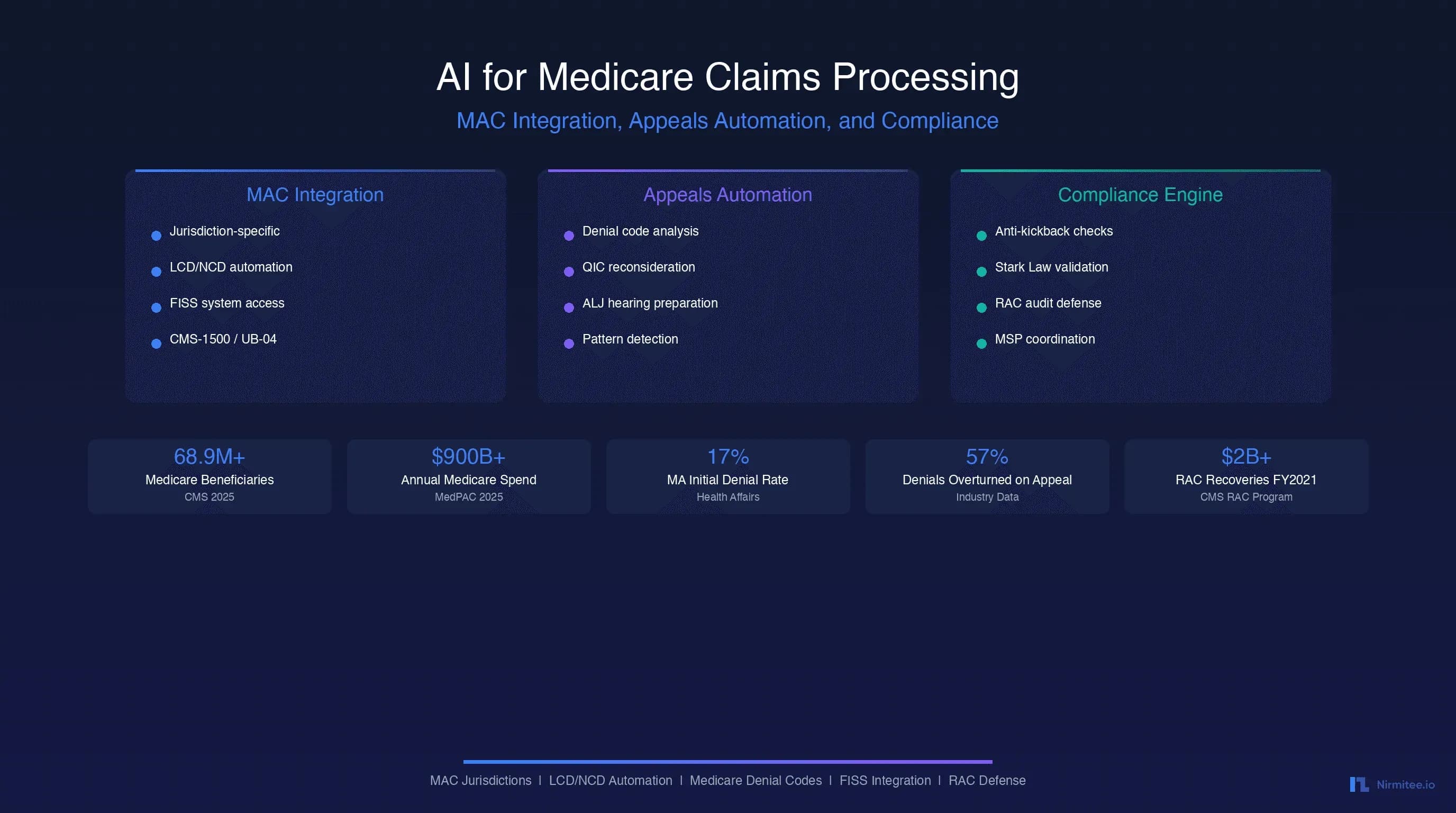
Medicare is the largest single payer in the United States healthcare system, covering 68.9 million beneficiaries as of 2025 and processing more than $900 billion in annual claims expenditure. For healthcare organizations that depend on Medicare reimbursement, claims processing is not just an operational concern. It is the financial backbone of the entire organization. And yet, most healthcare providers still process Medicare claims using the same manual workflows they used a decade ago, resulting in denial rates that have climbed to 17% for Medicare Advantage initial claims submissions and an industry-wide average of 11.8% for all initial claims.
The complexity of Medicare claims is unlike anything in commercial insurance. You are not dealing with a single payer. You are dealing with a system of seven Medicare Administrative Contractors (MACs) spread across different jurisdictions, each with their own Local Coverage Determinations (LCDs), claims processing nuances, and appeal procedures. You have four distinct parts of Medicare (A, B, C, and D), each with different claim forms, coverage rules, and payment methodologies. You have the Fiscal Intermediary Shared System (FISS) processing institutional claims and the Multi-Carrier System (MCS) handling professional claims. And on top of all this, you have Recovery Audit Contractors (RACs) looking backward at every claim you have submitted for up to six years, demanding refunds on anything they deem an overpayment.
This is the environment where AI-powered claims processing moves from nice-to-have to existential necessity. This guide goes deep into the Medicare-specific aspects of AI claims automation: how to integrate with MAC jurisdictions, automate LCD/NCD medical necessity checking, generate ABN notices, handle Medicare-specific denial codes, automate the five-level appeals process, coordinate Medicare Secondary Payer rules, and defend against RAC audits. If you are processing Medicare claims and not using AI for these workflows, you are leaving significant revenue on the table.
The Medicare Claims Landscape: Parts A, B, C, and D
Before diving into AI applications, it is essential to understand the structural complexity that makes Medicare claims fundamentally different from commercial insurance claims. Medicare is not one program. It is four distinct programs, each with different claim submission requirements, coverage rules, and payment methodologies.
Medicare Part A: Hospital Insurance
Part A covers inpatient hospital stays, skilled nursing facility care, hospice care, and some home health services. Claims are submitted on the UB-04 (CMS-1450) form, which requires revenue codes, HCPCS/CPT codes, and detailed accommodation information. Part A claims are processed through the Fiscal Intermediary Shared System (FISS), and the payment methodology is based on DRGs (Diagnosis-Related Groups) for inpatient hospital services, with prospective payment systems for other settings. The complexity here is in the DRG assignment: a single coding error can shift a claim from one DRG to another, resulting in payment differences of thousands of dollars.
Medicare Part B: Medical Insurance
Part B covers physician services, outpatient care, durable medical equipment, and preventive services. Claims are submitted on the CMS-1500 form using ICD-10 diagnosis codes and CPT/HCPCS procedure codes. Part B has a $283 annual deductible in 2026 (up from $257 in 2025) and requires 20% coinsurance from the beneficiary. The payment methodology is the Medicare Physician Fee Schedule (MPFS), which assigns Relative Value Units (RVUs) to each procedure. AI is particularly valuable for Part B claims because of the extensive LCD/NCD coverage policies that determine medical necessity for each service.
Medicare Part C: Medicare Advantage
More than 54% of Medicare beneficiaries, which is 34.1 million people, now choose Medicare Advantage over Original Medicare. Part C plans are administered by private insurers (UnitedHealthcare, Humana, Aetna, Cigna, and others) and create an entirely different claims workflow. While the claim forms may be similar, the coverage rules, prior authorization requirements, and appeal processes follow the plan's own guidelines rather than Original Medicare's policies. According to Health Affairs research published in 2025, Medicare Advantage plans deny 17% of initial claim submissions, and prior authorization denial rates have doubled since 2020. AI systems must maintain separate rule engines for Medicare Advantage plans versus Original Medicare, as the coverage criteria and appeal procedures differ substantially.
Medicare Part D: Prescription Drug Coverage
Part D covers outpatient prescription drugs through private insurance plans. Claims processing involves pharmacy benefit management (PBM) systems, drug formulary checking, prior authorization for specialty medications, and step therapy requirements. While Part D claims follow a different technical pathway than medical claims, AI is increasingly important for formulary exception processing and medication therapy management (MTM) programs.
The MAC System: Understanding Medicare's Regional Contractors
One of the most critical and least understood aspects of Medicare claims processing is the MAC system. Medicare does not process claims centrally. Instead, CMS contracts with private companies called Medicare Administrative Contractors to process and pay claims in specific geographic jurisdictions. Each MAC has its own portal, its own claims processing timelines, its own LCD/NCD interpretations, and its own appeal procedures. For AI systems, this means you cannot build a single claims processing engine. You need jurisdiction-aware intelligence that adapts to the specific MAC handling each claim.
Current MAC Jurisdictions (2026)
The current A/B MAC structure consists of seven primary contractors managing twelve jurisdictions across all fifty states and territories:
- Palmetto GBA (Jurisdictions JJ, JM): Covers Virginia, West Virginia, North Carolina, South Carolina, Georgia, Alabama, and Tennessee. Palmetto is known for detailed LCD policies on advanced imaging and surgical procedures.
- Novitas Solutions (Jurisdictions JL, JH): Covers Pennsylvania, New Jersey, Delaware, Maryland, DC, Arizona, Colorado, Louisiana, Mississippi, New Mexico, Oklahoma, and Texas. Novitas manages two of the largest jurisdictions by claim volume.
- National Government Services (NGS) (Jurisdictions JK, J6): Covers the Northeast (Connecticut, Maine, Massachusetts, New Hampshire, New York, Rhode Island, Vermont) and Upper Midwest (Illinois, Minnesota, Wisconsin).
- CGS Administrators (Jurisdiction J15): Covers Kentucky and Ohio. Despite being the smallest MAC by state count, CGS processes significant claim volume due to the population density of Ohio.
- WPS Government Health Administrators (Jurisdictions J5, J8): Covers Iowa, Kansas, Missouri, Nebraska, Indiana, and Michigan.
- First Coast Service Options (Jurisdiction JN): Covers Florida, Puerto Rico, and the US Virgin Islands. Florida has one of the highest Medicare utilization rates in the country due to its large retiree population.
- Noridian Healthcare Solutions (Jurisdictions JF, JE): Covers the largest geographic area spanning Alaska, Arizona, California, Hawaii, Idaho, Montana, Nevada, North Dakota, Oregon, South Dakota, Utah, Washington, and Wyoming.
Why MAC Jurisdiction Awareness Matters for AI
Each MAC develops its own Local Coverage Determinations (LCDs) that interpret national coverage policy for their jurisdiction. An LCD from Palmetto GBA for a specific procedure may have different documentation requirements than the LCD from Noridian for the same procedure. This means an AI system that works perfectly for a provider in Georgia may generate denials for a provider in California submitting identical claims for identical services, because the LCDs differ. AI claims processing systems must maintain a continuously updated database of LCD/NCD policies indexed by MAC jurisdiction, procedure code, and diagnosis code. When a claim is being prepared, the AI must identify which MAC will process the claim based on the provider's location, retrieve the applicable LCD/NCD policies, and validate that the documentation meets that specific MAC's requirements.
AI for LCD/NCD Medical Necessity Checking
Medical necessity is the single largest reason for Medicare claim denials. Local Coverage Determinations (LCDs) and National Coverage Determinations (NCDs) define which services Medicare covers and under what clinical circumstances. There are hundreds of active LCDs across all MAC jurisdictions, and they change regularly. Manually checking every claim against applicable LCDs before submission is humanly impossible at scale. This is where AI delivers its highest ROI in Medicare claims processing.
How AI-Powered LCD/NCD Checking Works
An AI medical necessity engine operates in the pre-submission workflow, intercepting every claim before it is sent to the MAC. The process follows these steps:
- Claim parsing: The AI reads the claim data including CPT/HCPCS procedure codes, ICD-10 diagnosis codes, place of service, and provider NPI.
- MAC identification: Based on the provider's state and the service type (Part A vs Part B), the AI identifies which MAC will process the claim.
- LCD/NCD retrieval: The AI queries its policy database for all applicable LCDs and NCDs covering the billed procedure codes in the identified MAC jurisdiction.
- Coverage analysis: The AI cross-references the diagnosis codes on the claim against the LCD's covered diagnosis list. If the diagnosis is not on the covered list, the claim will be denied for medical necessity.
- Documentation validation: For LCDs that require specific documentation elements (progress notes, test results, prior treatment records), the AI checks whether the supporting documentation is attached or available in the EHR.
- Decision output: The AI returns one of three results: claim is clean (submit), claim needs additional documentation (hold for review), or claim will not meet medical necessity (generate ABN).
Organizations that implement AI-powered LCD/NCD checking before claim submission report 40 to 55% reduction in medical necessity denials. For a mid-size hospital processing 50,000 Medicare claims per year with a 15% denial rate, this translates to preventing 3,000 to 4,000 denials annually, saving hundreds of thousands of dollars in rework and appeals costs. For a comprehensive view of how AI prevents denials across the entire revenue cycle, see our analysis on AI denial management architecture.
ABN (Advance Beneficiary Notice) Generation Automation
When the AI determines that a service is not likely to be covered under Medicare's medical necessity criteria, the provider must issue an Advance Beneficiary Notice of Noncoverage (ABN) to the patient before the service is rendered. The ABN (CMS form R-131) informs the patient that Medicare may not pay for the service and gives them the choice to receive the service and accept financial responsibility, or to decline the service.
AI automates ABN generation by detecting non-covered diagnosis-procedure combinations during eligibility checking or at the point of order entry in the EHR. When a physician orders a lab test or procedure that the AI determines lacks LCD-supported diagnosis coverage, the system automatically generates the ABN with the correct service description, estimated cost, and reason for expected non-coverage. This is triggered in real-time during the clinical workflow, not after the fact when the patient has already received the service. Without an ABN on file, the provider cannot bill the patient for a service Medicare denies. AI-driven ABN automation protects revenue that would otherwise be lost to uncollectable write-offs.
Medicare Claim Submission: CMS-1500 and UB-04 Specifics
CMS-1500 for Professional Claims (Part B)
The CMS-1500 is the standard claim form for professional services billed under Part B. AI validates critical fields that are frequent sources of Medicare denials:
- Box 21 (Diagnosis Codes): AI verifies ICD-10 codes are valid, specific to the required digit level, and support medical necessity per applicable LCDs. Medicare rejects claims with unspecified diagnosis codes when more specific codes are available.
- Box 24 (Service Lines): AI validates CPT/HCPCS codes, checks modifier requirements (modifier 25 for significant E/M with procedures, modifier 59 for distinct procedures), and ensures date of service accuracy.
- Box 11 (Insurance Information): AI checks for Medicare Secondary Payer situations by cross-referencing the patient's age, employment status, and other insurance coverage against MSP rules.
- Box 17 (Referring Provider): For services requiring referrals, AI validates that the referring provider NPI is active in PECOS (Provider Enrollment, Chain, and Ownership System).
UB-04 for Institutional Claims (Part A)
The UB-04 (CMS-1450) is used for institutional claims from hospitals, SNFs, home health agencies, and hospice providers. The UB-04 is substantially more complex than the CMS-1500, with 81 form locators that must be populated correctly. AI addresses the most denial-prone areas:
- Revenue Codes (FL 42): AI maps services to correct revenue codes and validates that revenue code, HCPCS code, and service description align. Mismatched revenue codes are a top cause of institutional claim denials.
- Occurrence Codes (FL 31-34): AI populates condition-specific occurrence codes (accident dates, symptom onset dates, transfer dates) that Medicare requires for certain claim types.
- Value Codes (FL 39-41): AI calculates and populates value codes for accommodations, blood deductibles, and other monetary amounts that affect payment.
- DRG Assignment Validation: For inpatient claims, AI reviews the principal diagnosis, secondary diagnoses, and procedures to predict the expected DRG assignment and flags cases where coding changes could result in a more accurate (and often higher-paying) DRG.
Medicare-Specific Denial Codes: AI Classification and Response
Medicare denial management requires understanding a specific taxonomy of denial codes that are unique to the Medicare program. While commercial insurers use standard CARC/RARC codes, Medicare adds its own layer of MA (Medicare Alert) codes and applies CO (Contractual Obligation) and PR (Patient Responsibility) codes in Medicare-specific ways. AI systems must be trained on these Medicare-specific code patterns to automate denial classification and response. For context on how AI manages denials across all payers, see our guide on US payer integration for eligibility, claims, and EDI.
CO (Contractual Obligation) Codes in Medicare Context
CO codes indicate amounts that the provider must write off per their Medicare participation agreement. The most common Medicare CO denial codes that AI must handle include:
- CO-4 (Procedure code inconsistent with modifier): Medicare is strict about modifier usage. AI auto-validates modifier-procedure combinations against Medicare's NCCI (National Correct Coding Initiative) edits before submission, preventing this denial entirely.
- CO-16 (Claim lacks information): The most common Medicare denial code. AI cross-checks all required fields against MAC-specific submission requirements and flags missing data before the claim is submitted.
- CO-18 (Duplicate claim): Medicare's duplicate detection is aggressive. AI maintains a claim submission log and checks for exact and near-duplicate claims before submission, flagging potential duplicates for review.
- CO-50 (Not deemed medically necessary): The medical necessity denial. AI automatically retrieves the applicable LCD/NCD, compares the claim's diagnosis codes against the covered diagnosis list, and either corrects the coding or prepares an appeal with supporting clinical documentation.
- CO-97 (Payment already included in another service): CCI bundling edits. AI checks all procedure code combinations on a claim against Medicare's CCI edit table and applies appropriate modifiers or separates services to different dates when clinically appropriate.
MA (Medicare Alert) Codes
MA codes are unique to Medicare and appear on the Medicare Remittance Advice (MRA). They are informational alerts that guide provider response. Key MA codes that AI must process:
- MA01: Alert indicating appeal rights. The AI tracks the 120-day appeal window and auto-schedules appeal preparation when the denial is appealable.
- MA07: Alert for missing or incomplete information. AI cross-references against the original claim to identify exactly what information is missing and auto-generates a corrected claim.
- MA13: Medicare Secondary Payer alert indicating COB coordination is needed. AI triggers the MSP workflow to identify the primary payer and resubmit the claim correctly.
- MA15: Alert for separately payable services. AI analyzes revenue code and HCPCS combinations to unbundle services that were incorrectly combined.
- MA130: Home Health Agency surety bond requirement. AI automatically verifies bond status and flags when renewal is approaching.
AI-Powered Denial Triage
When a Medicare denial is received, the AI triage engine classifies it into one of four response categories within seconds: (1) auto-correct and resubmit, for claims with fixable data errors; (2) appeal with clinical evidence, for medical necessity denials where documentation supports coverage; (3) patient billing, for legitimate patient responsibility amounts; or (4) write off, for contractual obligations that cannot be recovered. This classification, which typically takes a billing specialist 15 to 30 minutes per denial, happens in under 2 minutes with AI. For organizations processing thousands of Medicare denials monthly, this reduces denial resolution time from an average of 45 days to under 7 days.
AI Appeals Automation for Medicare: The 5-Level Process
Medicare has a structured five-level appeals process that is more formalized and more complex than any commercial payer's appeal system. Each level has specific deadlines, submission requirements, and reviewing entities. Fewer than 1% of denied Medicare claims are ever appealed, yet 44% of those that are appealed succeed. This represents a massive missed revenue opportunity that AI is uniquely positioned to capture.
Level 1: Redetermination by the MAC
The first level of appeal is a redetermination request submitted to the original MAC that denied the claim. The provider has 120 days from receipt of the Medicare Remittance Advice to file. According to CMS data, approximately 56% of redetermination appeals are decided fully or partially in favor of the provider.
AI automates Level 1 appeals by analyzing the denial reason code, retrieving the original claim and all supporting documentation from the EHR, identifying what additional evidence would support the claim, and generating a structured appeal letter that addresses the specific denial reason. For medical necessity denials (CO-50), the AI attaches relevant clinical documentation, references the applicable LCD/NCD policy, and articulates why the documentation meets the coverage criteria. For coding-related denials, the AI suggests code corrections with supporting clinical rationale.
Level 2: QIC Reconsideration
If the redetermination is unfavorable, the provider can request reconsideration by a Qualified Independent Contractor (QIC) within 180 days. The QIC is an independent entity that reviews the case fresh, without deference to the MAC's original decision. Success rates at the QIC level are approximately 33%, but AI-prepared cases consistently outperform manually prepared cases because the evidence package is more complete and the arguments are more precisely targeted to the regulatory criteria.
AI enhances QIC submissions by strengthening the evidence package with peer-reviewed literature supporting the clinical decision, adding detailed clinical timelines that demonstrate the progression of the patient's condition, and including comparative analysis showing how the treatment aligns with standard of care guidelines. The AI also identifies weaknesses in the MAC's original denial rationale and addresses them directly in the reconsideration request.
Level 3: Administrative Law Judge (ALJ) Hearing
The ALJ hearing is conducted by the Office of Medicare Hearings and Appeals (OMHA) and must be requested within 60 days of the QIC decision. This is a quasi-judicial proceeding where the provider can present testimony and evidence before an Administrative Law Judge. According to OMHA statistics, approximately 42% of ALJ appeals result in fully or partially favorable decisions.
AI transforms ALJ hearing preparation by organizing all case documents into a structured exhibit package, preparing hearing briefs that reference relevant Medicare statutes, regulations, and prior ALJ decisions, identifying the most persuasive clinical evidence, and generating predictive analytics on case outcomes based on the specific ALJ's decision history and the denial type. Some AI systems can even analyze the specific judge's prior rulings to identify which arguments and evidence types are most likely to succeed with that particular ALJ.
Level 4: Medicare Appeals Council
The Medicare Appeals Council (part of the Departmental Appeals Board, or DAB) reviews ALJ decisions on request. The provider has 60 days to request review. Success rates at this level drop to approximately 15%, as the Council generally defers to the ALJ's factual findings and reviews primarily for legal errors. AI supports Level 4 appeals by identifying legal arguments, regulatory interpretation issues, and precedent cases that could persuade the Council to overturn the ALJ decision.
Level 5: Federal District Court
The final appeal level is judicial review by a US District Court, available within 60 days of the Appeals Council decision. Fewer than 10% of cases that reach this level succeed. AI provides discovery support, document analysis, and regulatory tracking for cases that escalate to federal court, though human legal counsel is essential at this stage.
AI Appeals Impact
The financial impact of AI-automated Medicare appeals is substantial. The average value of a Medicare appeal ranges from $10,000 to $50,000 depending on the service type. Organizations that implement AI-powered appeals automation report preparing appeals 3 to 4 times faster than manual processes (7 to 14 days versus 30 to 45 days), filing appeals on a significantly higher percentage of denied claims (from less than 1% to 15 to 25%), and improving appeal success rates by 15 to 25 percentage points through better evidence assembly and argument construction.
Medicare Secondary Payer (MSP) Coordination
Medicare Secondary Payer rules are among the most complex aspects of Medicare claims processing. When a Medicare beneficiary has other insurance coverage through an employer group health plan, auto insurance, workers' compensation, or other liability insurance, Medicare may be the secondary payer rather than the primary payer. Billing Medicare as primary when another payer is primary results in improper payments that are subject to recovery, and the penalties for MSP violations can be severe.
AI automates MSP coordination through several mechanisms. First, the AI screens every Medicare patient at registration for potential MSP situations by checking the patient's age, employment status, disability status, and ESRD status against MSP rules. Second, the AI queries the CMS Coordination of Benefits (COB) database to identify other insurance coverage. Third, when MSP applies, the AI routes the claim to the primary payer first, tracks the primary payer's response, and then submits the residual balance to Medicare as secondary with the correct MSP indicator codes. Fourth, the AI monitors for changes in patient employment or insurance status that could change MSP eligibility.
MSP errors are a major target for RAC audits. CMS recovers billions annually in MSP-related overpayments. AI-driven MSP screening prevents these overpayments by identifying the correct payment order before claims are submitted, rather than after RAC auditors discover the error years later.
RAC Audit Preparation and Defense
Recovery Audit Contractors are private companies hired by CMS to identify and recover improper Medicare payments. RAC contractors identified over $2 billion in improper payments in FY 2021 alone. In 2025, CMS awarded new RAC contracts to Cotiviti GOV Services LLC for Regions 3, 4, and 5, signaling an expansion of audit activity. CMS is also completing outstanding RADV (Risk Adjustment Data Validation) audits for Payment Years 2018 through 2024 by early 2026, meaning retroactive scrutiny will be intense.
AI-Powered Pre-Audit Protection
The most effective RAC defense is not responding to audits. It is preventing audit findings in the first place. AI provides proactive RAC protection through continuous monitoring of claims against known RAC target areas, identification of billing patterns that match audit triggers (high frequency of certain procedure codes, unusual modifier usage patterns, outlier charges), documentation completeness verification before claims are submitted, and automated internal audits that mirror RAC review methodologies.
RAC contractors performed 168,000 reviews in a recent audit cycle and denied 35,000 claims, yielding a 20.8% denial rate. Of those denials, approximately 56% were overturned at the first level of appeal. This means RAC auditors are wrong more than half the time at the redetermination level, but providers only recover that money if they appeal. AI systems that automatically prepare RAC appeal packets ensure that every recoverable denial is contested.
RAC Audit Response Workflow
When a RAC request is received, the AI-powered response workflow activates immediately. The system identifies the specific claims under review, retrieves all supporting documentation from the EHR, evaluates whether the claim is defensible based on LCD/NCD requirements and clinical documentation, prepares a response package for defensible claims, identifies claims where refund is appropriate (preventing unnecessary appeal costs), and tracks all RAC interaction deadlines to prevent default losses. Organizations that implement AI-powered RAC defense report reducing audit exposure by 60% through proactive claim screening and increasing appeal success rates from the industry average of 56% to 73% or higher.
FISS Integration: Connecting AI to Medicare's Processing Systems
The Fiscal Intermediary Shared System (FISS) is the claims processing system used by all MACs to adjudicate Medicare Part A institutional claims. FISS processes claims through a series of automated edits, checking for coding validity, coverage compliance, and payment accuracy. Understanding how FISS processes claims is essential for building AI systems that minimize claim rejections and accelerate payment.
FISS Claim Lifecycle
When an institutional claim enters FISS, it passes through several processing stages. Each stage applies specific edits that can result in the claim being returned to provider (RTP), suspended for additional information, or denied. The AI pre-submission engine mirrors these FISS edits locally, running the claim through the same validation logic before submission so that claims that would fail FISS edits are caught and corrected before they ever reach the MAC. Key FISS edits that AI must replicate include provider enrollment verification (checking that the billing provider is active in PECOS), beneficiary eligibility confirmation (verifying the patient has active Part A coverage on the date of service), CCI edit application (checking procedure code combinations against NCCI bundling rules), and coverage period validation (ensuring the service dates fall within the patient's benefit period).
Direct Data Entry (DDE) and AI
FISS Direct Data Entry allows providers to interact with FISS directly to submit claims, check claim status, and correct returned claims. AI systems can interface with DDE functionality through automated screen interactions or, where available, through batch processing interfaces. The AI monitors claim status in FISS, identifies claims that have been RTP'd or suspended, retrieves the specific reason codes, and initiates corrective action automatically.
Medicare Advantage vs Original Medicare: AI Workflow Differences
The shift of 54% of Medicare beneficiaries to Medicare Advantage creates a dual-track claims processing challenge. Providers must maintain separate workflows for Original Medicare (processed through MACs and FISS) and Medicare Advantage (processed through private plan portals and clearinghouses). AI systems must detect which track a claim should follow based on the patient's coverage type.
Key Differences for AI Workflow Design
| Dimension | Original Medicare | Medicare Advantage (Part C) |
|---|---|---|
| Claims processor | MAC (7 contractors) | Private insurer (100+ plans) |
| Prior authorization | Limited (expanding with WISeR 2026) | Extensive for most services |
| Coverage rules | NCD/LCD national + local | Plan-specific formulary + network |
| Denial rate | ~8-10% (Part A/B) | ~17% (MA initial claims) |
| Appeal process | 5 levels (MAC to Federal Court) | Plan internal + external review |
| Payment methodology | FFS (DRG, MPFS, OPPS) | Capitated to plan; plan pays FFS |
| RAC audit exposure | Direct RAC review | RADV audit (risk adjustment) |
The CMS WISeR (Wasteful and Inappropriate Service Reduction) Model launching January 2026 introduces AI-powered prior authorization to Original Medicare in six pilot states (New Jersey, Ohio, Oklahoma, Texas, Arizona, and Washington). This is a significant development because Original Medicare has historically required minimal prior authorization. AI systems must now handle prior authorization workflows for Original Medicare claims in these states, adding a new layer of complexity to what was previously a simpler submission process. For a detailed analysis of regulatory changes affecting healthcare technology, see our guide on CMS and ONC healthcare regulations 2026.
Compliance in AI-Powered Medicare Claims Processing
Deploying AI for Medicare claims processing introduces specific compliance obligations that go beyond standard HIPAA requirements. The three major compliance frameworks that AI systems must address are the Anti-Kickback Statute (AKS), the Stark Law (Physician Self-Referral Law), and the False Claims Act (FCA).
Anti-Kickback Statute and AI
The AKS prohibits offering, paying, soliciting, or receiving anything of value to induce referrals for services covered by federal healthcare programs, including Medicare. AI systems must be designed so they do not create incentives for unnecessary services. Specifically, if an AI system recommends additional procedures or tests, it must do so based solely on clinical evidence and coverage criteria, not on revenue optimization. AI audit trails must demonstrate that every recommendation is clinically justified, and the system must not be trained to maximize billing revenue as a primary objective.
Stark Law and AI
The Stark Law prohibits physicians from referring Medicare patients for designated health services to entities with which the physician (or an immediate family member) has a financial relationship, unless an exception applies. AI systems that route referrals or recommend downstream services must incorporate Stark Law compliance checking. The AI must maintain a database of physician financial relationships and validate that every referral recommendation complies with applicable Stark exceptions before the referral is processed.
False Claims Act and AI
The FCA imposes liability on anyone who knowingly submits false or fraudulent claims to the government. If an AI system submits a claim that it should have identified as incorrect, the provider could face FCA liability. This means AI systems must be conservative in their coding recommendations, must flag uncertain claims for human review rather than auto-submitting, and must maintain detailed audit trails showing the reasoning behind every claim submission decision. The "knowing" standard under the FCA includes reckless disregard, so an AI system that could have caught an error but did not may expose the provider to triple damages and per-claim penalties.
Building Compliance into AI Architecture
Compliance cannot be bolted onto an AI claims processing system after the fact. It must be built into the architecture from the ground up. Key architectural requirements include complete audit logging of every AI decision with the reasoning chain preserved, human-in-the-loop checkpoints for high-value claims and coding changes that exceed configurable thresholds, regular model validation against known correct claim outcomes, separation of the AI recommendation engine from the claim submission engine (so a human or rule-based system makes the final submit decision), and built-in bias detection to ensure the AI does not systematically upcode, unbundle, or optimize in ways that could be interpreted as fraudulent billing patterns.
Implementation Roadmap: Medicare AI Claims Processing
For healthcare organizations ready to deploy AI for Medicare claims processing, the implementation follows a phased approach that builds capability incrementally while maintaining compliance at every stage.
Phase 1: Pre-Submission Intelligence (Months 1-3)
Deploy AI-powered LCD/NCD checking and claim validation before claims are submitted. This is the lowest-risk, highest-ROI starting point. The AI reads claims from the billing system, validates against MAC-specific coverage policies, and flags potential denials before submission. ABN generation automation is included in this phase. Expected impact: 40 to 55% reduction in preventable denials.
Phase 2: Denial Triage and Response (Months 4-6)
Extend the AI to Medicare denial management. The system reads ERAs from all MACs, classifies denial codes into response categories, and auto-generates corrected claims and Level 1 appeal letters. Expected impact: denial resolution time reduced from 45 days to under 7 days, with 15 to 25% more denials successfully appealed.
Phase 3: Full Appeals Automation (Months 7-9)
Expand to full five-level Medicare appeals automation, including QIC reconsideration packages and ALJ hearing preparation. AI builds evidence packages, tracks all appeal deadlines, and maintains case files across appeal levels. Expected impact: 3 to 4x increase in appeal filing rate, with improved success rates across all appeal levels.
Phase 4: RAC Defense and Compliance (Months 10-12)
Deploy proactive RAC audit defense including continuous claims monitoring, internal audit simulation, MSP screening, and compliance validation against AKS, Stark, and FCA requirements. Expected impact: 60% reduction in RAC audit exposure, with audit response time reduced to under 48 hours.
Frequently Asked Questions
How does AI handle the differences between Medicare Part A and Part B claims processing?
AI maintains separate processing pipelines for Part A (institutional, UB-04) and Part B (professional, CMS-1500) claims. For Part A, the AI validates DRG assignment accuracy, revenue code mapping, and FISS edit compliance. For Part B, the AI focuses on LCD/NCD medical necessity checking, modifier validation against NCCI edits, and MPFS fee schedule verification. The AI identifies the correct pipeline based on the claim type, provider type, and place of service, then applies the appropriate validation rules and submission routing for each MAC jurisdiction.
What is the ROI of AI-powered Medicare appeals automation?
The ROI is substantial because of the high value of Medicare claims and the current low appeal rate. Fewer than 1% of denied Medicare claims are appealed, yet 44% of those that are appealed succeed. For a healthcare organization with $50 million in annual Medicare revenue and a 12% denial rate, that represents $6 million in denials. If AI increases the appeal rate from 1% to 20% and maintains a 50% success rate, the organization recovers an additional $570,000 annually. The cost of AI appeals automation typically ranges from $150,000 to $300,000 annually, delivering a 2 to 4x return in the first year alone, with improvements in subsequent years as the AI learns from outcomes.
How does AI coordinate Medicare Secondary Payer rules across multiple insurance types?
AI automates MSP coordination by maintaining a decision engine that evaluates each patient encounter against the full MSP priority matrix. The AI checks the patient's age (working aged provisions apply at 65+), employment status (employer group health plans are primary for active employees), disability status (large group health plans are primary for disabled beneficiaries under 65), ESRD status (coordination period rules differ), and other liability coverage (auto insurance, workers' compensation). The AI queries the CMS COB database, routes claims to the correct primary payer first, and submits the balance to Medicare with the appropriate MSP conditional payment indicators.
Can AI help with the new CMS WISeR prior authorization requirements for Original Medicare?
Yes. The WISeR Model launching in January 2026 introduces AI-screened prior authorization for Original Medicare in six pilot states (NJ, OH, OK, TX, AZ, WA). AI systems can prepare prior authorization requests by extracting clinical information from the EHR, matching it against WISeR's coverage criteria, assembling the required documentation, and submitting the authorization request. Since WISeR uses AI and ML for its own review, providers that use AI to prepare thorough, well-documented authorization requests will likely experience higher approval rates because the submissions will be more complete and better aligned with the algorithmic review criteria.
What compliance safeguards must be built into AI Medicare claims processing systems?
Five critical safeguards are non-negotiable. First, complete audit trails that log every AI decision with its reasoning chain, preserving evidence for regulatory review. Second, human-in-the-loop checkpoints for high-value claims, coding changes above configurable thresholds, and any claim where AI confidence is below a set level. Third, anti-upcoding detection that monitors for systematic coding optimization patterns that could trigger False Claims Act liability. Fourth, Stark Law referral checking that validates every referral recommendation against a database of physician financial relationships. Fifth, regular model validation against known correct outcomes, with mandatory retraining when accuracy drops below defined thresholds. These safeguards must be architectural requirements, not optional features.
Ready to scale?
Talk to our healthcare engineering team about building, integrating, and shipping faster.
Frequently Asked Questions
How can AI improve Medicare claims processing?
What is a Medicare Administrative Contractor (MAC)?
What is the denial rate for Medicare Advantage claims?
What is the difference between Medicare Part A and Part B claims?
Why do Medicare claims need AI for compliance and audit defense?
How does Nirmitee.io approach healthcare software development?