Why Claims Integration Breaks Dev Teams: 7 Traps in the 837/835 Loop

CTO & Co-Founder
CTO & Co-Founder at Nirmitee.io. Architects healthcare integrations across FHIR, SMART on FHIR, ABDM and NHCX, writing from production experience taking hospital software from sandbox to go-live.
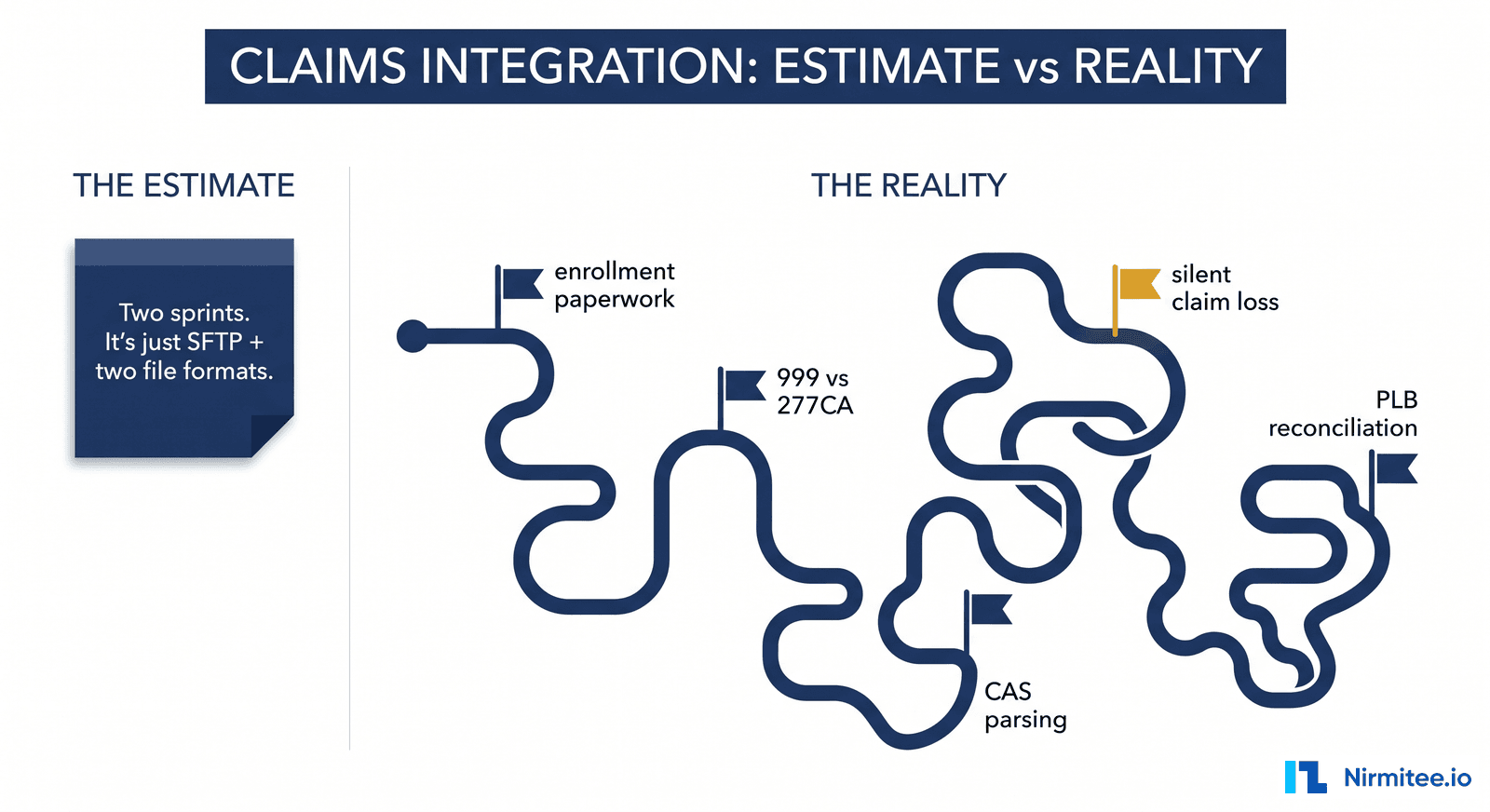
Every claims integration starts with the same estimate: “it's an SFTP drop and two file formats — a sprint, maybe two.” Then reality arrives: 45% of organizations report taking five or more months to integrate a single new payer, and denial rates keep climbing while the team debugs acknowledgements they didn't know existed. This post is the list of traps we wish someone had handed us before our first X12 claims integration — each one verified in production.
Trap #1: The 999 Says “Accepted” — Your Claim Wasn't
Acknowledgements come in layers, and each one answers a different question:
- TA1 — “your envelope was readable.”
- 999 — “your file's syntax conforms.” Nothing about your claims.
- 277CA — the actual claim-level verdict: accepted into processing, or rejected with a reason, one by one.
A clean 999 followed by a rejected 277CA is a documented, normal pattern (see the Minnesota AUC acknowledgement best-practice guide). Teams that stop parsing at the 999 mark claims “sent successfully” while a third of them bounced — and nobody finds out until the aging report.
Trap #2: Two Different Transactions Are Both Called a “277”
The clearinghouse's claim acknowledgement (277CA) and the payer's claim-status response (to a 276 inquiry) share the same transaction code. They are different business messages, distinguished by the BHT06 value — the 277CA carries TH per the CAQH CORE rule. Route both into one parser and your claim statuses quietly stop updating — a bug we have personally debugged in a production EHR. Almost nobody documents this. Now you know.
Trap #3: Enrollment Paperwork Is Your Real Critical Path
EDI enrollment runs 2–6 weeks per payer; ERA enrollment up to 60 days — forms, portals, sometimes literal signatures. Your sprint plan is hostage to paperwork, not code. The fix is sequencing: start enrollment for your top payers before the first line of integration code, and build an enrollment tracker, because “payer X never sends us 835s” is usually an enrollment that never completed.
Trap #4: The Mailbox Is Not a System of Record
Clearinghouse SFTP folders are a conveyor belt, not an archive: uploads are consumed on pickup, and response files age out. If you don't download and persist every raw file and acknowledgement on receipt, the audit trail is gone — and the day you need it is exactly the day you're proving timely filing on an appeal. Persist everything, immutably, from day one.
Trap #5: Claims Can Vanish Silently
There are documented ways a claim disappears with no rejection ever reaching you: dropped between clearinghouse and payer, stalled in forwarding, or routed to the wrong payer ID (some Blues plans resolve to dozens of regional payer IDs). The cost of silence is brutal: timely-filing denials are almost never overturned, so a silently lost claim converts directly into a permanent write-off. The defenses: alert when any batch has no acknowledgement inside its expected window, and run 276 status polling as a safety net for claims that go quiet.
Trap #6: CAS Segments Will Break Your First Parser
The 835's adjustment segment (CAS) packs up to six reason-code triplets per segment, repeats per group code, and appears at both claim and service-line level. Get the iteration wrong and every adjustment after the first inherits the wrong group code — which silently corrupts write-off vs patient-responsibility math. This is not a beginner mistake: IBM shipped a fix for exactly this bug in its own EDI translator. Test your parser against multi-adjustment CAS segments specifically.
Trap #7: The ERA Is Not the Money
The 835's payment total follows a balancing rule: BPR02 = ΣCLP04 − net PLB — the claim payments minus provider-level adjustments like recoupments, interest, and offsets (UHC's PLB reference). Skip PLB handling and your posting engine will chase phantom discrepancies between remits and bank deposits forever. Reconcile via the TRN trace number to the actual EFT — our guide to reading an ERA walks the full math.
What a Production-Grade Claims Pipeline Actually Needs
- An acknowledgement state machine — TA1 → 999 → 277CA → 835, per claim, with alerting on silence
- Raw-file persistence — every file in and out, immutable, timestamped
- 276 status polling for claims that go quiet
- An enrollment tracker treated as seriously as the code
- PLB-aware, CAS-correct posting with group-code logic (CO write-off vs PR patient vs OA/PI review)
None of this is exotic — but all of it is invisible until it fails, which is why the two-sprint estimate keeps happening. For the step-by-step build sequence, see our clearinghouse integration guide; for what the responses mean, start with the 835 file explained.
We have shipped this pipeline — acknowledgement handling, 835 posting, denial routing — inside production EHRs, and debugged most of these traps the hard way first. If your team is scoping a claims build, a one-hour architecture review against this checklist is cheap insurance. Explore our healthcare interoperability solutions or talk to our team.
Ready to scale?
Talk to our healthcare engineering team about building, integrating, and shipping faster.
Frequently Asked Questions
Does a 999 acceptance mean the payer accepted my claim?
What is the difference between a 277CA and a 277?
How long does payer EDI and ERA enrollment take?
Why doesn't the 835 total match the bank deposit?
What causes claims to be lost between clearinghouse and payer?
How much does it cost to rework a denied claim?