What Is an 835 File? ERA Explained With a Real Example

CTO & Co-Founder
CTO & Co-Founder at Nirmitee.io. Architects healthcare integrations across FHIR, SMART on FHIR, ABDM and NHCX, writing from production experience taking hospital software from sandbox to go-live.
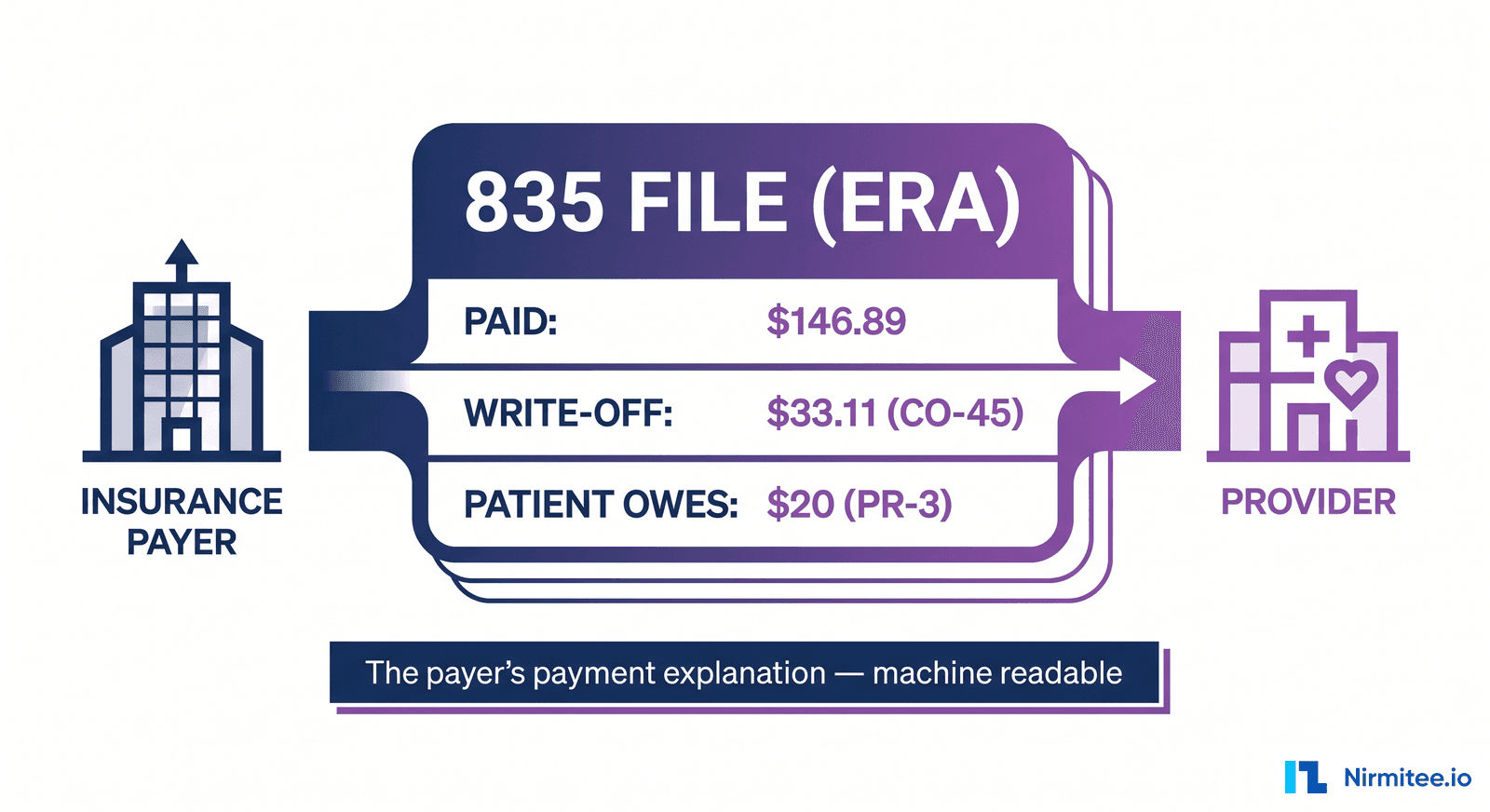
An 835 file is the electronic file an insurance payer sends a healthcare provider after processing a claim. It says what was paid, what was adjusted, what was denied, and why — for every claim in the batch. It is the machine-readable version of an EOB, and it is what your billing software uses to post payments automatically. The 835 is also called an ERA (Electronic Remittance Advice), and it is a HIPAA-standard X12 EDI transaction (version 005010X221A1).
Watch: How to Read an 835 ERA: Billed vs Paid vs Adjusted, Explained for Engineers (9:29).
Watch: 835 vs EFT: Why an ERA Does Not Mean You Got Paid (8:13).
Where the 835 Fits in the Claim Cycle
The claim cycle is a round trip. You send a bill; the payer sends back an answer:
- 837 goes out — your claim, sent to the payer (usually through a clearinghouse).
- 999 and 277CA come back — quick acknowledgements: “file received” and “claim accepted/rejected for processing.”
- The payer adjudicates — decides what it will pay.
- The 835 comes back — the payment explanation, alongside the actual money (EFT or check). This typically arrives 7–21 days after submission.
835 vs 837 vs EOB: What's the Difference?
| 837 | 835 | EOB | |
|---|---|---|---|
| What it is | The claim (the bill) | The payment explanation | The patient's copy of the decision |
| Direction | Provider → payer | Payer → provider | Payer → patient |
| Format | X12 EDI file | X12 EDI file | Human-readable letter/PDF |
| Purpose | “Please pay for this care” | “Here's what we paid and why” | “Here's what your plan did” |
Simple rule: the 837 asks for money, the 835 explains the money. For a side-by-side 835 vs 837 comparison, including how each 835 matches back to its 837, see our developer guide.
A Real 835 Example, Decoded Line by Line
Here is a simplified (fully synthetic) 835 — and what each line actually says:
BPR*I*146.89*C*ACH************20260824~
TRN*1*1512345678*1999999999~
N1*PR*SAMPLE HEALTH PLAN~
N1*PE*RIVERBEND CLINIC*XX*1999999999~
CLP*ACCT-2001*1*200*146.89*20*12*...~
CAS*CO*45*33.11~
CAS*PR*3*20~
SVC*HC:90837*200*146.89~- BPR — the money line: $146.89 total, paid by ACH, effective Aug 24.
- TRN — the trace number. The same number rides on your bank deposit — it is how you match this file to actual money.
- N1*PR / N1*PE — who paid (payer) and who got paid (payee).
- CLP — one claim's outcome: billed $200, paid $146.89, patient owes $20, status
1(processed as primary). Status4would mean denied. - CAS — the adjustments: $33.11 written off as a contractual adjustment (CO-45), $20 is the patient's copay (PR-3).
- SVC — the same story per service line: CPT 90837, billed $200, paid $146.89.
The math always reconciles: billed ($200) = paid ($146.89) + patient ($20) + adjustments ($33.11).
The Adjustment Codes: CO, PR, OA, PI
Every dollar the payer didn't pay carries a group code (who absorbs it) and a reason code (why):
- CO (Contractual Obligation) — your write-off. Never billable to the patient. CO-45 (charge over the fee schedule) is the most common code on almost every remit.
- PR (Patient Responsibility) — billable to the patient: PR-1 deductible, PR-2 coinsurance, PR-3 copay.
- OA (Other Adjustments) — neither of the above; review before writing off.
- PI (Payer-Initiated Reductions) — payer-side reductions; often worth appealing.
Reason codes (CARCs) are maintained by X12 and updated three times a year. We keep a plain-English reference of the most common ones in our denial codes guide.
Why Your 835 Doesn't Match Your Bank Deposit
Three usual suspects:
- PLB segments — provider-level adjustments like recoupments of past overpayments or interest, applied to the check total but not to any claim in this file.
- Split payments — one deposit covering multiple 835 files (or the reverse).
- Reassociation gaps — the TRN trace number on the 835 must match the EFT addenda; CAQH CORE operating rules exist precisely to make this matching possible.
How to Open and Read an 835 File
Raw 835s are deliberately machine-readable — CMS itself notes the format is “not suitable for viewing by provider personnel.” Your options:
- Your practice management system — auto-posts ERAs; most staff never see the raw file.
- Free CMS tools — Medicare Remit Easy Print (MREP) for Part B and PC-Print for Part A turn raw 835s into readable remits.
- EDI viewers — developer tools that decode any X12 file segment by segment.
The Business Case: Manual vs Electronic Remittance
Per the 2024 CAQH Index: 89% of medical remittances are now electronic; a manual remittance costs about $6.24 to process versus $3.03 electronic — roughly $3.21 saved per transaction, and about 4 minutes of staff time per remit. If your team still keys payments from paper EOBs, that difference compounds on every single payment you receive.
Want to read your own 835? Paste it into our free EDI Inspector — hover any element for its meaning, see the denial autopsy, all in your browser with nothing uploaded.
If your billing platform struggles to parse, post, or reconcile 835s — or your “remaining balance” math never quite closes — our revenue cycle management software development team builds this exact layer for EHRs and billing platforms. Talk to our team.
Ready to scale?
Talk to our healthcare engineering team about building, integrating, and shipping faster.
Frequently Asked Questions
What is the difference between an 835 and an 837 file?
Is an 835 the same as an ERA or an EOB?
Who sends the 835 file?
How do I open an 835 file?
Why doesn't my 835 total match my bank deposit?
Are payers required to send an 835?