The Hidden Integration Gap in Modern Radiology
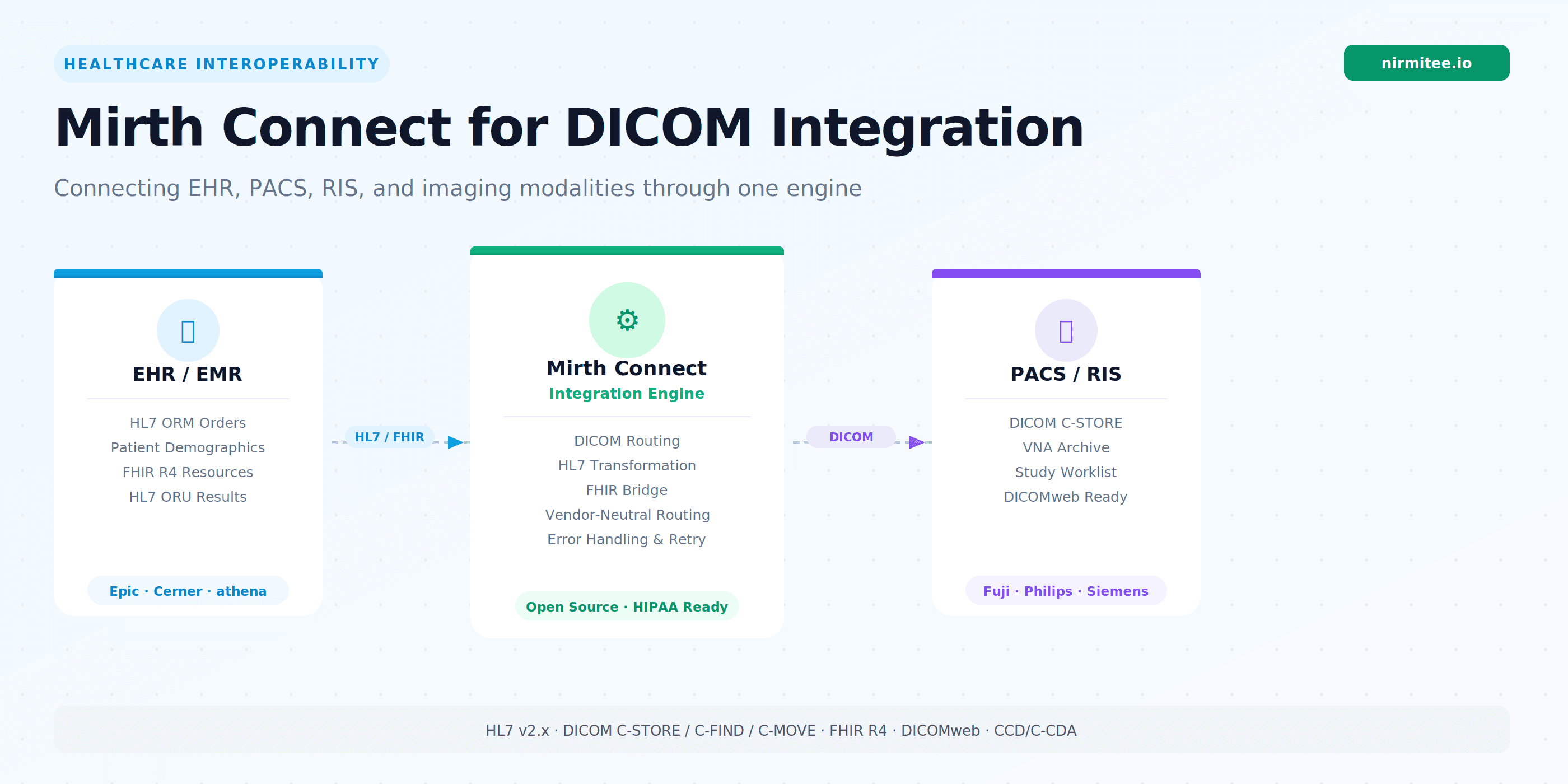
Medical imaging sits at the center of nearly every clinical decision. But the systems that generate, store, and consume that data almost never talk to each other natively. Your EHR is from Epic or Cerner. Your PACS is from Fuji or Philips. Your RIS is a third system entirely. Without a capable integration layer between them, your radiology department is manually stitching together data that should flow automatically. That integration layer is Mirth Connect.
What Is Mirth Connect, and Why Does It Matter for DICOM?
Mirth Connect is an open-source healthcare integration engine built specifically for clinical data exchange. It routes and transforms messages between systems — ingesting in one protocol format and delivering in whatever the receiving system expects.
While most teams deploy Mirth Connect for HL7 v2 messaging, its DICOM capabilities are equally mature. It supports DICOM C-STORE, C-FIND, C-MOVE, and C-GET — the core service classes imaging systems use to send, query, and retrieve studies. A single Mirth Connect deployment handles both the clinical messaging layer (HL7 orders and results) and the imaging layer (DICOM study routing) without separate middleware stacks. One platform, one set of channels, one point of control over data flow across your entire imaging ecosystem.
The Core Challenges Mirth Connect Solves
Protocol Fragmentation
A single imaging order touches multiple protocols. The physician places the order in the EHR using HL7 ORM. The RIS receives it. The modality produces DICOM images. The radiologist's report comes back as HL7 ORU. Without middleware that understands each protocol, you get manual workarounds and data silos at every handoff.
Vendor Heterogeneity
Hospital networks run imaging equipment from multiple manufacturers, each with its own DICOM implementation quirks. Mirth Connect's channel-based architecture handles these differences at the routing layer — no changes required at source or destination systems.
Workflow Synchronization
Radiology is not just about images. It is the data that contextualizes those images: patient demographics, order details, prior studies, and billing codes. Syncing all of this across PACS, RIS, and EHR in real time requires a routing engine that understands the relationship between clinical messages and imaging data.
How the Radiology Workflow Looks with Mirth Connect
- The physician places an imaging order in the EHR. HL7 ORM message generated. Mirth Connect validates and routes it to the RIS.
- Mirth Connect routes to RIS. Transforms message format if needed. No changes required at source or destination.
- Radiology team performs a scan. DICOM images produced. Patient demographics auto-populated in headers from the worklist via Mirth Connect.
- DICOM study routed to PACS. Mirth Connect sends via C-STORE to PACS and optionally to VNA or cloud archive simultaneously.
- Radiologist signs report. HL7 ORU message generated and sent back through Mirth Connect to the ordering EHR.
- Physician receives results in EHR. Imaging order, DICOM study reference, and signed report synchronized — no manual lookup required.
Key Reasons Engineering Teams Choose Mirth Connect for DICOM
Vendor-Neutral by Design
Mirth Connect connects any PACS, RIS, or EHR combination. This makes it the right choice for hospital networks with heterogeneous vendor environments and for teams consolidating systems after acquisitions. You are building a routing layer that adapts to your systems, not locking into a vendor ecosystem.
Open Source with Enterprise-Grade Stability
Mirth Connect's open-source core has been in production in healthcare environments for over a decade. Commercial support from NextGen Healthcare is available for SLA-backed deployments. No per-channel or per-message fees in the open-source version.
Single Engine for All Protocols
A single deployment manages HL7 v2 ORM/ORU messaging, DICOM C-STORE/C-FIND operations, and FHIR R4 ImagingStudy resources — without separate middleware per protocol layer.
Automation at Scale
Mirth Connect's channel architecture supports high-throughput message processing with configurable queuing, retry logic, and error alerting — workflows stay reliable at peak imaging volume.
Scalability and Future-Readiness
DICOMweb support (WADO-RS, STOW-RS, QIDO-RS) means channels can interface with cloud-native imaging systems just as easily as legacy PACS. For teams building AI diagnostic pipelines, Mirth Connect serves as the routing layer that feeds DICOM studies to ML inference services and returns AI-generated annotations back as structured DICOM SR documents.
What to Consider Before Implementation
- DICOM conformance statements. Every PACS and modality defines which service classes it supports. Review these before designing channels — mismatched SCU/SCP configurations are the most common integration failure cause.
- HL7-to-DICOM demographic mapping. Patient data in HL7 messages must map correctly to DICOM worklist entries and study headers. Mismatches create patient ID errors with serious clinical consequences.
- Security and HIPAA compliance. TLS encryption must be explicitly configured per channel — not enabled by default. Audit logging should be enabled to satisfy HIPAA Security Rule requirements.
- Testing with real DICOM data. DICOM header formatting differences between manufacturers surface only with real data from your actual modalities.
How Nirmitee.io Approaches DICOM Integration
At Nirmitee.io, our engineering team has built and deployed Mirth Connect integrations across EHR, PACS, and RIS environments for hospitals and healthtech teams — covering HL7 v2 messaging, FHIR R4 APIs, DICOM routing, and ABDM integration for the Indian market.
We start every project by reviewing existing DICOM conformance statements, mapping data flows before writing a single channel, and validating every integration against actual imaging equipment before go-live. If you are evaluating Mirth Connect for a new imaging integration, modernizing an existing HL7 environment, or building a healthtech platform that needs DICOM data exchange with hospital PACS systems, our team can scope and build it.