Every prior authorization request that sits in a fax queue costs money. According to the AMA's 2023 Prior Authorization Physician Survey, practices complete an average of 43 prior authorizations per physician per week, spending nearly two business days on the process. CMS decided this is unacceptable. The CMS-0057-F final rule (Interoperability and Prior Authorization) targets the root cause: the absence of standardized, machine-readable APIs connecting payers and providers.
If you build or maintain systems for a Medicare Advantage, Medicaid, or CHIP payer, this rule applies to you. The operational requirements hit in January 2026. The API build deadline is January 1, 2027. That is less than ten months from now.
This guide covers what the rule mandates, how the technical architecture works, what Da Vinci Implementation Guides you need to implement, and where the real engineering challenges hide.
What CMS-0057-F Actually Requires
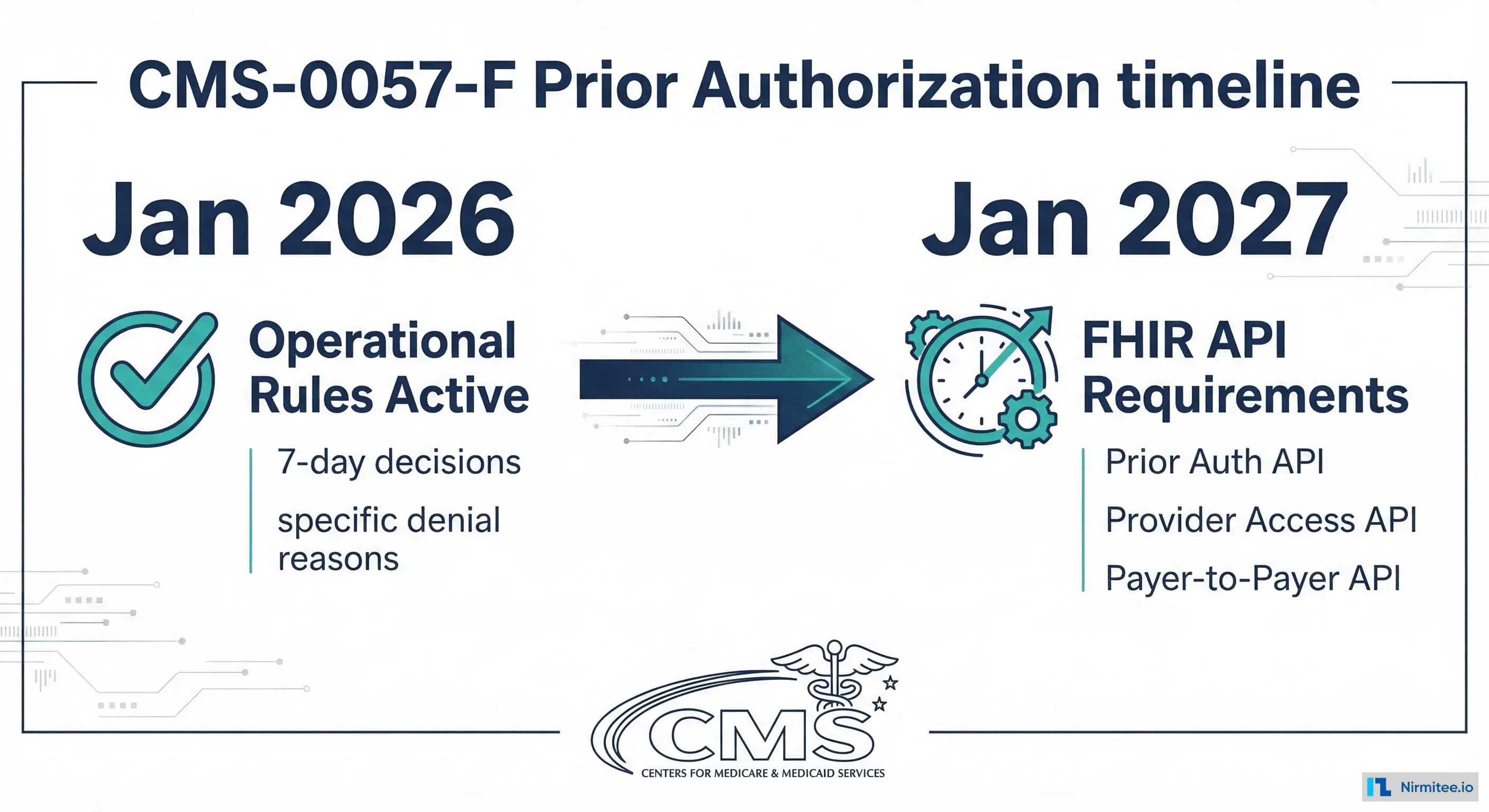
The final rule creates two enforcement phases. Understanding the distinction matters because Phase 1 is already live.
Phase 1: Operational Requirements (Effective January 1, 2026)
- 72-hour decision timeframe for expedited (urgent) prior authorization requests
- 7-calendar-day decision timeframe for standard prior authorization requests
- Specific reason for denial must be included in every adverse determination — no more generic "not medically necessary" without clinical rationale
- Publicly reported metrics: payers must publish prior auth approval/denial rates, average decision times, and appeal overturn rates on their websites
These are already enforceable. If your payer org is still taking 14 days on standard PAs or sending one-line denials, you are out of compliance today.
Phase 2: API Requirements (Effective January 1, 2027)
This is where the engineering work lives. Payers must expose three FHIR R4-based APIs:
- Prior Authorization API: Allows providers to submit, query, and receive decisions on prior auth requests via FHIR. Must include the specific reason for any denial or modification.
- Provider Access API: Gives in-network providers access to their patients' claims, encounter data, and prior auth decisions via FHIR (with patient attribution).
- Payer-to-Payer API (FHIR): Enables data exchange when a patient switches plans. The new payer can request up to 5 years of claims and clinical data from the previous payer.
The Patient Access API (required under prior rules CMS-9115-F) must also be updated to include prior authorization decision data with the specific denial reason.
Penalties and Enforcement
CMS has not published a fixed penalty schedule for API non-compliance under 0057-F specifically. But the enforcement mechanisms are real:
- Medicare Advantage: Non-compliance can affect Star Ratings, which directly impacts quality bonus payments worth millions in revenue
- Medicaid/CHIP: CMS can withhold federal matching funds from states whose managed care plans fail to comply
- Contract-level action: CMS can issue corrective action plans, impose civil monetary penalties, or terminate contracts for persistent non-compliance
- Public reporting: Failure to publish PA metrics is itself a compliance violation, and CMS has signaled it will monitor these reports
The financial exposure is significant enough that most large payers have already started implementation. If you haven't, you are behind.
The Da Vinci Implementation Guides
CMS doesn't prescribe exact API specifications in the rule text. Instead, it points to HL7's Da Vinci Project Implementation Guides as the technical standard. Three IGs form the core of prior authorization compliance.
CRD — Coverage Requirements Discovery
CRD answers the question: "Does this service require prior authorization for this patient's plan?"
It operates as a CDS Hooks service. When a provider orders a procedure or medication in their EHR, the EHR fires a CDS Hook to the payer's CRD endpoint. The payer responds with a card indicating whether PA is required, what documentation is needed, and links to relevant forms or DTR (Documentation Templates and Rules) questionnaires.
Key FHIR resources: CoverageEligibilityRequest, CoverageEligibilityResponse, Coverage.
PAS — Prior Authorization Support
PAS is the core prior auth submission and tracking API. It replaces the phone/fax/portal workflow with a FHIR-based Claim submission (using Claim.use = "preauthorization") and returns a ClaimResponse with the payer's decision.
PAS also supports:
- Querying the status of pending requests
- Updating or canceling submitted requests
- Receiving asynchronous decisions via subscription
- Attaching clinical documentation as
Bundleresources
Key FHIR resources: Claim, ClaimResponse, Bundle, Patient, Practitioner, Organization, Coverage.
PDex — Payer Data Exchange
PDex handles the broader data exchange requirements. For prior auth specifically, it enables payers to share clinical and claims data with providers through the Provider Access API. It also powers the Payer-to-Payer API for member transitions.
PDex uses the $everything and $member-match operations extensively, along with US Core profiles for clinical data.
Technical Architecture: Building a Compliant Prior Auth API
Here is what the system looks like end-to-end.
Step 1: Patient Matching
Before any PA request, the provider's system must match the patient to the payer's member record. The Da Vinci guides use the Patient/$member-match operation:
POST [base]/Patient/$member-match
Content-Type: application/fhir+json

{
  "resourceType": "Parameters",
  "parameter": [
    {
      "name": "MemberPatient",
      "resource": {
        "resourceType": "Patient",
        "identifier": [{
          "type": {
            "coding": [{
              "system": "http://terminology.hl7.org/CodeSystem/v2-0203",
              "code": "MB"
            }]
          },
          "system": "http://example.org/payer",
          "value": "member-id-12345"
        }],
        "name": [{"family": "Smith", "given": ["Jane"]}],
        "birthDate": "1985-07-15"
      }
    },
    {
      "name": "CoverageToMatch",
      "resource": {
        "resourceType": "Coverage",
        "status": "active",
        "beneficiary": {"reference": "Patient/member-id-12345"},
        "payor": [{"reference": "Organization/payer-org-1"}]
      }
    }
  ]
}
The payer returns a matched Patient reference or an OperationOutcome if no match is found. This step is deceptively hard at scale — more on that below.
Step 2: Coverage Requirements Discovery
The EHR fires a CDS Hook (e.g., order-sign) to the payer's CRD service. The hook context includes the proposed order. The payer evaluates its PA rules engine and returns one of:
- No PA required — proceed with the order
- PA required — here are the documentation requirements
- PA required + DTR link — launch this SMART app to fill out the questionnaire
Step 3: Prior Auth Submission via PAS
The provider submits a Claim resource with use: "preauthorization":
{
  "resourceType": "Claim",
  "status": "active",
  "type": {
    "coding": [{
      "system": "http://terminology.hl7.org/CodeSystem/claim-type",
      "code": "professional"
    }]
  },
  "use": "preauthorization",
  "patient": {"reference": "Patient/member-12345"},
  "created": "2026-03-16",
  "provider": {"reference": "Organization/provider-org-99"},
  "insurer": {"reference": "Organization/payer-org-1"},
  "priority": {"coding": [{"code": "normal"}]},
  "insurance": [{
    "sequence": 1,
    "focal": true,
    "coverage": {"reference": "Coverage/cov-abc-123"}
  }],
  "item": [{
    "sequence": 1,
    "productOrService": {
      "coding": [{
        "system": "http://www.ama-assn.org/go/cpt",
        "code": "27447",
        "display": "Total knee arthroplasty"
      }]
    },
    "servicedDate": "2026-04-15",
    "locationCodeableConcept": {
      "coding": [{
        "system": "https://www.cms.gov/Medicare/Coding/place-of-service-codes",
        "code": "21",
        "display": "Inpatient Hospital"
      }]
    }
  }],
  "supportingInfo": [{
    "sequence": 1,
    "category": {
      "coding": [{"code": "info"}]
    },
    "valueReference": {
      "reference": "DocumentReference/clinical-notes-456"
    }
  }]
}
Step 4: Payer Response
The payer returns a ClaimResponse with the decision:
{
  "resourceType": "ClaimResponse",
  "status": "active",
  "type": {
    "coding": [{
      "system": "http://terminology.hl7.org/CodeSystem/claim-type",
      "code": "professional"
    }]
  },
  "use": "preauthorization",
  "patient": {"reference": "Patient/member-12345"},
  "created": "2026-03-16T14:30:00Z",
  "insurer": {"reference": "Organization/payer-org-1"},
  "outcome": "complete",
  "preAuthRef": "PA-2026-789012",
  "item": [{
    "itemSequence": 1,
    "adjudication": [{
      "category": {
        "coding": [{
          "system": "http://terminology.hl7.org/CodeSystem/adjudication",
          "code": "submitted"
        }]
      }
    }],
    "extension": [{
      "url": "http://hl7.org/fhir/us/davinci-pas/StructureDefinition/reviewAction",
      "extension": [
        {"url": "number", "valueString": "AUTH-789012"},
        {"url": "reasonCode", "valueCodeableConcept": {
          "coding": [{
            "system": "https://codesystem.x12.org/005010/306",
            "code": "A1",
            "display": "Certified in total"
          }]
        }}
      ]
    }]
  }]
}
If the outcome is "queued", the provider polls GET [base]/Claim/[id] or subscribes for async notification. CMS requires the payer to render a decision within the mandated timeframes (7 days standard, 72 hours expedited).
The X12 278 Bridge Problem
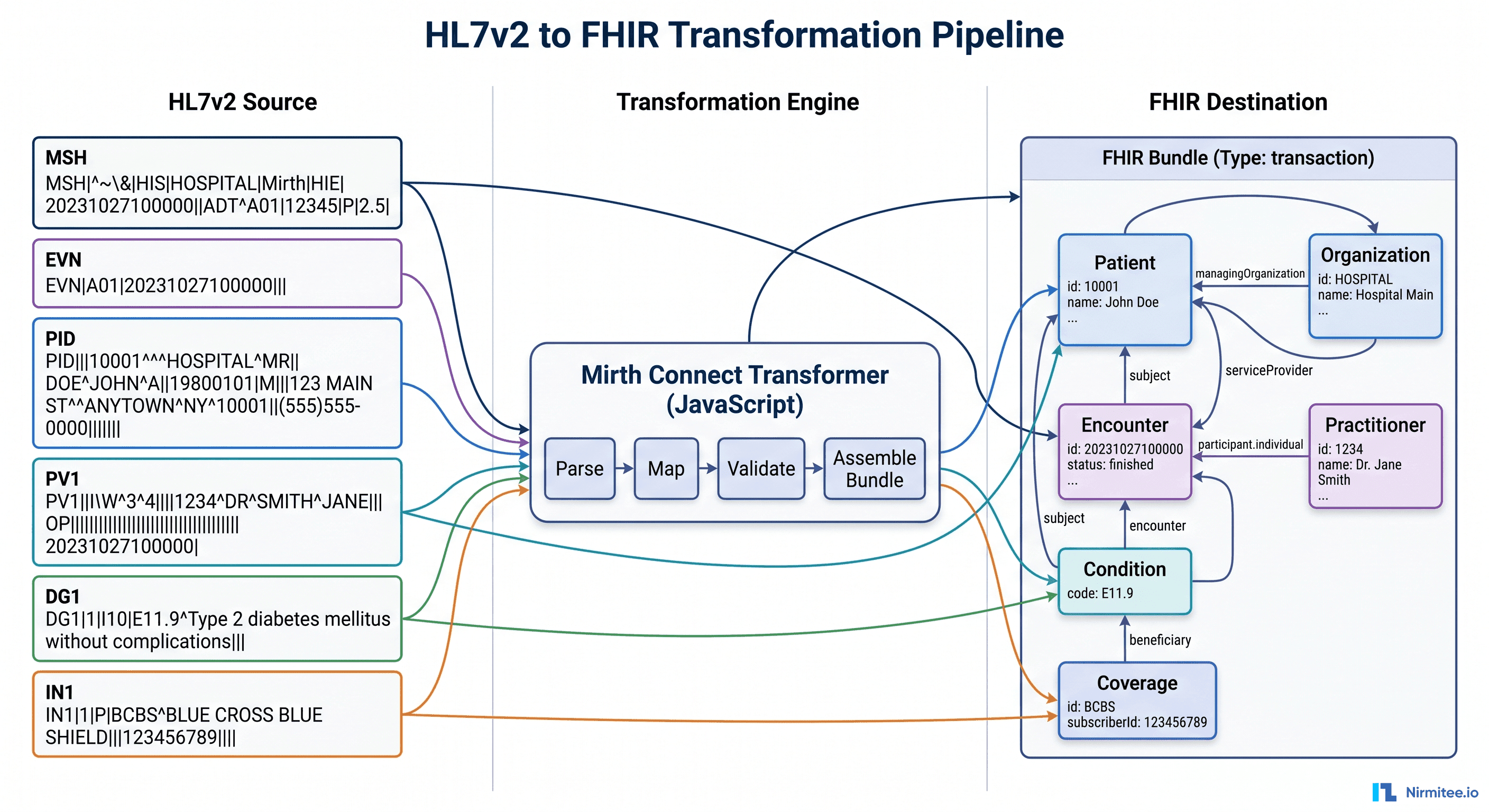
Here is the part nobody likes talking about. Most payer adjudication systems still run on X12 278 transactions internally. The FHIR API is a facade. Behind the API layer, you need a translation engine that maps FHIR Claim resources to X12 278 requests and X12 278 responses back to FHIR ClaimResponses.
This mapping is not trivial. Consider these translation challenges:
| X12 278 Element | FHIR Mapping | Complexity |
|---|---|---|
| Subscriber ID (Loop 2010B) | Coverage.identifier / Patient.identifier | Moderate — need to resolve member vs. subscriber |
| Procedure Code (Loop 2000E/SV1) | Claim.item.productOrService.coding | Low — direct code mapping |
| Diagnosis (Loop 2000E/HI) | Claim.diagnosis.diagnosisCodeableConcept | Low — ICD-10 maps directly |
| Certification Action (HCR segment) | ClaimResponse.item.extension (reviewAction) | High — X12 action codes to FHIR extensions |
| Event Date Range (Loop 2000E/DTP) | Claim.item.servicedPeriod | Moderate — multiple date qualifiers to resolve |
| Provider Info (Loop 2010EA) | Claim.provider / PractitionerRole | High — NPI lookup, taxonomy codes |
The Da Vinci PAS IG explicitly acknowledges this. It includes an X12-to-FHIR mapping appendix and requires that implementations support round-trip fidelity: a FHIR request converted to X12 and back must preserve all clinically relevant data.
The Real Engineering Challenges
Having built these integrations, here is where teams actually get stuck.
1. Patient/Member Matching at Scale
The $member-match operation sounds simple. In practice, it is a nightmare. Patient data arrives with misspellings, outdated addresses, transposed digits in member IDs, and hyphenated last names stored inconsistently. You need probabilistic matching with configurable confidence thresholds. A false positive match is a HIPAA violation. A false negative blocks care. Most teams underestimate the effort here by 3-4x.
2. Consent and Authorization
The Provider Access API requires patient attribution — providers can only access data for patients they have a treatment relationship with. The Payer-to-Payer API requires patient consent for data transfer. You need a consent management layer that tracks:
- Active treatment relationships (often inferred from claims data)
- Explicit patient consent/denial for data sharing
- Consent expiration and revocation
- Granular consent (patient may consent to sharing claims but not behavioral health records)
FHIR Consent resources can model some of this, but the business rules around 42 CFR Part 2 (substance use disorder records) and state-level mental health privacy laws add significant complexity.
3. Multi-Payer Complexity
Providers submit PAs to dozens of payers. Each payer's API will have different:
- Required extensions and profiles
- Supporting documentation expectations
- Error response patterns
- Subscription mechanisms for async decisions
- Rate limits and availability windows
Provider-side systems need a payer configuration registry and enough abstraction to handle these variations without custom code per payer. This is the same problem the Carequality and CommonWell frameworks have been solving for clinical data exchange, now extended to administrative transactions.
4. SMART on FHIR Authorization
All APIs must be secured with SMART on FHIR (OAuth 2.0). For system-to-system (backend) access, you implement the SMART Backend Services flow (client credentials with signed JWTs). For provider-facing apps, you need the EHR Launch or Standalone Launch flows. Getting the scoping right — especially for bulk data access in the Provider Access API — requires careful attention to the SMART scopes specification.
5. Performance Under Regulatory SLAs
The 72-hour expedited window creates an implicit system requirement: your API must be highly available, and your adjudication pipeline must process requests within hours, not days. If your PA queue backs up behind a batch processing job that runs nightly, you will miss the SLA. This often requires re-architecting from batch to event-driven processing.
Implementation Readiness Checklist
If you are a payer or payer technology vendor evaluating readiness, here is a practical checklist:
| Capability | Deadline | Key Standard | Status |
|---|---|---|---|
| Patient Access API (updated with PA data) | Jan 2027 | CARIN IG for Blue Button / US Core | Required |
| Provider Access API | Jan 2027 | Da Vinci PDex | Required |
| Prior Authorization API | Jan 2027 | Da Vinci PAS + CRD | Required |
| Payer-to-Payer API | Jan 2027 | Da Vinci PDex | Required |
| SMART on FHIR Authorization | Jan 2027 | SMART App Launch IG | Required |
| Public Developer Portal | Jan 2027 | CMS requirement | Required |
| Operational PA timeframes (7-day/72-hour) | Jan 2026 | Regulatory (42 CFR 438/457) | Already active |
| Specific denial reasons | Jan 2026 | Regulatory | Already active |
Where Nirmitee Fits
We build FHIR-native healthcare platforms. Our team has implemented SMART on FHIR authorization servers, FHIR R4 APIs with US Core and Da Vinci profile support, and the integration plumbing that connects modern API layers to legacy payer systems.
We are particularly deep in SMART on FHIR auth (we have passed Inferno certification testing), FHIR resource modeling, and building the consent and patient-matching layers that most teams struggle with.
Key Takeaways
- The operational requirements (7-day/72-hour PA decisions, specific denial reasons) are already in effect as of January 2026. Payers that are not meeting these are already non-compliant.
- The API requirements (Prior Auth API, Provider Access API, Payer-to-Payer API) hit January 1, 2027. That is under 10 months away.
- Da Vinci PAS, CRD, and PDex are the implementation guides to follow. They are complex but well-documented.
- The hardest problems are not in the FHIR API layer itself — they are in patient matching, consent management, X12-FHIR translation fidelity, and handling multi-payer variability.
- Start with your
$member-matchimplementation and X12 translation layer. Everything else depends on getting those right.
Need expert help with healthcare data integration? Explore our Healthcare Interoperability Solutions to see how we connect systems seamlessly. We also offer specialized Healthcare Software Product Development services. Talk to our team to get started.