The Hidden Bottlenecks in Healthcare Operations AI Agents Can Solve

Digital Growth Lead
Writes about healthcare technology, interoperability, and AI-driven transformation across modern care systems.
The Medical Group Management Association regularly reports that administrative work consumes 15–25% of total practice operating costs — and the highest-impact savings rarely show up on a strategy slide. Health systems focus on big problems like denial rates and wait times. The bigger story is the long tail of hidden bottlenecks underneath them.
This blog walks through seven invisible operational bottlenecks AI agents are uniquely good at unblocking. For broader context, see our pillar on AI Agents in Healthcare.
What Counts as a "Hidden Bottleneck"?
A hidden bottleneck is a small, repeated, attention-fragmented workflow that bleeds operational time. Each instance costs 5–30 minutes. Multiply by daily volume across an entire health system, and the cumulative cost rivals the workflows leadership actually tracks.
These aren't transformations. They're a thousand-cuts cleanup — and they're the AI agent sweet spot. The why healthcare workflows break and how AI agents fix them list overlaps heavily with these.
Bottleneck 1: The Verification Gauntlet
Before a patient is seen, someone verifies eligibility, checks benefits, confirms prior auth, validates the network, and updates demographics. In most practices, that's 8–15 minutes of human work per patient. Multiply by daily volume.
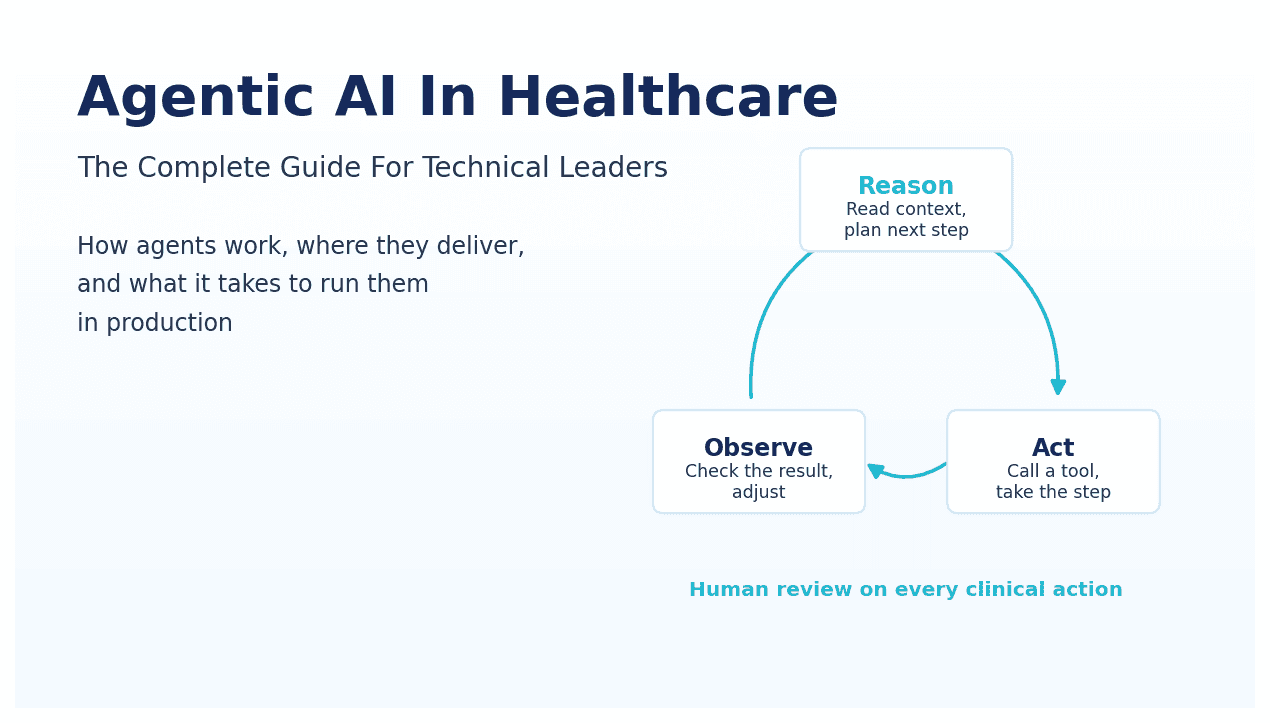
Agents handle this by chaining tool calls across payer APIs, EHR records, and benefits portals — and reasoning when the response isn't clean. We've seen this drop to under 30 seconds per patient in production, with a human queue for the 5% of cases that genuinely need review.
Bottleneck 2: The Denial Re-Work Cycle
A denial comes in. Someone reads it, identifies the denial code, pulls the claim, finds the missing piece, re-submits, waits, and repeats because the appeal got denied for a different reason. The information is everywhere; nothing is connected.
An agent that reads the denial, pulls the clinical context, and drafts the appeal cuts cycle time from days to hours — connected directly to how AI agents reduced claim processing time in healthcare.
Bottleneck 3: The Referral Black Box
A referral lands in a queue. Someone opens it, extracts demographics, checks insurance, schedules (or doesn't), and notifies the patient (or doesn't). Most referrals lose 20–40% of patients somewhere in this process and nobody can point to where.
The bottleneck isn't volume. It's unstructured input. PDFs, faxes, secure messages, EHR notes — none of them are machine-readable the same way. An agent that parses all of those into a structured record solves the bottleneck. The scheduling part is the easy part.
Bottleneck 4: The Documentation Lag
A physician sees a patient. The note gets written hours later. Diagnoses get coded the day after. The claim goes out three days after that. Each step waits on the previous one. Nothing is parallel.
Ambient AI scribes have accelerated the first step. The bottleneck moves — now coders and billers are the constraint. Agent-driven coding suggestions and claim assembly are where the next wave of cycle-time improvement comes from.
Bottleneck 5: Inbox Triage
Physician inboxes are the unspoken disaster of modern healthcare. Pre-visit messages, post-visit messages, refill requests, lab questions, prior auth pings, payer notifications — all in one queue. A primary care physician spends 1–2 hours per day on inbox, per multiple published studies.
Agents that read the inbox, classify messages, draft replies for the easy ones, and surface hard ones with context can recover 60–80% of that time. The constraint isn't the agent. It's whether clinical workflow allows it.
Bottleneck 6: The Scheduling Mess
Most scheduling looks fine on paper. In practice: no-show patterns nobody analyses, double-booking fire drills, slots blocked for cancelled procedures, providers who can see one patient type but not another.
Agents reason across constraints rather than executing fixed rules. "This patient needs a 30-minute follow-up. The only slot is the provider's lunch. Their next opening is 6 weeks out. Offer the lunch slot with a note, ask for a different provider, or escalate?" That's reasoning work, not rule-engine work.
Bottleneck 7: The Hand-Off Loss
Every transition between teams loses information: ED to inpatient, inpatient to discharge, discharge to follow-up. Missing medication reconciliations. Follow-ups that don't get scheduled. Open lab orders that nobody pursues. The cumulative effect is enormous.
Agents bridging these transitions — reading the upstream record, identifying what should carry forward, executing or queuing for review — are where some of the highest-leverage operational wins are showing up.
The Pattern
None of these is a single high-stakes decision. None shows up on a strategy slide. All are small, repeated, attention-fragmented workflows that bleed time across the operations function. That's the AI agent ROI sweet spot.
Real-World Example
Researchers at the University of California San Francisco have published on the volume of physician inbox messages and the time burden they impose, with multiple studies estimating 100+ messages per physician per day. Cleveland Clinic and Geisinger have both publicly discussed deployment of AI message-classification systems specifically to address this bottleneck. The point isn't a single vendor or technique — it's that the workflow is universal and the cost is enormous. (Specific outcomes vary by deployment and should not be treated as guaranteed.)
Common Pitfalls When Targeting Hidden Bottlenecks
Teams that try to deploy agents against operational bottlenecks consistently hit these traps:
- Picking the most visible bottleneck instead of the highest-leverage one. Denial rate gets exec attention, so teams start there. But denial work has a high bar for accuracy. Eligibility verification or referral intake — less glamorous — often produces faster wins because the consequences of a wrong action are lower and the workflow is more bounded.
- Trying to automate end-to-end on day one. The first deployment should automate one stage of the workflow, with a human reviewing every agent action. Once the review reveals the agent is right 95%+ of the time, expand autonomy. Skipping this stage produces production incidents that destroy trust.
- Not measuring before deploying. If you can't say "we currently spend X minutes per case on this workflow," you can't claim the agent saved time. Instrument first. Deploy second.
A Practical Sequencing
The progression that works across most ops teams: start with a workflow that has clear inputs, clear outputs, and a low cost of error. Eligibility verification fits this. So does basic referral parsing. Prove the architecture there for 60-90 days. Then move to higher-stakes workflows — denial work, prior auth — with the architecture and the team's trust already established.
Key Takeaways
- The biggest operational savings in healthcare hide in small, repeated, invisible workflows — not in the executive-level metrics.
- AI agents are best at exactly these workflows: variation, unstructured input, multi-system reasoning.
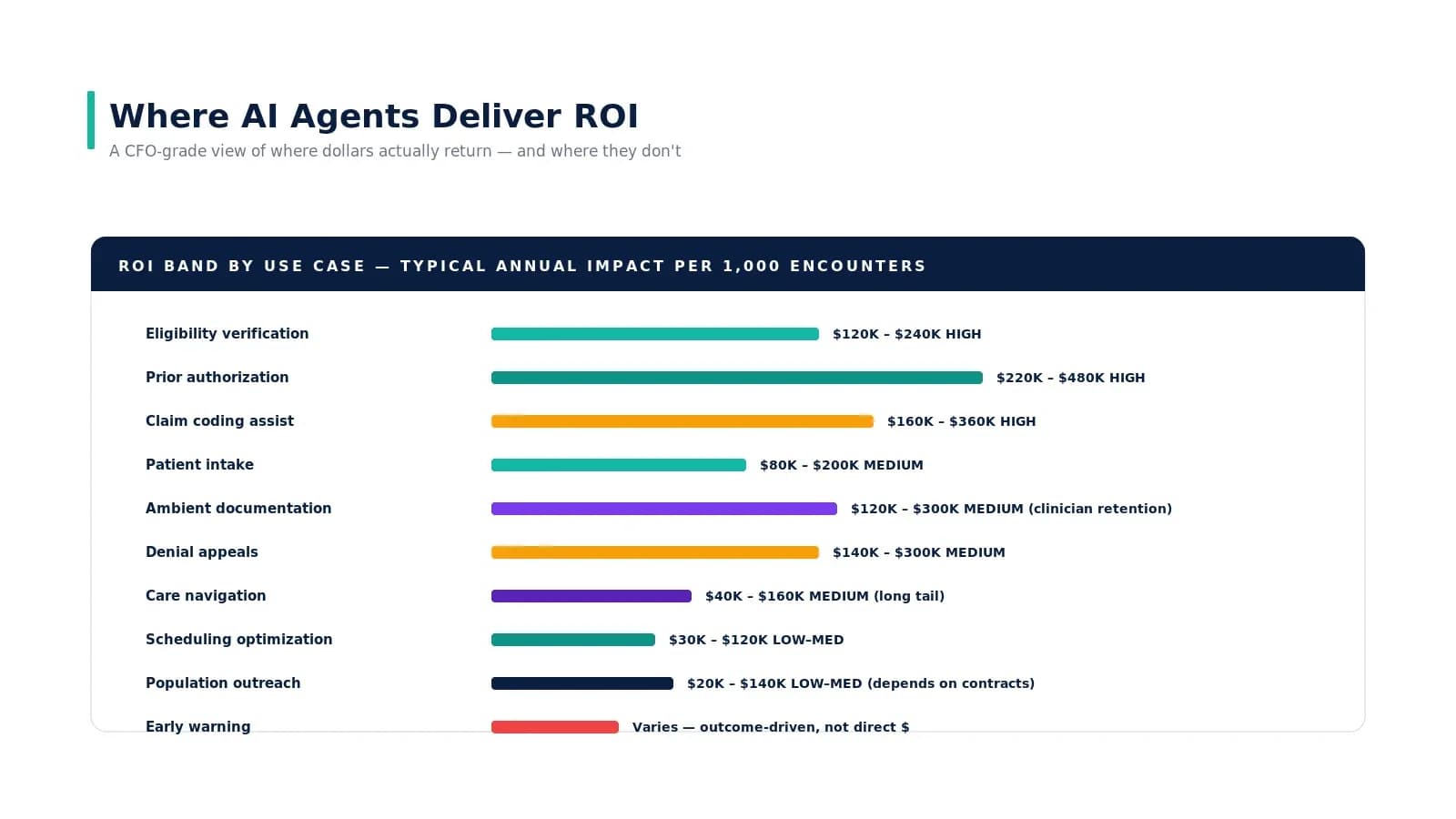
- Highest-ROI starting points: eligibility verification, denial re-work, referral intake.
- The pattern is consistent: anywhere humans re-read the same documents and click the same screens, an agent fits.
- Pick the right small workflow first. Prove the architecture. Then scale.
This blog is one piece of a larger picture. For the full overview, read the pillar guide: top use cases for AI agents in healthcare.
Ready to scale?
Talk to our healthcare engineering team about building, integrating, and shipping faster.
Frequently Asked Questions
What healthcare workflows are AI agents best at?
How do I find where to deploy AI agents first?
Can AI agents handle physician inbox overload?
Where does AI agent automation deliver the fastest ROI in healthcare?