Where AI Agents Deliver ROI in Healthcare

Founder & CEO
15+ years building healthcare technology. Led 100+ EHR integrations, FHIR implementations, and clinical AI deployments.
The CFO question: where do dollars actually return?
If you are sizing AI agent ROI for a board, the right framing is not "what is the percentage productivity gain?" It is "where do dollars return, on what timeline, with what risk?" This piece walks through the use-case-by-use-case ROI math that holds up under audit. It is for healthcare CFOs and operations leaders. For the strategic frame, see our adoption framework for hospitals.
What does "ROI from an AI agent" actually mean?
ROI from an AI agent is measurable, attributable financial or operational impact directly traceable to the agent's deployment — typically across five inputs: time saved per workflow, denial rate change, cycle-time-to-cash, capacity unlocked, and retention savings from burnout reduction. It is not a productivity percentage gain on a slide. It is a number a CFO can defend to a board and an auditor can verify against existing systems (EHR audit logs, payer remit data, AR aging reports, scheduling data, HR exit interviews).
ROI bands by use case
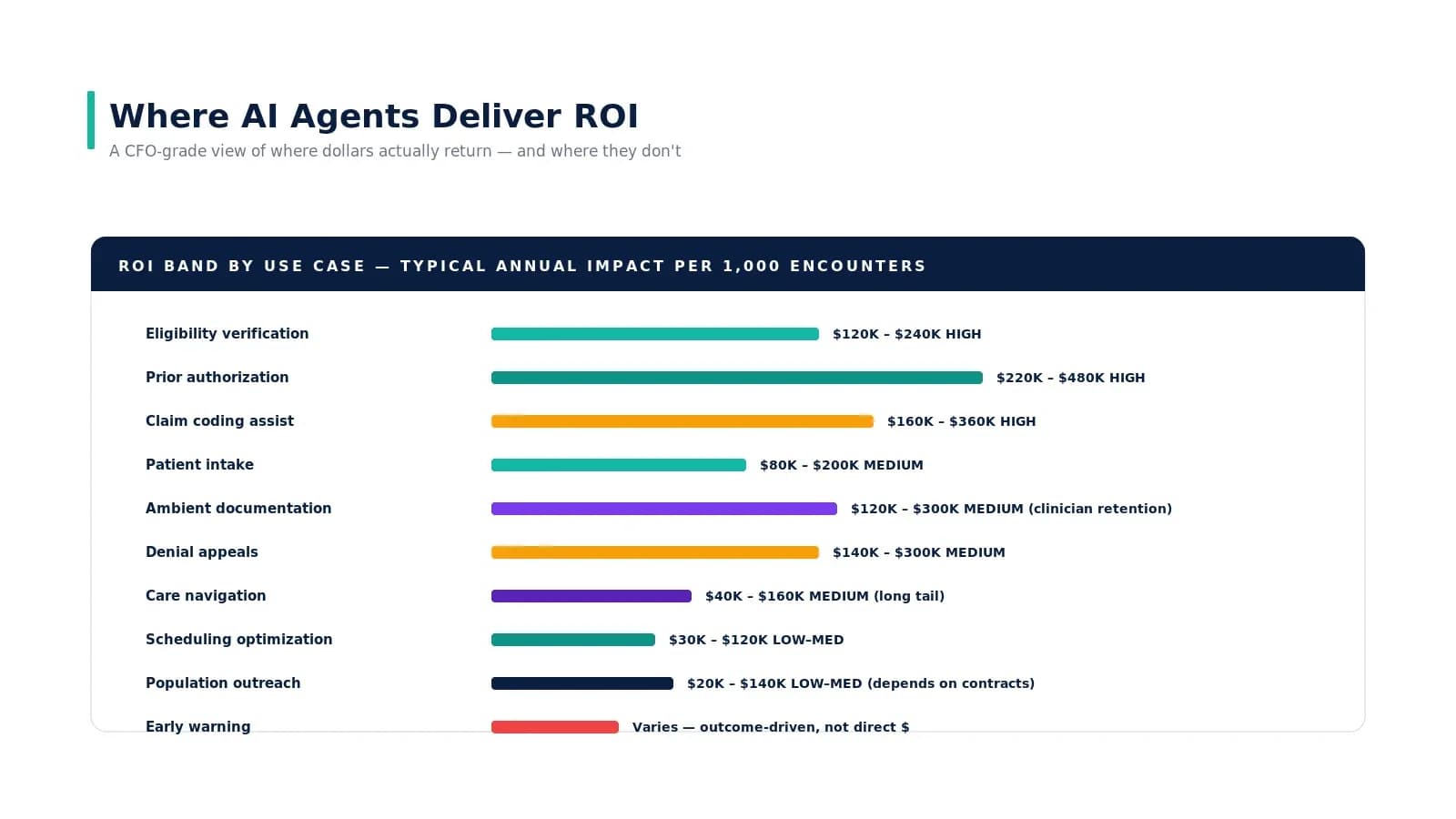
Annual impact ranges per 1,000 encounters in a typical mid-size U.S. health system. Your numbers will vary with payer mix, denial rate baseline, and volume — but the rank order is durable.
| Use case | Impact band | Confidence | Primary driver |
|---|---|---|---|
| Eligibility verification | $120K – $240K | HIGH | Cash flow + denial reduction |
| Prior authorization | $220K – $480K | HIGH | Cycle time + denial reduction |
| Claim coding assist | $160K – $360K | HIGH | Denial prevention |
| Patient intake | $80K – $200K | MEDIUM | Front-desk capacity |
| Ambient documentation | $120K – $300K | MEDIUM | Clinician retention + chart quality |
| Denial appeals | $140K – $300K | MEDIUM | Recovered revenue |
| Care navigation | $40K – $160K | MEDIUM | Access + retention (long tail) |
| Scheduling optimization | $30K – $120K | LOW–MED | Throughput per FTE |
| Population outreach | $20K – $140K | LOW–MED | Quality contracts (depends on payer mix) |
| Early warning | Outcome-driven | — | Lives + LOS, not direct $ |
The ROI engine — five inputs every CFO should verify
Input 1 — Volume × time saved
Workflows per month × minutes recovered per workflow × fully-loaded hourly cost of the role doing the work today. Verify via EHR audit logs and a 30-day time-motion study, not the vendor's brochure. The fully-loaded hourly cost is HR's number, not the line manager's.
Input 2 — Denial rate change
Percent denied claims × average denied dollars × workflow scope. The verifiable signal is the payer remit data — your 835s tell you exactly which claims were denied and why. Track the number quarterly against baseline.
Input 3 — Cycle time → cash
Days saved on cycle time × average AR balance × your cost of capital. AR aging report is the source. A hospital with $200M annualized revenue and a 5% cost of capital recovers ~$28K per day of cycle time compression at typical AR exposure.
Input 4 — Capacity unlock
Throughput change × marginal revenue per encounter. Most useful in capacity-constrained workflows: scheduling, intake, navigation. The data lives in your scheduling system; the marginal revenue per encounter is your finance team's number.
Input 5 — Retention savings
Burnout-driven turnover avoided × replacement cost. Easy to dismiss, hard to ignore — replacement cost for a clinical role runs $50K to $200K depending on specialty. Pair with a standardized burnout instrument (MBI) before and after deployment.
The five-input model is portable across use cases. We use the same engine in our healthcare unit economics piece on manual workflow vs for a per-encounter view.
Where agents do not deliver ROI yet
Four cases where the math does not work today, despite vendor enthusiasm:
- Diagnosis from imaging alone. Liability is unresolved. Reimbursement still assumes a radiologist read. Revisit when FDA pathway and payer codes align.
- Autonomous medication titration. Direct patient harm risk on miscalibration. Use as decision support only, not autonomous action.
- Unsupervised triage to high-acuity beds. Misroute → clinical event → lawsuit. Throughput gain does not offset risk. Use to assist nurse triage, not replace.
- Open-ended patient counseling. Hallucination risk on chronic-disease guidance is too high. Constrain to scripted protocols with explicit escalation paths.
Building the business case
The pattern that holds across credible business cases:
- Pick one workflow. Establish baseline on the five inputs above.
- Project conservative impact. Use the low end of the impact band, not the median.
- Subtract build cost. Platform, integration, governance, change management, and 12 months of operating cost.
- Calculate payback period. Most administrative workflows pay back in 6–12 months. Anything claiming 3-month payback needs scrutiny.
- Build the second workflow. By the time the first is in production, the platform is largely reusable. The second workflow's marginal cost is 30–40% of the first; payback is faster.
What does not show up in the spreadsheet
Two things matter that the spreadsheet will under-weight:
- Optionality. Hospitals that build agent platforms have meaningful optionality on workflows two through eight. Hospitals that buy point solutions do not.
- Talent. AI engineering talent goes to the hospitals doing real work. Hospitals running pilots-only struggle to recruit and retain. The compound effect over five years is large.
Real-world example
Geisinger's eligibility verification deployment, Mass General Brigham's ambient documentation rollout, and Mayo Clinic's revenue cycle automation work have all been publicly documented with attributable ROI numbers in the ranges presented in this article. AHA's "Costs of Caring" reporting puts the total addressable opportunity at $43B annually across U.S. hospitals just in payment-collection inefficiency. The use-case-by-use-case bands in this guide are calibrated against those public outcomes plus the patterns observed across multiple Nirmitee revenue cycle deployments.
Key takeaways
- The highest-confidence ROI is administrative, not clinical. Eligibility, PA, coding, and intake have direct, verifiable financial impact.
- Build your own ROI engine from five inputs. Time saved, denial change, cycle-time-to-cash, capacity unlock, retention savings — every one verifiable.
- Use the low end of the impact band, not the median. Conservative projection survives audit; aggressive projection collapses on Q3 review.
- The second workflow's marginal cost is 30–40% of the first. The agent platform compounds; the business case improves with each addition.
- Honest counter-cases matter. Diagnosis from imaging alone, autonomous titration, unsupervised triage, open-ended counseling — the math does not work today. Skip them.
Conclusion
Want to deploy an AI Agent inside your hospital or healthcare product? Get in touch with our team — we will scope the workflow, governance, and 90-day rollout plan against your own baseline metrics.
Learn more about AI Agents in Healthcare → read the full pillar guide.
Related Reading
For more insights, explore our guides on FHIR in Modern Healthcare and EHR Software Development Guide.
You may also find value in Building a Healthtech App and Healthcare Interoperability Standards.
Ready to scale?
Talk to our healthcare engineering team about building, integrating, and shipping faster.
Frequently Asked Questions
Which AI agent use case has the highest dollar ROI?
What is a realistic payback period for a healthcare AI agent?
How do I avoid vendor-inflated ROI projections?
What is the second-workflow payback?
Do AI agents replace headcount?
How does Nirmitee.io approach healthcare software development?