A Nursing Times survey of 1,000 nurses, conducted jointly with GS1, found that one in three nurses spends over an hour per shift searching for equipment. Not treating patients. Not documenting care. Walking hallways, checking storage rooms, and calling other departments asking "Have you seen the infusion pump?"
Multiply that across a 300-bed hospital with 500+ nursing shifts per week, and you are looking at 6,000+ hours per month of clinical time wasted on equipment searches. At Rs 300-500 per nursing hour, that is Rs 18-30 lakhs per month in lost productivity alone, before you count the Rs 80 lakh to Rs 1.6 crore in equipment that goes permanently missing each year (Chief Healthcare Executive).
Equipment tracking software solves this problem, but only if you choose the right system. The market is projected to grow from $28.5 billion in 2024 to $237.2 billion by 2034 (Market.us), which means there are hundreds of vendors all claiming to be the best. Most of them are not built for the specific challenges Indian hospitals face: NABH compliance requirements, multi-site operations, integration with Indian HIS systems, and budget constraints that make enterprise RTLS unaffordable for anything smaller than a 500-bed hospital.
This guide breaks down the 10 features that actually matter, with real cost data, integration specifics, and a decision framework so you do not waste months evaluating systems that will not work for your hospital.
Feature 1: Real-Time Location Tracking (RTLS)
This is the feature that separates equipment tracking from simple inventory management. Real-time location tracking tells you not just what equipment you have, but where it is right now.
There are four tracking technologies, and the right choice depends on your budget and requirements:
QR Codes (Rs 1-8 per tag)
Best for: Hospitals under 200 beds, tight budgets, equipment identification and maintenance logging. QR codes are essentially free to generate and print. Staff scan with any smartphone camera. The limitation is that you only know where equipment was (at last scan), not where it is right now. For hospitals where the primary goal is NABH compliance documentation rather than live tracking, QR codes are the pragmatic starting point.
Passive RFID (Rs 25-65 per tag)
Best for: Batch scanning during audits, inventory counts, and zone-based tracking. Passive RFID tags have no battery and can be read dozens at a time without line-of-sight. An auditor can walk through a department with a handheld reader and scan every tagged device in minutes instead of hours. AssetPulse reports that RFID reduces audit times by over 85% compared to barcode/QR scanning. Medical-grade RFID tags certified to ISO 10993 cost Rs 55-70 per tag.
Active RFID/BLE (Rs 1,600-4,000 per tag)
Best for: Large hospitals (300+ beds) that need continuous real-time location of high-value mobile equipment. BLE (Bluetooth Low Energy) beacons broadcast their location to gateway receivers installed throughout the facility. Battery life is 5-8 years. This is the technology behind true RTLS solutions that show live equipment positions on a floor map. The infrastructure cost (BLE gateways at under Rs 8,000 each, installed every 10-15 meters) adds up, but the ROI is proven: GE HealthCare reports that RTLS reduces lost monitors by 2-5%, recovering tens of thousands in CapEx annually, and increases equipment utilization by 10-15%.
The Hybrid Approach
Most Indian hospitals should start with QR codes for their entire fleet and add BLE tags only to high-value mobile equipment (infusion pumps, portable monitors, wheelchairs, ultrasound machines). This gives you comprehensive identification at Rs 5-10 per device and real-time tracking where it matters most at Rs 1,600-4,000 per critical device.
Feature 2: Preventive Maintenance Scheduling and Tracking
Equipment tracking without maintenance tracking is only half the solution. The software must generate, assign, and track preventive maintenance (PM) work orders automatically based on:
- Time-based schedules: Monthly PM for life-support devices, quarterly for imaging equipment, semi-annual for general equipment
- Usage-based triggers: PM after every 500 operating hours, every 1,000 sterilization cycles, or every 10,000 patient contacts
- Risk-based priority: Critical equipment (ventilators, defibrillators) gets flagged first when PM is overdue
- Manufacturer recommendations: OEM-specified service intervals stored per equipment model
The system should track PM completion rates and generate compliance reports. NABH assessors will ask for documented evidence that PM schedules are being followed. If your PM compliance rate drops below 90%, you need alerts going to the biomedical engineering head and the hospital administrator, not just the technician who missed the work order.
What to look for: Automated work order generation, mobile-friendly completion (technician can close work orders from their phone at the equipment location), photo documentation of completed work, parts consumption tracking per work order, and escalation rules for overdue PMs.
Feature 3: Equipment History and Lifecycle Management
Every piece of medical equipment has a story: when it was purchased, how much it cost, every repair it has undergone, every calibration it has passed, every PM it has received, and when it should be retired. NABH requires this documented as an "equipment history sheet" for every device.
The software should maintain a complete lifecycle record:
- Acquisition: Purchase date, cost, vendor, warranty terms, AMC details
- Location history: Every department transfer with dates and authorization
- Maintenance history: Every PM, repair, calibration, with technician name, parts used, and cost
- Downtime log: Every period of non-availability with reason codes (maintenance, repair, awaiting parts, condemned)
- Financial: Cumulative maintenance cost, depreciation, current book value, total cost of ownership
- End-of-life: Condemnation recommendation when cumulative repair cost exceeds 50-60% of replacement cost
This data drives the most important financial decision in equipment management: repair versus replace. When a 10-year-old CT scanner has consumed Rs 1.2 crore in maintenance against a replacement cost of Rs 2.5 crore, the decision point is approaching. The software should flag this automatically, not leave it to annual budget reviews.
Feature 4: Utilization Analytics and Reporting
Knowing where equipment is located is table stakes. Knowing how much it is being used is where the financial insight lives. Indian hospital data shows dramatic underutilization across equipment categories: MRI scanners at 48% utilization, CT scanners at 73%, and ventilators as low as 6.2% in public hospitals (published studies, PMC research).
The tracking software should calculate and display:
- Utilization Rate: Actual usage hours divided by available hours, by device, department, and shift
- Idle Time Analysis: Periods where functional equipment sits unused, with patterns (time of day, day of week)
- Peak Demand Mapping: When and where equipment demand exceeds supply, driving rental or procurement decisions
- Break-Even Analysis: Minimum utilization required to justify the equipment's operating cost (for an MRI, this is approximately 203 scans per month based on Indian hospital economics)
A Zebra Technologies survey of 280 non-clinical healthcare decision makers found that 77% say staff spend excessive time searching for equipment and 84% prioritize digitizing inventory management. The utilization data from tracking software directly addresses both problems by making equipment availability visible and actionable.
Feature 5: System Integration (HIS, CMMS, ERP)
Equipment tracking software that operates in isolation creates data silos. The system must integrate with your existing hospital information systems:
HIS/EHR Integration
When a patient is admitted to the ICU, the HIS creates the admission record. The equipment tracking system should automatically log which ventilator, monitor, and infusion pump are assigned to that patient. This creates traceability: if there is ever a device recall or safety alert, you can instantly identify every patient who was treated with that specific device. For hospitals using HL7-based HIS systems, the integration uses HL7 ADT messages to trigger equipment assignment workflows.
CMMS Integration
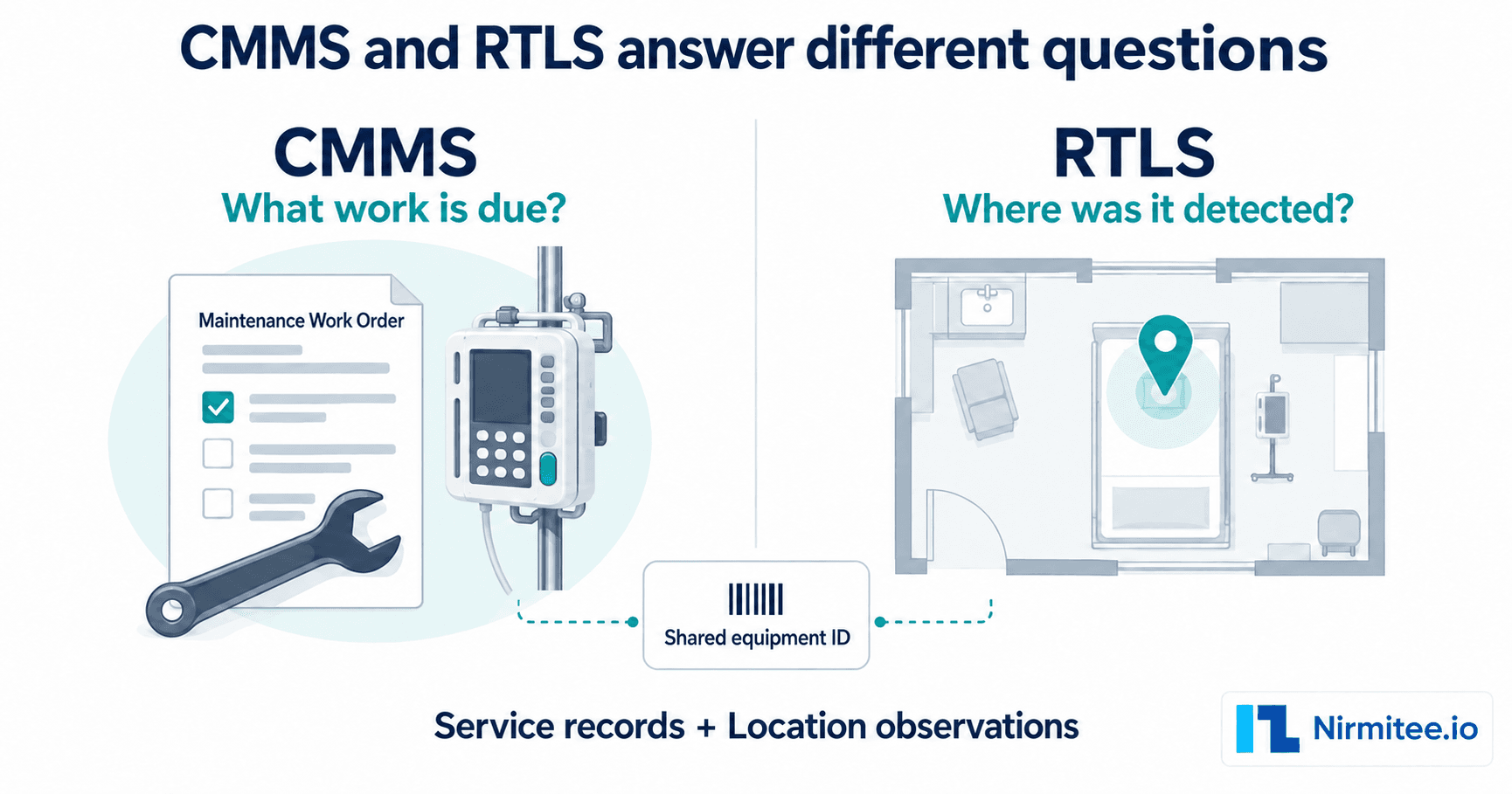
If you already have a Computerized Maintenance Management System, the tracking software should either replace it or integrate bidirectionally. Equipment location data feeds into the CMMS for work order routing. CMMS maintenance data feeds back into the tracking system for lifecycle analysis.
Financial/ERP Integration
For Indian hospitals, this means GST compliance, depreciation calculation per Income Tax Act schedules, and asset register updates that satisfy statutory audit requirements. The tracking system should export data in formats compatible with Tally, SAP, or whatever ERP the hospital uses. Every equipment transfer between departments should automatically update the fixed asset register.
ABDM Integration (India-Specific)
As India's Ayushman Bharat Digital Mission (ABDM) expands, equipment tracking data may eventually feed into facility certification and quality metrics. Forward-looking systems should be designed with FHIR-compatible data models that can participate in the broader digital health ecosystem.
Feature 6: Mobile Access and QR/RFID Scanning
Biomedical engineers, nurses, and department heads need to interact with the tracking system from the floor, not from a desktop computer. The mobile app should support:
- QR/barcode scanning: Point the phone camera at the equipment tag to pull up its full profile, maintenance history, and current status
- Equipment request: Department head requests a specific device type; system shows nearest available unit and sends pickup notification
- PM completion: Technician scans equipment QR, fills the PM checklist on-screen, takes photo evidence, closes the work order, all from the device location
- Issue reporting: Any staff member can scan equipment and report a malfunction with photos and description, creating a repair work order automatically
- Transfer logging: Scan equipment when moving between departments to maintain real-time location accuracy without BLE infrastructure
Indian hospitals increasingly use smartphones as primary work devices. The mobile app must work on Android (dominant in Indian healthcare settings), support offline mode for areas with poor connectivity, and handle Hindi or regional language interfaces for non-English-speaking staff.
Feature 7: Compliance and Audit Reporting
NABH accreditation reviews require specific documentation that the tracking software should generate automatically:
- Equipment inventory report: Complete list with unique IDs, locations, risk classifications, and current status
- PM compliance report: Percentage of scheduled PMs completed on time, overdue PMs with reasons, trend analysis
- Calibration status report: List of all calibrated instruments with last calibration date, next due date, and certificate references
- Uptime/downtime report: Equipment availability percentage by device, department, and time period
- Condemnation report: Equipment recommended for disposal with financial justification (cumulative repair cost vs replacement cost)
- AMC/warranty tracker: Contracts expiring in the next 30/60/90 days with renewal cost estimates
The system should also generate reports for statutory compliance: fixed asset register for CA audit, GST input credit documentation for equipment purchases, and depreciation schedules per Income Tax Act.
Feature 8: Alert and Notification System
The value of tracking software is diminished if nobody acts on the data. A robust alert system should include:
- PM overdue alerts: Escalating notifications — first to technician, then to biomed head, then to administration
- Equipment not found: Alert when a tagged device has not been scanned or detected for a configurable period (e.g., 72 hours)
- Warranty/AMC expiry: 90-day, 60-day, and 30-day advance notifications
- Calibration due: Alerts before calibration certificates expire
- Utilization threshold: Alert when equipment utilization drops below target (e.g., MRI below 50%)
- Unauthorized movement: Alert when equipment leaves a designated zone (requires RFID/BLE)
- Condemnation trigger: Automatic alert when cumulative maintenance cost exceeds the defined threshold of replacement value
Alerts should be configurable by role. The hospital administrator does not need every PM reminder, but they need to know when critical equipment is down or when maintenance spending exceeds budget thresholds.
Feature 9: Multi-Site and Multi-Department Management
Hospital groups operating across multiple locations need a unified view of their entire equipment fleet. This is increasingly relevant in India where private hospital chains are adding 4,000+ beds with Rs 11,500 crore investment in FY26.
The software should support:
- Centralized dashboard: View equipment status across all locations from a single login
- Inter-facility transfers: Track equipment movement between hospitals with approval workflows and transport logging
- Comparative analytics: Compare PM compliance, utilization rates, and maintenance costs across facilities to identify best practices and problem areas
- Centralized procurement: Aggregate equipment needs across sites for volume-discounted purchasing
- Role-based access: Department heads see their department. Facility managers see their hospital. The COO sees everything.
For hospital groups, the equipment sharing feature alone can justify the software investment. If Hospital A has three unused ultrasound machines while Hospital B is renting one, the tracking system makes this visible and actionable.
Feature 10: Data Security and Access Control
Equipment tracking data intersects with patient data when devices are assigned to specific patients or procedures. The software must meet healthcare data security standards:
- Role-based access control (RBAC): Define who can view, edit, transfer, or condemn equipment
- Audit trail: Every data change logged with timestamp, user identity, and old/new values
- Data encryption: At rest and in transit, minimum AES-256 for stored data, TLS 1.2+ for transmission
- Backup and disaster recovery: Automated daily backups with tested recovery procedures
- Data residency: For Indian hospitals, the option to host data within India (important for government and NABH-accredited facilities)
- HIPAA/DISHA compliance: If the system stores any patient-associated device usage data, it must comply with applicable healthcare data protection regulations
Implementation: A Realistic Timeline and Budget
Based on Indian hospital implementations:
Phase 1: Pilot (4-6 weeks)
- Select one department (ICU or Radiology recommended — high-value equipment, motivated staff)
- Tag all equipment with QR codes
- Train 10-15 staff members
- Configure PM schedules for the department
- Cost: Rs 2-5 lakhs (software setup + QR tags + training)
Phase 2: Facility-Wide Rollout (8-12 weeks)
- Tag remaining equipment across all departments
- Configure all PM schedules, calibration tracking, and alert rules
- Integrate with HIS and financial systems
- Train all relevant staff (biomedical, nursing supervisors, department heads)
- Cost: Rs 10-25 lakhs (depending on hospital size and integration complexity)
Phase 3: Optimization (Ongoing)
- Add BLE tags to high-value mobile equipment (if budget permits)
- Enable utilization analytics and optimize equipment distribution
- Connect to predictive maintenance data sources
- Cost: Rs 5-15 lakhs for BLE infrastructure (optional)
Every healthcare organization has unique needs. Our Custom Healthcare Software Development practice builds tailored solutions that fit your clinical workflows. We also offer specialized Healthcare Software Product Development services. Talk to our team to get started.
Frequently Asked QuestionsWhat is the minimum hospital size that benefits from tracking software?
Any hospital with more than 50 beds and 200+ medical devices benefits from digital tracking. Below 50 beds, a well-maintained spreadsheet with QR code scanning may suffice. Above 100 beds, the manual approach becomes unsustainable and error-prone.
Should we use cloud-based or on-premise software?
Cloud-based (SaaS) is recommended for most Indian hospitals. Lower upfront cost, automatic updates, no IT infrastructure to maintain, and accessible from anywhere. On-premise makes sense only for government hospitals with strict data residency requirements or facilities with unreliable internet connectivity.
How long does it take to tag all equipment?
A team of 2-3 people can physically verify and tag approximately 50-80 devices per day. A 200-bed hospital with 500 devices takes 7-10 working days. A 500-bed hospital with 1,500+ devices takes 3-4 weeks. The tagging is a one-time effort; ongoing effort is minimal (tag new purchases, re-tag damaged labels).
What ROI can we expect?
Based on industry data: 10-15% improvement in equipment utilization, 50% reduction in equipment loss, 30-40% reduction in time spent searching for equipment, and 20-30% reduction in unnecessary equipment rentals. For a 300-bed hospital, the annual savings typically range from Rs 25-60 lakhs, against a software cost of Rs 10-25 lakhs. Payback period: 6-12 months.
Does the software replace our existing CMMS?
It depends on the product. Some equipment tracking platforms include full CMMS functionality (work orders, spare parts, vendor management). Others focus on tracking and integrate with existing CMMS. If you do not have a CMMS, choose a tracking solution with built-in maintenance management to avoid running two separate systems.
The Bottom Line
The right equipment tracking software transforms hospital operations from reactive guesswork to data-driven management. But "right" means different things for different hospitals. A 100-bed hospital in Tier 2 India needs QR-based tracking with NABH compliance reports and a mobile app that works in Hindi. A 500-bed multi-specialty hospital in Mumbai needs RTLS with BLE, full CMMS integration, and multi-site analytics.
Start with these 10 features as your evaluation checklist. Score every vendor against each feature. Ask for references from Indian hospitals of similar size. And most importantly, start with a pilot, prove the ROI in one department, and then scale. The hospitals that lose crores to poor equipment management are the ones that keep postponing the decision.