Part of our complete guide to Hospital Asset Management: The Complete Guide.
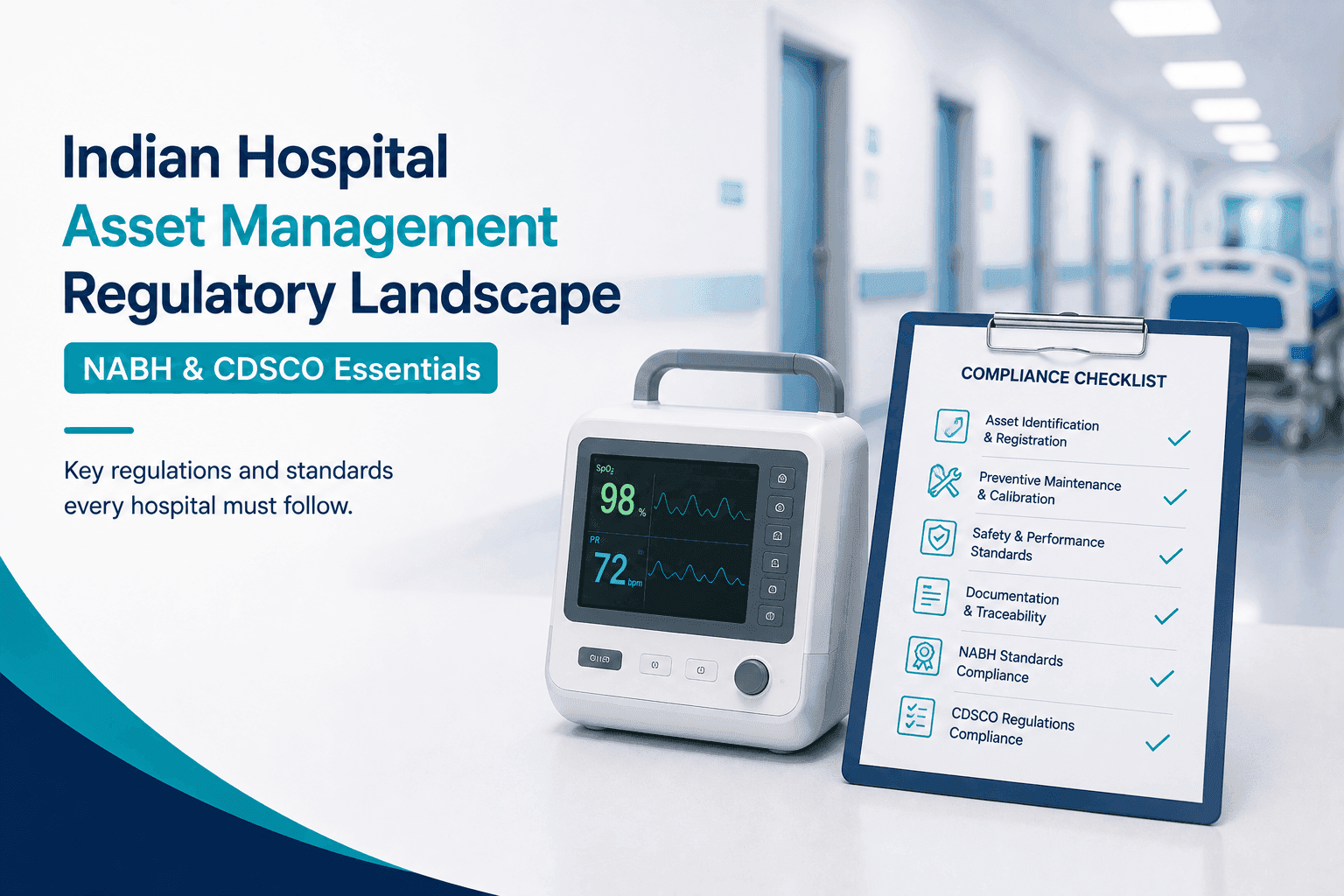
Every hospital running NABH accreditation has to maintain an asset register that survives audit scrutiny. Every hospital importing or operating Class B / C / D medical devices is bound by CDSCO record-keeping rules. Every hospital disposing of end-of-life biomedical equipment must comply with the Bio-Medical Waste (Management & Handling) Rules, 2016. These three regimes overlap on a single document — your asset register — and most hospital biomedical teams discover the overlap only during their first audit gap.
This guide explains the three regulatory regimes most relevant to hospital asset management in India, what auditors actually look for, and how to design an asset register that satisfies all three. US health systems running Joint Commission EC.02.04 equipment maintenance standards face a parallel set of obligations — referenced where they map cleanly.
1. NABH HCO 5th Edition — the asset management backbone
NABH's HCO 5th Edition standards include several chapters that touch the asset register directly. The most operationally relevant are Facility Management and Safety (FMS) and Management of Medication (MOM). FMS clauses require documented preventive maintenance schedules, calibration records, and incident logs for every applicable biomedical asset.
What the auditor expects to see, in order:
- An asset register that includes asset ID, location, manufacturer, model, serial number, commissioning date, and warranty status.
- Linked preventive maintenance (PM) schedule for each applicable asset, with PM completion rate over the last 12 months exceeding 95%.
- Calibration certificates for measurement equipment, accessible on demand and current within the manufacturer-specified interval.
- Incident or breakdown log for each asset, with root cause and corrective action documented.
- Retirement/disposal trail for any asset removed from service in the last 36 months.
The most common NABH non-conformance for biomedical asset management is "physical asset count does not reconcile with the asset register" — typically caused by undocumented transfers between departments. A real-time asset tracking system eliminates this category of finding.
2. CDSCO — medical device regulation that touches the asset register
The Central Drugs Standard Control Organization (CDSCO) regulates medical devices in India under the Medical Devices Rules, 2017. For asset management, the relevant obligations are:
- Imported medical devices in Classes B, C, and D require a CDSCO import licence reference recorded against the asset.
- The Unique Device Identifier (UDI) — where the manufacturer provides one — must be linked to the asset record.
- Adverse event reports involving an asset must be traceable from the asset record back to the manufacturer's UDI, batch, and serial.
Hospitals planning multi-state expansion or future device export to the US (FDA UDI) or EU (EU MDR) face a much smoother regulatory path if their asset register already captures UDI from day one. This is one of the highest-leverage decisions a hospital can make in its asset management software configuration.
3. Bio-Medical Waste Rules
The Bio-Medical Waste (Management & Handling) Rules, 2016, regulate the disposal of end-of-life biomedical equipment. Hospitals must:
- Submit quarterly returns to the State Pollution Control Board on biomedical waste generated and disposed.
- Document the chain of custody from asset retirement to disposal partner (CPCB-authorized treatment facility).
- Retain disposal certificates for a minimum of 5 years.
The asset register is the operational anchor for this. When an asset is retired, the asset record should automatically trigger a disposal workflow: generate a disposal request, capture the disposal partner reference, and store the disposal certificate as a linked document.
Real-world: a NABH re-accreditation save
A 350-bed multispecialty hospital in Pune entered its 2024 NABH re-accreditation with a 4-year-old Excel-based asset register. During the pre-audit gap analysis, the biomedical team discovered 32 of 1,400 assets (2.3%) could not be physically located, and 11% of PM records had drifted out of compliance window. Re-accreditation was at risk.
The hospital deployed Assetly with QR labelling across the campus in a 6-week sprint, ran a full 5-day reconciliation cycle, and entered the formal audit with a clean asset register: 0% missing assets, 97% PM compliance, calibration certificates linked. The audit closed without an asset-management non-conformance — a result the hospital had not achieved in its previous two cycles.
How to design an asset register that satisfies all three regimes
The minimum field set:
- Core identifiers: asset ID, name, manufacturer, model, serial number, location.
- Compliance fields: CDSCO import licence ref (where applicable), UDI, manufacturer batch.
- Operational fields: commissioning date, warranty start/end, AMC contract reference.
- Maintenance fields: linked PM schedule, last PM date, next PM due date, calibration certificate URL.
- Lifecycle fields: status (in-service / under-repair / retired), retirement date, disposal partner ref, disposal certificate URL.
Key takeaways
- Three regulations touch the hospital asset register in India: NABH HCO 5th Ed (operational), CDSCO Medical Device Rules (compliance), and BMW Rules 2016 (disposal).
- NABH auditors look for asset count reconciliation, PM completion rate above 95%, linked calibration certificates, and a documented disposal trail.
- CDSCO compliance demands UDI and import licence reference linked to applicable medical device assets.
- BMW Rules require 5-year retention of disposal certificates and quarterly state-board returns.
- One well-designed asset register satisfies all three regimes — Excel-based registers don't, at scale.
Preparing for your next NABH cycle?
Audit-ready asset management starts with the right schema, the right hardware, and the right software. Read our pillar guide on healthcare asset management, or talk to the Assetly team about a NABH gap analysis for your asset register.