athenahealth is one of the more pleasant EHRs to integrate with, and one of the easier ones to underestimate. It is cloud-native and single-instance, which means every customer runs on the same codebase and the same API endpoints, so you are not chasing a different configuration at every practice. The part teams underestimate is that Athenahealth is really two systems wearing one name: a clinical platform and a revenue platform. If your integration only thinks about one, it will fall short. This guide covers connecting both clinical and billing workflows through Mirth Connect.
We have built EHR integrations for 30+ healthtech startups, and athenahealth is one of the vendors behind several of them, so the clinical-plus-billing pattern below comes from shipping it, not theorizing about it.
What you are actually integrating with
Athenahealth (now Athenahealth by Veradigm) exposes three integration surfaces: a FHIR R4 REST API for app-facing data access, HL7 v2 interfaces for lab and billing workflows, and webhooks for real-time event delivery. athenaClinicals is the clinical EHR side (records, notes, orders, results); AthenaCollector is the billing and revenue cycle side (charges, eligibility, claims). Most integrations need both surfaces, which require different credentials and different Mirth channel patterns.
The product most people mean when they say Athenahealth is AthenaOne, which bundles AthenaClinicals, the clinical EHR, and AthenaCollector, the practice management and revenue cycle system. The two share a network of 160,000-plus providers and a single cloud platform, but they expose data through different surfaces.
On the clinical side, Athenahealth supports HL7 FHIR R4 with SMART on FHIR, covering resources like Patient, Practitioner, Encounter, Observation, Appointment, and DocumentReference. On the revenue side, the athenaOne REST APIs handle the practice-management reality: eligibility checks, claims, charges, scheduling, and patient registration. The full developer reference lives at docs.athenahealth.com, and if the standards underneath are new to you, our guide to HL7 covers the basics. The single-instance design is a genuine advantage: build once against the documented endpoints, and it behaves consistently across practices.
Why route athenahealth through Mirth Connect
athenahealth's three surfaces (REST, HL7 v2, webhooks) each have different authentication, different data shapes, and different reliability characteristics. Mirth Connect consolidates all three into one engine — normalising, transforming, and routing to downstream systems from a single place with logging, retries, and code mapping. Without Mirth, each surface requires a separate integration that breaks independently and has no shared audit trail.
You can call Athenahealth's APIs directly from your application, and for a narrow read-only feature that may be fine. The moment your product touches both clinical and billing data, or needs events to trigger work, an interface engine starts paying for itself.
Mirth Connect gives you one place to do the things that direct integration makes painful:
- Coordinate two APIs as one workflow. A real patient journey crosses both systems: an appointment is scheduled, an encounter happens, results come back, charges are captured, and a claim goes out. Mirth can sequence and correlate those events instead of leaving your app to stitch them together.
- Absorb pagination, rate limits, and retries. REST APIs page their results and throttle heavy callers. A channel handles paging, backoff, and retries in one place rather than scattering that logic through your app.
- Normalize and route. Map athenahealth's codes to your standards and fan data out to your database, your revenue-cycle tooling, and your analytics warehouse from a single channel.
- Keep one pattern across EHRs. If you also integrate Epic or Cerner, Mirth gives you a consistent engine. Our multi-EHR FHIR facade hides Athenahealth, Epic, and Cerner behind one API.
New to the engine itself? Start with our complete guide to Mirth Connect and the architecture and deployment guide. The same engine pattern applies to other vendors, as our Cerner integration guide shows.
Clinical and billing, side by side
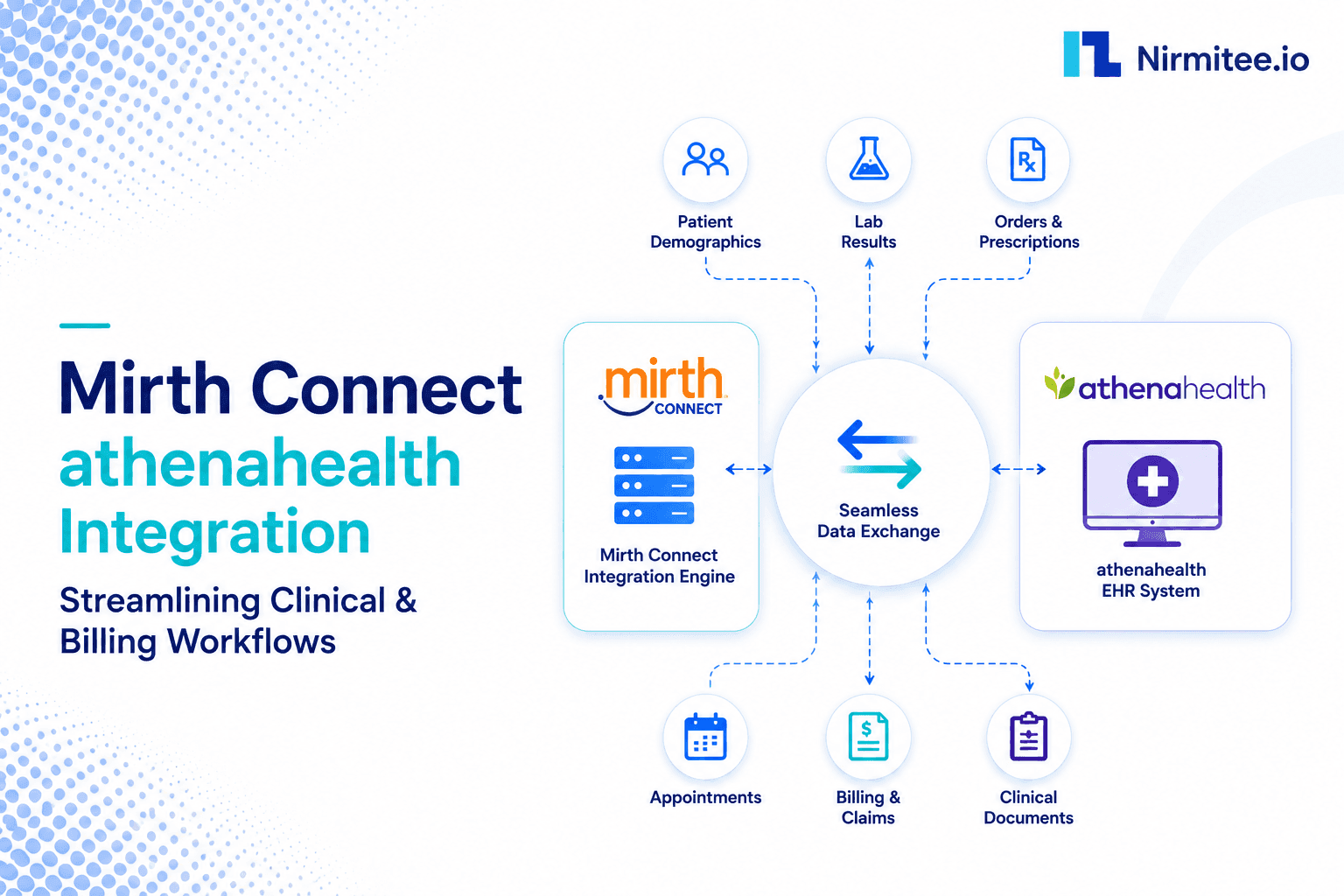
AthenaClinicals integration delivers: patient records (FHIR Patient), notes (FHIR DocumentReference), orders (FHIR ServiceRequest or HL7 ORM), results (FHIR Observation or HL7 ORU), and encounter data (FHIR Encounter). AthenaCollector integration delivers: charge capture (HL7 DFT), eligibility verification (REST API call to Athena), and claim status. Mirth handles both sides from the same engine, routing clinical events to your app and billing events to your RCM system.
Seeing the two surfaces next to each other makes the design obvious. Clinical data comes through FHIR R4 with SMART on FHIR authorization, which is ideal for charts, results, and patient-facing apps. Billing data comes through the athenaOne REST APIs, which is where eligibility, claims, and charge capture live. Mirth's job differs on each: on the clinical side it normalizes and routes FHIR resources; on the billing side it triggers and reconciles revenue events.
The point is that a single engine speaks to both so your product sees one coherent picture. Note that "supports FHIR" does not mean every field behaves identically across vendors, a nuance we explore in why FHIR compliant does not mean interoperable.
The architecture
The shape is familiar: a Mirth channel between athenahealth and your stack. The source connector pulls from a FHIR endpoint or an athenaOne REST API, or receives an event. The filter keeps only what matters. The transformer normalizes codes and, importantly, links related clinical and billing events so a result and its charge are not two disconnected records. The destination connector writes to your FHIR store, your revenue-cycle tooling, and your analytics layer.
That correlation logic is where the value is. An appointment in the billing system and an encounter in the clinical system describe the same visit, and tying them together is what turns raw API data into a usable workflow. For the mechanics of mapping codes correctly, our HL7 v2 to FHIR R4 mapping guide is the reference, and a large set of channels stays maintainable only with consistent channel design patterns.
A combined clinical-billing workflow, end-to-end
Here is how the two halves connect in practice. A patient books an appointment, which surfaces through the scheduling API. The visit happens and produces clinical data, observations, diagnoses, and notes, available as FHIR resources. Those clinical facts drive charge capture on the billing side, eligibility is verified, and a claim is generated and tracked through the athenaOne APIs. If you only integrated the clinical half, your product would know what happened to the patient, but nothing about whether the visit got paid. If you only integrated billing, you would have charges with no clinical context.
Mirth lets you model the whole arc. A channel can watch for a completed encounter, pull the associated clinical data, and signal your revenue tooling that a charge is ready, while another channel tracks claim status back into your dashboards. The result is a product that understands both the care and the economics of a visit, which is exactly what most healthtech buyers are trying to build.
Where Athenahealth integrations get tricky
Four things that slow Athenahealth integrations:
(1) FHIR resource availability varies by practice configuration — verify in the athenahealth sandbox before committing scope;
(2) the athenahealth REST API has rate limits that require batching and backoff logic in Mirth;
(3) webhook delivery is not guaranteed — build idempotent handlers that can process the same event twice without duplication;
(4) AthenaCollector billing feeds require a separate API agreement from AthenaClinicals clinical access.
A few things reliably cause friction, and knowing them upfront helps. API pagination and rate limits mean a naive full sync can be slow or throttled, so design for incremental pulls and respect backoff. Data correlation across the clinical and billing surfaces is non-trivial because the two use their own identifiers, so you need a reliable way to join them.
FHIR coverage is good but not total, and some workflow data only lives in the athenaOne REST APIs, so we plan to use both rather than forcing everything through FHIR. And every channel needs a recovery path for the calls that fail, which our guide to message replay and dead letter queues covers. Build for these from the start, and the integration stays calm in production.
What flows on each side
Being concrete about the data helps you scope the first channels. On the clinical side, you will work with FHIR resources: Patient and Practitioner for the people involved, Encounter for the visit, Observation for vitals and results, Condition for diagnoses, MedicationRequest for prescriptions, and DocumentReference for notes and attachments. These are what power charts, results views, and patient-facing features. On the billing side, the athenaOne REST APIs expose the revenue reality: patient registration and demographics, insurance and eligibility, appointment scheduling, charge entry, claims, and remittance. These drive anything to do with getting a visit paid.
The two describe the same events from different angles. A single visit is an Encounter in FHIR and a set of charges and a claim in the billing APIs. Designing your channels around that overlap, rather than treating clinical and billing as unrelated feeds, is what separates an integration that merely pulls data from one that actually models a practice's workflow.
Performance and reliability in production
Athenahealth's cloud platform is dependable, but your integration still has to behave well against it. Plan for incremental synchronization rather than repeated full pulls, using timestamps or change markers so you only fetch what is new. Respect rate limits with backoff and queueing inside your Mirth channels, so a burst of activity does not get your calls throttled. Page through large result sets deliberately instead of assuming a single response holds everything. And instrument every channel: track call volumes, error rates, and latency, so you notice a degraded feed before a user does.
These habits matter more in a combined clinical-billing integration than in a single-feed one, because a stall on either side can leave a workflow half-complete, a captured charge with no claim, or a result with no encounter to attach to. Treating the channels as monitored production services, with retries and a recovery path, keeps those half-states from turning into support tickets. The discipline is the same one that keeps any high-volume Mirth deployment healthy, and it pays for itself the first time a transient API error resolves itself quietly instead of paging your team.
Getting listed and staying compliant
If your product will be distributed through the Athenahealth Marketplace, there is a review and certification process to plan for: a security review, SOC 2 expectations, HIPAA attestation, and technical validation. None of it is surprising if you build to it from the beginning. On the data side, any athenahealth integration handles Protected Health Information, so a Business Associate Agreement is required.
We sign BAAs with US health systems and digital health customers, and we build on HIPAA-compliant, SOC 2 Type II, and ISO 27001 certified infrastructure with FHIR R4 native architecture. For the FHIR resource reference, see hl7.org/fhir/R4.
This content describes engineering patterns. It does not include actual Protected Health Information. All data examples are synthetic.
How Nirmitee.io approaches Athenahealth's work
Healthcare is the only industry we serve, and athenahealth is one of the EHRs we work with directly. We built Yown Health, a health data platform with multi-EHR integration spanning Epic, Cerner, Allscripts, and athenahealth, so coordinating athenahealth alongside other systems is familiar ground. Our architecture is FHIR R4 native, which makes the clinical side straightforward, and we treat the billing side with the same rigor rather than as an afterthought. For teams unifying several EHRs, our multi-EHR integration layer piece shows the one-API approach.
Integrate both halves of Athenahealth, correlate the events, and put an engine in the middle so your product sees one coherent workflow. If you want a second set of eyes on an Athenahealth integration, or want it built, share your use case at nirmitee.io, and we will tell you what we have shipped for similar problems.