Part of our complete guide to Hospital Asset Management: The Complete Guide.
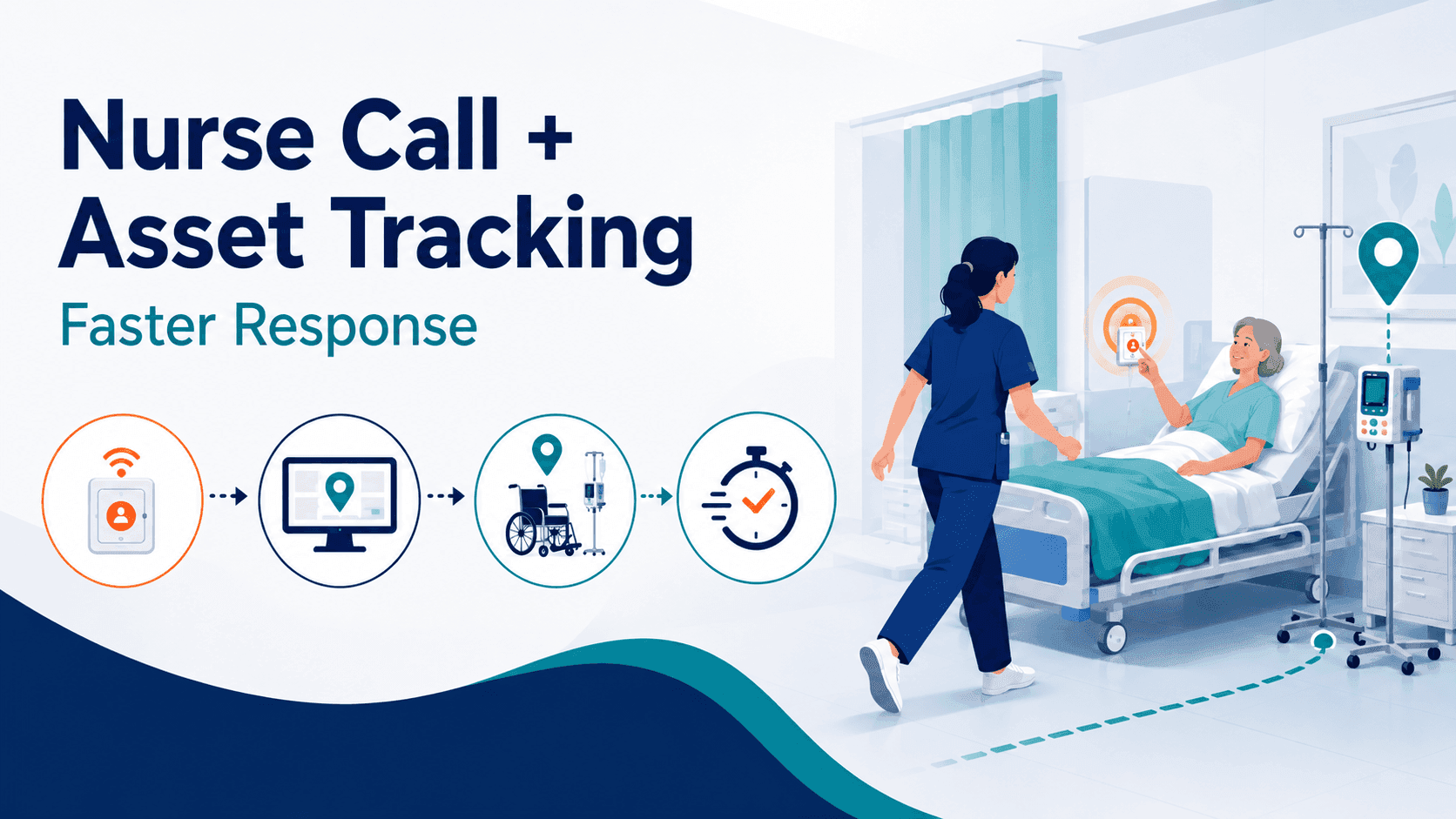
Quick answer: A nurse call system integration connects the call event at the bedside to the hospital's asset management or RTLS platform, so the responding nurse is told where the nearest available infusion pump, wheelchair, or monitor is when the call fires. Modern nurse call systems (Ascom, Rauland, Hill-Rom, Philips, Schrack, Tunstall and others) publish events over HL7 v2, REST webhooks, or MQTT, which is what makes the integration possible. In a 500-bed hospital, it deploys in 8-12 weeks and typically cuts equipment-related response time by 30-40%.
This guide is for hospital IT directors, nursing heads, and biomedical engineers evaluating a nurse call system for a hospital, or trying to get more out of the one already installed. It covers what a nurse call system is and how it works, the types you will be quoted, how the integration with asset tracking software is built, which vendors support it, and what it costs in time and money.
Reviewed by the Assetly product team at Nirmitee.io. Last updated August 2026.
What Is A Nurse Call System And How Does It Work?
A nurse call system is the bedside-to-nurse-station alerting network in a hospital. The patient presses a pendant or pull-cord; the call registers on a corridor dome light, a nurse station console, and increasingly on a nurse's mobile handset. The nurse acknowledges, attends, and cancels the call at the bedside. Every event is time-stamped, which is what makes response time measurable.
The basic components are the same across vendors:
- Call points. Patient handsets, pull-cords in bathrooms, code-blue buttons in ICU and OT, staff-assist buttons.
- Room controller and dome light. Local logic and the corridor indicator, colour-coded by call priority.
- Nurse station console. Displays active calls by bed and priority; may be a physical panel or a screen.
- Server and middleware. Routes calls to staff, escalates unanswered calls, logs everything, and exposes the event feed that other systems consume.
- Mobile delivery. DECT handsets, Wi-Fi phones, or smartphone apps that receive the call wherever the nurse is.
Types Of Nurse Call Systems Hospitals Are Quoted
| Type | How It Connects | Where It Fits | Integration Readiness |
|---|---|---|---|
| Wired nurse call bell system | Dedicated cabling to a panel per ward | Older buildings, nursing homes, budget wards | Low: usually no event export |
| Wireless nurse call system | RF or Wi-Fi call points to a gateway | Retrofits, day-care, OPD, older wards | Medium: gateway may expose events |
| IP / networked nurse call | Ethernet or PoE room controllers on the hospital LAN | New builds, tier-1 hospitals, ICU/OT | High: HL7, REST, or MQTT event feed |
| Integrated clinical communication platform | Nurse call plus middleware plus mobile app | Large multi-specialty and teaching hospitals | High: built for third-party integration |
The integration described below needs the third or fourth type, or a wireless system whose gateway can publish events. If the hospital is still on a wired bell system, the integration is a reason to upgrade, not something to bolt on.
The 90 Seconds That Matter
When a nurse call event fires from a patient bedside, the response window is 90 seconds, sometimes less. Most of those seconds are spent navigating to the patient. But for any call that requires equipment (an infusion pump, a wheelchair, a portable suction unit, a vital signs monitor) the second-order delay is finding the equipment. In hospitals where the asset register isn't synchronised with reality, this can add 60-180 seconds to the response.
Integrating the nurse call system with asset management software collapses that delay. When the call event fires, the asset platform returns the nearest available asset of the right type, its location, and the path to it. The responding nurse goes directly to the equipment. Assetly customers locate any tagged asset in under 30 seconds; the integration removes even the lookup step.
What The Nurse Call Integration Actually Does
The integration is event-driven. When a nurse call event of a relevant type fires (call types are configurable: bedside emergency, equipment request, transfer assist), the asset management platform receives the event with the patient location, equipment type required, and priority. The platform queries its real-time asset location index and returns the nearest available asset.
"Available" means: tagged, currently in service, not checked out elsewhere, not under maintenance. The platform applies a routing function, typically Manhattan distance on the hospital floor plan, to identify the nearest match. The answer is pushed to whichever screen the responding nurse is looking at.
The same event feed also supports:
- Response-time reporting. Call-to-acknowledge and call-to-cancel by ward, shift, and call type, which is the evidence NABH surveyors ask for.
- Equipment demand mapping. Which wards generate the most equipment-request calls, and for what, so biomed can rebalance the fleet.
- Escalation to RTLS. If the nearest asset is BLE-tagged, the nurse gets a live position rather than a last-known zone. See how IoT sensors and RTLS extend hospital asset tracking.
Nurse Call Systems That Support The Integration
The architecture is vendor-neutral. What matters is whether the nurse call server exposes an event feed. The systems most often integrated in Indian hospitals:
- Ascom Telligence: strong in ICU and maternity, well-defined event schema, widely installed in Indian tier-1 hospitals.
- Rauland Responder: high volume in large Indian corporate hospitals, mature HL7 and API support.
- Hill-Rom (Baxter) NaviCare / Voalte: common in academic and teaching hospitals, native mobile delivery.
- Philips PCMS / IntelliVue: heavy presence where nurse call is bundled with patient monitoring in OT and ICU.
- Schrack Seconet, Tunstall, Ackermann, Legrand: frequently specified in Indian new-build projects; integration capability varies by generation, so check the server model before assuming an event feed exists.
- Indian OEM wireless systems (Forbix and similar): usually a closed gateway; ask the vendor for an MQTT or REST export before signing.
Related reading: $262B Hospital Revenue Leak: Integration & Automation Fix.
Integration Architecture: The 4 Layers
Layer 1: Event Source
The nurse call system publishes events on its native protocol: HL7 v2 messaging for older systems, REST webhooks for modern ones, MQTT for event-driven deployments.
Layer 2: Event Broker
An MQTT broker or webhook handler ingests events in real time. The broker normalises the event format across nurse call vendors so the asset platform sees a single schema. This is also where the hospital's integration engine (Mirth Connect is common) sits if HL7 v2 is in play.
Layer 3: Asset Management Lookup
Assetly's API receives the normalised event, extracts patient location and required equipment type, and queries the real-time asset location index. Response time is typically under 200 ms.
Layer 4: Notification Delivery
The asset location is surfaced on the responding nurse's mobile device, the nurse station screen, or back into the nurse call system's own UI. The exact delivery point depends on the hospital's clinical workflow. Pushing it back into the nurse call handset is usually best, because it means no new app for nursing staff.
Nurse Call And RTLS: When You Need Both
Asset management gives you the register and last-known location of every tagged device. RTLS (real-time location, usually BLE or Wi-Fi) gives you live position. For most equipment-request calls, last-known zone from RFID portals is enough to send the nurse to the right room. For ICU ventilators, crash carts, and transport monitors, hospitals add BLE so the nurse call integration returns a live position. The RFID vs barcode comparison covers when each tracking layer earns its cost.
Worked Example: A 900-Bed Hospital's Response-Time Gain
Shown as a worked scenario for a 900-bed quaternary hospital integrating Rauland Responder with Assetly. Pre-integration baseline: median time from nurse call event to nurse arriving at the patient with the required equipment is 4 minutes 18 seconds. Six months after integration: 2 minutes 42 seconds, a 38% reduction. The largest gains are on mobile equipment requests (infusion pumps, wheelchairs) where pre-integration response had drifted to 5-7 minutes because the nearest pump was on another floor and nobody knew it.
What It Means For NABH Hospitals In India
NABH assessors look for evidence that patient calls are attended within a defined time and that critical equipment is available when needed. A nurse call system with an integrated asset lookup produces both pieces of evidence from the same log: call-to-response time by ward, and time-to-equipment for equipment-request calls. One 120-bed specialty hospital running Assetly cut NABH audit prep from 4 weeks to 4 days once its equipment records reconciled automatically; adding the nurse call feed extends that to the response-time chapter. Indian hospitals also tend to have mixed estates, a new IP nurse call block next to a 15-year-old wired bell system, so the integration usually starts in the new block and becomes the business case for upgrading the rest.
Deployment Timeline And What It Costs
Typical integration deployment for a 500-bed hospital:
- Week 1-2: Architecture design, event schema review with the nurse call vendor. Confirm the server exposes events; this is where closed systems get found out.
- Week 3-4: Test environment integration, end-to-end event flow validation.
- Week 5-6: Pilot in 2 departments. Measure baseline vs integrated response time.
- Week 7-12: Phased roll-out across remaining departments.
Cost has two parts. The integration itself is a software project measured in weeks of engineering plus any vendor API licence the nurse call OEM charges. The larger line is asset tagging: the integration is only as good as the share of mobile equipment that is tagged, so hospitals that have not yet deployed asset tracking budget for that first. Assetly goes live in 4-6 weeks with zero downtime, and the nurse call integration can run in parallel with tagging.
Key Takeaways
- A nurse call system integration with asset management cuts equipment-related response time by 30-40%.
- The architecture is event-driven: nurse call event triggers an asset platform lookup, and the answer goes to the responding nurse.
- It needs an IP or integration-ready nurse call system; wired bell systems have no event feed.
- Largest gains are on mobile equipment requests: infusion pumps, wheelchairs, vital signs monitors.
- Ascom, Rauland, Hill-Rom, Philips, Schrack, and Tunstall all support the pattern in current generations; check the server model.
- Deployment for a 500-bed hospital is typically 8-12 weeks, and the same log satisfies NABH response-time evidence.
Planning A Nurse Call System Integration?
Read the complete guide to hospital asset management, or talk to the Assetly team for a review of your nurse call system's event capability and a response-time baseline. Start with a 30-day pilot in one department.