Claims Submission Is the Easy Half: Payment Posting Is the Real Work

CTO & Co-Founder
CTO & Co-Founder at Nirmitee.io. Architects healthcare integrations across FHIR, SMART on FHIR, ABDM and NHCX, writing from production experience taking hospital software from sandbox to go-live.
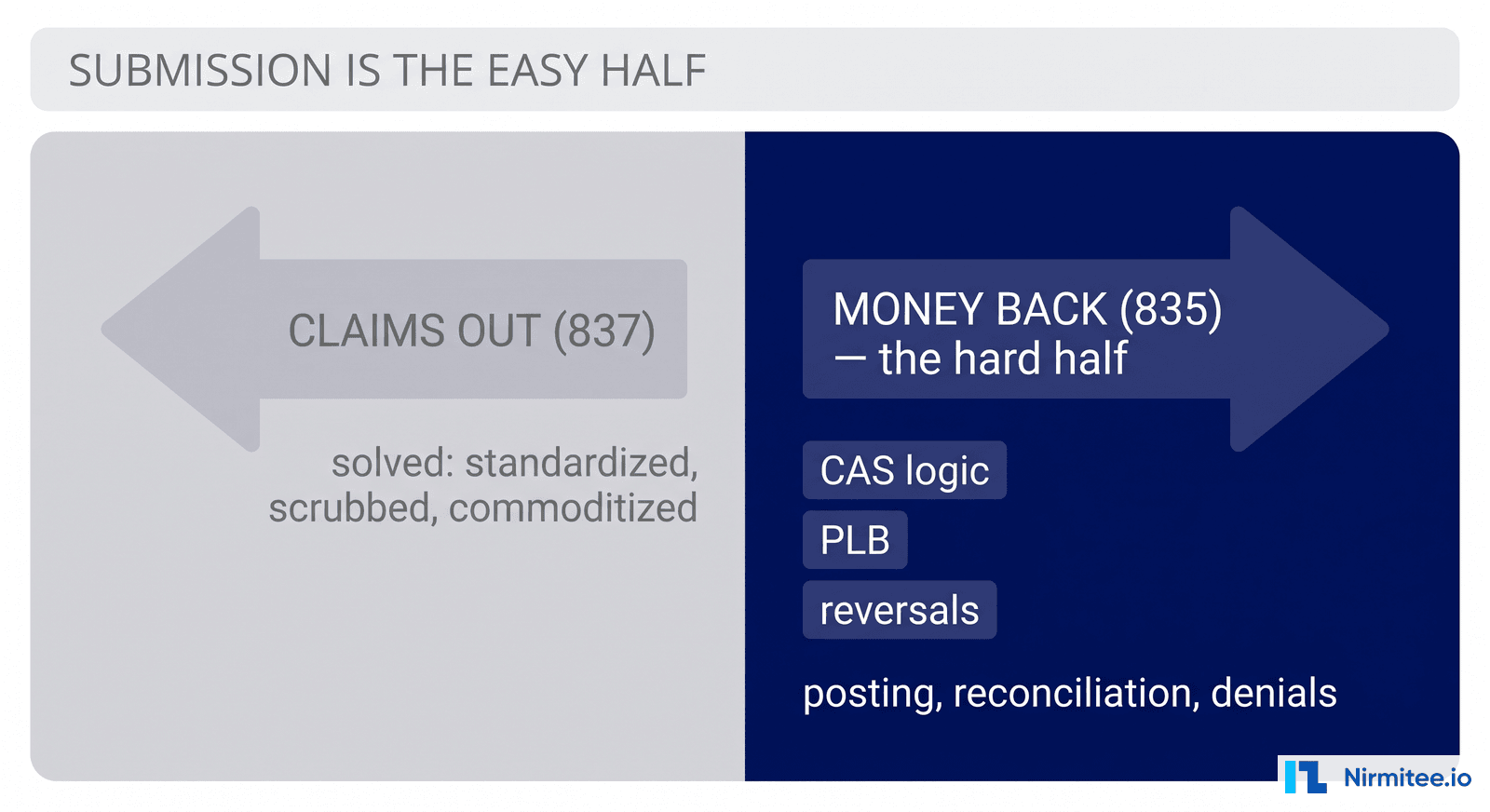
Getting a claim out the door is a solved problem — clearinghouses scrub it, standards define it, and every vendor does it. Payment posting — turning the 835 remittance that comes back into correctly applied cash, correct patient balances, and routed denials — is where billing platforms actually win or lose. Native EHR auto-posting typically handles only 60–70% of real-world remit volume; the other third is the product.
Watch: 835 vs EFT: Why an ERA Does Not Mean You Got Paid (8:13).
What Payment Posting Automation Actually Means
When an 835 file arrives, an automated posting engine must: match the file to a bank deposit, apply each claim's payment, classify every adjustment (write-off vs patient balance vs review), post reversals, roll patient responsibility up to statements, and route denials to worklists. Per the CAQH Index, electronic remittance saves about $2.42 per transaction over manual — and cuts posting time by more than 70%. But those numbers only materialize when the automation survives the messy remits, not just the clean ones.
The 60–70% Ceiling
Clean-remit auto-posting is table stakes — one payer, one check, simple CO/PR adjustments. What breaks the ceiling is everything else, and the industry numbers show it: 72% of health systems say payment reconciliation is only partially automated (HFMA), and over half of large systems still reconcile unapplied cash on spreadsheets, typically burning a full-time person per accounting entity.
The Seven Hard Parts of 835 Auto-Posting
1. CAS group-code logic
CO means write it off (billing the patient breaches your contract); PR rolls to the patient; OA and PI have no universal rule and need a configurable review policy. The two failure modes are mirror images: writing off PR leaves collectible money on the table; billing CO violates contracts. Our ERA reading guide covers the codes in plain English.
2. PLB segments
Provider-level adjustments — recoupments, interest, forward balances — hit the check total without belonging to any claim, breaking the “claims sum to the deposit” invariant. Multi-TIN attribution makes it worse.
3. Reversals (CLP status 22)
Takebacks arrive as a negated copy of the original claim followed by a corrected one. The engine must net all three against the ledger — or the books quietly corrupt.
4. Split and bundled payments
One check covering many claims; one claim split across checks; payers paying service lines on separate remits.
5. EFT–ERA reassociation
Matching the 835 to the bank deposit via the TRN trace number — defeated by virtual credit card payments (which can't auto-reassociate, and carry 2–5% interchange fees per MGMA) and by timing skew that creates the unapplied-cash pile.
6. Secondary and COB posting
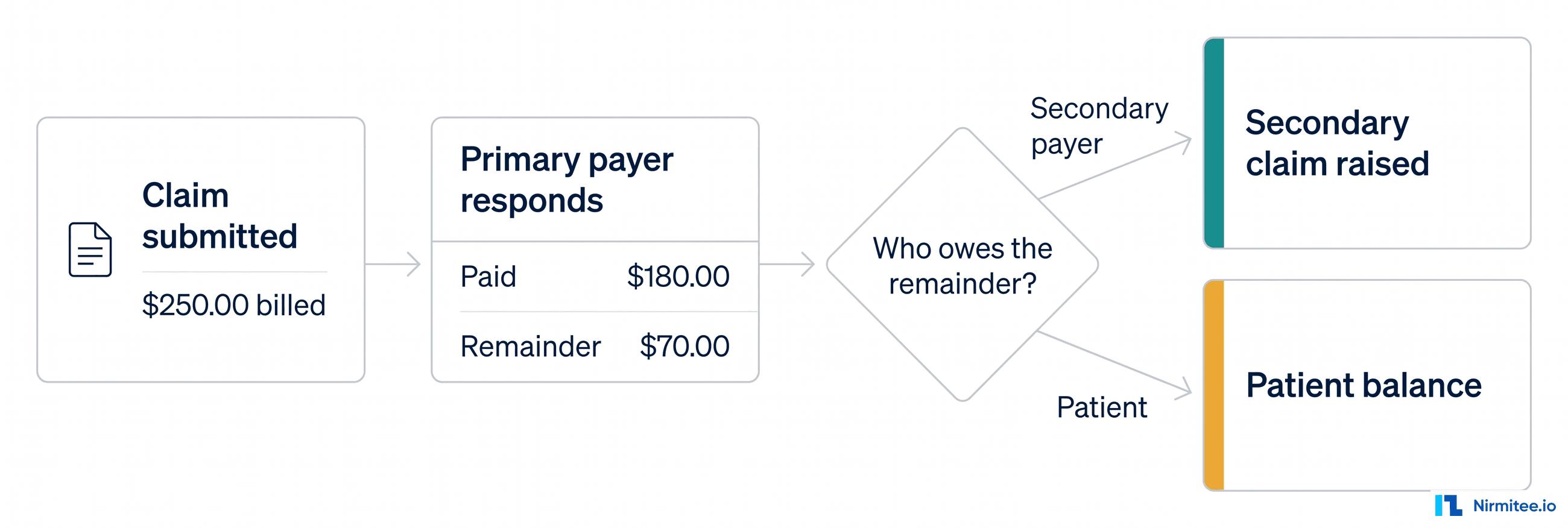
Secondary remits carry the prior payer's adjudication baked in; posting them without that context creates false patient balances.
7. Patient-responsibility rollup
Deductible, copay, and coinsurance from possibly multiple payers must net correctly before a statement fires — premature statements are the symptom patients actually see.
The 835 Is Your Denial-Management Front Door
Every denial arrives as a $0-pay claim line in an 835. Engines that “just post the zero” are the reason ~65% of denials are never worked — while 54–70% of the denials that are appealed get overturned. Routing $0 CLPs by their CARC codes into owned worklists (auth, eligibility, coding, timely filing) is the single highest-ROI feature in the posting layer. Our breakdown of claim denial reasons maps codes to worklists.
What “Good” Looks Like
- Auto-post rate above 90% of remit lines, with exceptions — not everything — going to humans
- Unapplied-cash days trending to near zero
- Exception aging measured in days, not weeks
- Denial-routing accuracy — every $0 CLP lands in the right queue with its reason attached
Audit your own 835s: paste one into our free EDI Inspector and see the CAS groups, PLBs, and reversals this post describes — decoded in your browser.
We build this layer — CAS-correct, PLB-aware, reversal-safe posting with denial routing — inside EHRs and billing platforms. If your team posts remits by hand past the clean ones, or your patient balances don't reconcile, that's exactly the system we ship. See our RCM software development services or talk to our team.
Ready to scale?
Talk to our healthcare engineering team about building, integrating, and shipping faster.
Frequently Asked Questions
What is payment posting in medical billing?
What percentage of payments can be auto-posted?
How do you post a reversal or takeback from an 835?
Why doesn't the 835 total match the bank deposit?
How should secondary insurance payments be posted?
What do CO, PR, OA and PI mean when posting?