One RFID family does not solve every hospital workflow
Hospitals starting an RFID program often choose one tag type — usually UHF, because it sounds the most general — and discover six months later that the workflow they actually need (real-time ICU location) doesn't work on UHF. The fix is to think workflow-first, then pick the tag.
This guide compares the three main RFID families used in hospital asset programs — UHF, HF, and BLE — and the on-metal UHF variant for surgical trays. Each has a clear sweet spot.
UHF RFID (860-960 MHz)
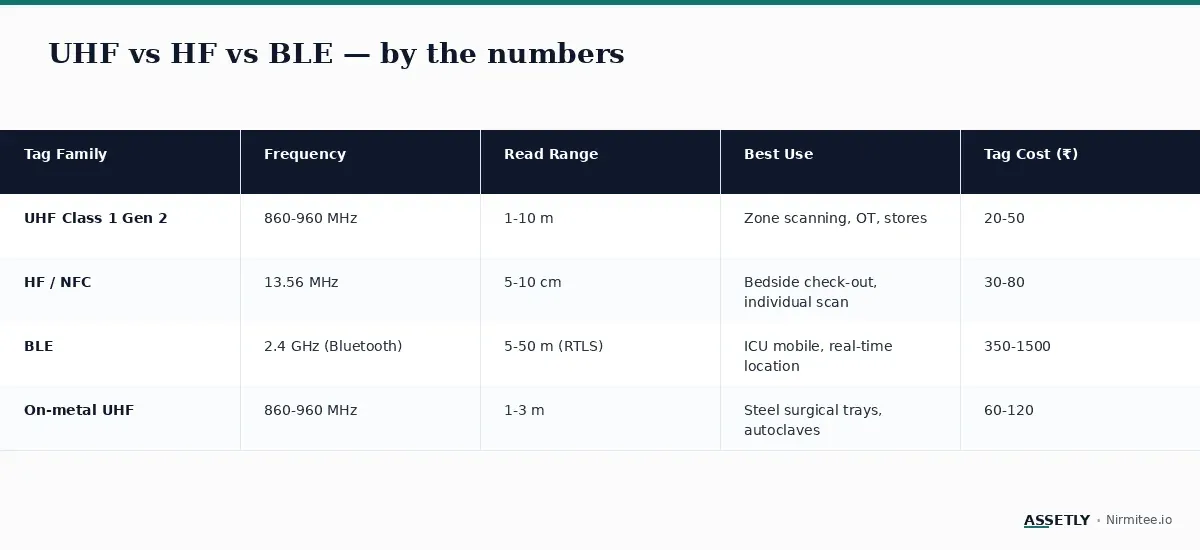
UHF Class 1 Gen 2 is the workhorse RFID family for hospital asset programs. Read range is 1-10 metres, depending on antenna power and tag orientation. Bulk reads of 50-200 tags in a single antenna pass are standard. Tag cost is the lowest of the RFID families — ₹20-50 ($0.25-0.60) per tag.
Strengths: bulk scanning, longest non-battery read range, lowest tag cost, broadest reader ecosystem.
Weaknesses: read accuracy degrades around metal and water (and hospitals have lots of both), tags can drift in inventory in unintended ways.
Where UHF belongs: Central stores inventory, OT instrument-tray check-in/out, asset-zone exit portals (e.g. tracking equipment moving from biomedical workshop back into wards), large-scale daily audit programs.
HF RFID / NFC (13.56 MHz)
HF (and the consumer NFC variant) reads at very short range — typically 5-10 cm. Each tag must be brought close to the reader; bulk scanning is not the workflow. Tag cost is mid-range at ₹30-80 ($0.36-0.96).
Strengths: very high read accuracy at short range, no interference from neighbouring tags, supports rich data on the tag, NFC-readable from any modern smartphone.
Weaknesses: single-tag scan only, no bulk read.
Where HF belongs: Bedside individual asset check-out at a nurse station, pharmacy individual-item scanning, patient-bedside equipment assignment, single-asset audit confirmation by a roving biomedical staff member.
BLE (Bluetooth Low Energy)
BLE tags are battery-powered active tags that broadcast at 2.4 GHz. Range is 5-50 metres depending on transmit power. They support real-time location services (RTLS) — a hospital can know where every tagged asset is, continuously, when paired with ceiling-mounted Bluetooth gateways.
Strengths: real-time location, long range, works through walls and around metal, integrates with smartphone-based gateways.
Weaknesses: highest tag cost (₹350-1500 / $4-18 per tag), battery life of 2-7 years requires replacement cycles, requires gateway infrastructure.
Where BLE belongs: ICU mobile equipment (infusion pumps, ventilators), critical-care wheelchairs and stretchers, high-value mobile diagnostic equipment, any asset where minutes-to-locate matters more than per-tag cost.
On-metal UHF tags
Standard UHF tags fail when applied directly to metal — the metal substrate detunes the antenna. On-metal UHF tags include a foam or ferrite isolation layer that lifts the antenna off the metal surface and restores read performance.
Where on-metal UHF belongs: Surgical instrument trays (steel), autoclave-resistant tagging, metal-bodied diagnostic equipment, and any asset where the tagging surface is bare metal.
Real-world: a hybrid deployment in a 700-bed multispecialty
A 700-bed hospital in Pune runs all four tag families across 5,800 biomedical assets: 3,200 standard UHF tags on stationary assets and stores inventory; 1,400 BLE tags on ICU and high-acuity mobile equipment; 800 on-metal UHF tags on OT instrument trays; 400 HF tags at nurse-station bedside check-out points. Total tag investment year-1 was ₹19 lakh ($23,000) but the program runs every audit cycle now without manual intervention.
Decision rule
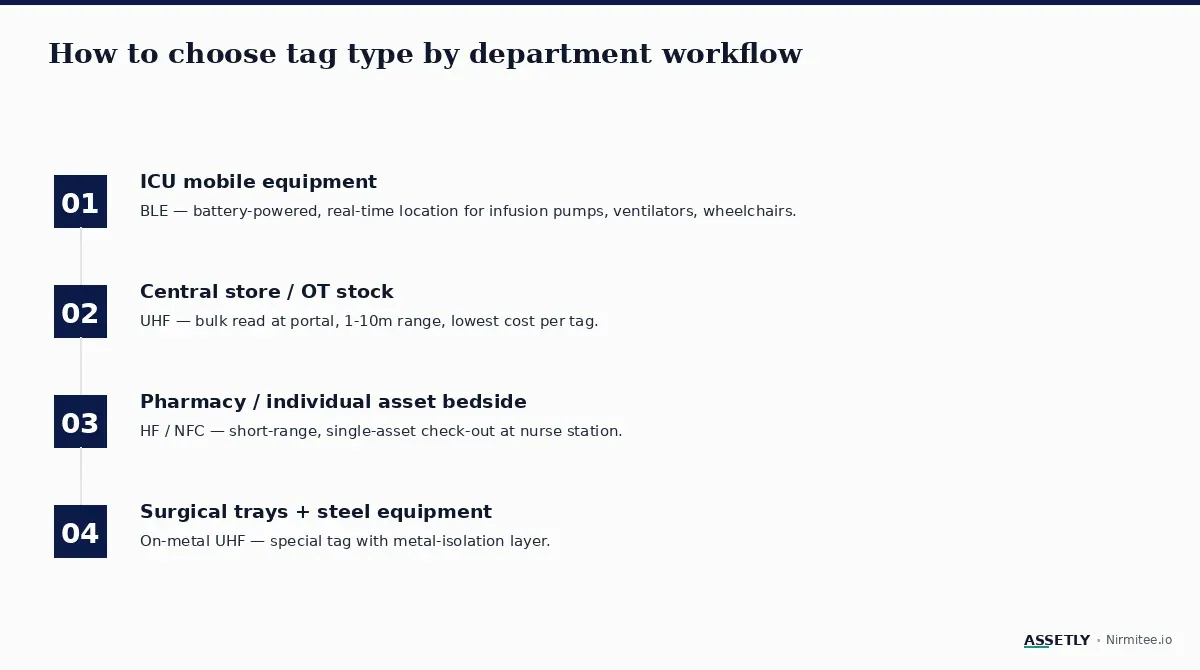
The defensible decision rule: map workflow to tag family before specifying any reader. ICU mobility = BLE. Bulk zone scanning = UHF. Bedside individual scan = HF. Steel surgical trays = on-metal UHF. The hospital that picks one family for all four workflows ends up retrofitting at scale.
Key takeaways
- UHF for bulk-read zones (stores, OT entry, biomedical workshop exit). Lowest cost.
- HF / NFC for individual bedside check-out. Smartphone-readable.
- BLE for ICU mobile equipment requiring real-time location. Highest cost, highest value where minutes-to-locate matters.
- On-metal UHF for steel surgical trays and metal-bodied equipment.
- Most hospitals end up running 2-4 tag families in production. Single-family standardisation is rarely the right answer.
Specifying RFID for your hospital?
Tag selection is workflow-driven. Read our pillar guide on healthcare asset management, or talk to the Assetly team about a tag-by-workflow specification review.